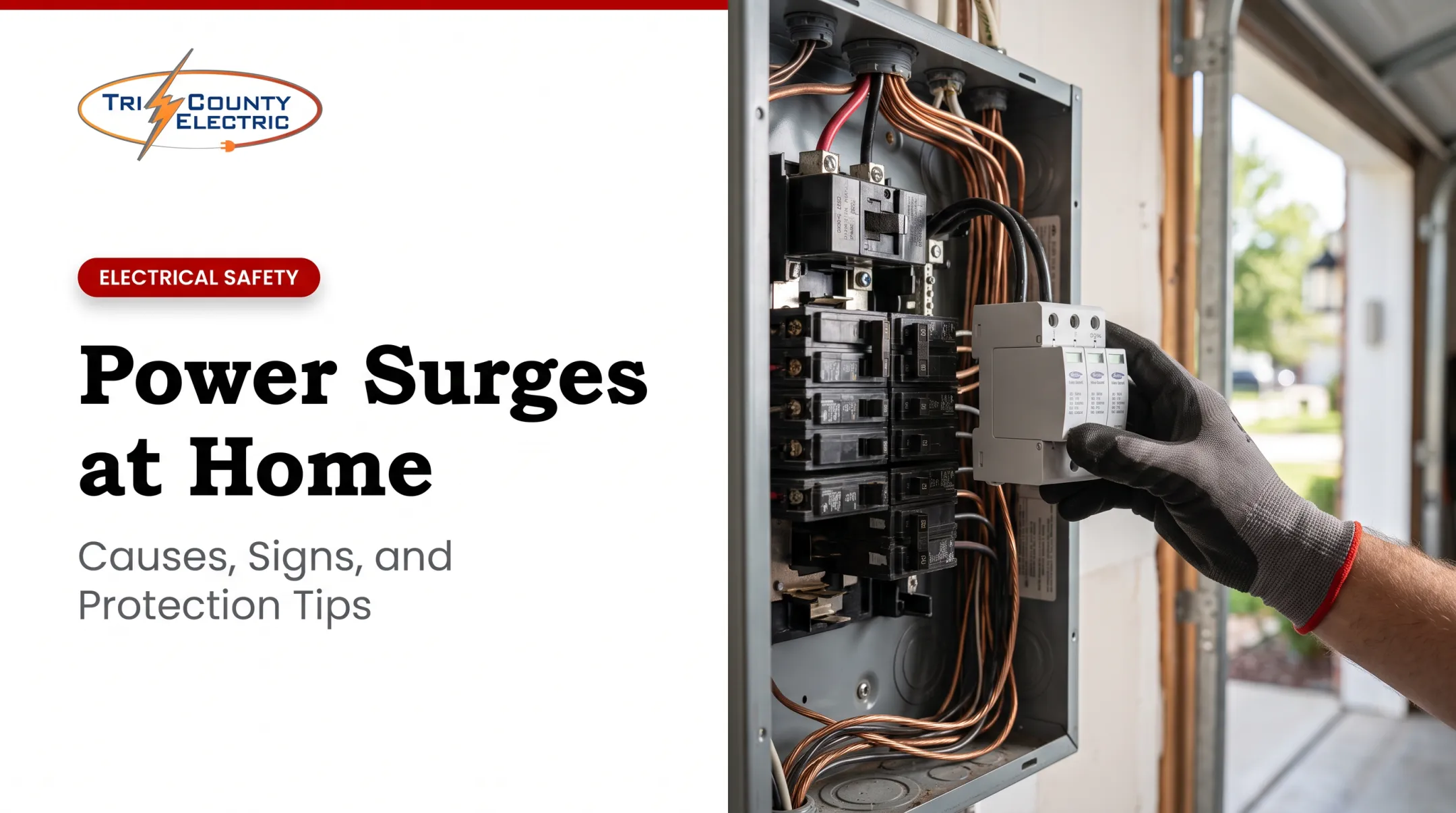

Installing one is not a plug-and-play job. It's a moderately complex electrical task that involves opening your main service panel and working near live utility power. This guide walks through the full process, but we'll say this upfront: this is licensed electrician territory, not a weekend DIY project.
Incorrect installation can lead to:
- Voided manufacturer warranties
- A device that fails silently during an actual surge event
- Serious shock hazards from energized service lugs
Below, we'll cover the step-by-step process, safety considerations, and what to expect when you hire a professional.
TL;DR
- Whole-house surge protectors mount at the main service panel and need a dedicated double-pole breaker
- Installation means shutting off power, mounting the unit, then wiring to the breaker, neutral bar, and ground
- This isn't DIY-friendly — service lugs stay energized even with the main breaker off
- Professional installation typically costs $70 to $700, averaging about $300 for parts and labor
- Short wire runs and solid grounding are required for the device to work
Installation Guide for a Whole-House Surge Protector
The process breaks down into four phases:
- Evaluating the panel
- Mounting the device
- Wiring it into a dedicated breaker
- Testing operation

A licensed electrician typically completes a straightforward installation in a few hours. If your panel needs a subpanel or an upgrade to accommodate the new breaker, expect the timeline to stretch. Most panel upgrades wrap up in a single day, though complex jobs can run longer.
We'll break down each phase below, along with the safety checks that matter most.
Prerequisites and Safety Considerations
Before any wires are connected, confirm a few essentials first.
Panel compatibility comes first. The electrician needs to verify:
- Manufacturer and model of your existing panel
- Available breaker space for a double-pole breaker
- Amperage rating of the panel
Grounding matters just as much as compatibility. A surge protector works by redirecting excess voltage into the ground — if the grounding and bonding aren't solid, the device has nowhere to send that energy.
The National Electrical Code (NEC, Article 230.67) now requires all dwelling-unit services to include a Type 1 or Type 2 surge-protective device. That device must sit integral to, or immediately adjacent to, the service equipment.
Here's the part homeowners often don't realize: turning off the main breaker does not de-energize the service lugs. Those terminals stay hot from the utility connection regardless. That single fact is why this job belongs to a licensed electrician every time, no exceptions.
If the panel shows damage, outdated wiring, or insufficient grounding, fix those issues before installation moves forward.
Tools and Parts Required
Tools needed:
- Voltage tester
- Flathead and Phillips screwdrivers
- Wire strippers and cutters
- Insulated gloves and eye protection
- Drill (if mounting externally)
Parts needed:
- Type 2 whole-house surge protector
- Compatible double-pole breaker matched to the panel manufacturer
If there's no available breaker space, a subpanel may be required. Tri-County Electric Service's electricians typically inspect the existing panel first and recommend whether a repair, a service upgrade ("heavy up"), or a subpanel makes more sense before any new hardware goes in.
How to Install a Whole-House Surge Protector (Step-by-Step)
Cutting corners during installation can weaken surge response or cause long-term panel damage that goes unnoticed for months. If you are not trained to work inside an electrical panel, hire a licensed electrician.
- Kill the power and confirm zero voltage. Turn off the main breaker, then use a voltage tester to confirm there's no live current before opening the panel cover.
- Mount the surge protector. Install it internally or externally, as close to the main breaker as possible. Shorter wire runs improve performance. Eaton estimates that every inch of lead length adds roughly 15V to 25V of let-through voltage, which matters during a real surge.
- Install the dedicated double-pole breaker. Connect the surge protector's hot wires to this breaker, never to an existing circuit.
- Connect neutral and ground. The neutral wire lands on the neutral bar; the ground wire lands on the grounding bar.
- Restore power. Flip the main breaker back on and confirm the indicator light shows normal operation.

Avoid double-tapping the surge protector onto an existing breaker or the main lugs when panel space is tight. Skipping a dedicated breaker compromises protection entirely.
Post-Installation Checks and Validation
The job isn't done once power is restored. A few final checks separate a solid install from one that fails silently.
- Confirm the indicator light. A steady LED means protection is intact; if it goes out later, replace the unit—these devices aren't repairable.
- Check every wire connection for tightness. Loose terminals are a leading cause of intermittent failure.
- Confirm no exposed copper remains. Check the full panel so no bare conductor is left visible.

Skip this step and a faulty install can sit unnoticed for months or years. The failure only shows up when a surge hits and your appliances take the damage the device was supposed to stop.
Common Installation Problems and Fixes
Most post-install issues fall into three buckets: indicator problems, breaker incompatibility, or grounding weaknesses.
Indicator Light Won't Turn On
Problem: No power indicator, or a red warning light, after installation.
Likely cause: Incorrect wiring polarity, a loose breaker connection, or a defective unit.
Fix: A licensed electrician should recheck every terminal connection and confirm the breaker is fully seated before assuming the unit is defective.
Breaker Won't Fit or Trips Immediately
Problem: The panel doesn't have room for a double-pole breaker, or the new breaker trips the moment power is restored.
Likely cause: An incompatible breaker brand or rating, or a wiring short somewhere in the circuit.
Fix: Have your electrician install a breaker matched to the panel manufacturer's specs, or ask about a subpanel if space is the real constraint.
Weak or Inconsistent Surge Protection
Problem: Appliances still take damage during smaller surges even after installation.
Likely cause: Long wire runs between the panel and the device, or poor grounding resistance.
Fix: An electrician can shorten the wire path and test grounding resistance to confirm the surge protector has a clean path to dissipate voltage.

Pro Tips for Effective Installation
A few things to know before you buy a surge protector:
- Get the panel assessed first. Have an electrician check panel condition and grounding before you purchase. Compatibility issues found after the fact waste time and money.
- Pair it with other panel work. Install the protector during a panel upgrade or replacement so the job stays code-compliant from the start. Local contractors such as Tri-County Electric Service, a Generac Certified Installer serving Northeast Ohio, Southwestern Ohio, and Northern Kentucky, often bundle this with other panel work.
- Bundle it with a routine inspection. Surge protectors should be checked during regular electrical inspections anyway. Scheduling both together can catch corrosion, overheating, or outdated wiring before those issues grow.
Conclusion
A whole-house surge protector only works as well as its installation. Wire runs that are too long, a missing dedicated breaker, or weak grounding can all undermine the protection you paid for, and you won't find out until a real surge hits.
That's why this panel-level work belongs with a licensed electrician rather than a DIY attempt. The service lugs stay energized no matter what you switch off, and the margin for error is thin. Tri-County Services handles whole-house surge protector installation with licensed electricians, free estimates, and upfront pricing across Northeast Ohio, Southwestern Ohio, and Northern Kentucky.
Frequently Asked Questions
How much does it cost to install a whole house surge protector?
Professional installation typically runs $70 to $700, averaging around $300 for materials and labor combined. Costs vary based on panel type, amperage, and whether panel upgrades are also needed.
Do I need an electrician to install a whole house surge protector?
Yes. Service lugs remain energized even with the main breaker off, and code compliance requires proper installation. This is a licensed-electrician job, not a DIY project.
How is surge protection installed?
The device mounts near the main breaker and wires into a dedicated double-pole breaker, the neutral bar, and the grounding bar. Power is shut off first, then restored and tested once wiring is complete.
Where should a surge protection device be installed?
At or immediately adjacent to the main electrical panel, positioned as close to the main breaker as possible to keep wire runs short and minimize voltage let-through.
Does a whole house surge protector require a dedicated breaker?
Yes, typically a double-pole breaker matched to your panel's manufacturer and amperage rating. Some units include internal protection and skip this requirement, but most don't.
What's the difference between a Type 1 and Type 2 surge protection device?
Type 1 installs before the main breaker, protecting against external surges like lightning strikes. Type 2 installs after the main breaker and handles surges generated inside the home, such as appliances cycling on and off.