
Seasonal plumbing maintenance means giving your pipes, drains, fixtures and water heater a short, scheduled look four times a year, so small problems get caught before they turn into a burst pipe or a flooded basement. In Northeast Ohio, where winters freeze lines and springs soak foundations, the calendar matters. This guide walks through what to watch for each season, what the research says about how often, and where a trained eye does more than a flashlight can. At Tri-County Services Electric & Plumbing, we have worked on Northeast Ohio homes since 1975, and the pattern is consistent: the expensive calls come from things that were quietly wrong for months.
If something already looks wrong, call our office at (440) 253-0332 and we will tell you whether it can wait.
TL;DR
- Inspect twice a year at minimum (spring and fall), and add a cold-weather check before the first hard freeze.
- Fall is the high-stakes season in Ohio: drain outdoor hoses, shut off and drain exterior spigots, insulate exposed lines and have the water heater looked at.
- Spring is for finding what winter did: damp basement walls, stained ceilings, slow drains and corroded water heater fittings.
- Some checks are quick observations, but anything behind a wall, under a slab or inside the sewer line belongs to a professional plumber.
- Call (440) 253-0332 when you see a leak, a repeat clog, rust-colored water or a pipe that has frozen.
Table of Contents
- Why plumbing needs a seasonal rhythm
- Spring: find out what winter did
- Summer: demand is highest, humidity is too
- Fall: the most important season in Ohio
- Winter: keep pipes from freezing
- A quick seasonal calendar
- Why we ask homeowners to call a professional first
- Our perspective
- Maintenance plans: how to judge the value
- Book your seasonal plumbing check
- FAQ
- Sources
Why plumbing needs a seasonal rhythm
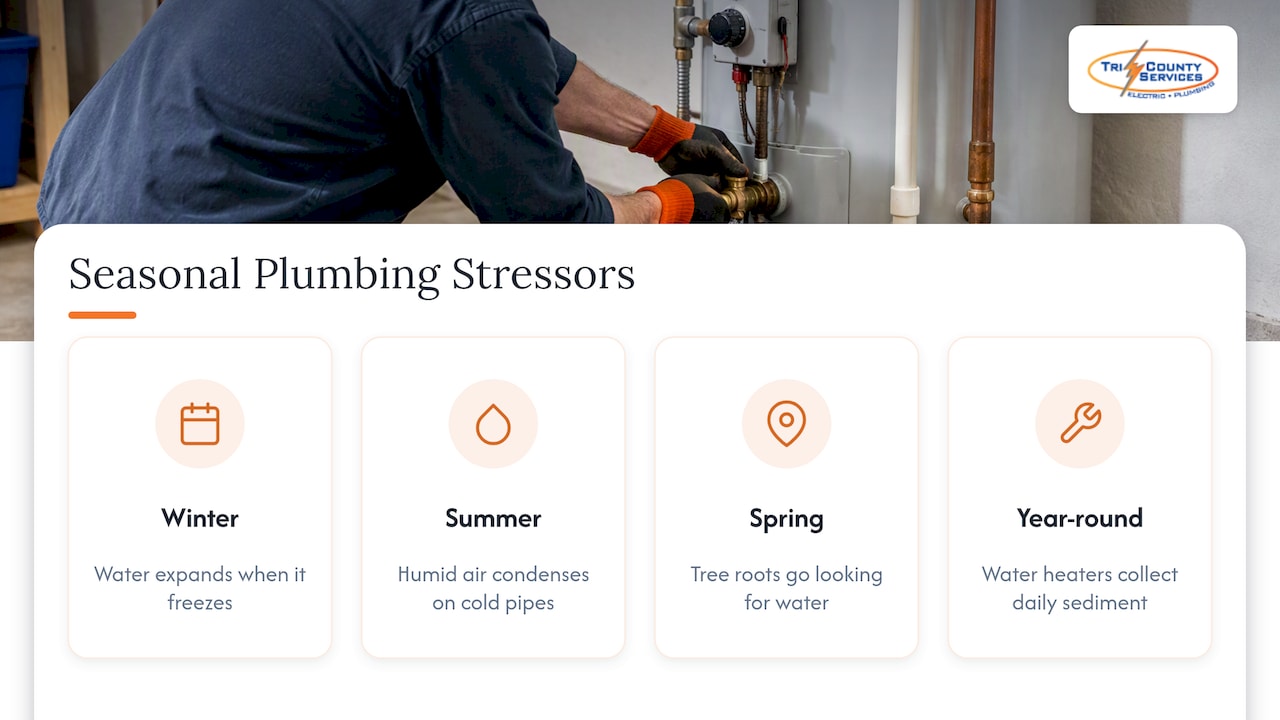
Plumbing fails in patterns. Water expands when it freezes, humid air condenses on cold pipes in summer, tree roots go looking for water in spring, and a water heater collects sediment every day it runs. Each season stresses a different part of the system.
The cost of ignoring it is real. Homeowners insurance may cover resulting water damage, but it generally does not pay for damage to a pipe caused by wear and tear. A slow, neglected leak is exactly the kind of problem that falls on you.
A seasonal routine also takes the guesswork out. You do not need to remember everything; you need to remember four dates. Many homeowners tie them to the clocks changing in spring and fall, plus the first week of November and the first week of April.
Spring: find out what winter did
The first warm weeks are for damage assessment. University of Missouri Extension advises that after winter and spring storms you check the basement and foundation for dampness or cracks, inspect the water heater for corrosion and leaks, and look at bathrooms and under-sink areas for moisture.
In a typical Northeast Ohio house, that translates to a short walk-through:
- Basement and crawl space. Look at the lowest points of walls and around the floor drain for staining, efflorescence (white mineral crust) or fresh dampness. Note the location and take a photo so you can compare next season.
- Ceilings under bathrooms and the kitchen. A new brown ring is a leak announcing itself.
- Under every sink. Look at supply lines, shutoff valves and drain connections for beads of water, green corrosion or swollen cabinet bottoms.
- Outdoor spigots. Turn the water back on slowly and watch the connection inside the house. A spigot that froze can crack inside the wall and only leak when it is turned on.
- Water heater. Look for rust at the fittings, moisture at the base and any mineral crust around the relief valve.
Post-winter moisture is not always a leak
Before you assume a pipe has burst, know that University of Minnesota Extension explains basement moisture is often condensation from humid air meeting cool surfaces rather than an active leak. The telling difference is pattern: condensation shows up on cold pipes and walls on humid days, while a leak keeps producing water regardless of weather. Moisture can also travel upward, and attic mold in winter is a reminder that wet materials need to be dried and sealed quickly wherever they are found.
If you cannot tell which one you have, that is a good moment for a professional. Our leak detection and plumbing repair team can find the source without opening walls blindly.
Check your water meter
The EPA’s WaterSense program gives a simple test for hidden leaks: read the water meter when no water is being used, then read it again two hours later. If the reading changed, you probably have a leak somewhere. It is a diagnostic, not a repair. If the number moves, stop there and call us, because the leak could be in a supply line you cannot see.
Drains and sewer line in spring
Spring rain and thawing ground are when root intrusion and partial blockages show up. Signs to watch for are gurgling fixtures, a drain that is slow in more than one room, or a sewer smell in the basement. A single slow sink is usually local. Several slow fixtures point to the main line.
This is where a camera earns its price. Our published range for a sewer camera inspection is $250-$400, and for drain cleaning it is $250-$600, depending on the situation. You can see the full list on our plumbing pricing guide. The camera shows the actual condition of the pipe, so you are not guessing between a clog, a root and a collapsed section. For stubborn buildup, drain cleaning, hydro jetting and sewer inspections are the appropriate next step.
Drain chemicals and improvised tools are tempting, but they can damage older pipes and make a professional’s job harder. If a drain has clogged twice in a season, skip the experiments and call.
Summer: demand is highest, humidity is too
Summer is when water use peaks: laundry, guests, sprinklers, pools, and the occasional garden hose left running. It is also the best time to deal with things that are hard to fix in winter.
- Toilets. WaterSense recommends testing for silent leaks at least once a year with food coloring or a dye tablet in the tank, waiting 10 minutes. Color in the bowl means a leak, often a worn flapper. The same page says rubber flappers should be replaced at least every five years. If your toilet runs on its own, our guide to the overflow tube and dye test for a running toilet explains what the results mean, and a plumber can confirm whether the flapper or the fill valve is at fault.
- Faucets and showerheads. Drips waste water and wear out seats. Mineral buildup on showerheads is a sign your water is hard and your water heater is collecting scale too.
- Irrigation. EPA guidance includes inspecting irrigation systems for damage, clogs or leaks. A broken head near the foundation can quietly saturate soil against your basement wall.
- Basement humidity. On muggy days, cold water lines sweat. Insulating those lines and running a dehumidifier helps. Do not open windows to “air out” a humid basement, since the Minnesota guidance advises against ventilating with humid outdoor air.
- Kitchen. Grease, food scraps and a garbage disposal that is overworked lead to summer clogs. Our kitchen plumbing maintenance tips cover habits that keep the line clear.
Summer is also the right season to schedule work that needs the water off for a few hours, like replacing a worn faucet or toilet. Our published ranges are $500-$900 for faucet installation and $500-$800 for toilet installation.
Private wells
If your home is on a private well, University of Nebraska-Lincoln Extension says mid-to-late spring or early summer is a good time to inspect the wellhead, casing, cap, vent and electrical conduit, review filters and softeners, and flush the water heater. It also recommends testing well water annually for nitrate and coliform bacteria. Well pumps and pressure tanks involve both electrical and plumbing work, which is one reason homeowners in rural parts of Northeast Ohio often call a company that handles both.
Fall: the most important season in Ohio
If you only do one seasonal routine, make it this one. Fall maintenance is about getting the house ready for freezing weather, and the University of Georgia Cooperative Extension home maintenance checklist lists fall as a time to check toilets, tanks, faucets, tubs and showers for leaks, inspect caulk and grout, change water-treatment filters, and inspect the water heater and its temperature-and-pressure relief valve.
Layer the Northeast Ohio freeze on top, and the list becomes:
- Disconnect and drain every garden hose. Cleveland Water advises disconnecting and draining outdoor hoses before freezing weather. A hose left attached traps water in the spigot, which is how pipes split inside walls.
- Shut off and drain exterior spigots. The EPA’s winter guidance says to shut off and drain outdoor spigots before freezing temperatures. Our six-step guide to winterizing outdoor faucets shows what a properly winterized faucet looks like. If your spigot has no interior shutoff, ask a plumber to look at it first.
- Insulate pipes in unheated spaces. Cleveland Water recommends insulating pipes in unheated garages or crawl spaces. Insulation also saves energy: the U.S. Department of Energy reports that adding three-quarter-inch pipe insulation can cut water heating energy use by 4% to 5% a year.
- Know where your main shutoff is. The EPA advises learning how to shut off your water valves. In an emergency, the minute it takes to find the valve is the minute water is damaging your floor. Test it once a year: a valve that will not turn is better discovered in October than during a leak.
- Seal air gaps around pipes where they pass through cabinets, walls and crawl space penetrations. A cold draft on a pipe is worse than a cold room.
- Have the water heater serviced. A heater going into winter needs to be at its best. Flushing removes sediment that makes the unit work harder, which is why we wrote about why sludge in a water heater costs you money. If you have a tankless unit, see our annual maintenance guide for tankless water heaters.
A water heater that is more than a decade old, leaking at the base or struggling to make enough hot water is a candidate for replacement rather than another repair. Our water heater repair and replacement page and our tankless installation page explain the options.
Winter: keep pipes from freezing
By winter, most of the work is done and the job is vigilance. The EPA says that during extreme cold you should leave taps on exterior walls slightly open and open cabinet doors so warmer air reaches the pipes. Keep the heat on, even in rooms you are not using, and keep it on if you travel.
For a deeper checklist, read our winter plumbing checklist and our guide to protecting your home from frozen pipes in Ohio’s harsh winter.
If a pipe does freeze
A frozen pipe can split and flood a home within hours of thawing, which is why we ask homeowners to treat it as a call-first situation. Public utility guidance, such as that from Seattle Public Utilities, notes that an accessible pipe can be warmed gently with towels soaked in hot water, a heating pad or a hair dryer, never an open flame, and that a plumber should be called if the frozen section is inaccessible, cannot be found or will not thaw. Our safety guide for frozen pipes lists the steps.
The first move is to shut off the main valve and call. If you see water, hear water or smell anything unusual near the electrical panel, do not touch anything. Water and electricity together is a situation for professionals, and we handle both trades.
And if a power outage knocks out your hot water, our meter-to-heater checks after an outage walk you through what is safe to look at and when to stop.
A quick seasonal calendar
| Season | Focus | Call a professional when |
|---|---|---|
| Spring | Basement dampness, under-sink leaks, water heater condition, slow drains | Meter moves with water off, stains spread, multiple drains are slow |
| Summer | Toilets, faucets, irrigation, humidity, well checks | A toilet keeps running after a flapper change, or a fixture needs replacing |
| Fall | Hoses, spigots, insulation, water heater, shutoff valve | A spigot has no interior shutoff, the heater is leaking or old |
| Winter | Heat on, cabinets open, drips in extreme cold | Any pipe freezes, or a pipe is inaccessible or will not thaw |
Why we ask homeowners to call a professional first
Most homeowners can spot a problem. Diagnosing it is a different skill. A wet spot on a basement wall might be condensation, a failing supply line or a cracked drain. A slow drain might be hair, or a root. Guess wrong and you can pay twice: once for the wrong fix and again for the damage while you waited.
Our view is that a seasonal visit is cheaper than the emergency it prevents. A professional brings a camera for the sewer line, the experience to recognize a failing shutoff valve, and a sense of what the next 12 months look like for your particular plumbing. They also protect you from the hazards that do not look like hazards, such as work near a gas-fired water heater or plumbing close to electrical equipment.
When you hire a company that handles both electrical and plumbing, the handoffs disappear. A water heater, sump pump, well pump or a leak near a panel often touches both trades, and a single team can see the whole picture.

Our perspective
We have served Northeast Ohio families since 1975, and what we see is that homeowners rarely lack the will to maintain their plumbing. They lack someone they trust to tell them what actually needs doing now and what can wait. That is why we offer flexible scheduling to keep disruption low, clear upfront pricing and a satisfaction guarantee, and why our technicians treat your home as if it were their own.
Our advice is simple. Pick two dates, one in spring and one in fall. Walk the house with a notebook. Write down anything that looks off and, when you are unsure, call us rather than guess. The cheapest repair is almost always the one you made before the pipe let go.
— Lindsay Paramore
Maintenance plans: how to judge the value
Many plumbing companies sell annual maintenance memberships that bundle a yearly inspection with discounted repairs or priority scheduling. Whether one is worth it depends on the home. An older house with original galvanized or cast iron lines, a basement that has taken on water, or an aging water heater gets more from regular inspections than a five-year-old home does.
Before signing, ask these questions:
- What exactly is inspected, and do you get a written report?
- Is the visit itself included, or only a discount on it?
- What does “priority service” mean in hours, not adjectives?
- Are drain cleaning, camera inspections or water heater flushing included or extra?
- Can you cancel, and does the price rise at renewal?
A plan is also not a warranty or insurance policy. It is a prepaid inspection and a pricing agreement. Compare it with what a one-time seasonal visit would cost you, and choose whichever you will actually use. If you want to talk through what your house needs, call our office at (440) 253-0332.
Book your seasonal plumbing check
Tri-County Services Electric & Plumbing handles drain cleaning, sewer camera inspections, hydro jetting, leak repair, water heater repair and replacement, and faucet and toilet installation for Northeast Ohio homes and businesses. See typical ranges on our plumbing pricing guide, or call (440) 253-0332 to schedule a visit before the next freeze.
FAQ
How often should I have my plumbing maintained?
A homeowner’s visual check works best twice a year, in spring and fall, with extra attention to freeze protection before winter. Certain items run on their own schedule: the EPA suggests a toilet leak test at least once a year and flapper replacement at least every five years. Having a professional look at the whole system annually is a sensible baseline, especially for older homes.
Is plumbing work seasonal?
Demand is. Frozen pipes and burst lines spike in winter, drain backups rise with spring rain, and summer brings heavy water use. The problems themselves are year-round, which is why scheduling maintenance in the quieter months usually means easier appointment times.
Are plumbing maintenance plans worth it?
They can be, for older homes or households that want regular inspections and priority service. Read the fine print on what is included, how fast they respond and what renewal costs. A plan only has value if it covers inspections you would otherwise skip.
How do I winterize my house plumbing?
Disconnect and drain garden hoses, shut off and drain exterior spigots, insulate pipes in unheated spaces, seal air gaps, know your main shutoff and keep the heat on. If a spigot has no indoor shutoff or you have pipes in an exterior wall that have frozen before, call us at (440) 253-0332 for an assessment before cold weather arrives.
Sources
- University of Georgia Cooperative Extension: Home Maintenance checklist
- University of Missouri Extension: Check home inside and out after spring storms
- University of Nebraska-Lincoln: Private well maintenance
- US EPA WaterSense: Home Maintenance
- University of Minnesota Extension: Moisture in basements
- US EPA: Winter Weather and Indoor Air Quality
- Cleveland Water: Home Tips
- US Department of Energy: Pipes in Exterior Walls
- Seattle Public Utilities: Frozen Pipes in Winter Weather
- Amica Insurance: Preventive Plumbing Tips