
Most homeowners find the cause is a tripped breaker, a utility load-control delay, or a water heater control that needs a reset. Check your dedicated water heater breaker first, since that single check resolves a large share of post-outage cases. If you smell gas, see water anywhere near wiring, or the breaker trips again right after you reset it, stop and call a professional instead of testing further.
TL;DR:
- The main cause of post-outage water heater issues is often a tripped breaker or a utility load-control delay, which can take up to 30 minutes to resolve naturally.
- If a gas unit loses its pilot light or shows an error code, professional inspection is necessary to verify gas pressure and ignition system integrity.
- Homeowners should avoid further resets if the breaker trips again immediately, water pooling near connections, or if there are unusual smells or burn marks, and call a professional.
- Recovery times vary: electric tanks may take hours to reheat, gas tanks usually recover faster once starting systems are confirmed, and tankless units heat water instantly upon power restoration.
- Trapped air and sediment buildup after an outage can mimic heating failures, so proper flushing and venting by a professional are recommended for thorough system recovery.
Table of Contents
- Diagnostic checklist for finding the cause safely
- How to do the safe checks yourself right now
- What’s likely wrong, based on your water heater type
- How long it should take before hot water comes back
- When to stop troubleshooting and call a professional
- Why professional diagnosis matters for outage-related failures
- How to flush and vent your water heater after an outage
- Could your water supply be the actual problem?
- How to check and relight a gas water heater’s pilot light
- What extended outages do to electronics and battery backups
- Common mistakes homeowners make after an outage
- Getting your hot water back with professional help
- Sources
- FAQ
Diagnostic checklist for finding the cause safely
Work through this in order, since each step narrows down what’s actually wrong before you touch anything electrical or gas-related.
-
Note whether the whole house lost hot water or just one fixture, and whether other appliances are also affected.
-
Find your electrical panel and locate the breaker labeled for the water heater.
-
Check whether that breaker sits in the “off” position or lands between on and off, which signals a trip.
-
Look for a separate utility load-control switch or timer near the meter or panel, since some utilities install these to delay hot water circuits after an outage.
-
For gas units, glance at the control panel display or pilot indicator light without removing any covers.
Stop immediately and call a professional if you notice any of these:
- A gas odor near the water heater or anywhere in the house.
- Water pooling near the breaker panel or electrical connections.
- The breaker trips again immediately after you reset it.
- A burning smell coming from the unit or the panel.
Pro Tip: Write down which breaker is labeled for the water heater and what position it was in before you touch it. That detail helps a technician diagnose the problem faster over the phone.
If breaker trips have been a recurring issue even before the outage, that pattern points to a wiring problem rather than a one-time event, which is worth mentioning when you call about frequent breaker trips.
How to do the safe checks yourself right now
A few checks are low-risk and don’t require opening any panels or handling gas components. Anything beyond this list is where a homeowner should stop.
-
Flip the water heater breaker fully off, wait a few seconds, then flip it fully back to on. A “tripped” breaker often rests in a middle position rather than a clean off.
-
If you have an electric tank, locate the red reset button, sometimes labeled E.C.O. for emergency cutoff. Turn off power to the unit first, then press it once.
-
If the reset button trips again within a few minutes of restoring power, that usually means a failed heating element or thermostat rather than a simple reset issue.
-
For gas units with an electronic display, check whether it shows a normal standby light or an error code, but don’t remove the burner access panel to inspect the pilot assembly yourself.
A short outage can leave an electric water heater apparently dead even after other appliances recover, because utility load-control switches may intentionally delay the heater’s element for a period after service restoration. Waiting briefly before assuming a failure can save you an unnecessary call.
Beyond these steps, resist the urge to remove panels or probe wiring with anything other than a basic voltage tester. Water heaters carry enough voltage to cause real harm, and misreading a live circuit as dead is a common and dangerous mistake.
What’s likely wrong, based on your water heater type
The probable cause changes depending on what kind of unit you have, so match your symptoms to your heater’s technology before assuming the worst.
- Electric storage tanks often show a failed element, a bad thermostat, or a high-limit switch that tripped from an internal safety condition, on top of the breaker itself.
- Gas storage tanks frequently lose their pilot light during an outage, or their electronic-ignition and power-vent systems, which still depend on electricity, fail to restart.
- Tankless units rely on controller power and ignition systems that can throw error codes after a power interruption, even though there’s no tank to reheat.
- Heat-pump water heaters often need a manufacturer-specific reset sequence after an outage, and their recovery is more sensitive to ambient temperature than other types.
Sediment buildup at the bottom of a tank can compound any of these issues, since it insulates the element from the water and forces it to work harder, which is also a common driver of rising electric bills.
How long it should take before hot water comes back
Recovery time depends heavily on your heater type, so use these as rough benchmarks rather than fixed rules.
- Electric storage tanks can take a couple of hours to fully reheat depending on tank size and element wattage, since the water heats gradually rather than all at once.
- Gas storage tanks often recover faster once the pilot or ignition system is confirmed working, since gas burners generally heat water quicker than electric elements.
- Tankless units heat on demand, so once power and ignition are restored, hot water should return as soon as you run a fixture.
- Heat-pump water heaters vary more with ambient temperature and may need a specific manufacturer reset rather than a simple wait.
If your unit is still cold well beyond these windows, that’s not a delay anymore. It’s a sign something failed and needs a professional look.
When to stop troubleshooting and call a professional
Certain signs mean you should call right away rather than keep testing on your own.
- A gas smell anywhere near the unit or in the house.
- The breaker trips again after a single reset attempt.
- Water is touching wiring or electrical connections.
- You see visible burn marks, melted plastic, or scorching on the unit or panel.
- An error code on a gas or tankless unit doesn’t clear after power is restored.
If you’ve already waited through a reasonable recovery window and a basic breaker or reset attempt didn’t fix it, that’s the point to schedule a diagnostic visit rather than keep guessing. Before you call, have the water heater’s type, age, and any error codes or breaker behavior written down. A technician checking voltage, element continuity, gas pressure, or control board function will move faster with that information in hand, and it helps to review what circuit breaker repair actually involves so you know what to expect.
Pro Tip: Take a photo of the breaker panel and any error code on the display before you reset anything. It gives the technician a clear starting point.
Why professional diagnosis matters for outage-related failures
Experienced professional technicians handle both the electrical and plumbing side of water heater problems.
- Technicians can trace the full energy path from panel to control board to element or burner, rather than guessing at one component.
- Water heater repair and replacement are offered alongside whole-home surge protection, which matters since repeated power interruptions stress both the heater and the home’s electrical system.
- A professional visit typically includes checking breaker and panel condition, testing element or thermostat continuity, and inspecting gas ignition components without exposing the homeowner to live wiring or gas lines.
Handling this work without the right equipment risks misdiagnosis, and misdiagnosis often means replacing a part that wasn’t actually the problem.
How to flush and vent your water heater after an outage
Air can get trapped in a water heater’s lines during a power interruption, especially if the water supply was also disrupted, and that trapped air can mimic a heating failure even when the element or burner is fine.
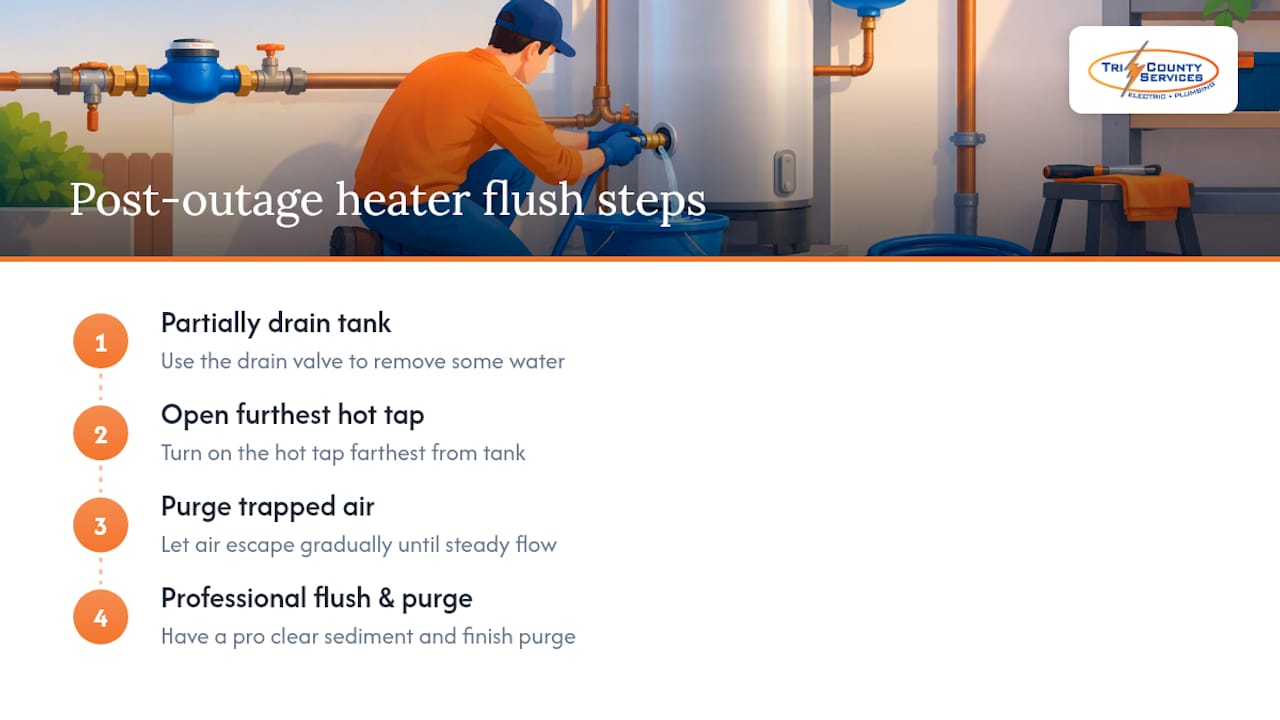
A professional flush addresses this by draining a portion of the tank through the drain valve to clear sediment that settled during the downtime, then opening a hot water tap furthest from the tank to let trapped air escape the lines gradually. Skipping this step after an outage is a common reason homeowners report lukewarm or sputtering water even after confirming power and gas are both restored.
Sediment buildup is worth taking seriously beyond just this one event. A tank that hasn’t been flushed in a while accumulates mineral deposits that insulate the bottom of the tank, forcing the element or burner to run longer to produce the same amount of hot water, which is part of why some units seem to lose capacity gradually rather than all at once.
This is exactly the kind of task where DIY attempts create more problems than they solve, since draining a pressurized tank incorrectly can cause scalding water discharge or introduce air into the wrong part of the system. A professional visit handles the flush and the air purge together, which is safer and more thorough than trying to isolate one without the other.
Could your water supply be the actual problem?
Power outages don’t just affect electrical components. If your water supply also lost pressure or was shut off during the event, whether from a municipal issue or storm damage, that alone can produce the same symptom as a heater failure: cold or no water at the tap.
Low incoming water pressure means the tank isn’t refilling properly after use, which can make it seem like the heater “ran out” of hot water almost immediately. A full shutoff, meanwhile, means there’s no water flowing at all, hot or cold, so check whether cold water is also affected before assuming the heater itself is broken.
If your cold water taps are also weak or absent, the water heater likely isn’t the source of the problem, and the fix lies with the water supply itself rather than the unit’s electrical or gas components. This is a useful early check because it can save you from troubleshooting a heater that was never actually the issue.
How to check and relight a gas water heater’s pilot light
Gas storage water heaters with a standing pilot can lose that flame during a power outage, particularly if the outage coincided with a draft or a gas supply interruption.
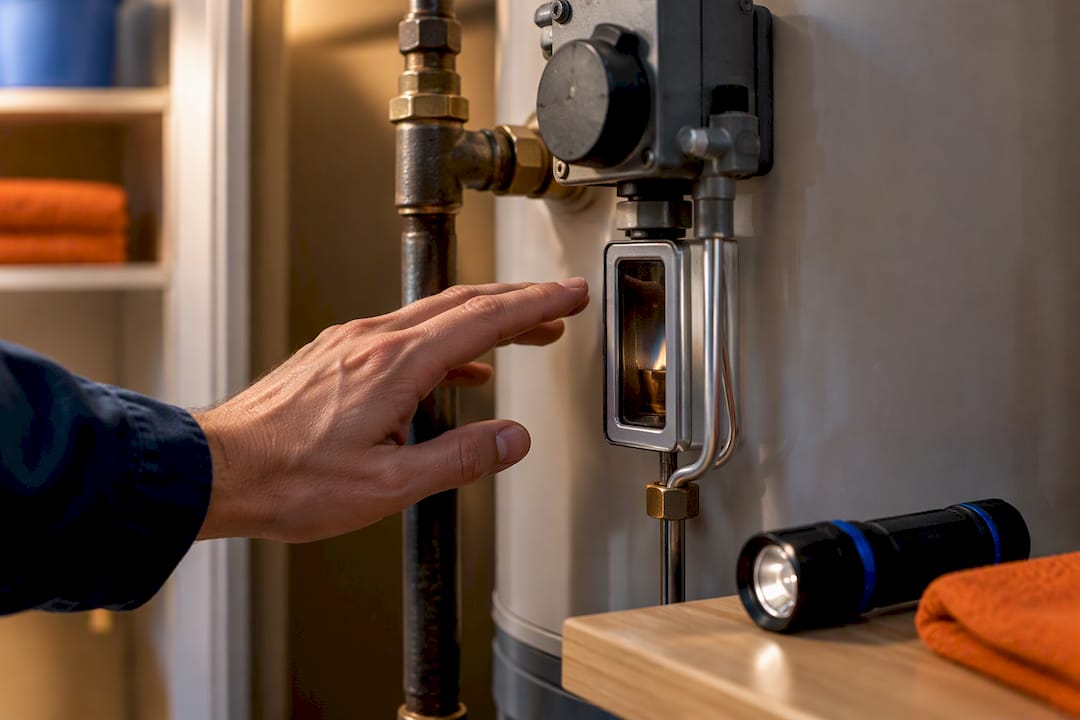
Most units have a control valve on the front with settings for pilot, off, and on, along with a viewing window or indicator light that shows pilot status. If the pilot appears out, the valve typically needs to be turned to the pilot setting and held while a igniter button is pressed, following the sequence printed directly on the unit’s data plate.
This is one of the areas where we’re steering you toward calling rather than attempting it yourself. Relighting a pilot involves handling a gas valve and confirming the flame catches properly, and a pilot that won’t stay lit after a proper attempt usually signals a failing thermocouple or a venting issue rather than something a homeowner can fix by trying again. A professional will also confirm gas pressure and venting are correct, which isn’t something you can verify with the naked eye.
What extended outages do to electronics and battery backups
Newer water heaters, especially tankless and heat-pump models, rely on circuit boards and sometimes small battery backups to retain settings and manage ignition or compressor cycles. A short outage rarely causes lasting harm, but a longer one introduces more risk.
Extended power loss can drain backup batteries that some units use to hold programmed settings, meaning the unit may reset to factory defaults once power returns, which can look like a malfunction when it’s really just a configuration reset. Voltage fluctuations during power restoration, particularly with older grid infrastructure, can also stress sensitive control boards more than the outage itself did.
Heat-pump water heaters are worth special attention here, since DOE guidance for these units outlines specific post-outage start-up and safety checks rather than a simple power-on. Powering a heat-pump unit back on without following that sequence, including verifying the tank is full and air has been purged, can produce false no-heat symptoms or, in rarer cases, damage to the unit according to HPWH installation job aids. If your unit shows an error code that doesn’t clear on its own, that’s a sign the control board needs a professional look rather than repeated power cycling.
Common mistakes homeowners make after an outage
Resetting a tripped breaker over and over rarely fixes anything and usually means a component has actually failed. When you call, tell the technician your heater’s type, its age, and exactly what the breaker or display did. Most outage-related problems are fixable, but they’re worth getting right the first time.
— Lindsay Paramore
Getting your hot water back with professional help
If your breaker keeps tripping or your gas unit’s pilot won’t hold after a power outage, Tri-County Services Electric & Plumbing can send a technician to diagnose the actual cause rather than leaving you to guess. As a family-owned team serving Northeast Ohio since 1975, we handle both the electrical and plumbing side of these problems in one visit.

- Diagnostic visits cover both the water heater and the electrical circuit feeding it.
- Repair or replacement options are available depending on what’s actually failed.
- Scheduling is built around minimizing disruption to your home or business.
Call (440) 253-0332 or visit our water heater repair and replacement page to get a technician out to your home.
Sources
- Is Your Hot Water Not Getting Hot? Common Causes & What To Do About Them
- Hot Water Switch
- Water heating system selection guidance (Building America / DOE)
- Job Aids for the Retrofit Installation of Heat Pump Water Heaters
FAQ
Why is my hot water not working after a power outage?
The most common causes are a tripped breaker, a utility load-control delay of up to 30 minutes, or a control system, such as a heat-pump reset, that needs to be restarted properly. Gas units may also have lost their pilot light during the outage.
How long does it take to get hot water back after a power outage?
Electric storage tanks can take a couple of hours to fully reheat depending on tank size and element wattage. Gas and tankless units often recover faster once ignition is confirmed working, while heat-pump units vary more depending on the temperature around the unit.
What is the first thing to check when there is no hot water?
Check the dedicated breaker for your water heater first, since a tripped breaker is one of the most common causes after an outage. If the breaker looks normal, check for a separate utility load-control switch that may be delaying the heater intentionally.
How long can I be without hot water before it’s a real problem?
If your heater hasn’t started producing hot water within a few hours for electric units, or shortly after confirming gas ignition on a gas unit, that’s beyond a normal recovery delay. At that point, it’s worth calling a professional rather than continuing to wait or reset the breaker repeatedly.