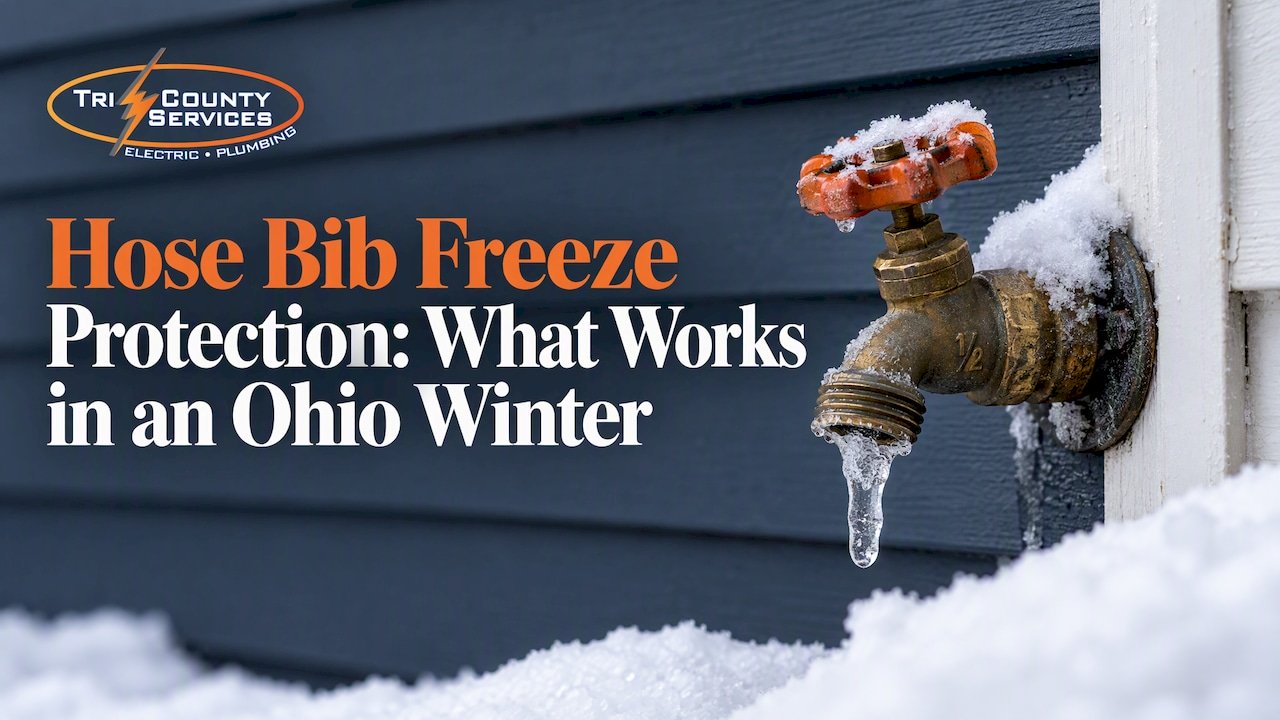


The most reliable hose bib freeze protection is a frost-free sillcock, installed by a professional with the right pitch, plus a disconnected hose and a shut-off and drain routine before the first hard freeze. Foam covers help on a cold night, but they only slow the cold down. They don’t remove the water that sits in the pipe. If you aren’t sure what kind of spigot you have, or you’ve already seen a drip inside the wall, call us at (440) 253-0332.
We are Tri-County Services Electric & Plumbing, a family-owned business that has served Northeast Ohio since 1975. We now offer plumbing, and outdoor faucets that split open in January are one of the calls we see every winter. This guide explains why they fail, which protection is worth your money, and where a professional saves you from a flooded wall.
TL;DR
- A hose bib freezes when water stays trapped in the pipe behind the spigot. Covers slow the cold, but removing the water is what prevents the split.
- A frost-free hose bib puts the shutoff valve inside the heated part of the house, so the exposed section drains when it’s turned off.
- Disconnect every hose before freezing weather, and shut off and drain the line if you have an interior shutoff.
- A frost-free bib that is installed level or pitched the wrong way can still freeze. Installation matters as much as the product.
- A hidden split often shows up only in spring, as water in the wall. Call a pro before that happens: (440) 253-0332.
Table of Contents
- Why a hose bib freezes and splits
- The three layers of protection
- How a frost-free hose bib works
- Your fall routine before the first hard freeze
- Heat tape and pipe insulation: when they help
- Signs your hose bib already has a problem
- Our perspective: replace, don’t patch
- When to call a plumbing professional
- What it costs to have us replace a hose bib
- Book your pre-winter hose bib check
- FAQ
- Sources
Why a hose bib freezes and splits
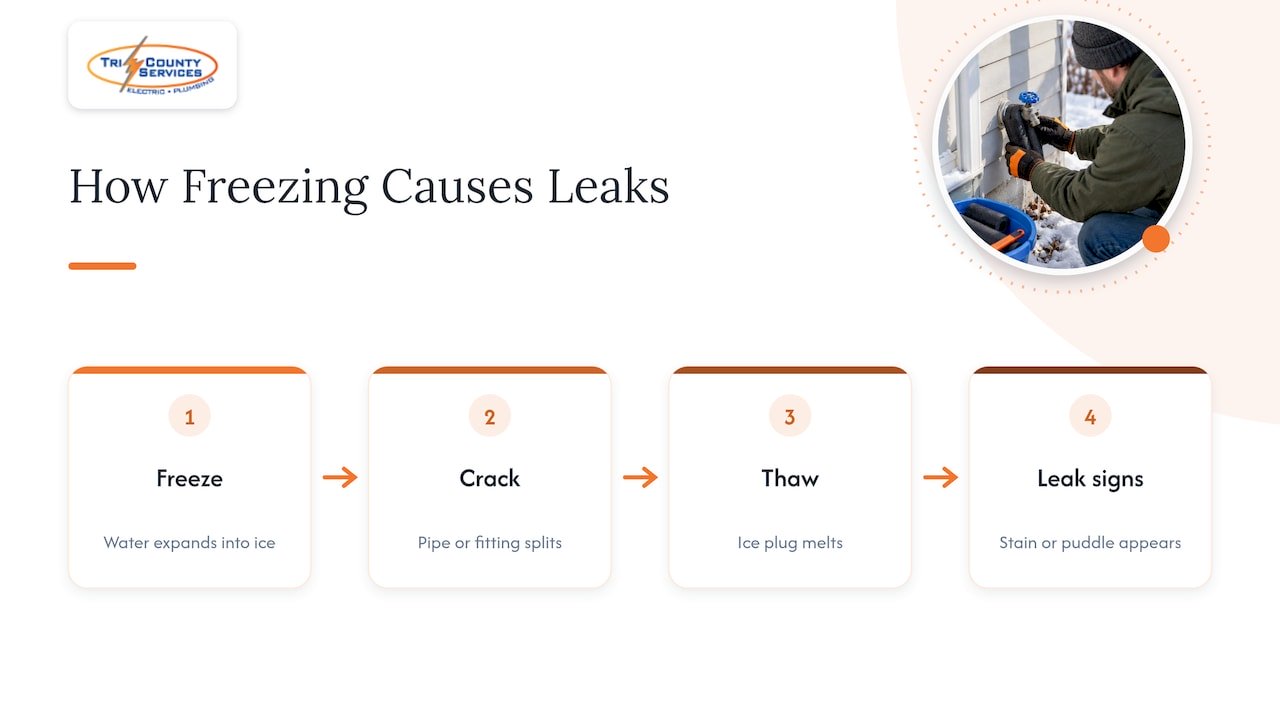
Water expands when it turns to ice. A standard hose bib has its valve right at the outside face of the wall, so the water behind the handle is exposed to the cold. When that water freezes, the pipe or the fitting can crack. Cleveland Water points out that a single hard freeze can be enough to damage a pipe, and that detaching hoses lets water drain instead of freezing in place.
The damage is often invisible until later. The ice acts as a plug while it lasts. When it melts, water flows through the crack, sometimes inside the wall or into a basement ceiling, and the first sign is a stain or a puddle. That is why a spigot that “looks fine” in February can be a leak in April. Other outdoor water sources, such as sprinkler lines, are at risk in the same way.
Why the hose is part of the problem
A hose left attached holds water against the spigot. Even a frost-free bib can’t drain if a hose or a splitter keeps the water in place. Hoses, splitters and timers are the first thing to remove each fall, and it costs nothing.
The three layers of protection
Think of freeze protection as layers. Each one helps, and the best result comes from combining them.
| Layer | What it does | Strength | Limit |
|---|---|---|---|
| Disconnect the hose | Lets the spigot drain | Free, essential | Doesn’t help a bib with trapped water |
| Insulated cover | Slows heat loss at the wall | Cheap, quick | Doesn’t remove water; a long deep freeze beats it |
| Interior shutoff and drain | Removes water from the exterior run | Strong when the valve exists | Needs a valve, and it has to be used correctly |
| Frost-free hose bib | Moves the valve into the heated space | The strongest permanent fix | Fails if installed wrong or if a hose stays on |
Foam covers are what most top search results sell, and they are fine as a backup for a night or two of hard cold. They are not a substitute for getting the water out of the line.
How a frost-free hose bib works
A frost-free hose bib, also called a frost-proof or anti-siphon sillcock, has its shutoff valve 4 to 12 inches inside the wall. When you turn it off, the water stops inside the warm part of the house. The exposed section of pipe is left empty, so there is nothing to freeze there.
That design only works when two conditions are met:
- The bib is pitched slightly downward toward the outside. If it sits level or tilts up, water stays in the stem and can freeze. Plumbers in Ohio see this often, and it is the most common reason a “freeze-proof” faucet fails.
- The stem is long enough to reach heated space. In a home with a thick wall, or a spigot that runs through an unheated garage or crawl space, a short stem may not reach warm air.
A university extension writer once described losing a faucet sold as freeze-proof. Most such faucets work because the shutoff valve is recessed in the shaft that runs through the wall. When the installation or the setup lets water sit in that shaft, the protection is gone.
Anti-siphon and code details
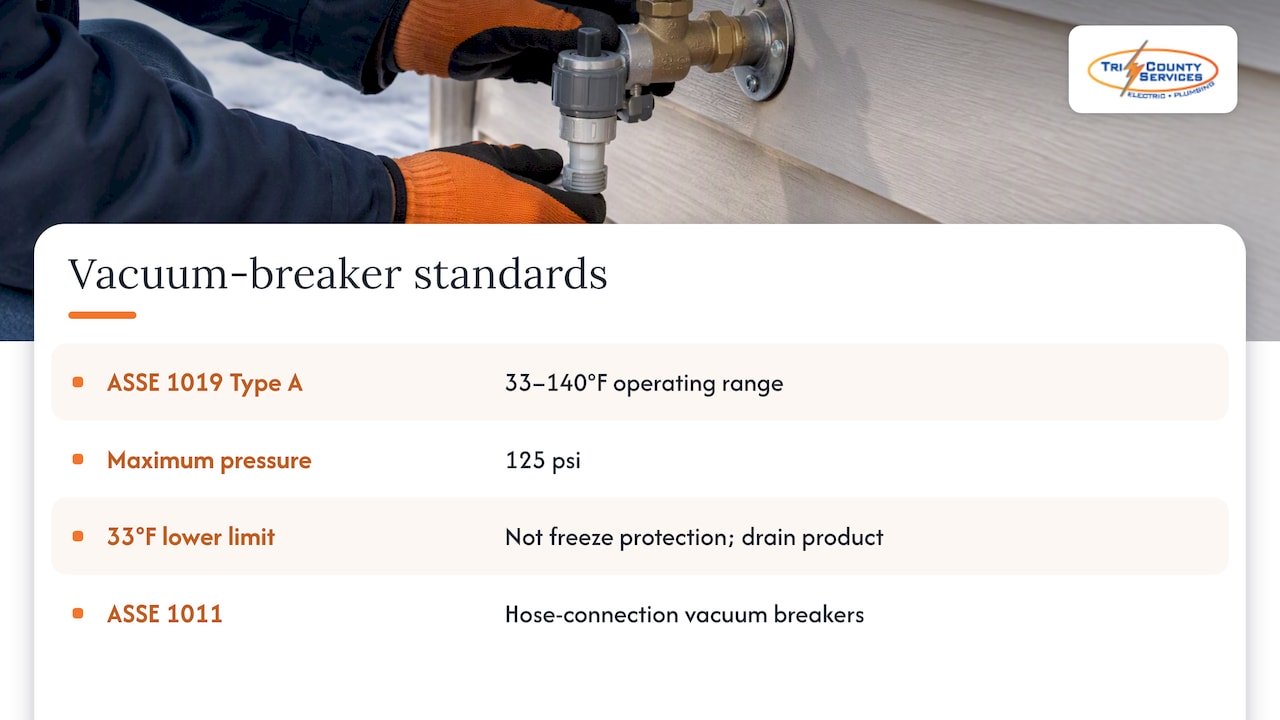
Many frost-free bibs also include a vacuum breaker, a device that stops dirty water from being drawn back into the house supply. One common model is certified to ASSE 1019 Type A, with an operating temperature range of 33 to 140 degrees F and a maximum 125 psi. Note that 33 degrees F lower limit: it describes the water in the product, which is a good reason to drain it rather than rely on it in freezing weather. The ASSE 1011 standard for hose connection vacuum breakers covers the device that threads onto the spigot outlet.
Your fall routine before the first hard freeze
In Northeast Ohio, plan this for late October or early November, before lake-effect cold arrives. Start with the part that needs no tools:
- Disconnect and coil every hose. Take off splitters, timers and sprayers too.
- Look at the spigot. Drips, a loose handle, rust staining or water marks on the siding or inside the wall mean the bib needs a professional’s attention before winter, not after.
- Find the interior shutoff. Some outdoor lines have a separate valve inside, often in a basement or utility area. Cleveland Water advises to shut off the water supply to outside spigots if they have a separate shutoff valve. If you can’t find one, that tells you something too.
- Cover the bib with an insulated cover as a backup, once the water is out of the line.
- Check the pipes behind it. Utilities such as Seattle Public Utilities advise protecting water pipes in exposed or unheated areas like attics, crawl spaces and garages, and the same applies to the run that feeds your spigot.
We have a longer walkthrough in 6 steps to winterize outdoor faucets for Ohio homeowners and a broader list in our winter plumbing checklist.
Why we don’t recommend tinkering first
It’s tempting to start unscrewing things or cranking valves. We’d rather you didn’t. An old shutoff valve can snap, a corroded bib can break at the wall, and a newly cracked pipe can pour water into the house before you’ve found the main. If a handle is stuck or a valve won’t turn, stop and read our guide to a stuck main shutoff, then call a professional plumber before you force anything.
Heat tape and pipe insulation: when they help
When a pipe leading to the bib runs through a cold space, foam insulation or heat tape can add protection. A fact sheet on preventing and thawing frozen pipes from a Red Cross-based guide covers the general idea of insulating exposed pipes. Heat tape is an electrical device, though, and the wrong product, a damaged cord or an overloaded outlet is a fire risk. If you want it on a long run, have a professional check the pipe, the product and the circuit. The same logic applies to outdoor outlets: if there’s no safe, dedicated circuit near the spot, that is an electrical job, and our electricians handle it.
Signs your hose bib already has a problem
- Water drips from the spigot with the handle fully closed.
- Water sprays from behind the handle when the hose is on.
- You see damp drywall, a ceiling stain, or mold-like smell near where the pipe enters the house.
- The meter moves when every fixture is off.
- Your bib has no vacuum breaker and sits flat against the siding with no pitch.
Any of these is worth a call. Our post on fixing a leaking outdoor spigot explains how a small leak outside can become a flooded wall. If you see active water inside, shut off the main and call. If you don’t know where it is, read where your main water shutoff is now, before you need it.
Our perspective: replace, don’t patch
We’ve been in Northeast Ohio homes since 1975, and we look at hose bibs a little differently than a product page does. A cover is a bandage. A frost-free bib that is pitched correctly, with a hose off in winter, is a repair. When a homeowner calls after a freeze, the question we ask first is how old the spigot is and whether it has an interior shutoff. Most of the time, the cheapest long-term answer is replacing the old bib once, properly, rather than buying a new cover every fall.
We also think the order of operations matters. Many people try a fix, make the crack worse, and then call us when water is already in the wall. We’d rather you call first. A short visit to assess the pipe, the pitch and the shutoff costs far less than drywall repair, and our technicians are professionals who respect your home while they work.
— Lindsay Paramore
When to call a plumbing professional
Call right away if:
- The spigot split or leaked after a freeze and water is running inside the house.
- A pipe is frozen and won’t thaw, or you can’t tell where the freeze is. Our safety guide for frozen pipes explains what to avoid.
- The valve or main shutoff is stuck.
- You want a frost-free bib installed or an old one replaced.
As a general rule, calling a plumber early is cheaper than a burst pipe, and the same goes for hose bibs. For emergencies, see five signs you need emergency plumbing service. For a broader look at how winter affects the whole house, read protecting your home from frozen pipes in Ohio’s harsh winter.
What it costs to have us replace a hose bib
Our published range for faucet installation is $500-$900, one-off, and you’ll find it on our plumbing pricing guide. The final number depends on the job itself, such as access to the pipe and what is behind the wall, so we give you clear, upfront pricing before work starts. Compare that to a split pipe inside a wall, which can mean opening drywall, drying, and repairing.
If the bib isn’t the only concern, we can also check the rest of the winter-exposed plumbing. A plumbing maintenance plan is one way to keep that on a schedule.
Book your pre-winter hose bib check
Tri-County Services Electric & Plumbing serves homeowners and businesses across Northeast Ohio, with flexible scheduling to keep disruption low. We can inspect your outdoor faucets, replace old ones with frost-free models, and check the lines behind them. See our local plumbing services or call our office at (440) 253-0332 to get on the schedule before the first freeze.
FAQ
What’s the best frost-free hose bib?
The best one is the one installed correctly. Look for a stem long enough to reach heated space, a built-in vacuum breaker, and a downward pitch toward the outside. A professional can match the stem length to your wall thickness, which is something a package label can’t do.
Do I still need to disconnect the hose with a frost-free bib?
Yes. A hose left on holds water against the spigot and keeps the stem from draining. That can freeze and crack even a good frost-free bib. Disconnect hoses before freezing weather arrives.
Are faucet covers enough?
Covers slow heat loss, so they help during short cold snaps. They don’t remove water already in the pipe, and a long deep freeze can get past them. Use a cover as a backup, not as the only protection.
How do I know if my hose bib is frost-free?
Frost-free bibs usually have a long body that runs back into the wall, and the spigot may angle slightly downward. A standard bib has a short body and a valve at the wall. If you can’t tell, call us at (440) 253-0332 and we can identify it during a visit.
Sources
- Winterizing Pipes, Cleveland Water
- What to do if your pipes freeze, CBS News
- What Homeowners Need to Know About Hose Bib Installation
- Frost-Free vs. Standard Hose Bib
- Impending cold weather could burst exposed water pipes, CAES Field Report
- Model T-550 installation instructions
- ASSE 1011 Hose Connection Vacuum Breakers
- Frozen Pipes in Winter Weather, Seattle Public Utilities
- Preventing and Thawing Frozen Pipes fact sheet
- 4 Low Cost Moves to Prevent Frozen Pipes