

Replace a tank water heater when it reaches roughly 10 years old, or sooner if it leaks, rusts, rumbles or can’t keep up. Don’t wait for it to fail. Planning the swap lets you pick the right model and avoid a flooded basement. A tankless unit can run much longer, but it still needs regular service. If your heater is in the gray zone, call Tri-County Services Electric & Plumbing at (440) 253-0332 and we will tell you honestly whether it has life left.
TL;DR
- Most tank water heaters last 8 to 15 years. Once yours passes 10, start planning the replacement.
- Leaks, rust-colored water, visible corrosion, loud rumbling or popping and a shrinking hot water supply are the signs to act on.
- Soot or burn marks near a gas unit’s vent can point to dangerous backdrafting. Treat that as urgent and call a professional.
- Replacing on your schedule is usually cheaper and less stressful than replacing after a tank rupture.
- Call (440) 253-0332 and we will inspect the unit and give you a straight answer.
Table of Contents
- How long a water heater really lasts
- Warning signs it is time to replace
- Repair or replace: a simple way to decide
- What waiting too long costs you
- What about flushing an old tank?
- Tank or tankless when you replace
- What replacement costs
- Why call a professional first
- Our perspective
- Get your water heater checked
- Frequently asked questions
- Sources
How long a water heater really lasts
There is no single number, and that is why the advice online seems to contradict itself. Government and university sources give overlapping ranges:
- A Texas consumer agency says hot-water heaters typically last 8 to 12 years.
- Minnesota’s Department of Commerce puts the average life expectancy at 10 to 12 years.
- The University of Florida says most units last 10 to 15 years and suggests you begin shopping once yours is over 10.
- Consumer Reports says tankless models generally last at least 20 years, provided they get routine maintenance.
Put together, a practical rule for a conventional tank is this: under 8 years, you are fine. Between 8 and 12, you are in the replacement window. Past 12, you are on borrowed time, even if the water still runs hot.
The Minnesota guidance adds a point many homeowners miss. An old unit can operate inefficiently for years before it finally leaks. So a heater that still works is not necessarily a heater that is working well.
Find your heater’s age
Look for the data plate on the side of the tank. The serial number usually encodes the month and year of manufacture, though each brand formats it differently. If you can’t decode it, a plumber can read it in a few seconds. We do this on every water heater visit, so you don’t have to guess.
Warning signs it is time to replace
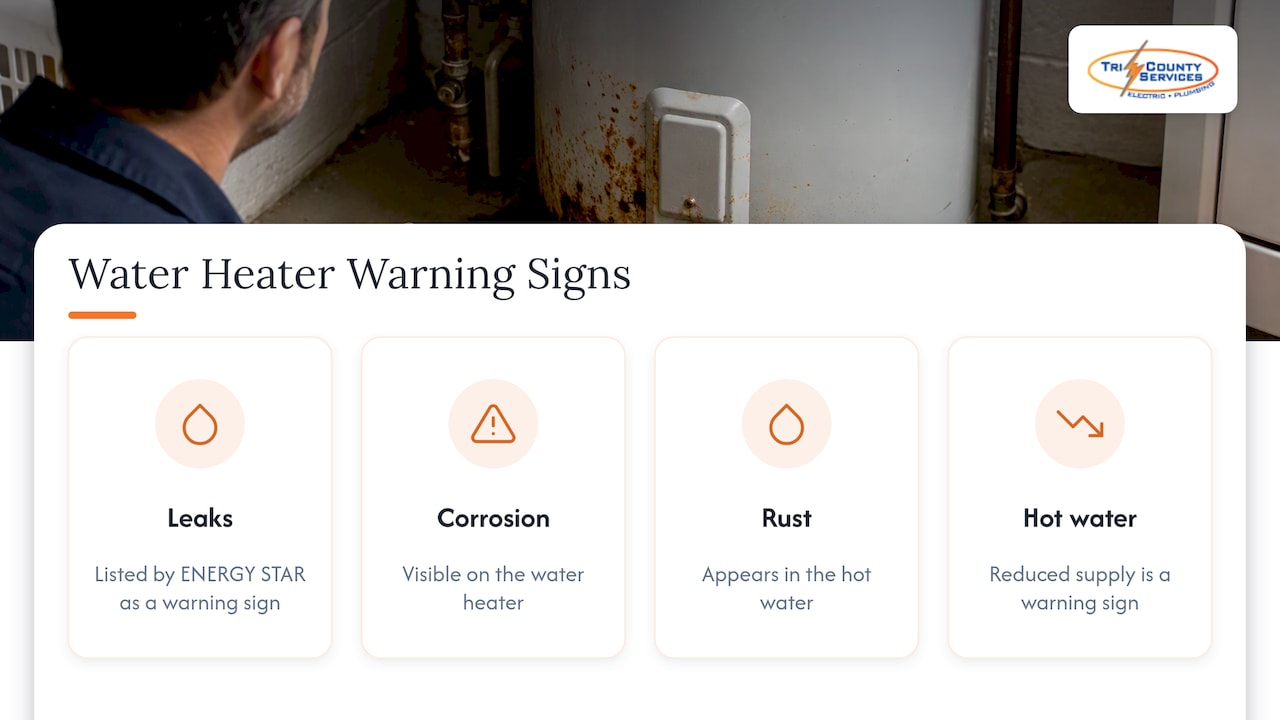
Age sets the schedule. Symptoms tell you whether you are running out of it. ENERGY STAR lists visible corrosion, leaks, rust in the water, reduced hot water and unusual rumbling or vibration as warning signs. Here is what each one tends to mean in a real Northeast Ohio home.
Water pooling around the base
This is the sign that matters most. Texas guidance notes that an older unit pooling water beneath it may mean replacement is needed. A loose fitting or valve can leak too, and those are sometimes easy fixes. But if the water is coming from the tank itself, the steel has failed and no repair will fix it.
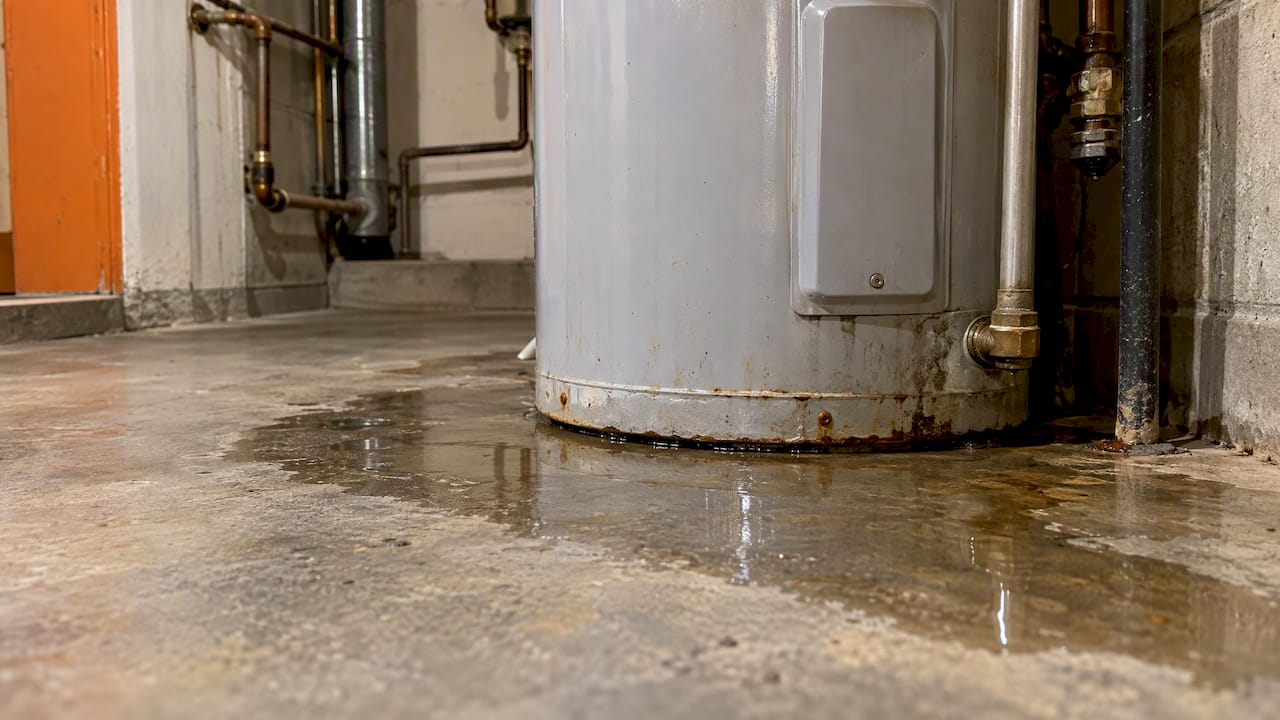
A leak from an old tank tends to get worse, not better. Shut off the water supply to the heater and call a professional the same day. Our water heater repair team can work out whether you have a fitting problem or a dead tank.
Rust-colored water or visible corrosion
Rusty hot water, with clear cold water, points at the tank. Rust streaks or corrosion on the tank, pipes or fittings are another warning on ENERGY STAR’s list. If only the hot side runs brown, don’t assume it will clear up on its own.
Rumbling, popping or banging
Sediment settles at the bottom of a tank, hardens and gets cooked over and over. The result is rumbling, popping or cracking sounds. Texas guidance says strange hissing, popping, banging or rumbling noises should be addressed promptly. Sediment also slows heat transfer, which the University of Florida says reduces efficiency.
In a young heater, noise can be a sign of buildup that a professional can deal with. In a heater over 10 years old, it usually means the tank is near the end. If you are curious how sediment hits your wallet, we wrote about it in our guide to water heater sludge.
Not enough hot water, or water that won’t stay hot
If showers go cold faster than they used to, or you keep turning the thermostat up, the unit is losing capacity. Minnesota lists needing progressively higher temperature settings as a reason to consider replacement. Texas guidance adds that inconsistent temperature or pressure may come from sediment, which can sometimes be flushed if the buildup is not excessive.
The word “sometimes” matters. Sediment in a tank that has gone years without service may be too far gone, and a professional can tell you which case you have.
Soot, scorch marks or a burning smell on a gas unit
Minnesota’s guidance says soot or burn marks near the vent hood may indicate dangerous backdrafting. That is a combustion safety issue, not an efficiency one. If you see it, or smell gas, leave the area, call your gas utility from outside and then call a professional. Do not keep running the heater to see what happens.
A water bill or energy bill that keeps climbing
A struggling heater works harder for the same hot water. If your electric bill has crept up and nothing else has changed, read our piece on whether your water heater is causing a high electric bill.
Repair or replace: a simple way to decide
Not every problem means a new heater. Here is how the decision usually breaks down.
| Situation | Usually best move |
|---|---|
| Heater under about 8 years old, one clear fault (thermostat, element, valve, loose connection) | Repair |
| Heater 8 to 12 years old, first repair needed | Repair if the cost is modest, but start planning the replacement |
| Heater over 10 years old with repeat breakdowns | Replace |
| Water leaking from the tank itself | Replace |
| Rust-colored hot water plus age over 10 | Replace |
| Soot or burn marks near a gas unit’s vent | Call a professional immediately, then likely replace or correct the venting |
| Heater is old but working fine | Plan and budget now, replace on your schedule |
Texas guidance describes the repair side well: loose connections or valves may be easy fixes, while an older unit that keeps going out, pools water or runs rusty may need replacing. ENERGY STAR’s view is preventive: if the unit is more than 10 years old, consider replacing it before an emergency failure.
Check the warranty before you decide
Consumer Reports says warranties typically run 3 to 15 years. A unit that fails inside its warranty may be partly covered, though labor often is not. Have the model and serial number handy when you call so we can check what applies.
The lower-bills argument
Replacement is not only about failure. The University of Florida says early replacement may be economically smarter if lower utility bills would make up the cost. A newer, more efficient unit can make sense when your current one is old and wasting energy. Ask for a clear comparison before you commit, and we are happy to provide one.

What waiting too long costs you
When homeowners put it off, the usual outcome is a failure at the worst time: a cold morning, a houseful of guests or a weekend when everything is booked. ENERGY STAR warns that ignoring the signs can lead to a sudden loss of hot water, tank rupture and water damage. It also points to emergency replacement expense and fewer efficient models to choose from, since you take whatever is available.
In a finished basement, even a slow tank leak can ruin flooring, drywall and stored belongings before anyone notices. The heater itself is the smaller bill. That is why we encourage a planned replacement, with time to compare options, over a scramble.
What about flushing an old tank?
Maintenance does extend a heater’s life. The University of Florida says draining about a quart from the tank every 3 to 6 months removes sediment that cuts heat-transfer efficiency, following the manufacturer’s instructions. Consumer Reports adds that storage heaters may need periodic flushing, temperature-and-pressure valve checks and anode-rod inspections.
But a heater that is 15 years old and has never been serviced is a different case. Old valves can fail when disturbed, and a rusted tank can start leaking once buildup is moved. Hot water under pressure is also a burn risk. For an older unit, have a professional look at it first. They can tell you whether a service is worthwhile or whether the money is better spent on a new unit. Our water heater maintenance and repair page explains what we check.
Tank or tankless when you replace
Replacement is the one moment when you can change the type of heater, so it is worth thinking about.
| Conventional tank | Tankless | |
|---|---|---|
| Typical life | 8 to 15 years, depending on the source | At least 20 years with maintenance |
| Hot water | Limited by tank size | Heated as needed |
| Upkeep | Periodic flushing, valve and anode checks | Descaling and flushing every one to two years |
| Install complexity | Usually simpler if hookups match | May need gas piping, venting or electrical changes |
Consumer Reports says tankless retrofits may require larger gas piping, different venting or electrical-service upgrades, which raises installation cost. That is where having an electrical and plumbing team under one roof helps. If your panel needs work to support a unit, we can handle both sides. Read more in our guide on why Northeast Ohio homeowners are moving to tankless, or see how we handle tankless installation and replacement. If you already have one, our annual tankless maintenance guide covers what the service involves.
What replacement costs
We don’t publish a fixed price for water heater replacement, because the right number depends on the unit, the fuel type, the venting and what the old installation looks like. For a rough outside reference, Consumer Reports reported in 2019 that swapping a storage heater with compatible existing hookups could run $600 to $800 for installation, while tankless installation was at least $800 to $1,500. Those are older national figures for labor and do not include the unit, so treat them as a floor and not a quote.
For a number that fits your house, we offer free estimates on water heater installation and replacement.
Why call a professional first
It is tempting to watch a video and try to sort it out yourself. A water heater combines water pressure, high heat and, depending on the model, gas combustion or high-amperage electricity. A mistake with any of those can mean scalding, a gas or carbon monoxide hazard, a fire or a flood.
A professional also sees things you may not: whether the venting is sound, whether the gas line is the right size, whether the electrical circuit can carry the load, and whether local code requirements are met. If you aren’t sure what is wrong, the safest first step is a call to a qualified pro, not a toolbox. A diagnosis is quick, and it often saves you from replacing a heater that only needs a small repair, or from nursing along one that should be replaced today.
Our perspective
We have been a family-owned business in Northeast Ohio since 1975, and we began with electrical work. We added plumbing because so many of the calls we got had both in them. A water heater that trips a breaker, a tankless unit that needs a bigger panel or a dead element are electrical and plumbing problems at the same time.
What we tell customers is simple. Don’t replace a heater just because someone says it is old, and don’t keep one because it still makes hot water. Look at the age, the symptoms and the safety of the installation, then decide. If a repair makes sense, we will say so. If the tank is leaking, we will say that too, and we will work around your schedule to keep disruption low. We would much rather help you plan a replacement than meet you at 2 a.m. with a wet-vac.
— Lindsay Paramore
Get your water heater checked
If your heater is past 10 years, making noise, leaking or running out of hot water, we can inspect it and give you clear options. Our technicians are certified, respect your home and offer flexible scheduling. See our hot water tank repair and replacement service, or call our office at (440) 253-0332.
Frequently asked questions
How quickly should I replace a leaking water heater?
As soon as you can. Shut off the water supply to the heater and call a professional the same day. A leak from the tank itself means the tank has failed, and ENERGY STAR notes that ignoring such signs can lead to tank rupture and water damage. Call us at (440) 253-0332 if it is happening now.
Is a 10-year-old water heater too old?
Not necessarily broken, but it is time to plan. Sources give 8 to 12 or 10 to 15 years for tank models. At 10, ENERGY STAR advises considering replacement before an emergency, and the University of Florida suggests starting to shop. A professional inspection tells you how much time yours likely has left.
Should I flush a 15-year-old water heater?
Ask a professional first. Regular flushing helps a young heater, but an old tank that has gone years without it may have heavy sediment and aging valves that can leak once disturbed. A technician can decide whether servicing is worth it or whether replacement is the better use of your money.
What are the signs of a water heater going bad?
The main ones are leaks or pooling water, rust-colored water, visible corrosion, rumbling or popping noises, less hot water and temperatures you keep having to raise. On gas units, soot or burn marks near the vent are a safety warning. Any of these in a unit over 10 years old is a strong reason to book an inspection.
Sources
- Preventing Damage from Water Heaters, Texas Office of Public Insurance Counsel
- Water Heater Replacement, Minnesota Department of Commerce
- Energy Efficient Homes: Water Heaters, University of Florida IFAS
- Save Money with an Energy-Efficient Water Heater, Consumer Reports
- When Should You Replace Your Water Heater?, ENERGY STAR
- Tankless Water Heaters vs. Storage Tank Water Heaters, Consumer Reports