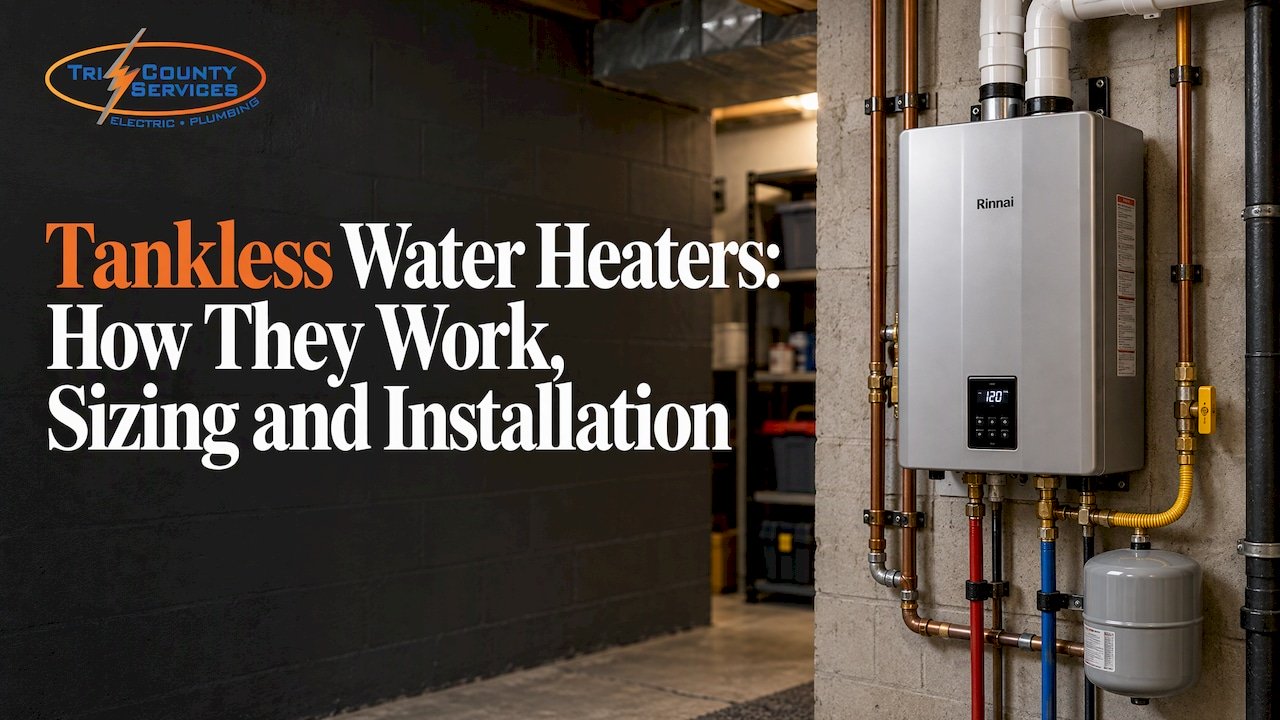


A tankless water heater heats water only when you open a hot tap, so it never keeps a tank of hot water waiting. That cuts standby energy loss, frees floor space and can last well beyond a traditional tank. The result depends on correct sizing, gas or electrical capacity and venting, which is why a Northeast Ohio home does best when a professional plans the job before the unit is chosen. At Tri-County Services Electric & Plumbing we handle tankless installation and replacement, and you can reach our office at (440) 253-0332.
TL;DR
- A tankless unit heats water on demand through a heat exchanger, so there is no stored tank to keep hot, and ENERGY STAR says demand heaters use no energy for standby storage.
- The Georgia Attorney General’s office estimates 10 to 20 percent less energy use than a tank heater, and Building America puts expected life above 20 years against 10 to 15 for tanks.
- Size the unit by flow rate and temperature rise, not by the gallons of your old tank.
- Gas line size, venting and electrical capacity decide how smooth the installation is, so have a professional assess them first.
- Call Tri-County Services Electric & Plumbing at (440) 253-0332 to plan a tankless installation or replacement.
Table of Contents
- How a tankless water heater works
- What you gain by switching
- Sizing: can a tankless unit replace your 40-gallon tank?
- What installation involves
- Why a professional should do this first, not last
- Keeping a tankless heater running for decades
- Tankless or tank: which fits your home?
- Our perspective
- Plan your tankless installation with Tri-County Services
- FAQ
- Sources
How a tankless water heater works
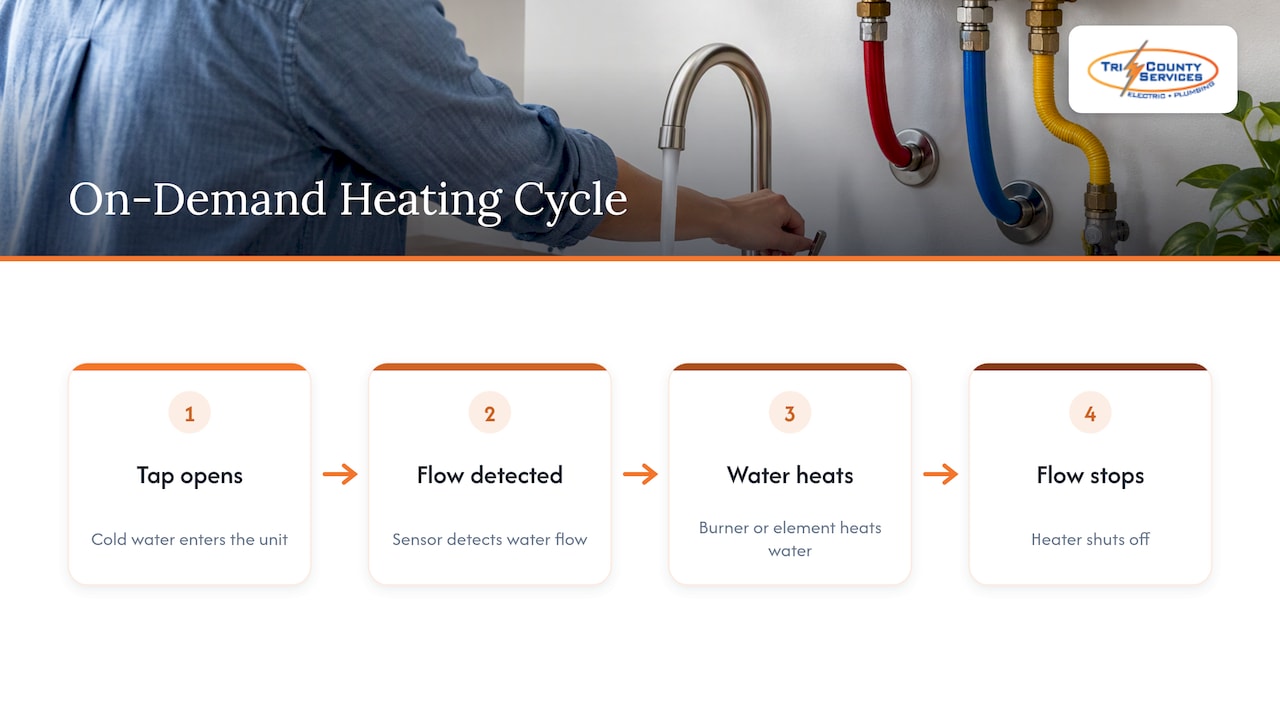
A traditional water heater holds a reservoir of hot water and reheats it around the clock. A tankless heater, also called an on-demand or instantaneous heater, has no reservoir. When you turn on a hot tap, cold water enters the unit, a flow sensor detects it and the heating element switches on. ENERGY STAR describes a gas model’s flow sensor firing the burner, which warms a heat exchanger and sends water out at the set temperature. When the flow stops, the heater shuts off.
The heat source is either a gas burner or an electric resistance coil. AHRI explains that both types are triggered by a flow-activated switch, and that units come as point-of-use models, which serve one fixture, or whole-house models, which serve the entire home.
The energy advantage comes from one thing: no standby losses. Building America reports that because a tankless heater does not keep a large reservoir hot, standby loss is almost nil. ENERGY STAR’s technical bulletin adds that storage heaters can spend 96 percent of each day in standby, which is heat you pay for but never use.
Condensing gas models go a step further. ENERGY STAR notes that a condensing unit uses a secondary heat exchanger and can use 9 percent less energy than a conventional gas tankless heater.
What you gain by switching
Lower energy use
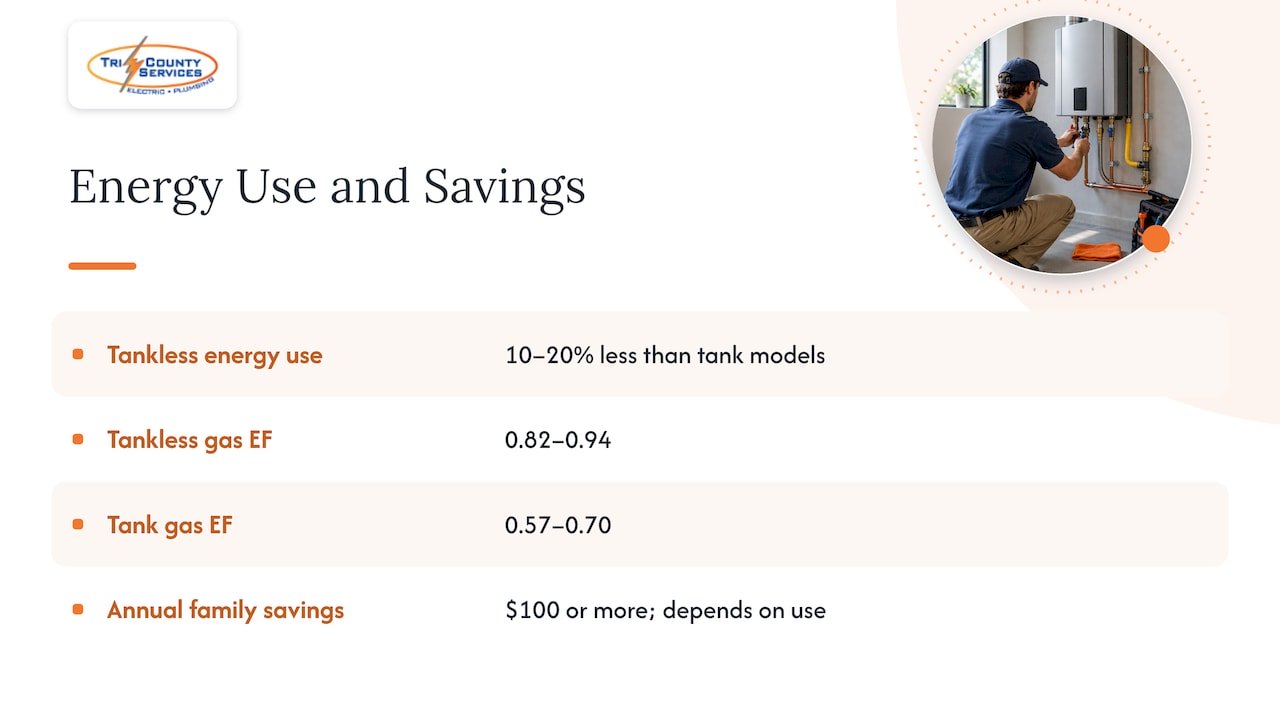
The Georgia Attorney General’s consumer guide estimates tankless heaters use 10 to 20 percent less energy than tank models. Building America lists gas tankless energy factors of about 0.82 to 0.94, against 0.57 to 0.70 for residential gas tanks. Family Handyman’s buyer’s guide says a typical family may save $100 or more per year, depending on how much hot water it uses.
Your own savings depend on your household’s habits and your utility rates. A larger family that showers back to back sees different numbers than a couple in a small house.
A longer service life
Without a tank full of stored water, there is less to corrode. Building America states that tankless heaters last more than 20 years, against 10 to 15 for traditional heaters. For a home you plan to stay in, that can mean one installation instead of two.
Floor space and a steady supply
Most tankless units mount on a wall, which gives back the footprint of a 40 or 50 gallon tank in a basement, utility room or closet. Because the heater makes hot water as you use it, a long shower or a second round of laundry does not drain a tank. The limit becomes the unit’s flow capacity, which is where sizing comes in.
Sizing: can a tankless unit replace your 40-gallon tank?
Yes, in most homes it can. The question is not the size of the old tank but how much hot water you draw at the same time. A tankless heater’s output is set by its capacity, specifically its maximum flow rate and the temperature rise it can deliver. Building America says maximum flow rate and temperature rise are determined by heater capacity.
Two numbers drive the choice:
- Temperature rise. This is the gap between your incoming cold water and the hot water you want. Northeast Ohio’s cold winter groundwater means a bigger rise than in a warmer climate, so a unit that looks adequate on paper in summer can fall short in January.
- Peak flow rate. This is the most hot water you run at once: two showers, a dishwasher and a kitchen tap, for example. Building America’s instantaneous sizing method selects a unit from exactly these two figures.
For scale, Building America says residential gas models are available that heat more than five gallons per minute through a 60°F rise, generally enough for two showers at once. Some demand heaters have fixed output while others modulate, so the right unit also depends on the model’s characteristics. Larger households may want a higher-capacity unit or a second one, which Family Handyman notes is common in higher-demand homes.
A quick worksheet to bring to a sizing visit:
| What to list | Why it matters |
|---|---|
| Fixtures that run at the same time | Sets peak flow rate |
| Number of bathrooms and showerheads | Shows how demand stacks up on busy mornings |
| Appliances that draw hot water | Dishwashers and washing machines add to peak flow |
| Gas or electric today | Decides which fuel and venting path is practical |
| Distance from the heater to the farthest fixture | Affects how long water takes to arrive |
Our team does this math on site. Technicians at Tri-County Services have completed Navien tankless water heater training, and sizing is part of planning a tankless installation with us.
What installation involves
Swapping a tank for a tankless unit is not a like-for-like job. The new heater has different demands on your gas, electrical and venting systems, and that is where a professional earns the work.
Gas models
AHRI notes that tankless heaters need larger gas lines and must be vented vertically through the roof or horizontally through a wall for indoor units, which is why installation can cost more than for a tank heater. Plumbing & Mechanical adds that gas tankless systems may need upgrades to the gas line or meter to supply enough gas pressure. A burner that is starved of gas or poorly vented is a safety matter, not a comfort issue, so these connections belong in a professional’s hands.
Electric models
Electric units pull a lot of power at once. The Georgia Attorney General’s guide warns that an electric tankless heater may raise monthly electricity use and that heavy demand can overload household panels. Plumbing & Mechanical says an electrical panel upgrade may be needed if the panel lacks capacity.
This is a real advantage of calling one company for both trades. We are an electrical and plumbing business, so the water heater, the dedicated circuit and, when needed, an electrical panel upgrade can be planned together rather than handed between contractors.
Permits and code
Cities set their own rules. One municipal tankless guide, for example, asks permit applicants for gas pipe sizing calculations, BTU ratings, the electrical source and manufacturer specifications, plus GFCI protection for receptacles in garages or outdoors. Requirements in your Cleveland, Akron or Canton-area community will differ in detail, and the permit step is part of the process that we manage with the job.
What it costs
Tankless units generally cost more up front than tank heaters, and the installation price swings with your home’s current gas line, venting and electrical setup. We do not publish a flat price for tankless installation, because the venting path and the gas or electrical work differ so much from house to house. The water heater installation page lists free estimates, and a visit gives you a firm number for your home.

Why a professional should do this first, not last
Water heaters combine gas, electricity, hot water and combustion exhaust in one appliance. A mistake in any of them can mean carbon monoxide risk, scalding, water damage or a voided manufacturer warranty. Sizing errors are quieter but just as costly: a unit that is too small gives lukewarm showers and gets replaced early.
Calling a professional before you buy also protects your budget. A technician can look at your gas meter, panel, venting route and plumbing, then tell you whether a gas or electric unit fits and what the whole project requires. Buying the unit first often leaves you with hardware that your home cannot yet support.
If you also want the service that surrounds the heater, we install tankless water heaters, and our guide for why Northeast Ohio homeowners are upgrading covers the local reasons in more depth.
Keeping a tankless heater running for decades
The most common problem is scale. Hard water leaves mineral deposits inside the heat exchanger, which reduces capacity and efficiency and can eventually cause failure. Northeast Ohio water is often described as hard, so this matters here. Building America recommends professional yearly cleaning with a mild acid solution such as vinegar and flush-kit valves installed with the unit so it can be isolated and flushed.
That last point is worth asking for at installation. Isolation valves added on day one make every later service visit faster.
A yearly visit typically covers:
- Flushing the heat exchanger to clear scale
- Cleaning the inlet filter screen
- Checking water pressure against the manufacturer’s range
- On gas models, inspecting the vent for blockages, loose joints, damage or corrosion
- Confirming performance and safety shutoffs
These steps involve gas, venting and live electrical supply, so they are best left to a technician. Our annual tankless maintenance guide explains what a yearly visit looks like.
A small addition that protects the rest of your home is leak detection. Sensors near the heater, combined with automatic water shutoff, limit damage if a connection ever fails while you are away.
Tankless or tank: which fits your home?
| Factor | Tankless | Traditional tank |
|---|---|---|
| Heating | On demand, no standby loss | Stored and reheated continuously |
| Energy use | About 10 to 20 percent less, per the Georgia Attorney General | Standby losses throughout the day |
| Expected life | More than 20 years, per Building America | 10 to 15 years |
| Space | Wall-mounted, compact | Floor-standing tank |
| Hot water supply | Continuous, within the unit’s flow capacity | Limited by tank volume |
| Installation | Gas line, venting and electrical need planning | Usually simpler swap |
For most households that plan to stay put, want lower operating costs and have an install path for venting and power, tankless is the stronger upgrade. If your existing tank is failing, our hot water tank repair and replacement page covers that route, and if your bill has climbed, this look at water heaters and high electric bills can help you see where the cost sits.
Our perspective
We have been serving Northeast Ohio homes since 1975, and the water heater conversations we have are rarely about the unit alone. They are about whether the house is ready for it.
A tankless heater is a strong upgrade because it gives a household steady hot water, frees up space and trims energy waste. We believe it works best when the gas supply, venting, electrical capacity and sizing are all planned before anyone orders equipment. Because we handle both electrical and plumbing work, we can look at the whole picture in one visit instead of passing you between trades.
Our technicians have completed Navien tankless training, and we plan flexible scheduling so the work disrupts your day as little as possible. Our promise is simple: clear, upfront pricing and a team that respects your home.
If you are weighing tankless, start with a professional assessment. It is the fastest way to a unit that fits your family for the next 20 years.
Lindsay Paramore
Plan your tankless installation with Tri-County Services
Tri-County Services Electric & Plumbing installs and replaces tankless water heaters for Northeast Ohio homes and businesses. We size the unit to your household, check the gas, venting and electrical needs and handle the install so the system is ready to run. See our tankless installation services for details, or call our office at (440) 253-0332.

If you want to see our full range of work first, our plumbing pricing guide lists services such as drain cleaning and sewer camera inspection alongside published ranges.
FAQ
Is it worth switching to a tankless water heater?
For many homes, yes. You get lower energy use (the Georgia Attorney General estimates 10 to 20 percent), a compact wall-mounted unit and a service life that Building America puts above 20 years. The value is greatest when the unit is sized correctly and installed with the right gas, venting or electrical support. Call (440) 253-0332 and we will look at your home.
Can I replace my 40-gallon water heater with a tankless one?
Yes. The size of the old tank does not decide it. Your peak hot water demand and the temperature rise in winter do, along with the gas or electrical capacity available at the unit. A professional assessment gives you the right model before you buy.
What is the most common problem with tankless water heaters?
Scale buildup in the heat exchanger, especially with hard water. It lowers capacity and efficiency over time. Yearly professional flushing, and isolation valves installed with the unit, keep it performing as designed.
Do tankless water heaters need a bigger gas line or panel upgrade?
Often they do. Gas models usually need a larger gas line and proper venting, and electric models can need more panel capacity than a tank heater. We evaluate the gas, venting and panel together as part of planning the installation.
How long does a tankless water heater last?
Building America puts expected life at more than 20 years, compared with 10 to 15 for traditional tanks. Annual maintenance is what helps a unit reach that range.
Sources
- Gas-Fired Tankless Water Heaters, Building America
- How It Works: Whole-Home Gas Tankless Water Heaters, ENERGY STAR
- Technical Bulletin: Demand Water Heaters, ENERGY STAR
- Tankless Water Heaters, AHRI
- Tankless Water Heaters, Georgia Attorney General’s Consumer Protection Division
- Tankless Water Heaters, Building America
- DHW Instantaneous Sizing, Building America Solution Center
- Tankless Water Heaters: A Buyer’s Guide, Family Handyman
- Tankless 101: What to Know About On-Demand Water Heating, Plumbing & Mechanical
- Tankless Water Heater Installation, municipal permit guide (2020)
- Automatic water shutoff at home