
Load shedding on a home generator is an automatic system that switches off lower-priority circuits, such as the air conditioner or dryer, when total demand gets close to what the generator can deliver. It keeps the generator running and your essential circuits powered instead of letting the engine bog down or trip. It is also different from the utility load shedding you may read about in the news, which is the power company cutting off whole areas. Below we explain both, show how the hardware decides what to turn off, and cover what a professional should handle. If you want a load-shedding setup planned for your home, call Tri-County Services Electric & Plumbing at (440) 253-0332.
TL;DR
- Generator load shedding automatically disconnects lower-priority loads when the generator is near its limit, then restores them in priority order once demand drops.
- Utility load shedding is a different thing: a grid operator’s last-resort, rotating interruption of customers to protect the whole system.
- Modules watch generator current and frequency. Big motor loads such as air conditioners and electric dryers are the usual first to go.
- Under the 2023 National Electrical Code, an automatic standby system must either carry the full connected load or use an energy management system. Sizing and wiring belong with a professional electrician.
- Call Tri-County Services Electric & Plumbing at (440) 253-0332 to plan generator sizing, transfer equipment and load management.
Table of Contents
- What load shedding means for a home generator
- Utility load shedding is a different thing
- How a generator decides what to shed
- What usually gets shed first
- What the codes say
- Sizing a generator around load shedding
- Why this is a job for a professional electrician
- When a load-shedding module seems to misbehave
- Our perspective
- Plan your backup power with Tri-County Services Electric & Plumbing
- FAQ
- Sources
What load shedding means for a home generator
A standby generator has a fixed capacity. Your house does not. On a hot evening you might have the air conditioner, an electric range, a dryer, a well pump and a refrigerator all asking for power at once. If the combined demand is more than the generator can supply, the engine slows, voltage and frequency sag, and sensitive electronics suffer.
Load shedding solves that. As Ferguson Home describes it, it is the automatic process of selectively turning off lower-priority loads so essential systems stay powered when the generator’s capacity is exceeded. You decide in advance which circuits matter most. The system does the rest, without you standing at the panel in the dark.
The benefit is practical. With load management in place, a generator can often be sized more sensibly for the circuits you truly need, rather than for every appliance running at the same moment. Kohler’s documentation says its load control module helps prevent frequency drops that can affect sensitive electronics and can allow a smaller generator set. Whether that applies to your home depends on a proper load calculation, which we cover below.
Utility load shedding is a different thing
Search results for this topic mix two meanings, so it helps to separate them.
Utility load shedding happens on the power grid. The Electric Reliability Council of Texas describes it as a last-resort action, used only when other options are exhausted. Operators direct transmission companies to disconnect some customers temporarily, in a controlled way, so demand does not exceed supply. Outages rotate to limit how long any one customer is without power.
The Midwest Reliability Organization says it is the unplanned but controlled interruption of firm demand during an emergency on the bulk power system, meant to prevent a large cascading outage. A local utility’s FAQ, from Grand Haven Board of Light & Power, notes that rotating outages for load shedding will likely last two hours or less at a time.
The two ideas share a principle: when supply cannot cover demand, drop some load on purpose so the whole system survives. The difference is who holds the switch. With the grid, it is the operator. With your generator, it is a module you configure for your own house.
How a generator decides what to shed
Most residential systems use a load control module or a smart management module. The details differ by manufacturer, but the logic is similar.
Watching current and frequency
Kohler’s load control module monitors generator current and frequency and adds or sheds loads by priority through its relays. Its residential manual explains that the controller reads current-transformer input and commands the load-management relays. After the house transfers to generator power, it initially sheds connected loads, then adds them back according to priority.
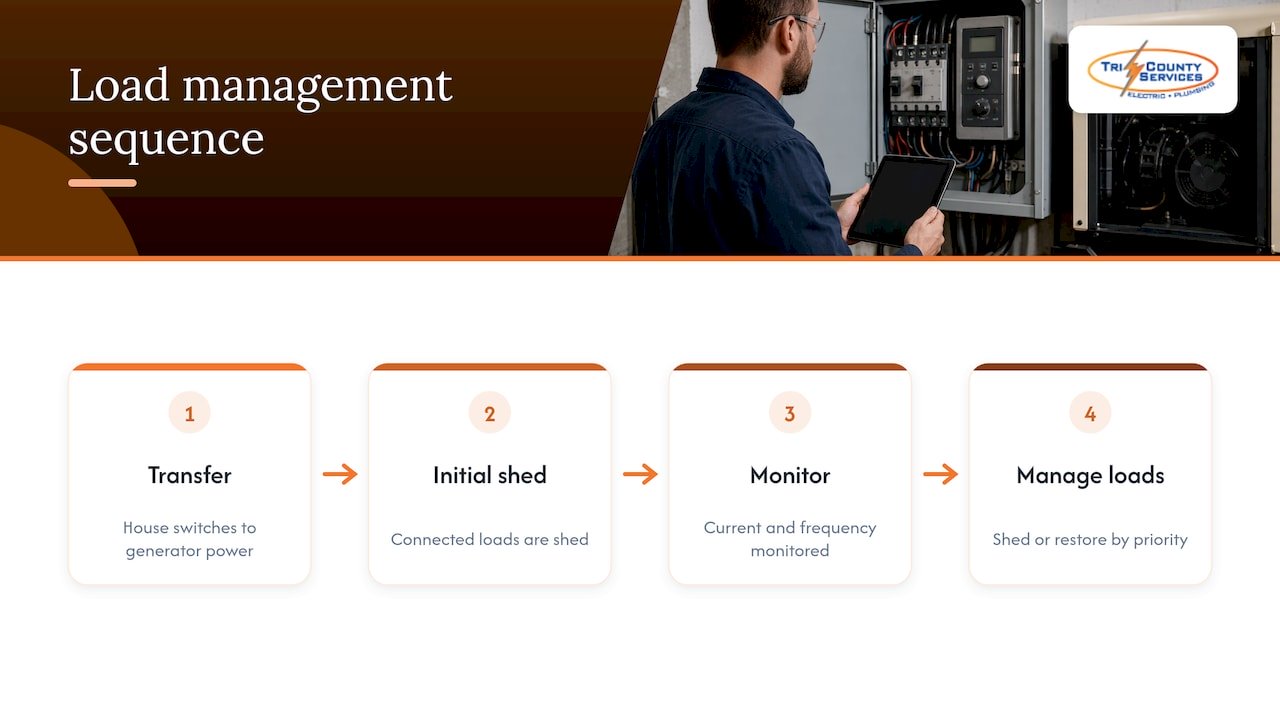
Generac’s smart management modules rely on frequency. Their manual says overload is determined by generator frequency: a load is shed when frequency falls below a preset value for a set time, and loads recover according to priority.
Priority numbers
Every managed circuit gets a priority. In Kohler’s system, less important loads carry larger priority numbers and are shed first, then re-added once generator loading falls enough. In Generac’s system, Priority 1 is the highest and the first load to activate, and Priority 8 is the last. Priority also sets the recovery order and delay timing after an outage or shed event.
Smart handling of motor starts
Air conditioners, refrigerators and water-pump motors draw a surge when they start. Kohler says its dynamic logic helps avoid unnecessary shedding of important loads during those starts. This is why running watts alone never tell the whole story. Our guide on why motor starting matters more than running watts walks through it.
What usually gets shed first
The loads that go first are the big, nonessential ones, usually the 240-volt appliances that eat generator capacity. Baltimore County’s generator guidance names air conditioners and dryers as examples of unnecessary loads a shedding device may turn off near peak generator output and restore when total load falls.
Generac’s manual gives an example configuration, and notes that real setups vary with the homeowner’s priorities:
| Priority | Example load in the manufacturer’s sample |
|---|---|
| 1 | Baseboard heat |
| 2 | Air conditioning |
| 3 | Range |
| 4 | Clothes dryer |
| 5 | Nonessential circuits |
| 6 | Pool pump or hot tub |
| 7 and 8 | Other circuits |
The same manual says high-priority 240-volt loads should get the highest priorities so they recover first after an overload. In a Northeast Ohio winter, that thinking changes. A furnace blower, sump pump, refrigerator and well pump should sit at the top of your list, while a pool heater has no business there. Your list will not match your neighbor’s, which is why it should be set up around how your household actually lives.
What the codes say
Load shedding is not only a convenience. Electrical codes recognize it as a way to size and wire an automatic standby system.
The 2023 NEC Section 702.4(A)(2), as explained by the North Carolina Office of the State Fire Marshal, requires an optional standby system with automatic load connection to either be capable of supplying the full connected load or use an energy management system under Section 750.30 that automatically manages the load. Manual load management is not allowed when the system is supplied through an automatic transfer switch.
Local jurisdictions spell out the same options. Broward County’s permitting checklist lists three approaches for automatic transfer: carry the entire service load, preselect loads on an optional-standby panel, or provide automatic load-shedding equipment that keeps imposed load at or below generator output. A Palm Beach County document likewise allows automatic load shedding to reduce total generator load to the unit’s output capacity.
Rules differ by city and county, and your local building department and utility have the final word in Ohio. A professional electrician who works in your area handles the permit and inspection side as part of the job.
Sizing a generator around load shedding
Sizing starts with a load calculation, not a guess. Baltimore County points to NEC Article 220 load calculations to establish generator size, and says to reduce natural-gas generator output by 5 percent. It also describes whole-house, selected-load and load-shedding approaches as options, and requires the system to be installed by electricians and gasfitters authorized under county rules. Broward County asks for identification of all connected loads, load calculations and a transfer switch rated for the connected load.
In practice, the sizing conversation for a typical home goes like this:
- List every circuit you want on backup. Furnace, refrigerator, sump pump, lights, internet, well pump if you have one, and any medical equipment.
- Separate essential from nice-to-have. Air conditioning, electric range, dryer and water heater are the usual candidates for shedding.
- Account for motor starting surges. Compressors and pumps draw far more at startup than while running.
- Choose the transfer arrangement. Whole-house, selected circuits, or load management.
- Match the generator to the result.
Our guides lay out the steps in more detail: how to calculate the load for your home, choosing the right transfer switch setup and home generator sizing steps. For businesses, see our commercial generator sizing checks.
A 200-amp panel rating is not the same as a generator size either, as we explain in why your panel rating isn’t the generator size.
Why this is a job for a professional electrician
A load-shedding module sits between your generator, your transfer equipment and your main panel. It involves current transformers, relays, 240-volt circuits and, often, a service-rated transfer switch. A wiring mistake can back-feed power onto utility lines, damage the generator or create a fire hazard. A wrong priority setting can leave a sump pump unpowered while a hot tub heater runs.
That is why we advise calling a professional first, before touching a panel or a module. A qualified electrician can:
- Run the load calculation so the generator and the shedding plan fit your home.
- Install the transfer equipment and current transformers correctly.
- Assign priorities so the circuits you depend on are the last to drop and the first to return.
- Handle permits and inspections so the system passes.
- Confirm that the whole setup works under load, not just on paper.
Generators also bring carbon monoxide and fuel-supply considerations that belong in the plan from day one. Our guide on transfer equipment and CO risk covers the basics, and when a homeowner should call a professional is worth a read before you start any generator project.
When a load-shedding module seems to misbehave
Many apparent faults are the module doing its job. Generac’s manual describes an LED flash code system for its smart management module:
- LED off and load not powered: the circuit breaker or the main load breaker may be off. During an outage, the generator itself needs to be confirmed as running.
- One-second flash: the module detected an overload and shed its load. The manual says to wait five minutes plus the priority time delay for output to return.
- Three-second flash: an overload happened during recovery, which triggers a 30-minute lockout. The manual advises reviewing household loads to avoid another overload.
- Six-second flash: the lockout switch is enabled while on generator power, and the manual says to contact a service dealer.
All of that comes from the manufacturer’s owner’s and installation manual. The takeaway for most homeowners is simple: a repeated shed event tells you the generator is being asked for more than it can give, and that is a signal to have the load plan reviewed. If a module stays dark, keeps flashing or you suspect a wiring problem, stop there and call a professional rather than opening the enclosure or bypassing it.
Our electrical troubleshooting service is listed at $300-$500 as a one-off, and it is the right starting point when something about your backup power is not behaving.
Our perspective
We have worked on Northeast Ohio homes and businesses since 1975, and the generator problems we see rarely come from the generator itself. They come from the plan around it. A unit gets installed, nobody maps the circuits, and the first time the furnace, the dryer and the air conditioner all call for power, the system struggles.
Load shedding fixes the part of that plan homeowners overlook. It lets a generator protect what matters most and gives back the rest as capacity allows. We believe it works best when it is designed with the generator, transfer switch and panel together, not bolted on later.
That is also why we do not encourage anyone to experiment with a panel or a transfer switch on their own. These are high-current systems tied to your home’s whole electrical service. A professional who sizes the load, sets the priorities and tests the result under real conditions gives you backup power you can trust at 2 a.m. in January.
Our goal is a long-term relationship with each customer: a clear plan, upfront pricing and work that respects your home.
Lindsay Paramore
Plan your backup power with Tri-County Services Electric & Plumbing
If you are adding a generator, upgrading a panel or wondering whether your current setup is carrying too much, our team can walk through your circuits, your panel and your priorities and recommend a plan that fits. We schedule flexibly to keep disruption low, and we treat your home with care.

Start with our electrical pricing guide or look at our electrical panel upgrades, which often go hand in hand with a generator project. To talk to our office, call (440) 253-0332.
FAQ
Is generator load shedding the same as rolling blackouts?
No. Rolling blackouts are utility load shedding: a grid operator deliberately interrupts service to rotating groups of customers as a last resort. Generator load shedding happens inside your own home, where a module turns off lower-priority circuits to keep the generator from overloading.
Do I need load shedding on a standby generator?
It depends on how the generator is sized and wired. The 2023 NEC requires an automatic standby system to either carry its full connected load or use an energy management system, so a load calculation by a professional electrician decides the answer for your home. Call (440) 253-0332 and we can help you work through it.
Which appliances are shed first?
Typically large, nonessential 240-volt loads such as air conditioners and dryers, as Baltimore County’s guidance notes. You assign the order. Many households put the furnace blower, refrigerator and sump pump at the top and pool or hot tub equipment near the bottom.
Why did a circuit stay off after the power came back?
The module may be in its recovery delay or a lockout after an overload. One manufacturer’s manual says to wait five minutes plus the priority delay after a shed, and 30 minutes after an overload during recovery. If the circuit stays off beyond that, have a professional electrician check the wiring and settings.
Sources
- Emergency Load Shedding FAQ, Grand Haven Board of Light & Power
- ERCOT Trending Topics: Load Shed
- Managing Periods of Bulk Power System Instability, Midwest Reliability Organization
- Generator Load Shedding, Ferguson Home
- Residential/Light Commercial Generator Accessories, Kohler
- Operation and Installation, Kohler
- Owner’s/Installation Manual, Generac Smart Management Module
- Generator Installations, Baltimore County Government
- Generator requirements, Broward County Building Code Division
- Residential and Commercial Generator, Palm Beach County
- Optional Standby Systems, North Carolina Office of the State Fire Marshal