
A commercial lighting upgrade means swapping old fluorescent, metal halide or other legacy fixtures for LED fixtures, ideally paired with controls such as occupancy sensors and scheduling. Done well, it cuts your electric bill, reduces maintenance calls and improves how your space looks and feels. At Tri-County Services Electric & Plumbing, we have helped Northeast Ohio businesses with electrical work since 1975. This guide covers how to know it’s time, what savings are realistic, what it costs, and how to plan the job so your business keeps running. To talk through your building, call our office at (440) 253-0332.
TL;DR
- LEDs use about 90% less energy than traditional bulbs and last 15 times longer, according to ENERGY STAR.
- Adding controls (occupancy sensing, scheduling, daylight dimming) can multiply the savings from the fixture swap alone.
- A 2026 industry estimate puts a complete high-bay retrofit at $0.21 to $0.40 per square foot, with simple payback often in the 1.5 to 3.5 year range.
- Many utility rebate programs require approval before you buy or install, so check your program first.
- A phased, zone-by-zone schedule keeps a warehouse, shop or office open during the work. Call (440) 253-0332 to plan yours.
Table of Contents
- How to Tell When Your Lighting Is Due for an Upgrade
- What LEDs and Controls Can Save
- Warehouse Lighting Upgrades: What to Get Right
- Controls and Code: Plan Them Before You Buy Fixtures
- What a Commercial Lighting Upgrade Costs
- Rebates and Incentives: Get Approval First
- Plan the Job So Your Business Keeps Running
- Our Perspective
- Work With Tri-County Services Electric & Plumbing
- FAQ
- Sources
How to Tell When Your Lighting Is Due for an Upgrade
Most businesses don’t upgrade on a schedule. They upgrade when something starts to bother them. These are the practical signals we see on walk-throughs:
- Repeated failures. If the same fixtures keep losing lamps or ballasts, the system is near the end of its life. Each repair call costs more than the part.
- Flicker, buzzing or slow warm-up. These usually point to aging lamps or ballasts. They also make a space feel tired to customers and staff.
- Dim or uneven light. Light output drops over a lamp’s life. A ten-year-old system often produces noticeably less light than the day it went in, even if every fixture still turns on.
- Dark corners and complaints. Eye strain, headaches and shadowed aisles are workplace issues, not just comfort issues.
- High, flat electric bills. Lighting is a large share of a building’s load. In the typical U.S. commercial building, lighting accounts for close to 35 percent of electricity use, according to the Energy Trust of Oregon’s guide.
- Lights that burn around the clock. If fixtures run in empty rooms, storage areas or parking lots, controls will pay back quickly.
The timing matters financially too. When old fixtures are already failing, you are paying for repairs anyway, so putting that money toward new fixtures makes the upgrade easier to justify.
Walk Your Building Before You Call
A short audit makes any estimate more accurate. Take a notebook and record, room by room:
- The fixture type and count (for example, 4-lamp fluorescent troffers, 400W metal halide high bays, wall packs).
- Mounting height and ceiling type.
- Hours the lights run each day and each week.
- Which areas are rarely occupied.
- Which fixtures have failed in the last year.
- Your electric rate per kWh from a recent bill.
Different spaces want different light. A retail floor, a classroom and a fitness studio each need a different feel, and the same fixture won’t suit all three. For an example of thinking about light by activity, see these lighting scenes for studios. With your notes in hand, our team can verify conditions on site and put real numbers to the project.
What LEDs and Controls Can Save
The headline figure comes from ENERGY STAR: LEDs provide the same brightness as traditional bulbs while using 90% less energy. Your real result depends on what you’re replacing, how many hours you run, and your rate. More conservative whole-project figures are worth planning around.
- The Building Energy Exchange reports that owners can reduce lighting energy use by as much as 75% by combining higher-efficiency fixtures with advanced controls, with payback in under three years.
- A January 2026 analysis puts typical LED retrofit savings at 40 to 70% versus legacy HID and fluorescent systems, with additional savings from avoided relamping and maintenance.
- A 2026 technical guide estimates that fixtures alone deliver a 50 to 70% wattage reduction versus HID, and that a controls layer can add a further 30 to 50% through dimming, scheduling and daylight harvesting.
A Worked Example
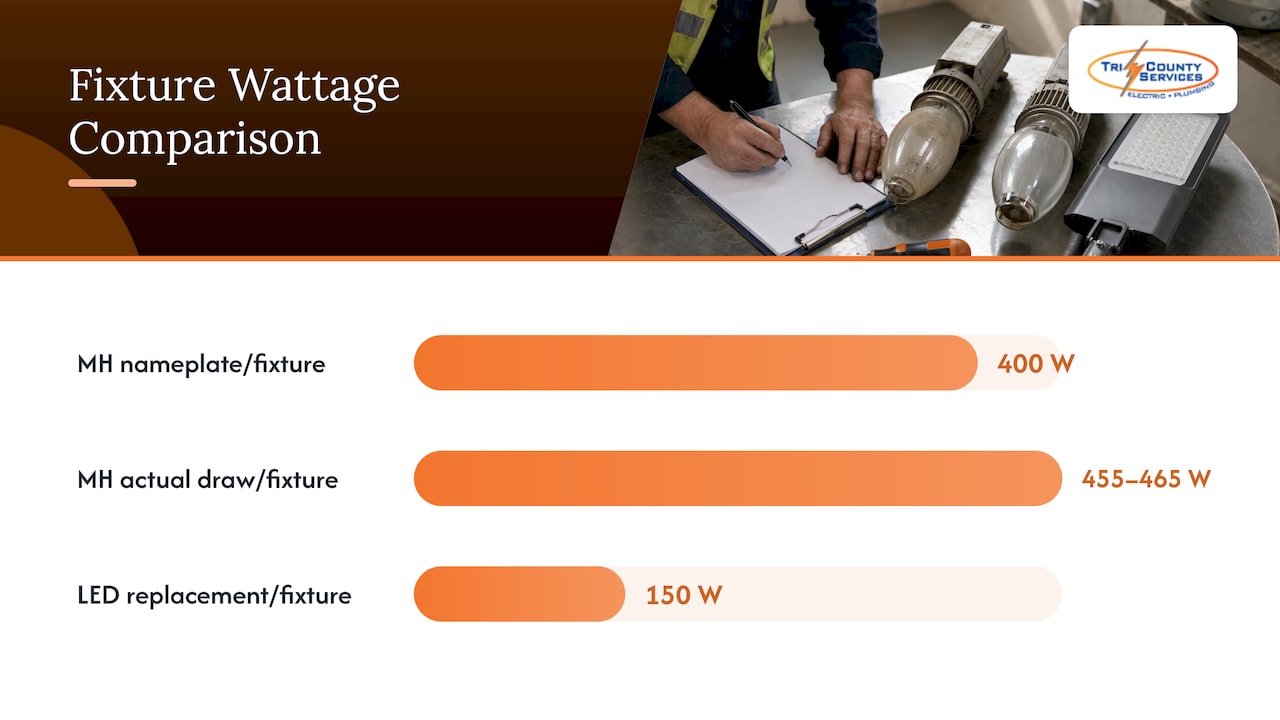
Take a 50-fixture warehouse replacing 400W metal halide fixtures with 150W LEDs. At $0.12 per kWh, that swap saves roughly $8,710 a year, according to that same guide. Your own figure will differ with your hours and rate, but the method is simple: wattage saved, times hours run, times your rate. Note that a 400W metal halide fixture actually draws closer to 455 to 465W once ballast losses are counted, so the real savings can be larger than the nameplate suggests.
Beyond the Utility Bill
Lighting quality has business value too. Well-designed lighting with good controls can reduce eye fatigue and support productivity and sales, and the Building Energy Exchange notes that better lighting can improve occupant well-being and support property values and rents. Fewer burned-out lamps also means fewer maintenance interruptions for your staff.
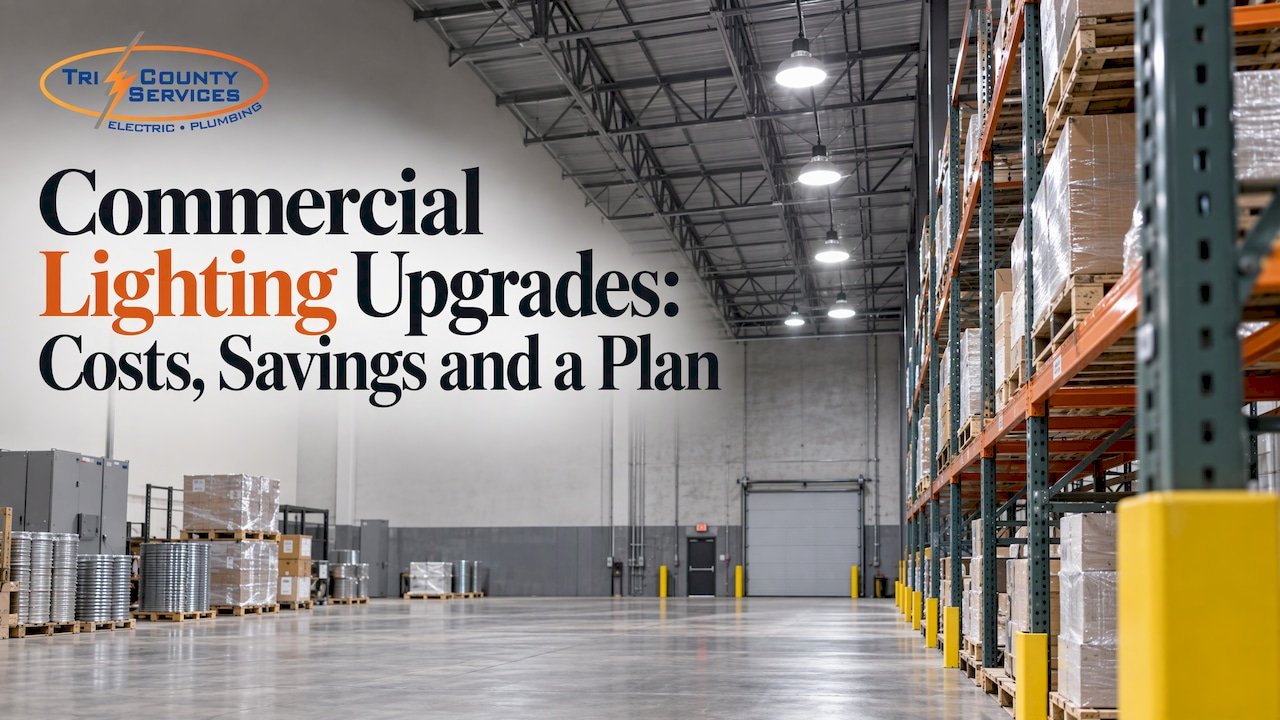
Warehouse Lighting Upgrades: What to Get Right
Warehouses are the most common big retrofit, and the layout details decide whether the result is good or merely bright.
Light the Vertical Surfaces
In a warehouse, most visual tasks are vertical: reading labels on racking, picking from shelves. High-angle lighting and glare control matter for that reason. Center high-bay fixtures over aisles, use narrow optics that put light on shelf faces and the floor, and keep the fixture bottom at or above the top of stored product.
Pick the Fixture Shape for the Aisle
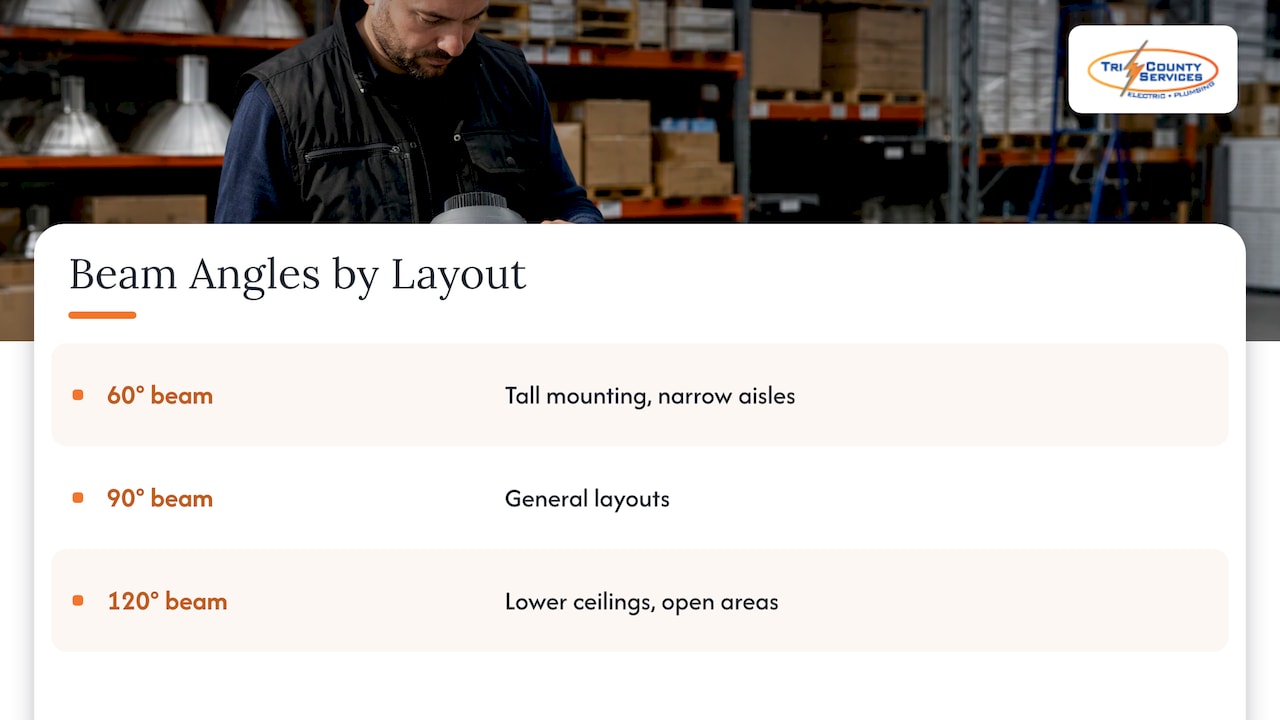
In narrow aisles 8 to 12 feet wide with racks 20 feet or higher, linear high bays with aisle-specific optics often outperform round UFO fixtures because they push light along the rack faces. In open floor areas, round high bays work well. A common early planning rule keeps fixture spacing at about 1.0 to 1.5 times mounting height, then refines it with a photometric layout. Beam angles of 60 degrees suit tall mounting and narrow aisles, 90 degrees suit general layouts, and 120 degrees suit lower ceilings or open areas.
Set Light Levels by Task
IES recommendations, as summarized in one 2026 retrofit guide, call for 30 to 50 foot-candles in bulk storage and 50 to 70 in active picking and inspection areas. Don’t light the whole building to the highest number. Light each zone to its task and let controls handle the rest.
Control Each Aisle Separately
Many jurisdictions require automatic-off occupancy sensors in warehouses, and controlling each aisle independently is a strong energy-saving strategy. Sensors mounted on each luminaire, called luminaire-level lighting controls, can also simplify commissioning.
Controls and Code: Plan Them Before You Buy Fixtures
The most common mistake on networked controls projects is choosing controls after the fixtures. Controls decide when, how brightly and for how long fixtures run, so they belong in the first conversation.
Energy codes now expect them. For example, ASHRAE 90.1-2022 calls for occupancy sensors in nearly every interior space, daylight harvesting in sidelit zones, scheduling, and the ability to cut lighting power by at least 50%. Which code edition applies to your building depends on your jurisdiction and the scope of work, so confirm with your local building department before design is finalized.
Two more practical points on equipment and safety:
- Inspectors and building codes generally expect UL or ETL Listed products, and DLC Qualified status is needed for most rebates.
- Emergency lighting is its own system. NFPA 101 governs it, including a minimum 90-minute battery runtime in public and commercial spaces. Exit and emergency fixtures should be part of your plan, not an afterthought.
This is where professional electrical work earns its keep. Retrofitting fixtures often exposes aging wiring, overloaded circuits or undersized panels, and the wiring behind a fixture matters as much as the fixture. A professional electrician can check circuits and connections, size controls correctly and make sure the finished system meets the inspector’s expectations. Wiring a commercial building is not a weekend project for staff or a handy tenant. Mistakes can cause fires, failed inspections and voided rebates, so bring in a pro first. Our electrical installation services cover this kind of work.
What a Commercial Lighting Upgrade Costs
Prices vary by building, so treat these as planning ranges rather than quotes. A 2026 industry analysis puts a complete high-bay retrofit at $0.21 to $0.40 per square foot, or about $150 to $250 per fixture installed for a standard 150W UFO high bay. Adding networked controls moves the range to $0.30 to $0.50 per square foot.
| Scope | Planning range | Source |
|---|---|---|
| High-bay retrofit, fixtures only | $0.21 to $0.40 per sq ft | Energy Solutions Intelligence, 2026 |
| High-bay retrofit with networked controls | $0.30 to $0.50 per sq ft | Energy Solutions Intelligence, 2026 |
| Standard 150W high bay, installed | About $150 to $250 per fixture | Energy Solutions Intelligence, 2026 |
What moves your number:
- Mounting height. Tall ceilings mean lifts and more labor.
- Fixture type and optics. Linear aisle fixtures and specialty optics cost differently than standard high bays.
- Controls. Networked controls add cost up front and often add savings and incentives.
- Existing wiring. Old or damaged circuits, ballast bypass work and panel capacity can add scope.
- Hours of operation. More burn hours shorten payback.
- Incentives. Rebates can offset a real portion of the bill.
For payback, the same 2026 analysis cites simple payback of 1.5 to 3.5 years for a typical commercial LED retrofit. Your own payback depends on operating hours, utility rates, existing lighting, installation cost, controls and incentives.
If you want to see how we price our own electrical work, our electrical pricing guide lists published ranges. Electrical troubleshooting, for example, runs $300 to $500 as a one-off. Lighting retrofits are scoped to the building, so we start with a walk-through.
Rebates and Incentives: Get Approval First
Utility incentives can make a big difference, but programs differ by utility and state, and they change. A few patterns hold across the country:
- Pre-approval is common. For example, Los Angeles’s commercial program requires approval before purchase and installation, DLC-listed equipment and at least 25% energy savings. New Hampshire’s 2026 program also requires pre-approval and an in-place, operational existing system at pre-inspection.
- DLC listing matters. Rebates generally apply to DLC-listed fixtures, and networked controls often earn bonus incentives.
- Amounts vary by region. One 2026 cost guide lists DLC fixture rebates of $15 to $100 per fixture depending on region, with the Midwest at $15 to $60.
- Federal deductions can change. One 2026 guide reports that the Section 179D deduction was terminated for projects beginning construction after June 30, 2026. Ask your accountant what applies to your project.
Those examples come from other states, so they show how programs work, not what you will receive in Ohio. Ask your electric utility’s business energy-efficiency program what it offers now, and get written approval before any equipment is ordered. Don’t buy fixtures first and hope to qualify later. We’re glad to coordinate the electrical scope with your program’s requirements.
Plan the Job So Your Business Keeps Running
Downtime is the biggest worry for most owners, and it is manageable.
- Walk the building and document fixtures, heights and hours.
- Decide the controls strategy first, then select fixtures that work with it.
- Confirm rebate rules and get pre-approval if your utility requires it.
- Phase the work by zone. One warehouse guide suggests zones of 20 to 30% of total fixtures, with a typical phased retrofit running 8 to 12 weeks in three phases. Smaller offices and shops may finish in days.
- Schedule around operations. Work in low-traffic periods, evenings or weekends.
- Keep light levels safe during the transition. Temporary LED work lights can maintain safe levels in zones under construction.
- Tell your team which zones are active each week, especially pickers, forklift drivers and receiving staff.
- Commission the controls. Set schedules, sensor timeouts and dimming levels, then adjust after a couple of weeks of real use.
Flexible scheduling to minimize disruption is part of how we work, so tell us your busy hours and we will build the schedule around them.
Our Perspective
Business owners often tell us the same thing: they didn’t plan to think about lighting until a ballast failed or a bill jumped. The best upgrades we see start earlier than that, with a plain look at what is installed and how the space is used.
We believe a lighting upgrade is an electrical project first. The fixtures are the visible part. Circuits, panels, connections and controls decide whether the system works safely for the next fifteen years. That is why we prefer to have a professional electrician involved from the start, not called in after a failed install.
Our team has served Northeast Ohio since 1975, and our approach is simple: clear, upfront pricing, careful work that respects your building and customers, and scheduling built around your day. If you are comparing a retrofit now against another year of repairs, we would be glad to walk the space with you and show you what makes sense.
Lindsay Paramore
Work With Tri-County Services Electric & Plumbing
We are a family-owned electrical and plumbing company serving residential and commercial clients across Northeast Ohio. For businesses, we handle electrical repairs, upgrades, new wiring, panel upgrades, lighting solutions, inspections and emergency repairs, with certified technicians and flexible scheduling.

If you’re planning a lighting upgrade, start with a conversation. Call our office at (440) 253-0332, or see our electrical pricing guide for published ranges. Customers with parking lots, entrances or building exteriors can also look at our outdoor lighting for residential and commercial properties, and our outdoor lighting control systems page.
FAQ
Is a warehouse lighting upgrade worth it?
For most warehouses that run long hours, yes. A 2026 analysis estimates typical simple payback of 1.5 to 3.5 years for commercial LED retrofits. Your payback depends on your hours, utility rate, current fixtures and any rebates. We can walk your building and help you scope it.
How long does a commercial lighting upgrade take?
It depends on size. A small office or shop can often be done in a few days, while a large warehouse may be phased. One guide describes a typical phased warehouse retrofit as 8 to 12 weeks across three phases. We schedule around your operations so you can keep working.
Do I need a professional electrician for a lighting retrofit?
Yes. Commercial lighting involves higher-voltage circuits, ballast bypass or removal, controls wiring, emergency lighting and code compliance. Errors can cause fires, failed inspections and lost rebates. A professional electrician protects your building, your staff and your project. Call (440) 253-0332 to schedule an evaluation.
Can I get rebates for LED upgrades?
Often you can. Utility programs commonly reward DLC-listed LED fixtures and controls, but many require approval before purchase and installation. Contact your electric utility’s business program before you order anything, and keep the written approval on file.
Sources
- Upgrade Your Lighting, ENERGY STAR
- Lighting the Way: Upgrading Lighting Systems for Commercial Offices, Building Energy Exchange
- Guide to new, energy-efficient lighting technologies, Energy Trust of Oregon
- Commercial Lighting Retrofit ROI 2026, Energy Solutions Intelligence
- Commercial LED Lighting: The Complete Technical Guide, Jarvis Lighting
- Guide to Warehouse Lighting Control, EC&M
- Warehouse Lighting Retrofit: LED Upgrade Guide & ROI
- High Bay Lighting Buying Guide, Stars and Stripes Lighting
- Commercial LED Lighting: The Ultimate 2026 Guide, PROLIGHTING
- Commercial Lighting Incentive Program, LADWP
- 2026 Lighting Incentive, NHSaves
- Commercial LED Lighting Cost Calculator 2026, Auvolar