


A sewer gas smell in your bathroom means gas from your drain system is getting into your living space, and it should be traced to its source rather than masked. The cause is usually a dry drain trap, a failing seal under the toilet, a blocked vent or a cracked drain pipe, and the last two are hard to confirm without the right tools. At Tri-County Services Electric & Plumbing, our plumbing team finds the source so the smell is fixed instead of coming back. Call our office at (440) 253-0332.
TL;DR
- Sewer gas is a mix of gases from decaying waste. Its rotten-egg smell comes mainly from hydrogen sulfide, and your nose is not a reliable alarm for how much is in the air.
- The usual causes are a dry P-trap, a worn toilet wax ring, a blocked or damaged vent, and leaking or clogged drain pipes.
- A smell that is strong, widespread or keeps returning calls for a professional inspection, not another round of drain cleaner.
- Headaches, dizziness or nausea together with the smell mean you should get fresh air and see a doctor. If you think the gas is concentrated in an enclosed space, leave and call the fire department.
- Call Tri-County Services Electric & Plumbing at (440) 253-0332 and we will find where the smell is coming from.
Table of Contents
- What sewer gas is and why it smells so bad
- Where the smell comes from: the usual causes
- Match the clue to the likely cause
- Is sewer gas dangerous?
- What to do while you wait for the plumber
- When to call right away
- Why a professional finds the cause faster
- Smell in the house, but not in the bathroom
- Fix it with Tri-County Services Electric & Plumbing
- Our perspective
- FAQ
- Sources
What sewer gas is and why it smells so bad
Sewer gas is not a single chemical. The Wisconsin Department of Health Services describes it as a mix of toxic and nontoxic gases that forms when household and industrial waste decays, with hydrogen sulfide and ammonia among the highly toxic components. The Illinois Department of Public Health adds that hydrogen sulfide is often called “sewer gas” and has a strong, rotten-egg odor at low levels.
That is why people describe the same problem in different ways: sewage, rotten eggs, sulfur, a swampy damp smell. They are all variations on one problem. Gas that belongs in the sewer or the vent system is escaping into your home.
Your plumbing is designed to keep that gas out. Every drain has a curved section of pipe called a trap that holds a plug of water, and a vent system lets air in so water drains smoothly and gas escapes safely above the roof. When any part of that system fails, the smell comes in through the bathroom, because that is where several drains, the toilet and often the closest vent connections sit.
Where the smell comes from: the usual causes
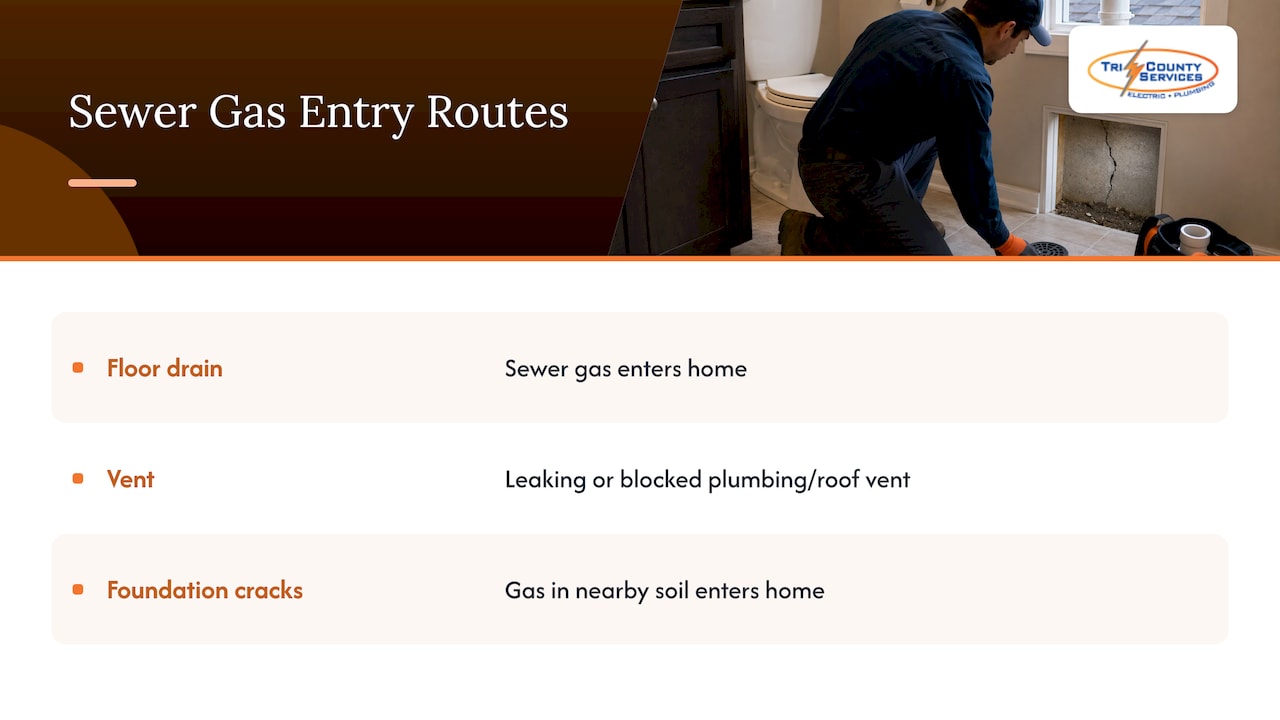
The Ohio EPA says sewer gas can enter a home through a floor drain, through a leaking or blocked plumbing or roof vent, or through foundation cracks if gas is in the soil next to the house. In a bathroom, these are the culprits we see named most often.
A dry P-trap
The trap under a sink, tub or shower drain only works while it holds water. Mt. View Sanitary District explains that if the water seal in a rarely used drain evaporates, sewer gas can seep into the home. A guest bathroom, a basement shower or a floor drain are the typical victims. If the smell is strongest near one fixture that nobody uses, this is a likely cause.
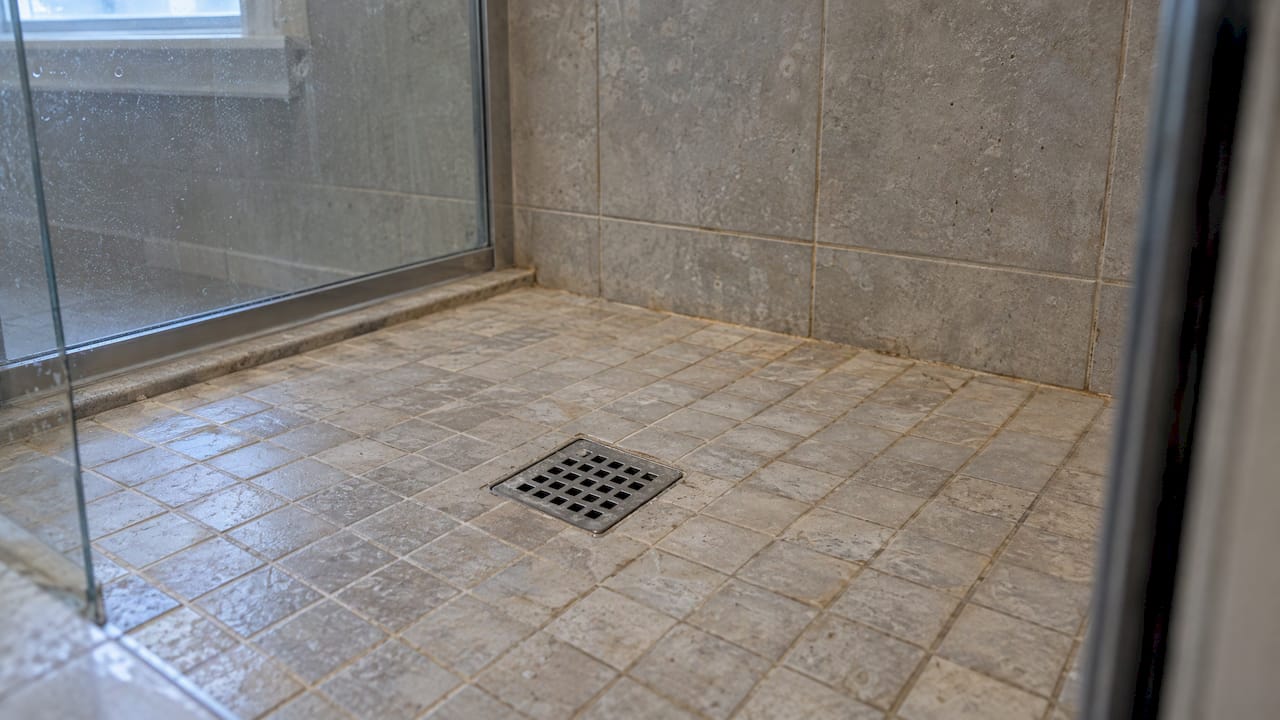
A dry trap can also be a symptom. If a trap keeps losing its water even though the fixture is used, the vent or the pipe behind it may be the real problem.
A failed wax ring under the toilet
A toilet sits on a wax ring that seals it to the drain flange. When the ring wears out or the toilet shifts, gas can escape around the base, and sometimes water does too. Smell at the base of the toilet, a rocking toilet or a stain on the floor around it all point here. Our guide on why a toilet leaks at the base explains what we look for.
A blocked or damaged vent
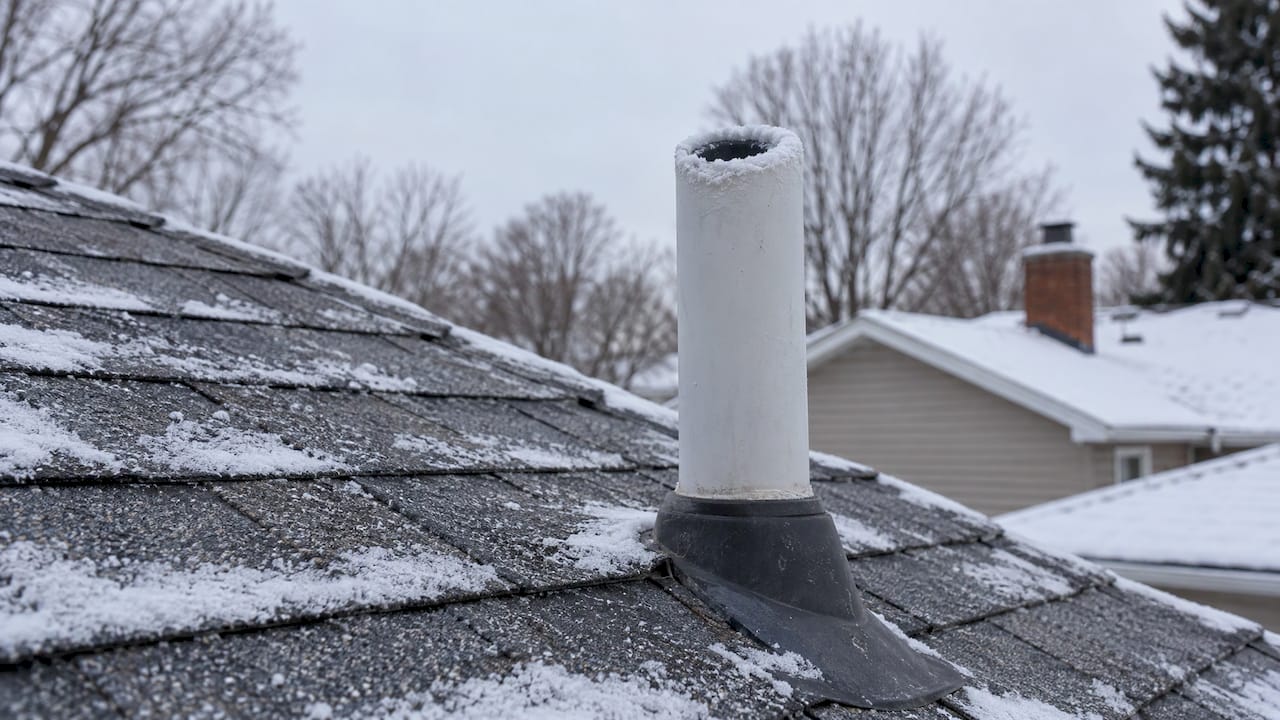
If the vent pipe through your roof is blocked by debris, a nest or ice, the system cannot breathe. Water in the traps can then be pulled out as fixtures drain, and gas is pushed into the room instead of up and out. NDSU Extension explains that in very cold weather, moisture in the gas can freeze at the top of a vent and plug it. That matters in Northeast Ohio winters. The same source says an early sign of a blocked vent can be a toilet that gurgles or does not flush properly. If that sounds familiar, read why a toilet gurgles after a flush.
Leaking, cracked or clogged drain pipes
A crack in a drain line inside a wall or under the floor lets gas escape right where you cannot see it. The Wisconsin DHS notes that if the leak is behind the wall, you may need a plumber to find and fix the source. A partial clog in a main line can also push gas back up through the lowest or weakest fixture in the house. Our list of main sewer clog signs covers what else to watch for, such as several drains slowing down at once.
The water heater, when it is a rotten-egg smell
If the smell shows up mainly with hot water, the drain may not be the problem. The CDC’s ATSDR notes that hydrogen sulfide can form in hot water heaters and give tap water a rotten-egg odor. That is a water heater question, not a sewer question, and it is worth telling us when you call.
Match the clue to the likely cause
| What you notice | Likely cause | What it takes to confirm |
|---|---|---|
| Smell strongest at one rarely used sink, tub or floor drain | Dry trap | Looking at the trap and the vent behind it |
| Smell and dampness at the base of the toilet | Worn wax ring or loose toilet | Pulling the toilet to inspect the seal and flange |
| Gurgling toilet, slow drains, smell in several rooms | Blocked vent or partial main-line clog | Vent inspection, and often a sewer camera |
| Smell that returns after cleaning | Cracked or leaking pipe, or a venting fault | Camera inspection and leak detection |
| Rotten egg smell only with hot water | Water heater | Water heater service call |
| Smell mainly in the basement or near a floor drain | Dry floor drain trap, or gas entering from the soil or foundation | Drain and foundation-area inspection |
Is sewer gas dangerous?
At the low levels that cause a household smell, harm is not likely. The ATSDR says typical environmental concentrations are not likely to cause health effects, while respiratory and neurological effects appear at levels at least 100 times higher. The Illinois DPH says a very high level of exposure would not be expected in a home.
Still, there are reasons to take the smell seriously:
- You cannot judge the level by smell. The ATSDR ToxFAQs says the odor becomes noticeable at very low levels (0.0005 ppm), but people lose the ability to smell it after about 2 to 15 minutes at about 100 ppm. Smell fading is not proof that the gas is gone.
- Lower-level exposure still has effects. The Illinois DPH lists eye irritation, a sore throat and cough, and with long-term low-level exposure, fatigue, headaches, irritability and dizziness.
- Symptoms matter. The Wisconsin DHS advises seeing a doctor if you have headaches, dizziness, drowsiness or nausea and suspect a sewer gas leak. If you believe there is a high concentration in an enclosed space, evacuate and call the fire department.
How you react depends on dose, duration and your own health, according to the ATSDR. Children, older adults and anyone with breathing problems are good reasons not to wait on a smell that keeps coming back.
A separate safety point: the ATSDR notes that household exposure to hydrogen sulfide can come from misusing drain cleaning products. Never mix drain cleaners or other household chemicals, and do not keep pouring more into a drain that smells. Call us instead.
What to do while you wait for the plumber
The first step is a phone call, because a smell that has a cause inside a wall, under a slab or on the roof will not be solved from the bathroom floor. While you arrange that visit, a few things keep the house comfortable and give the technician better information:
- Air the room out. The North Dakota DEQ recommends opening windows and doors and running exhaust fans in the affected area to circulate air.
- Run water in drains nobody uses. A few seconds in a guest sink, tub or floor drain refills the trap. If the smell disappears and stays gone, tell us. It points to a dry trap and helps us check why it dried out.
- Note the pattern. Does the smell come with rain, cold weather, a flush, hot water, or a gurgle? That detail speeds up the diagnosis.
- Stay off the roof. NDSU Extension warns that getting on the roof to clear a vent is dangerous in icy or snowy conditions, and that heat tape on attic sewer vents can create a fire hazard. Vent work belongs with a professional.
- Do not take apart the toilet or drain pipes yourself. A toilet reset that is not sealed correctly can leave you with a bigger smell and water damage.
If you want a short checklist of what is worth noting before you call, we wrote three things to check before calling a plumber.
When to call right away
The North Dakota DEQ says to contact a plumber immediately when sewer gas is strong and widespread even after basic cleaning attempts, and that a smell that keeps returning after cleaning likely needs a professional inspection to find the root cause. We agree, and add a few signals that make the call urgent:
- The smell is in more than one room, or it is strong enough to make you or your family feel unwell.
- Several fixtures gurgle, drain slowly, or back up at the same time.
- Water is appearing around a toilet base, a floor drain or in the basement.
- The smell appeared after a freeze, a storm or heavy rain, or work on your plumbing.
Our article on the top signs you need emergency plumbing service helps you decide how fast to move.
Why a professional finds the cause faster
Bathroom smell has a long list of possible causes, and several of them look identical from the room. The honest way to separate them is to inspect rather than guess. A baking soda and vinegar flush, for instance, can freshen a drain trap, but it does nothing for a cracked pipe, a bad seal or a vent problem. A smell that comes back a week later is the signal that the real fault is still there.
Here is how our team approaches it:
- Sewer camera inspection. A camera on a flexible line shows the inside of the drain and sewer line, so a crack, a sag, a root intrusion or a blockage is seen directly instead of assumed. Our sewer camera inspections are listed from $250-$400.
- Drain cleaning. When a partial clog is part of the cause, our drain cleaning is listed at $250-$600, and hydro jetting is available for heavier buildup.
- Leak detection and repair. When the gas path is a damaged pipe, we repair it. See our leak detection and plumbing repair service.
- Water heater service. If the rotten-egg smell follows the hot tap, we repair and replace water heaters, including tankless models.
Those prices are the ranges on our plumbing pricing guide, and we give clear, upfront pricing before work begins. If the problem turns out to be a failed main line, we explain the options in what happens with sewer line repair or replacement.
Smell in the house, but not in the bathroom
People who search for a sewer smell in the house often find that the bathroom is just where it is strongest. The same checks apply: floor drains in the basement, laundry standpipes, utility sinks and the main line. A floor drain that has not seen water for months is one of the most common sources, and the Ohio EPA lists floor drains among the entry points.
If you only notice it when it rains, or in the coldest weeks of winter, that timing is a clue worth telling the technician, since it can point to a vent or a line problem rather than a dry trap.
Fix it with Tri-County Services Electric & Plumbing
We are a family-owned business based in Northeast Ohio since 1975, and we now offer plumbing alongside our electrical work. Our technicians are skilled and certified, we work on a flexible schedule designed to minimize disruption, and we respect your home while we do it.
If your bathroom smells like sewage and you want the real cause found, our plumbing team can inspect, locate and repair it. See our plumbing services and pricing or call our office at (440) 253-0332.

If the smell comes with gurgling drains or backups, mention that when you call so we can send the right equipment.
Our perspective
Most homeowners we hear from have already tried something: a bottle of cleaner, a candle, a vinegar flush. The smell fades for a day and returns, and that is the pattern that tells us the cause is still there. A bathroom is a small room with a lot of plumbing connections, and the real problem often sits in a vent, a seal or a pipe that nobody can see from the floor.
That is why we start with finding the source. A family-owned business lives on its reputation in the neighborhood, so we would rather spend the time to locate the cause once than send you home with a cover-up. Because we do both electrical and plumbing work, we also look at the whole picture in your home, from the water heater to the fixtures, and we explain what we find in plain terms before anything is repaired.
A smell is your house telling you something. Call us early, while it is a small repair.
Lindsay Paramore
FAQ
Is it normal to smell sewer gas in the bathroom?
No. A working plumbing system keeps gas in the pipes and out of your rooms. An occasional whiff after a long absence can come from a dry trap, but a smell that repeats means something in the traps, seals, vents or pipes needs attention. Call us at (440) 253-0332 to have it checked.
Why does my bathroom smell like rotten eggs?
Rotten eggs is how hydrogen sulfide smells, and it is a main component of sewer gas. If the smell comes from the drain, a dry trap, a toilet seal or a vent problem is likely. If it appears mainly with hot water, the water heater can be the source, which is a different repair.
Can a dry P-trap make the whole bathroom smell?
Yes. When the water seal in a trap evaporates, there is nothing blocking gas from rising through that drain. It is common in guest baths and rarely used showers. If refilling it does not stop the smell for good, the vent or drain behind it needs a professional look.
Is sewer gas in a house dangerous?
At the low levels behind most household smells, health effects are not likely, but you cannot rely on your nose to judge the level. If you have headaches, dizziness or nausea, get fresh air and see a doctor. If you think gas is concentrated in an enclosed space, leave and call the fire department.
How much does it cost to find the cause?
Our sewer camera inspection is listed at $250-$400, and drain cleaning at $250-$600. The final price depends on what the inspection shows, and we give clear pricing before we start. Call (440) 253-0332 to schedule.
Sources
- Air: Sewer Gas, Wisconsin Department of Health Services
- Hydrogen Sulfide Gas, Illinois Department of Public Health
- Sewer gas odors in a home, Ohio EPA
- Hydrogen Sulfide Public Health Statement, ATSDR
- Hydrogen Sulfide ToxFAQs, ATSDR
- Prevent Sewer Gas Backup, NDSU Extension
- How does sewer gas get inside your home? Mt. View Sanitary District
- Sewer gas, North Dakota Department of Environmental Quality