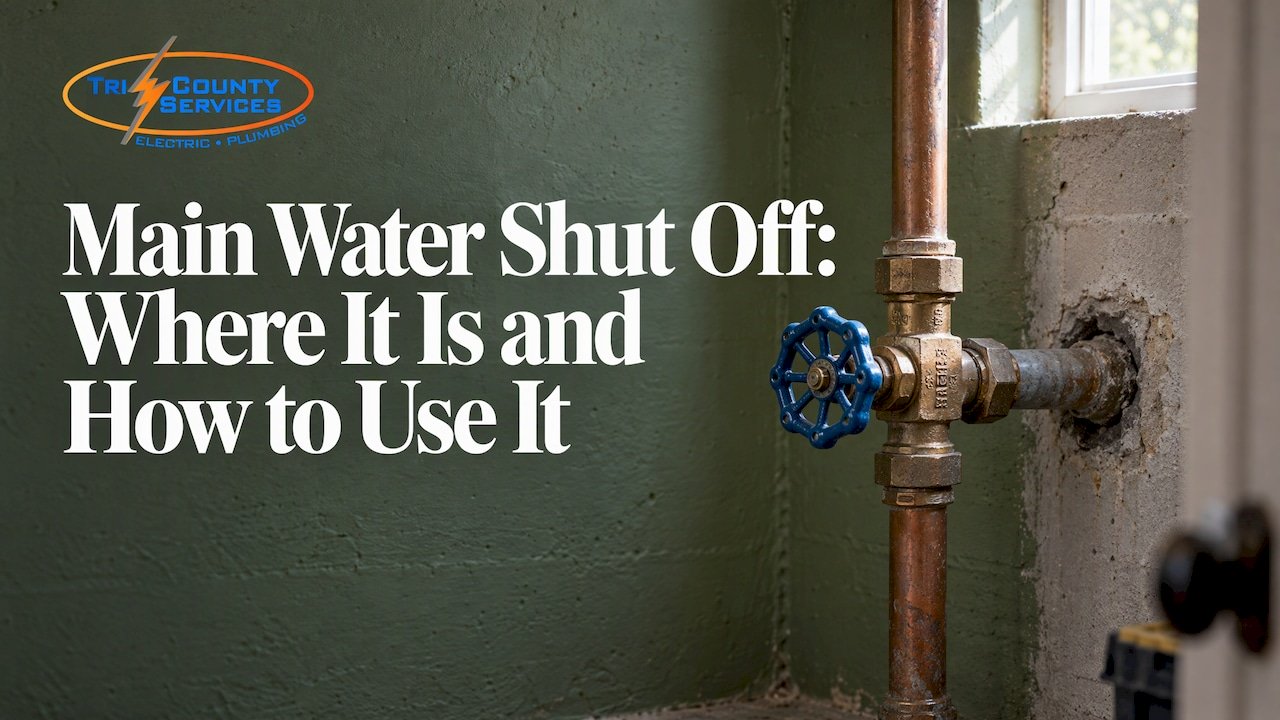


Your main water shut off valve is usually inside the home, near the spot where the water line enters the house, often in a basement, crawlspace, utility room or garage, and often close to the water meter. Turn a round wheel handle clockwise, or turn a lever handle a quarter turn so it sits across the pipe, and the water to the whole house stops. Find it before you need it. When a pipe bursts, you will not want to hunt for it in the dark with water on the floor.
This guide explains where to look, how to tell the valves apart, which way to turn, what to do when water keeps running, and when to stop and call a pro. If you are dealing with an active leak right now, call Tri-County Services Electric & Plumbing at (440) 253-0332.
TL;DR
- The main shut off is typically where the water line enters the house, often near the meter, in a basement, crawlspace, utility room or garage.
- Wheel handle (gate valve): turn clockwise. Lever handle (ball valve): turn a quarter turn until the handle crosses the pipe.
- Do not touch the meter or the underground valve at the property line. Those belong to the utility and to a professional.
- A valve that is stuck, leaking at the handle, or will not stop the flow needs a professional plumber, not more force.
- Call Tri-County Services Electric & Plumbing at (440) 253-0332 for emergency plumbing in Northeast Ohio.
Table of Contents
- Where to find your main water shut off valve
- What your valve looks like and which way to turn it
- Why your valve should be tested before an emergency
- When the valve is stuck, leaking or will not stop the water
- Why is water still running after the main is closed?
- What counts as a plumbing emergency?
- How long can the main water stay off?
- Our perspective on the main shut off
- Get help from Tri-County Services Electric & Plumbing
- A quick plan for every household
- FAQ
- Sources
Where to find your main water shut off valve
The main valve sits on the water line between the street and the rest of your plumbing. Water utilities commonly describe it as being near the water meter or close to where the water pipe enters the home, according to American Water’s shut off fact sheet.
In Northeast Ohio, where basements are standard in older homes, start there. Here are the places to check, in order.
Start on the street side of the house
Look at the wall that faces the street or the water meter. The service line has to come in somewhere on that side. Tracing the pipes from the street side is one of the most reliable ways to locate the valve. Look for a single pipe, usually copper, galvanized steel or plastic, rising out of the floor or coming through a foundation wall.
Check the usual mechanical areas
Most main valves are indoors. Common spots include:
- The basement, often on the front wall, near the water heater or the meter
- The crawlspace, near where the pipe comes through the foundation
- A utility or mechanical room, next to the furnace or water heater
- An attached garage, on the wall closest to the street
- A kitchen or laundry cabinet, in homes built on a slab
One tip from homeowners: the valve is sometimes installed beside an outdoor hose connection that stays live even when the valve is closed. That is a handy way to confirm you have the right one and still draw a bucket of water.
Use your inspection report
If you cannot find it, pull out the home inspection report from when you bought the house. The plumbing section of that report often notes the valve location, as The Spruce points out. It is also a good time to note the type of valve and its condition.
Do not confuse it with the street valve or the meter
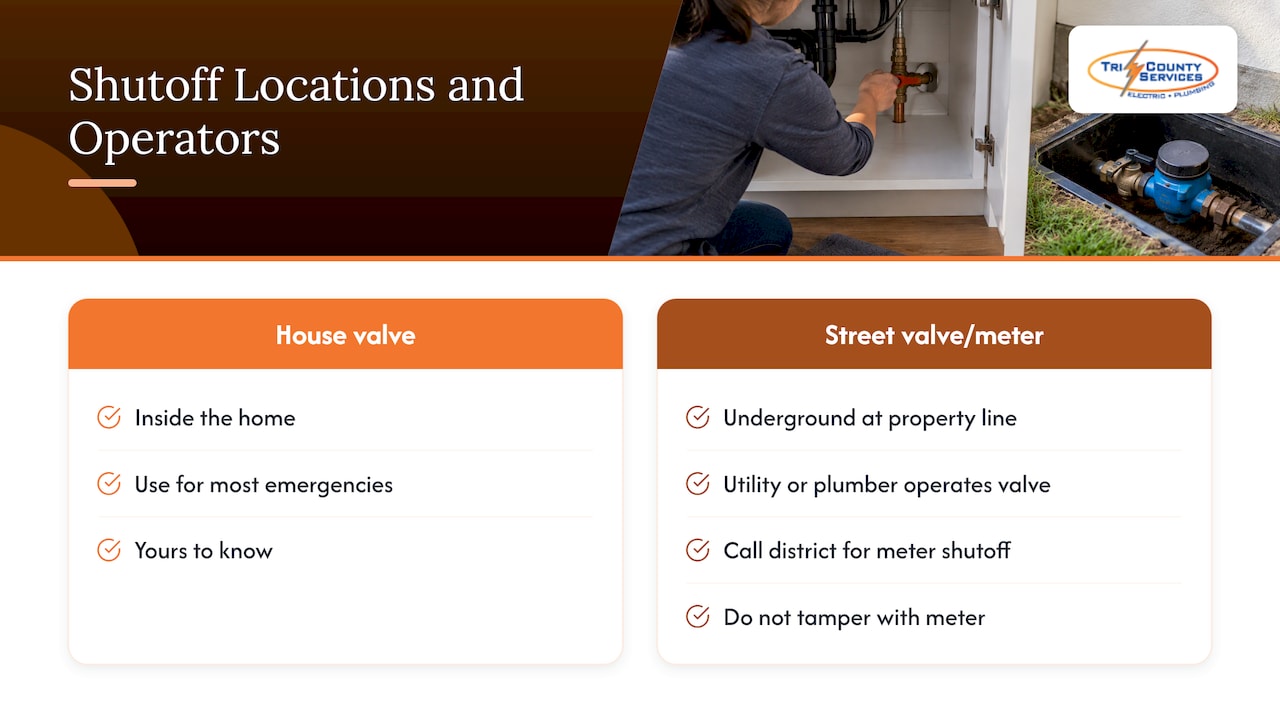
Many homes have two shut offs. The inside valve is the one you use for most emergencies and repairs. The underground valve sits outside at the property line and is operated by the utility or a plumber. WSSC Water advises calling a registered master plumber or the utility if that outside valve has to be shut off. Dublin San Ramon Services District says not to shut off water at the meter box or tamper with the meter, and to call the district if you cannot find or turn off the house valve and need the meter shut off.
In short: the valve inside your home is yours to know. The meter and the outside valve are not.
What your valve looks like and which way to turn it
There are two common styles. Knowing which one you have tells you how to close it.
| Valve type | What it looks like | How to close it | Open or closed? |
|---|---|---|---|
| Gate valve | Round wheel handle, like an outdoor spigot | Turn clockwise until it stops | Wheel fully counterclockwise is open |
| Ball valve | Short lever handle | Quarter turn clockwise so the lever crosses the pipe | Lever in line with the pipe is open; across the pipe is closed |
This matches guidance from Sacramento Suburban Water District, which says to turn a gate valve clockwise until the water is off and a ball valve one quarter turn clockwise. Dublin San Ramon Services District adds the visual cue: a ball valve handle aligned with the pipe is open, and one crossing the pipe is closed.
A useful memory aid is “righty tighty.” Clockwise closes the wheel. For levers, think of a barrier: a handle across the pipe blocks it.
Closing it the right way
- Turn the valve slowly and steadily. Do not slam or force it.
- Open a faucet at the lowest point in the house, or a hose bib, to confirm the flow stops and to drain the remaining water in the lines.
- Flush a toilet once if you want to clear what is left in the tank.
- If the valve will not budge, stop. Forcing an old valve can snap the stem or crack the fitting, and then you have a bigger leak.
Turning it back on
WSSC Water’s instructions are to open the valve slowly, let the pressure equalize, then open faucets one at a time to bleed air until it stops sputtering. Doing it slowly protects your fixtures, supply lines and appliances from a pressure surge.
Before you refill a system that was fully drained, the same guidance says to de-energize electric water heaters and boilers or set gas water heaters to pilot only. If you are not sure how to do that safely, call us rather than guess. Water heaters that run dry can be damaged, and a restart after an outage has its own checklist, which we cover in our guide to getting hot water back safely after an outage.
Why your valve should be tested before an emergency
Main valves can go years without being touched. Mineral buildup, corrosion and old packing can leave them seized or leaking when you finally need them. American Water suggests testing the valve to make sure it works and hanging an ID tag on it so anyone can find it fast in an emergency. Sacramento Suburban Water District likewise suggests labeling it so family members can find it quickly, even in the dark.
Here is what a sensible routine looks like:
- Show every adult in the household, and older kids, where the valve is and which way it closes.
- Tag it with a bright label.
- Keep the area around it clear of boxes, shelving and storage.
- Take a photo of it and save it on your phone.
- Have a professional look at it during any plumbing visit, especially if the valve is a decades-old gate valve.
If the handle feels crusty, wobbly or hard to turn, that is your signal to schedule an inspection. Do not wait for a burst pipe to find out. Our team can check it and replace it with a new quarter-turn ball valve when needed, so it closes cleanly when it counts.
When the valve is stuck, leaking or will not stop the water
This is where well-meaning homeowners turn a small problem into a flood. A stuck gate valve handle that suddenly gives way can leave you holding a broken stem while water sprays from the packing nut. Penetrating oil, wrenches and cheater bars are not the answer.
Call a plumber if:
- The handle will not turn with normal hand pressure
- Water seeps or drips around the handle or stem
- The handle spins freely but the water keeps flowing
- The valve or pipe is badly corroded
- You cannot find a valve at all
We wrote a full walkthrough for this situation: what to do with a stuck main shutoff. In the meantime, if water is actively flooding the house and you cannot stop it, get family and pets out of any flooded area, stay away from electrical outlets, cords and appliances in standing water, and call us at (440) 253-0332. If water has reached outlets, the panel or appliances, treat it as an electrical hazard as well. We handle both the plumbing and the electrical side, which saves you a second call in the middle of a crisis.
Why is water still running after the main is closed?
This is one of the most common follow-up questions, and the cause depends on what you see.
A short burst, then nothing. This is normal. Water already in the pipes above the valve will drain out of open faucets. It should dwindle to a trickle and stop within a minute or two.
A steady stream that does not stop. Possible causes include:
- You closed the wrong valve. A shut off under a sink, behind a toilet, or at the water heater only controls one fixture. The main is the one where the line enters the home.
- The valve is not fully closed. A gate valve may need more turns, or a ball valve may be only partway across the pipe.
- The valve has failed internally. Old gate valves can have a worn or broken internal disc, so the handle turns but the water does not stop.
- Another source feeds the system. Some properties have a separate line to a garage, outbuilding or irrigation system, or an additional feed that bypasses the valve you closed.
- The leak is on the street side of the valve. Water coming from before the valve is not stopped by closing it. That needs the utility or a pro on the outside valve.
If the flow does not stop, do not keep wrestling the handle. Call a plumber. Failed main valves are a real repair job, and replacing one means shutting water off at the street, which should be done by a professional or the utility, as WSSC Water notes above. Our water line repair and installation service covers the lines between the street and the house, and is the right call when the problem sits ahead of your valve.
What counts as a plumbing emergency?
Not every drip means you need to shut off the whole house. But these do:
- A burst or frozen pipe
- A supply line or fitting spraying water
- A failed water heater leaking onto the floor
- Sewage backing up into drains or tubs
- Water pouring from a ceiling or light fixture
Close the main first, then call. We lay out the signs in our post on what is considered a plumbing emergency at home. If you see sewage backing up, our guide to main sewer clog signs explains why you should stop using water in the house until a pro has looked at the line. For slower trouble, such as one slow drain, our checklist of three things to check before calling a plumber helps you describe the problem accurately on the phone.
How long can the main water stay off?
For a repair, a few hours is routine. For a vacant home, shutting off the main is a standard way to prevent water damage. Spotsylvania County’s plumbing guidance says the main valve can be turned off while a property is vacant, and recommends talking to a plumber or HVAC professional about long-term shut off of appliances such as water heaters.
That last point matters. With the water off for weeks, a water heater can be left in an unsafe state, and a heating system with a water-fed boiler may need attention. Before a long trip or a winter away, a plumber can walk you through the right steps for your setup. In our climate, freezing pipes are a concern in an unheated vacant house, so also read our winter plumbing checklist for preventing frozen pipes and our water heater winter preparation guide.
Preparing to drain the plumbing system
If you are leaving a house empty for a long period or planning major work, draining the system is sometimes part of the plan. Do it with a professional’s direction, because heaters and boilers must be handled first. Also think about the cost side. Water damage from one failed fitting can lead to an insurance claim, and it helps to know how homeowners insurance treats leaks at home before something goes wrong. Shutting the water off quickly and documenting the damage are the first steps either way.
Our perspective on the main shut off
After many years serving Northeast Ohio homes, we see the same story again and again. A homeowner calls us, panicked, with water running and no idea where the valve is. Or they find it, it is rusted solid, and they have made it worse trying to force it.
We believe the main shut off is the most important valve in the house, and it deserves a professional’s eye before there is a crisis. A quick look from one of our technicians tells you where it is, whether it closes fully, and whether it is due for replacement. Our approach is to treat your home with respect, explain what we see in plain language, and give you clear, upfront pricing so there are no surprises.
If you are ever unsure, do not experiment. Call us. A short phone call costs far less than a flooded basement.
Lindsay Paramore
Get help from Tri-County Services Electric & Plumbing
Whether the valve will not turn, the water will not stop or you simply want the main checked and replaced with a reliable quarter-turn valve, Tri-County Services Electric & Plumbing is a family-owned business that has served Northeast Ohio since 1975. Our technicians are certified, our scheduling is flexible to limit disruption, and we respect your home.

Call our office at (440) 253-0332. You can also see what common plumbing jobs cost on our plumbing pricing guide. Published ranges include drain cleaning at $250 to $600, sewer camera inspection at $250 to $400, faucet installation at $500 to $900 and toilet installation at $500 to $800. If a leak has affected your wiring, our electrical troubleshooting is listed at $300 to $500 on the electrical pricing guide. Final cost depends on the job, and we give clear, upfront pricing.
If your main shut off is tied up with other plumbing concerns, such as pressure, take a look at our guide to the pressure reducing valve setting. High pressure is hard on every fixture and valve in the house, including the main. Our overview of where your main water shut off valve should be and why it matters is also worth sharing with everyone in the household.
A quick plan for every household
Here is a simple routine that takes about fifteen minutes.
- Walk to the street side of your home and find where the line enters.
- Identify your valve as a wheel or a lever.
- Tag it and photograph it.
- Tell everyone in the house where it is and which way it closes.
- If it is stiff, leaking, corroded or hard to reach, schedule a professional check.
- Save (440) 253-0332 in your phone under “plumber.”
That last step is the one people skip, and the one that matters most at 2 a.m.
FAQ
How do I find my main water shut off if I just bought the house?
Start where the water line enters the house, usually on the street-facing wall in a basement, crawlspace, utility room or garage, and check near the water meter. Your inspection report’s plumbing section may also note the location. If you still cannot find it, call us at (440) 253-0332 and we will locate it and check its condition.
Which way do I turn the main water shut off valve?
Turn a round wheel handle clockwise until it stops. For a lever handle, turn it a quarter turn so it sits across the pipe. If either one resists, stop and call a plumber instead of forcing it.
Can I shut off the water at the meter?
No. Utilities generally ask homeowners not to tamper with the meter or the valve in the meter box. If you cannot close your house valve and need the water stopped, contact your water utility or call us, and a professional can help with the situation.
How long can I leave the main water shut off?
For a repair it is routine, and for a vacant home it is a common way to prevent water damage. For a long absence, ask a plumber how to handle your water heater and any boiler first, and plan for freeze protection in winter.
What if water is still running after I close the main?
Some water will drain from the pipes for a minute or two. If a steady flow continues, you may have closed the wrong valve, the valve may not be fully closed, or it may have failed inside. Call us at (440) 253-0332 so we can stop the flow and repair or replace the valve.
Sources
- The Spruce: Main Water Shutoff Valve, Where It Is and How to Find It
- WSSC Water: Find and Operate Your Main Water Valve
- Sacramento Suburban Water District: How to Turn Off Your Water
- Dublin San Ramon Services District: How to Turn Off Your Water
- American Water: Know How to Shut Off Your Water
- Spotsylvania County: Your Home’s Plumbing