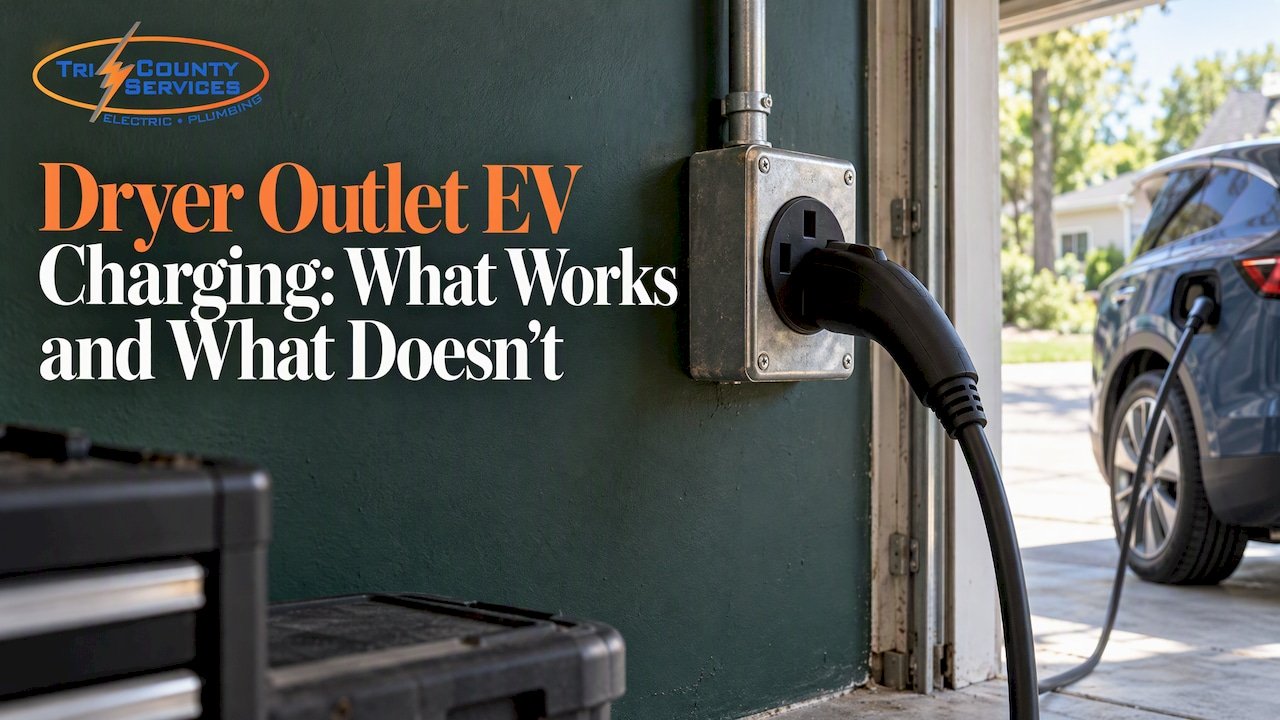

Yes, an electric car can charge from a dryer outlet, but only when the circuit is in good shape, the plug matches, and the charging current is held to 24 amps on a standard 30-amp circuit. The outlet itself is rarely the problem. The wiring behind it, the breaker, the grounding and the way the charger connects are what decide whether it is safe. At Tri-County Services Electric & Plumbing, we have this conversation with Northeast Ohio homeowners often, and the safest first step is a professional electrician looking at the circuit before a car ever gets plugged in. Call our office at (440) 253-0332 to set that up.
TL;DR
- A 30-amp dryer circuit can support EV charging at up to 24 amps, because EV charging counts as a continuous load.
- The outlet must be a 240-volt, 30-amp receptacle, and a 4-prong NEMA 14-30 is the version with a dedicated ground.
- Expect roughly 15 to 17 miles of range per hour of charging from a dryer outlet, based on Tesla’s own figures for older models.
- Y-splitters and extension cords are where most dryer-outlet setups go wrong. A shared circuit needs a purpose-built switching device, or better, its own circuit.
- Have a professional electrician check the wiring, breaker and grounding first. We can do that at (440) 253-0332.
Table of Contents
- Why a dryer outlet can charge a car at all
- The 24-amp limit, explained
- How fast does a dryer outlet charge?
- Matching the outlet, plug and charger
- Sharing the outlet with your dryer
- What a professional electrician checks first
- Permits and local codes
- When a dedicated circuit is the better move
- Our perspective
- Let us check your circuit
- FAQ
- Sources
Why a dryer outlet can charge a car at all
An electric dryer and a Level 2 EV charger both run on 240 volts. A typical dryer circuit is protected by a 30-amp breaker and ends in a NEMA 14-30 receptacle, which is the same type of outlet many EV makers offer an adapter for. Tesla, for example, publishes an installation sheet for its NEMA 14-30 adapter that pairs a 240-volt, 30-amp outlet with its mobile connector, with a maximum of 24 amps delivered to the vehicle.
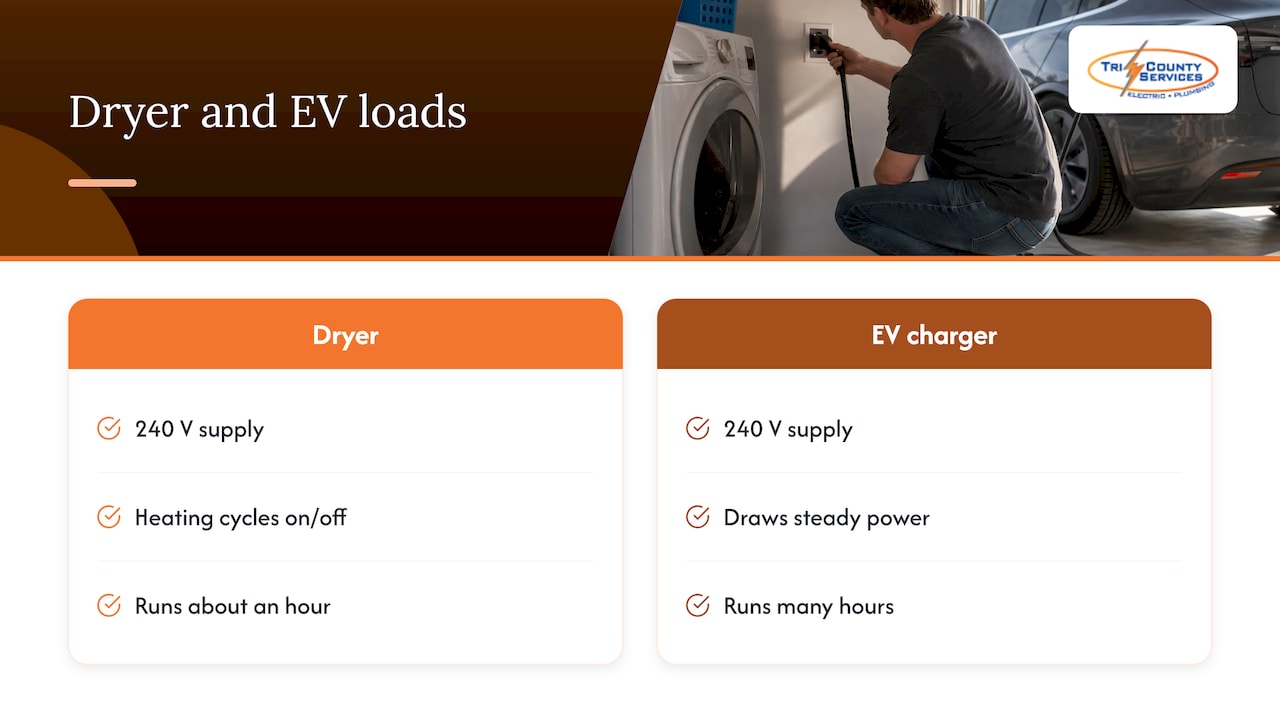
So the electrical “language” matches. What differs is how each load behaves. A dryer cycles its heating element on and off and runs for an hour or so. A car charger pulls steady power for many hours, overnight in most households. That difference is the whole reason the rules for the two are not the same.
The 24-amp limit, explained
EV charging is treated as a continuous load, meaning it runs for three hours or more. Under the National Electrical Code, the equipment and the breaker protecting it must be rated at 125% of the maximum load. One electrical training source describes this 125% rule for EV power transfer equipment.
Turn that around and you get the familiar 80% rule. On a 30-amp circuit, 30 amps times 0.8 equals 24 amps. Splitvolt’s FAQ states the same 24-amp ceiling for a standard 30-amp dryer circuit.
In practice that means:
- The charger or the car’s mobile connector must be set to 24 amps or lower, never higher.
- A charger that pulls 30 amps continuously on a 30-amp breaker is overloading the circuit by design. The breaker may trip, or worse, the wiring and plug can run hot for hours.
- If your breaker is larger than 30 amps, do not assume the outlet can use it. The wire, the receptacle and the breaker have to be matched as a set, and that is a job for a professional.
If you want to see how the same 125% math plays out on larger circuits, we walk through it in our guide to EV charger breaker size.
How fast does a dryer outlet charge?
At 240 volts and 24 amps, you are delivering about 5.8 kilowatts. Tesla’s installation sheet lists about 17 miles of range added per hour for a Model S and 15 for a Model X on a NEMA 14-30 outlet. Other vehicles vary with their efficiency, so treat these as a ballpark.
Here is what that looks like for a typical household:
| Charging overnight | Approximate range added |
|---|---|
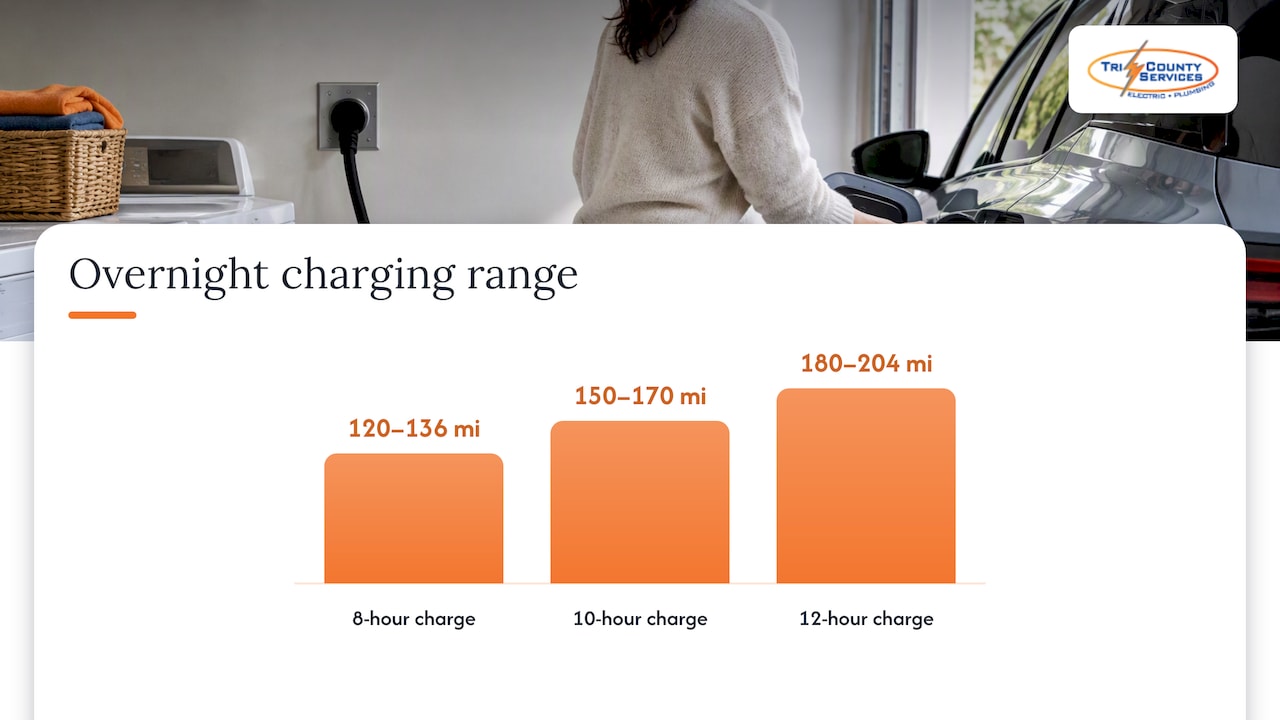
| 8 hours | 120 to 136 miles |
| 10 hours | 150 to 170 miles |
| 12 hours | 180 to 204 miles |
These are simple multiples of Tesla’s published per-hour figures. For most commuters, that covers a day or two of driving, which is why dryer-outlet charging is a reasonable starting point. It is far faster than a standard 120-volt household outlet, though slower than a 40 to 50 amp dedicated charger.
Matching the outlet, plug and charger
Three things have to line up: the receptacle, the plug and the charging equipment.
4-prong 14-30 versus 3-prong 10-30
Homes built before the mid-1990s often have a 3-prong NEMA 10-30 dryer outlet. It combines the neutral and ground into one conductor. A calculator guide notes that only the 4-prong NEMA 14-30 has a dedicated equipment ground. A car charger is a device you leave connected for hours, and a proper ground matters more with that kind of use. If your dryer outlet has three prongs, the receptacle and often the cable behind it need attention before it is used for charging.
Use certified equipment
The U.S. Department of Energy’s Alternative Fuels Data Center advises using safety-certified charging equipment tested by a nationally recognized laboratory. A cheap uncertified adapter cord is exactly where shortcuts cause trouble.
GFCI protection
The NEC calls for ground-fault protection on receptacles used for EV charging equipment. An older dryer outlet, installed long before EV charging existed, may not have it. Whether a given outlet meets the current requirement depends on the code edition your area has adopted and how the circuit was built, so it is something an electrician confirms on site. For a look at how recent code editions treat GFCI in other rooms, see our piece on bathroom GFCI requirements.
Sharing the outlet with your dryer
This is the question that gets homeowners in trouble. If the dryer and the car both want that outlet, you have three realistic options:
- Unplug the dryer every time you charge. Workable, but easy to forget. A forgotten swap can leave a plug warm overnight.
- Use a purpose-built switching device. These are listed (UL or ETL) interlock or smart splitter products that automatically prevent the dryer and EV charger from drawing power at the same time. They pause charging when the dryer runs.
- Install a dedicated circuit for the car. The NEC’s Article 625.40 calls for EV charging equipment to sit on its own branch circuit, which is the cleanest long-term answer.
What to avoid
An unlisted Y-connector can let both loads run at once. That can overload a 30-amp circuit, and while the breaker may trip, you should never rely on a breaker as the safety plan. Extension cords have the same problem: they add a connection point and a length of conductor that is not designed to carry 24 amps for eight hours.
If you are tempted by a gadget you found online, ask a professional electrician first. We would rather spend twenty minutes looking at your setup than have you find out about a melted plug at 2 a.m.
What a professional electrician checks first
A dryer circuit that has faithfully run a dryer for 25 years has not necessarily been asked to run at 80% load for ten hours straight. A thorough assessment covers:
- Conductor condition and size. Is the wire the right gauge, and is the insulation intact?
- Connections. Loose or discolored terminals at the receptacle and the panel are common culprits for heat.
- Grounding. Is there a true equipment ground, or an older 3-wire setup?
- Breaker compatibility. Is the breaker the right type and size for the wire and the load?
- Required protection. Does the circuit have the ground-fault protection current code expects?
- Run length. For long wire runs over 50 feet, voltage drop may call for heavier wire, which matters if the dryer is far from where you park.
The same logic of checking wire capacity and connections before adding a heavy new load applies elsewhere in the home. A guide on heat pump electrical requirements makes this point for HVAC equipment, and it holds for car chargers too.
Because a charger is not a one-time appliance load, we recommend having this check done by a professional rather than eyeballing the outlet yourself. Panel covers, breaker swaps and receptacle replacements involve live conductors, and mistakes can mean shock, fire or damaged equipment. Our electrical troubleshooting visits run $300 to $500, a small number compared with the cost of a damaged car charger or a burned receptacle.
Permits and local codes
EV charging installations must comply with local and state codes, and local permits may be required. Rules differ from one Ohio municipality to the next, and what applies in Cleveland may not match what applies in a neighboring suburb. A professional electrician who works in your area every week knows what the local building department expects, and can pull the permit and schedule the inspection for you. Much of the confusion homeowners run into around permits and compliance is covered in a general explainer on home code rules, though your local building department has the final word on what applies at your address.
When a dedicated circuit is the better move
Dryer-outlet charging is a good bridge, but a dedicated circuit makes sense when:
- You drive a vehicle with a large battery and a long daily commute.
- Your dryer is in a laundry room far from where you park, so cords or long runs come into play.
- You want to charge and dry laundry on the same evening without juggling plugs.
- You plan to add a second EV, or want faster charging at 40 to 50 amps.
In those cases, the question becomes breaker size, wire gauge and whether your panel has room. Our articles on when to install a garage subpanel for EV charging and Level 2 charger costs lay out those decisions. If you are weighing hardware, our comparison of the Tesla Wall Connector and ChargePoint is a good place to start, and our EV charger installation guide for Cleveland homeowners covers the local side.
Our perspective
We have been serving Northeast Ohio homes since 1975, and the pattern with dryer-outlet charging is consistent. Homeowners are right that the idea is practical. Where it goes sideways is the assumption that “it’s just an outlet.” The outlet is the visible 5% of the system. The other 95% is a cable in the wall, a breaker in the panel and a set of connections that were put there to run a dryer for an hour, not a car for ten.
That is why we start with a look at the circuit and not with a product. Our certified technicians check conductors, grounding and breaker compatibility, and we tell you plainly whether your dryer outlet is a fit for 24-amp charging, whether it needs a few corrections, or whether a dedicated circuit will serve you better for the long term. We schedule around your day to keep disruption low, and we respect your home while we work.
If you call a professional first, you get a safe setup and a straight answer on cost before any work begins. That is the kind of long-term relationship we have built with families here for decades.
Lindsay Paramore
Let us check your circuit
Tri-County Services Electric & Plumbing installs EV chargers, dedicated circuits and panel upgrades for homeowners across Northeast Ohio, and we can assess whether your existing dryer outlet is ready for charging. Learn more about our EV charger installation options and pricing, or read how we handle EV charger installs.

Ready to charge safely? Call our office at (440) 253-0332 and a professional electrician will help you plan the right setup for your home and your car.
FAQ
Can I plug my EV charger into any dryer outlet?
Not any outlet. It should be a 240-volt, 30-amp receptacle in good condition, ideally a 4-prong NEMA 14-30, and the charger must be limited to 24 amps. Have a professional electrician confirm the wiring and breaker first, since an old circuit may not be ready for hours of continuous load.
How fast does a dryer outlet charge a Tesla?
Tesla’s installation sheet for its NEMA 14-30 adapter lists about 17 miles of range per hour for a Model S and 15 for a Model X at 24 amps. Other vehicles and newer models differ with their efficiency, so expect a similar ballpark rather than an exact figure.
Does an electric dryer run on 110 or 220?
An electric dryer runs on 240 volts, often called 220 in everyday talk. That is the same voltage a Level 2 EV charger uses, which is why the two can share a similar outlet type. The dryer’s motor and controls use a smaller 120-volt portion through the neutral wire in a 4-prong circuit.
Is it safe to use an extension cord or Y-splitter with a dryer outlet?
We advise against both. A cord adds a weak point, and an unlisted Y-splitter can let the dryer and the car run together on one 30-amp circuit. If you need to share the outlet, a listed switching device or a dedicated circuit installed by a professional electrician is the safer path.
Do I need a permit to add EV charging at home?
Often, yes. Charging installations must follow local and state codes, and permits may be required depending on your municipality and the work involved. We handle permit questions as part of our installs. Call (440) 253-0332 to ask about your address.
Sources
- Tesla NEMA 14-30 adapter installation sheet
- Alternative Fuels Data Center: Charging Electric Vehicles at Home
- What is an Electric Vehicle Power Transfer System?
- FAQ, Splitvolt
- Charge an EV From a Dryer Outlet? Yes, 24A on a 14-30
- Can I Plug an EV Charger Into My Dryer Outlet?
- EV Charger Sizing Calculator
- Heat Pump Electrical Requirements for Homeowners
- Two Legal Ways to Power a Wall Mounted TV, Per NEC