

TL;DR:
- Knob and tube wiring remains safe if unmodified, without insulation contact or amateur splices. Any changes or modifications significantly increase the risks, requiring professional inspection, documentation, and careful evaluation of insurance and code compliance. Properly assessed and maintained, K&T can still be a manageable part of older homes, especially when bundled with renovations or repairs.
Knob and tube wiring can remain in service safely, but only when it’s in original, unmodified condition with no insulation contact and no amateur splices. The moment any of those conditions change, the risk profile shifts fast. Before you do anything else, call a professional electrician for a documented inspection, notify your homeowner’s insurance carrier, and keep your hands off any DIY splices or junction work. InterNACHI confirms that K&T is not inherently dangerous but becomes a real liability when it’s been modified or buried under insulation. Tri-County Services Electric & Plumbing handles these assessments regularly for older Northeast Ohio homes and can tell you exactly where you stand.
Table of Contents
- What knob and tube wiring is and how to spot it
- What actually makes knob and tube risky (and what’s overblown)
- How code, insurers, and lenders treat existing K&T in the U.S.
- Remediation options, typical costs, and realistic timelines
- Buying a house with knob and tube: what to do before you close
- When a rewire makes financial sense: timing and cost-saving guidance
- When to call a professional electrician and what to ask
- Key Takeaways
- What older Northeast Ohio homes have taught us about K&T
- Tri-County Services Electric & Plumbing handles K&T the right way
- Useful sources and further reading
- FAQ
What knob and tube wiring is and how to spot it
Knob and tube wiring, the formal term for what electricians also call K&T, consists of individual copper conductors wrapped in rubber or cloth insulation. Those conductors run separately through open air, supported by porcelain knobs nailed to framing members and threaded through porcelain tubes wherever they pass through joists or studs. There is no ground conductor. That’s the defining structural difference from modern Romex cable, which bundles hot, neutral, and ground together in one sheath.
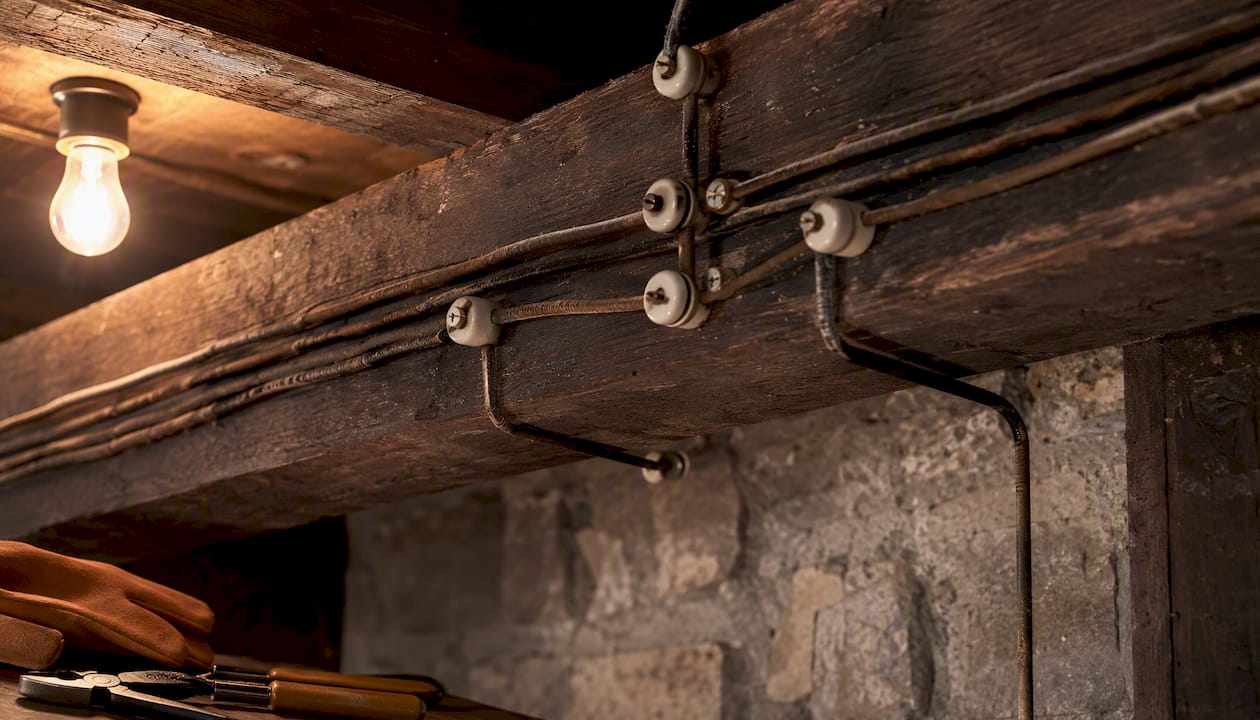
Wikipedia’s technical overview places K&T’s active installation period from roughly the 1880s through the 1940s in North America. It was the standard approach for decades, which means any home built before 1950 could still have active K&T circuits, even if some of the wiring has been updated since.
Where to look and what to photograph:
- Attic floor joists: look for small ceramic spools (the knobs) nailed to wood, with a single wire looped around each one
- Basement ceiling joists: same pattern, often with cloth-wrapped wire running between knobs
- Ceramic tubes: short cylindrical insulators threaded through holes in framing where wires change direction
- Woven cloth or rubber-coated wire (not the plastic-jacketed Romex you’d see in post-1960s work)
- Junction boxes or splices wrapped in cloth tape rather than wire nuts inside a covered box
When you photograph these for a contractor, shoot from directly above or below each run so the knob spacing is visible, and capture any point where the wire disappears into a wall or ceiling. That context helps an electrician trace active versus abandoned circuits before they ever set foot in your attic.
What actually makes knob and tube risky (and what’s overblown)
The honest answer is that age alone doesn’t make K&T dangerous. The original installation, done correctly and left alone, can still function. What creates real hazard is what’s happened to it over the past 80 years.
The four real failure modes:
- Insulation contact. K&T was engineered to dissipate heat to open air. Bury those runs under blown-in cellulose or spray foam and the heat has nowhere to go. The National Electrical Code (NEC) prohibits loose-fill or expanding foam insulation over active K&T for exactly this reason.
The myth worth correcting: K&T is not automatically illegal, and it doesn’t automatically require replacement. Condition and modification history matter far more than the age of the wire itself.
How code, insurers, and lenders treat existing K&T in the U.S.
The NEC does not require you to rip out K&T that was legally installed under the code in effect at the time. What it does prohibit is using K&T for new work and, critically, covering active K&T with insulation without specific authorization. Some states, including California, Washington, Nebraska, and Oregon, have adopted conditional exceptions that allow insulation over K&T if the system passes inspection and is documented. Most states have not.
What this means practically:
- Insurance: Carriers respond in three ways: refuse coverage outright, add a surcharge, or accept the policy conditionally after a professional inspection and certification. There is no universal rule. Get your insurer’s position in writing before you close on a purchase or renew a policy.
- Lenders: FHA and VA loans often require K&T to be remediated or certified before funding. Conventional lenders vary. Ask your loan officer directly and get the requirement documented.
- Permits and code compliance: Any renovation that opens walls or ceilings in a K&T home typically triggers a requirement to bring exposed wiring up to current code. That’s not a penalty; it’s an opportunity to address the problem in sections.
Actionable steps when a lender or insurer flags K&T:
- Get a written electrician’s report documenting the condition, extent, and any insulation contact
- Ask your insurer whether a certification letter from a professional electrician satisfies their underwriting requirement
- Add a repair contingency to any purchase contract that specifies the scope and timeline for remediation
- Get at least two written estimates before negotiating a seller credit
Remediation options, typical costs, and realistic timelines
There are three practical paths, and the right one depends on your insurance requirements, renovation plans, and budget.
| Approach | Typical Cost Range | Best For |
|---|---|---|
| Document and de-energize abandoned runs | $1,000–$1,500 | Runs already inactive; insurer needs written proof |
| Partial replacement (targeted circuits) | $2,000–$8,000 | Active K&T in specific areas; insurer accepts partial cert |
| Full house rewire + panel upgrade | $8,000–$25,000 + $1,500–$4,000 for panel | Widespread active K&T; insurer requires full replacement |
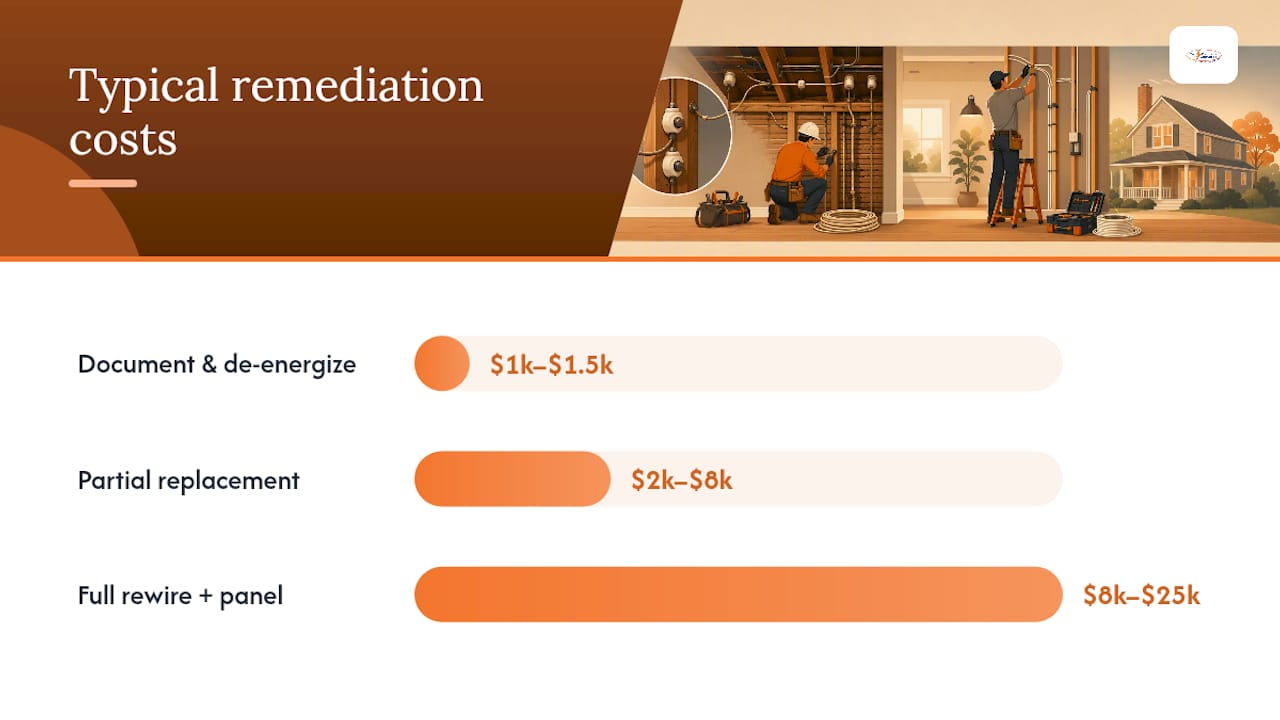
Cost figures are sourced from Block Renovation’s replacement cost guide. The main cost drivers are home size, wall finish type (plaster versus drywall), attic and basement access, and whether a panel upgrade is needed alongside the rewire.
One cost that quotes frequently understate: finish restoration. In older homes with plaster walls, cutting into walls to run new cable and patching the plaster can approach the electrical labor cost itself. Always confirm whether a quote includes plaster or drywall repair and repainting. If it doesn’t, you’re comparing apples to oranges between contractors.
Timeline for a full rewire in a typical 1,500–2,000 sq ft home runs three to seven days of electrical work, plus additional time for permits, inspections, and finish repairs. Permits are not optional. Any electrician who suggests skipping them is not someone you want working in your home.
Bundling saves money. If you’re already planning a kitchen renovation, bathroom remodel, or attic insulation project, coordinate the rewire at the same time. When walls and ceilings are already open, the access cost disappears and finish repairs are consolidated into one project.
Buying a house with knob and tube: what to do before you close
K&T in a home you’re considering buying is not an automatic dealbreaker, but it requires specific steps before you sign anything.
Pre-closing checklist for buyers:
- Get a professional electrician inspection, separate from the general home inspection. A home inspector will flag K&T; an electrician will tell you its actual condition, extent, and what remediation costs.
- Contact your insurer before closing. Ask specifically whether they will write a policy on a home with active K&T and under what conditions. Get that answer in writing.
- Add a repair contingency. Your purchase contract should specify that the seller either remediates identified K&T issues or provides a credit sufficient to cover professional remediation.
- Request disclosure of any prior electrical work. Unpermitted modifications are a red flag. Ask for permit records.
Negotiation options:
- Seller credit equal to the low-end remediation estimate (partial replacement if that satisfies your insurer)
- Seller-funded full remediation before closing, with permit and inspection documentation provided at settlement
- Staged plan: seller addresses the circuits flagged as highest risk; buyer accepts responsibility for the rest with a documented timeline
When to walk away: If your insurer refuses coverage outright, if the inspection reveals widespread amateur splices or insulation burial the seller won’t address, or if the seller can’t produce permit records for prior electrical work, the risk is no longer manageable through negotiation alone.
When a rewire makes financial sense: timing and cost-saving guidance
The single best time to replace K&T is when walls are already open for another reason. A kitchen gut renovation, a bathroom addition, or an attic insulation project all create natural access points. Bundling the electrical work into an existing renovation consolidates the finish repair cost and reduces total project disruption.
The hidden cost most homeowners don’t anticipate is plaster. Homes built before 1950 almost universally have plaster walls, and cutting into plaster to run new cable is significantly more expensive to repair than cutting drywall. A contractor who quotes a rewire without a finish-repair line item is either planning to leave you with open walls or expecting you not to notice the omission. Push for an itemized quote.
Remediation pathways that satisfy insurers without requiring a full rewire are worth exploring when the K&T is largely inactive. If an electrician can confirm that specific circuits are fully de-energized, disconnect both ends, and provide written documentation, some insurers will accept that as sufficient. The documentation needs to be detailed: circuit identification, disconnection method, and a statement that the runs carry no load.
For documentation that holds up with insurers and future buyers, request the following from your electrician: a written report with circuit maps, copies of all permits pulled, and before-and-after photographs of the work. That package protects you at resale and makes the next buyer’s insurance conversation much shorter.
When to call a professional electrician and what to ask
If you have K&T in your home, the first call is to a professional electrician, not a handyman and not a general contractor. Electrical work in older homes with K&T requires someone who understands circuit tracing, insulation resistance testing, and the documentation insurers actually need.
- Ask whether they map active versus abandoned circuits. A contractor who doesn’t distinguish between the two can’t give you an accurate scope or cost.
- Ask whether abandoned runs will be de-energized and labeled at both ends. Leaving live wire in walls without documentation is a liability.
- Ask whether the quote includes permits and inspection fees. Permits are required. If they’re not in the quote, they’ll show up as a surprise later.
- Ask whether the quote includes a panel upgrade assessment. Many K&T-era homes have 60-amp or 100-amp panels that need upgrading alongside a rewire. Panel upgrades typically add $1,500–$4,000 to the project but are often required by insurers anyway.
- Ask whether finish repairs are included. Plaster and drywall restoration should be a line item, not an afterthought.
- Ask for a written report suitable for your insurer. Not a verbal summary. A written document with specific language about condition, extent, and completed work.
Avoid DIY splices, do not add insulation over active K&T runs, and do not assume that a circuit that “works fine” is safe. Older homes with common electrical problems often show no symptoms until a failure occurs. The absence of tripped breakers is not a safety certification.
Key Takeaways
Knob and tube wiring requires a professional inspection, written insurer guidance, and a clear remediation plan before any homeowner or buyer can confidently assess their risk or negotiate a purchase.
| Point | Details |
|---|---|
| Inspect before anything else | Hire a professional electrician to map active circuits and document insulation contact before making any decisions. |
| Insurance requires written guidance | Ask your carrier in writing whether they’ll cover K&T and under what conditions, before closing or renewing. |
| Full rewire costs can be significant; panel upgrades also add cost. Always confirm whether finish repairs are included in the quote. | |
| Bundle with renovation to save | Rewiring when walls are already open consolidates access and finish-repair costs into one project. |
| Tri-County Services Electric & Plumbing | Provides K&T inspections, circuit mapping, insurer-ready reports, and full rewires for Northeast Ohio homeowners. |
What older Northeast Ohio homes have taught us about K&T
The conventional wisdom on knob and tube wiring tends to land in one of two places: either “it’s fine, people lived with it for decades” or “rip it all out immediately.” Neither is quite right, and both lead homeowners to make expensive mistakes.
The “it’s fine” camp underestimates how much has changed in the average older home since the wiring was installed. Insulation upgrades, circuit extensions, and decades of amateur electrical work have modified most K&T systems in ways the original installation never anticipated. The wiring itself may be intact. Everything done to it since 1960 is the actual question.
The “rip it all out” camp ignores the fact that a full rewire is a significant project that doesn’t always need to happen on an emergency timeline. A home with K&T that is genuinely inactive, properly documented, and free of insulation contact can often satisfy an insurer with a certification letter. Spending $20,000 on a full rewire when $1,500 of documentation work would have resolved the insurance issue is not a win.
What actually matters is the condition of the specific system in front of you, documented by someone who knows what they’re looking at. That’s the inspection. Everything else, the cost, the scope, the timeline, follows from what that inspection finds. Skipping it to save a few hundred dollars is the most expensive decision a homeowner can make.
Tri-County Services Electric & Plumbing handles K&T the right way
Northeast Ohio’s older housing stock means Tri-County Services Electric & Plumbing’s team has seen K&T in nearly every configuration: intact and dormant, buried under decades of blown-in insulation, spliced by three different homeowners, and everything in between. The difference in their approach is documentation. Every K&T assessment produces a written circuit map, a condition report with insurer-facing language, and a clear scope of work, whether that’s a certification letter, targeted circuit replacement, or a full rewire bundled with a panel upgrade.

Services include K&T inspections, written insurer-ready reports, partial and full rewires, panel upgrades, permit handling, and finish-repair coordination. Scheduling is flexible to minimize disruption, and every estimate is written with line items for permits, panel work, and finish restoration so there are no surprises. To schedule an inspection or get a written estimate, contact Tri-County Services Electric & Plumbing directly.
Useful sources and further reading
These sources informed this article and are worth bookmarking for your own research or to share with your electrician and insurer:
- Knob-and-Tube Wiring
- Knob & Tube Electrical Wiring Safety
- Knob and Tube Wiring Replacement Cost Guide
- Dealing with knob-and-tube wiring
- Knob-and-Tube Wiring: What to Do | Top Tier Electrical
- Knob and tube wiring – Wikipedia
- Knob and Tube Wiring Replacement Cost Guide
- Knob and Tube Wiring: What San Gabriel Valley Homeowners Need to Know in 2026 – Martin’s Electrical and Lighting Company
These are reference resources, not substitutes for a professional inspection. Give your electrician and insurer the permit numbers, written reports, and before-and-after photos from any completed work.
FAQ
Is knob and tube wiring still legal?
K&T is not prohibited for existing installations, but the NEC does not permit it for new work. Homes with original K&T are not automatically in violation, though local jurisdictions may impose additional requirements during renovations.
How much does it cost to rewire a house with knob and tube?
A full rewire typically runs $8,000–$25,000 depending on home size and access; a panel upgrade adds $1,500–$4,000. Partial replacements targeting specific circuits can run $2,000–$8,000.
Can you live in a house with knob and tube wiring?
Yes, with conditions. K&T that is in original condition, free of insulation contact, and free of amateur modifications can remain in service, though you should have it professionally inspected and confirm your insurer will cover it.
Is it worth buying a house with knob and tube wiring?
It can be, provided you get a professional electrician inspection before closing, secure written insurer guidance, and negotiate a repair contingency or seller credit that reflects the actual remediation cost. Walk away if the insurer refuses coverage or the seller won’t address documented hazards.