

Most homes with 200 amp service are best matched to a standby generator in the 17 to 26 kW range for near whole home backup, while essential-circuit backup often only needs 10 to 12 kW. The 48 kW you get from multiplying 200 amps by 240 volts is a theoretical ceiling, not a shopping target. A professional load calculation, not the panel rating, determines the right size for your home.
TL;DR:
- Most homes with 200 amp service typically require a 17 to 26 kW generator for near whole-home backup, based on actual load calculations rather than panel rating.
- Theoretical maximums of 48 kW from panel amps are rarely needed, as real demand usually stays well below that figure due to household cycling and load variance.
- Starting surges from motors like air conditioners or well pumps are often two to three times higher than running watts, justifying larger generator sizes or soft-start devices.
- Proper load calculation considers both simultaneous running loads and starting surges, which is essential to avoid oversizing or undersizing your backup generator.
- Safety requirements include using transfer switches and maintaining proper distance to prevent backfeeding and carbon monoxide risks during installation.
Table of Contents
- Why Your 200 Amp Panel Rating Isn’t the Generator Size
- How to Calculate the Load for Your Home
- Common Generator Sizes and What They Actually Power
- Why Motor Starting Matters More Than Running Watts
- Safety Rules You Can’t Skip: Transfer Equipment and CO Risk
- Choosing the Right Transfer Switch Setup
- When a Homeowner Should Call a Professional
- The Honest Tradeoff Between Bigger and Smarter
- How Tri-County Services Electric & Plumbing Can Help
- FAQ
- Sources
Why Your 200 Amp Panel Rating Isn’t the Generator Size
Your panel’s 200 amp rating describes the maximum current your service can deliver, not what your house actually draws at any given moment. Multiply 200 amps by 240 volts and you get 48 kilowatts on paper, but no home runs every circuit at full capacity at the same time. Refrigerators cycle on and off, the water heater isn’t always recovering, and most lighting circuits sit well under their rated load. That gap between theoretical and real demand is exactly why a 48 kW generator would be a waste of money for nearly every residential application.
Homeowners planning backup power generally land in one of three coverage tiers:
- Selected-circuit backup: Covers refrigeration, some lighting, a sump or well pump, and a few outlets, typically needing 10 to 12 kW.
- Managed whole-home backup: Runs most of the house with smart load management to stagger big draws like HVAC and the range.
- Near whole-home backup: Covers nearly everything simultaneously, which is where the 17 to 26 kW planning range common among 200 amp homes comes from.
Factors that increase generator size needs include electric heat instead of gas, a well pump, a hot tub, or an EV charger you want running during an outage. Smaller homes with gas heat and no major electric loads often land closer to the lower end, or even in the selected-circuit tier.
How to Calculate the Load for Your Home
A load calculation turns your appliance list into a number an installer can actually size equipment against. Here’s the process:
- List your major loads. Walk your home and note nameplate data on the HVAC compressor, well or sump pump, electric water heater, electric range or dryer, and any EV charger.
- Convert amps to watts. Multiply the nameplate amps by voltage (120 or 240, depending on the circuit) to get watts, then divide by 1,000 for kilowatts.
- Add simultaneous running loads. Sum only what realistically runs at the same time, not everything you own.
- Capture starting watts separately. Motors draw far more current for a second or two at startup than they do running, and that surge often decides your generator size.
- Estimate lighting and receptacles. A rough allowance for general circuits, usually a few hundred watts, rounds out the picture.
Pro Tip: Keep nameplate photos of your AC compressor, water heater, and any well pump on your phone. An installer can run a full load calculation from those numbers in minutes instead of guessing.
Here’s how that math plays out for a sample 1,800 to 2,200 square foot home with central air, a standard refrigerator, and a well pump: a 3-ton AC compressor might run around 3.5 kW with a starting surge closer to 7 to 8 kW, the refrigerator adds roughly 0.2 kW running, and a well pump adds another 1 to 1.5 kW running with its own starting spike. Summed running loads for a house like this often land between 8 and 12 kW before margin.
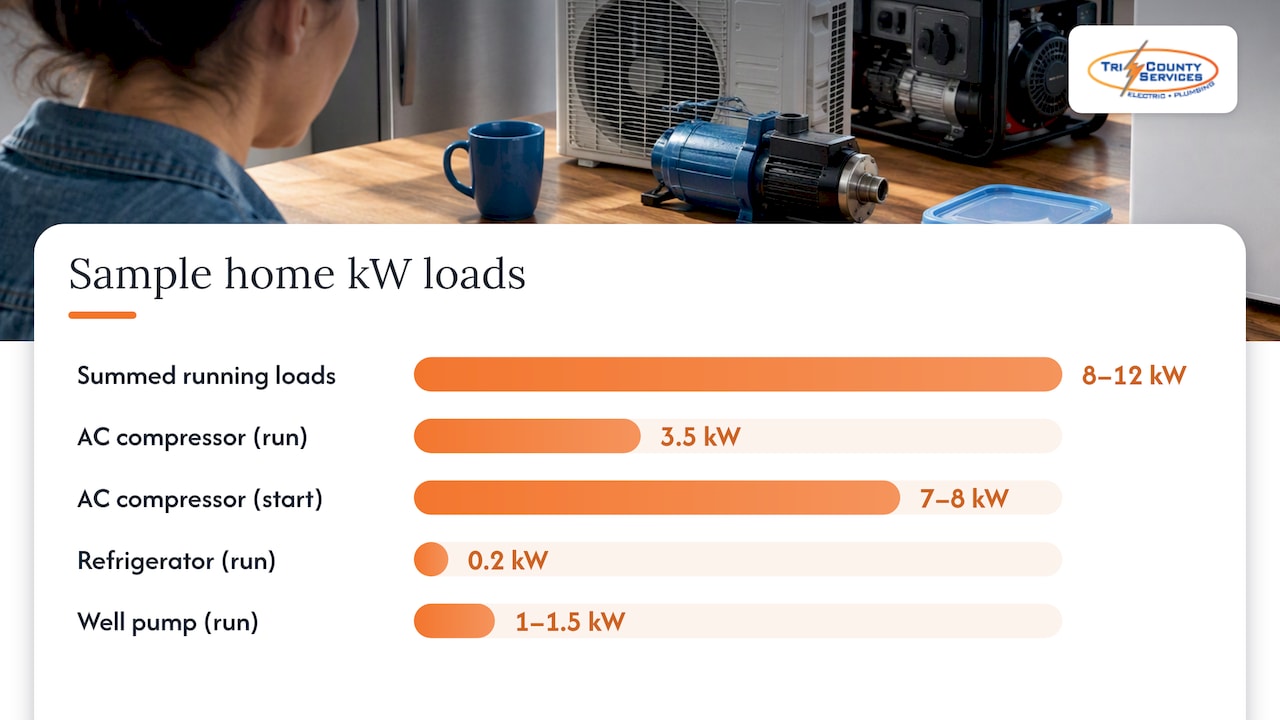
Most homeowner planning ranges for whole-home standby coverage fall between 17 and 26 kW, which already builds in room for simultaneous and starting loads beyond a bare running total.
That margin is also why sizing tools from manufacturers ask about home size, HVAC type, and EV plans rather than just panel amperage.
Common Generator Sizes and What They Actually Power
Generator sizing tends to cluster around a handful of practical bands rather than a continuous scale, and knowing what each band typically supports makes shopping faster.
- 10 to 12 kW portable or small standby: Covers a refrigerator, some lighting circuits, a sump pump, and maybe one window AC unit; a solid floor for minimal critical-load backup.
- 16 kW standby: Handles a small whole-home setup or gives robust essential coverage in a modest house with gas heat.
- 17 to 26 kW standby: The range most 200 amp homes land in for near whole-house coverage, balancing comfort against cost.
- 22 kW: Appears frequently in field reports as a common residential stationary size, according to a CPSC review of installed units.
- 30+ kW: Reserved for homes running electric heat, continuous EV charging, or larger motor loads that push well past standard residential demand.
One wrinkle worth knowing: generator output is sometimes listed in kVA rather than kW, and for loads with a power factor below 1.0, like motors and compressors, the real usable wattage is lower than the kVA number suggests. Ask any installer whether a quoted rating is kW or kVA before comparing units.
Why Motor Starting Matters More Than Running Watts
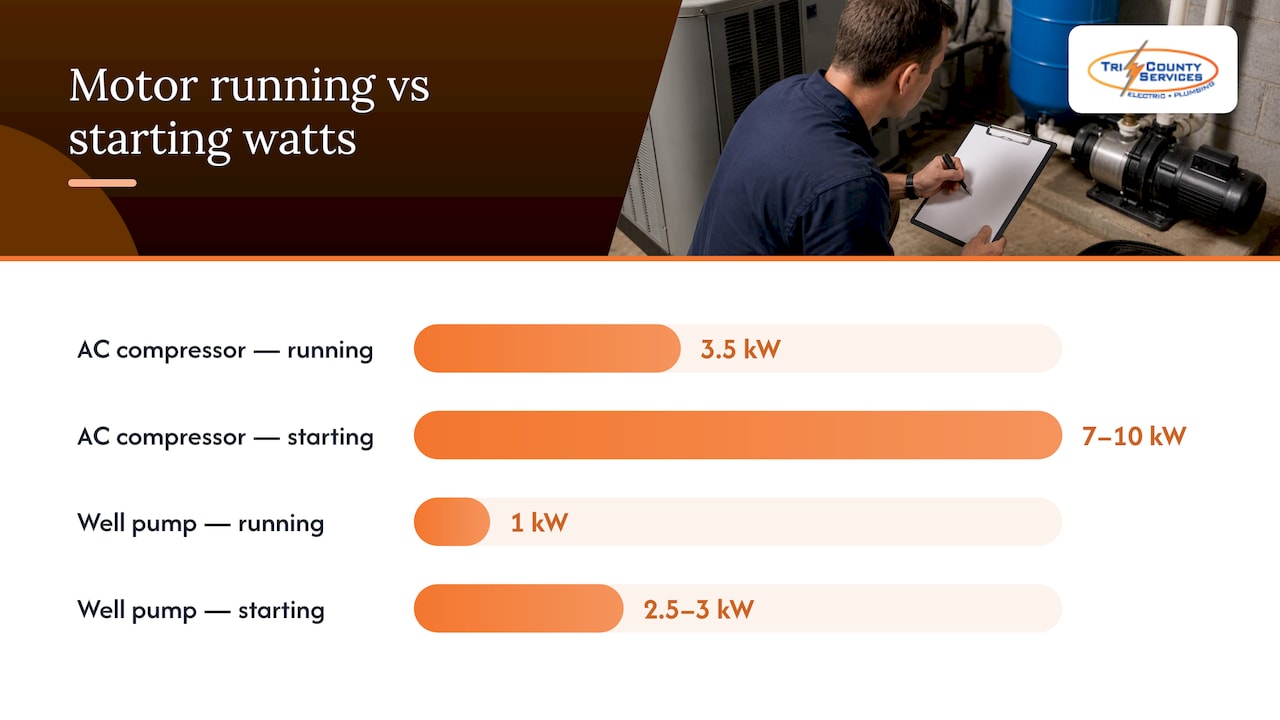
Running watts tell you what a motor draws once it’s up to speed. Starting watts, sometimes called surge or locked-rotor current, tell you what it draws for the first second or two, and that number is often two to three times higher than the running figure for compressors and pumps.
- A 3.5 kW running AC compressor can briefly demand 7 to 10 kW at startup.
- A well pump might run at 1 kW but spike to 2.5 to 3 kW on start.
- Multiple large motors starting at once can momentarily exceed what a modestly sized generator can deliver, even if none of them individually would.
That starting surge, not steady running demand, is frequently the reason a homeowner ends up buying a bigger generator than the running-watt math alone suggests. Two alternatives can avoid that oversizing: soft-start devices that reduce a motor’s inrush current, and load-shedding or staged-start controls that prevent two big motors from starting simultaneously.
Pro Tip: Adding a soft-start kit to a central AC compressor often costs far less than jumping up a full generator size class, and it solves the same starting-surge problem.
Safety Rules You Can’t Skip: Transfer Equipment and CO Risk
Two safety issues come up in nearly every generator installation, and neither is optional.
- Never backfeed your panel with a cord plugged into a regular outlet. This can send power back through the utility lines and seriously injure utility workers, and it violates code everywhere.
- Transfer equipment is required. NEC Article 702 requires transfer equipment, whether a listed automatic transfer switch or an approved interlock kit, specifically to prevent inadvertent interconnection between your generator and the utility grid.
- Portable generators must run outdoors. The Consumer Product Safety Commission recommends operating portable generators at least 20 feet from doors, windows, and vents, with exhaust pointed away from the home, to limit carbon monoxide exposure.
- Permits and inspection apply. Standby generator installations typically require a permit and a sign-off from your local authority having jurisdiction before the unit can be energized.
Carbon monoxide remains a documented risk with both portable and stationary units, and CPSC field data on stationary generator incidents underscores why placement distance and proper venting matter as much as electrical sizing. A generator sized perfectly for your panel still needs to be installed with these protections in place.
Choosing the Right Transfer Switch Setup
The transfer arrangement you choose has to match both your service and the generator itself.
- Automatic transfer switch (ATS): Senses an outage and switches your panel to generator power without you lifting a finger, standard for whole-home standby setups.
- Manual transfer switch: Requires someone to flip the switch, often paired with portable generators for selected-circuit backup.
- Interlock kit: A mechanical device on the panel that prevents both utility and generator breakers from being on at once, a lower-cost option for smaller setups.
- Match the ATS amperage to your service. A 200 amp service should pair with a 200 amp rated ATS, which then governs how much of your panel you can actually run during an outage, regardless of generator kW.
Before hiring anyone, ask directly: will they pull the permit, do they perform an on-site load calculation, and what CO protections come standard with the installation.
When a Homeowner Should Call a Professional
Certain situations push generator sizing well past what a spreadsheet and a flashlight can safely handle, and they’re worth recognizing before you start shopping.
- You have electric heat, a well pump, or an EV charger you want powered during outages.
- Your panel is older or already near capacity and might need a panel upgrade before a generator install.
- You’re unsure how to read nameplate data or calculate starting watts for your HVAC compressor.
- Multiple large motor loads in your home could start simultaneously.
- You want documented proof of code compliance for insurance or resale purposes.
A DIY approach to generator sizing or installation risks under-sizing for starting loads, missing a required permit, or creating a backfeed hazard, none of which show up until the generator is already running during a storm. Calling a professional for an on-site load calculation gets you a documented, code-compliant answer instead of a guess. Reach our team at (440) 253-0332 to schedule a site visit.
The Honest Tradeoff Between Bigger and Smarter
A slightly smaller generator paired with soft-starts and load management almost always beats buying maximum capacity you’ll rarely use. The real question isn’t “how big can I go,” it’s whether you’re planning for the house you have now or the EV charger and heat pump you’ll add in three years. Either way, the few hundred dollars a proper load calculation costs is cheap insurance against an oversized bill or an undersized system that trips under its own starting load.
— Lindsay Paramore
How Tri-County Services Electric & Plumbing Can Help
We provide electrical services and generator sizing assessments. We perform on-site load calculations and install transfer equipment sized to your service. 
- We calculate your real running and starting loads before recommending a generator size.
- We install ATS or interlock equipment matched to your service and handle the permit.
- We’re a family-owned team that schedules around your life, not the other way around.
| What we handle | What it covers |
|---|---|
| Load calculation | On-site assessment of running and starting watts |
| Transfer equipment | ATS or interlock sized to your service rating |
| Permitting | Submission and inspection coordination |
| Follow-up support | Maintenance and troubleshooting after install |
Call (440) 253-0332 or visit our electrical pricing guide to schedule a generator sizing assessment.
FAQ
How many amps will a 12,000 watt generator run?
Selected-circuit backup covers refrigeration, some lighting, a sump or well pump, and a few outlets, typically needing 10 to 12 kW, but not a full 200 amp home. It falls short of the 17 to 26 kW range typically planned for near whole-home coverage.
What size generator do I need for a 1,500 square foot house?
Homes with gas heat and no major electric loads often land closer to the lower end of selected-circuit backup ranges, typically needing around 10 to 12 kW, while those wanting near whole-home coverage typically move toward the lower end of the 17 to 26 kW planning range. The right number still depends on your specific appliance list and starting loads, which is why a load calculation matters more than square footage alone.
What size generator do I need to run a 200 amp welder?
Welders draw heavily on starting current and often run on dedicated 240 volt circuits, so sizing depends on the welder’s actual nameplate amperage and duty cycle rather than your home’s panel rating. A professional load calculation that accounts for the welder’s starting surge alongside your other household loads is the only reliable way to size correctly.
How big of a generator do I need for a 2,000 square foot house?
Homes with central air and a standard set of major appliances commonly land within the 17 to 26 kW standby range for near whole-home coverage. Homes with electric heat, a well pump, or EV charging tend to need the upper end of that range or beyond.
Do I need a transfer switch if I have a 200 amp panel?
Yes. NEC Article 702 requires transfer equipment, whether a listed automatic transfer switch or an interlock kit, to prevent your generator from backfeeding into utility lines regardless of your panel’s amperage.
Sources
- CPSC: Generators and engine-driven tools — Portable generator safety
- Norwall blog: What size generator for a 200‑amp service?
- CPSC report: Stationary generator CO hazard
- Electricians Authority: Backup generator electrical system connections