
TL;DR:
- Hydro jetting cleans the entire pipe wall and removes buildup more effectively than snaking. Snaking is better suited for first-time, soft clogs and fragile pipes, while jetting offers longer-lasting results for grease and scale buildup. A professional camera inspection is essential to choose the right method and prevent pipe damage.
How do hydro jetting and snaking compare for clearing drains?
Snaking punches a hole through a clog. Hydro jetting scours the entire pipe wall clean. Both clear blocked drains, but they work differently, cost differently, and suit different situations. For a first-time hair clog in a shower, snaking is the right call. For a kitchen drain that keeps backing up every few months, hydro jetting addresses what snaking leaves behind.
The core difference comes down to what each method actually removes. A drain snake feeds a rotating cable through the pipe to break up or hook a blockage, restoring flow. A hydro jet sends water at high pressure through specialized nozzles that blast grease, scale, and debris off the full circumference of the pipe wall. One clears a path; the other restores the pipe closer to its original diameter.
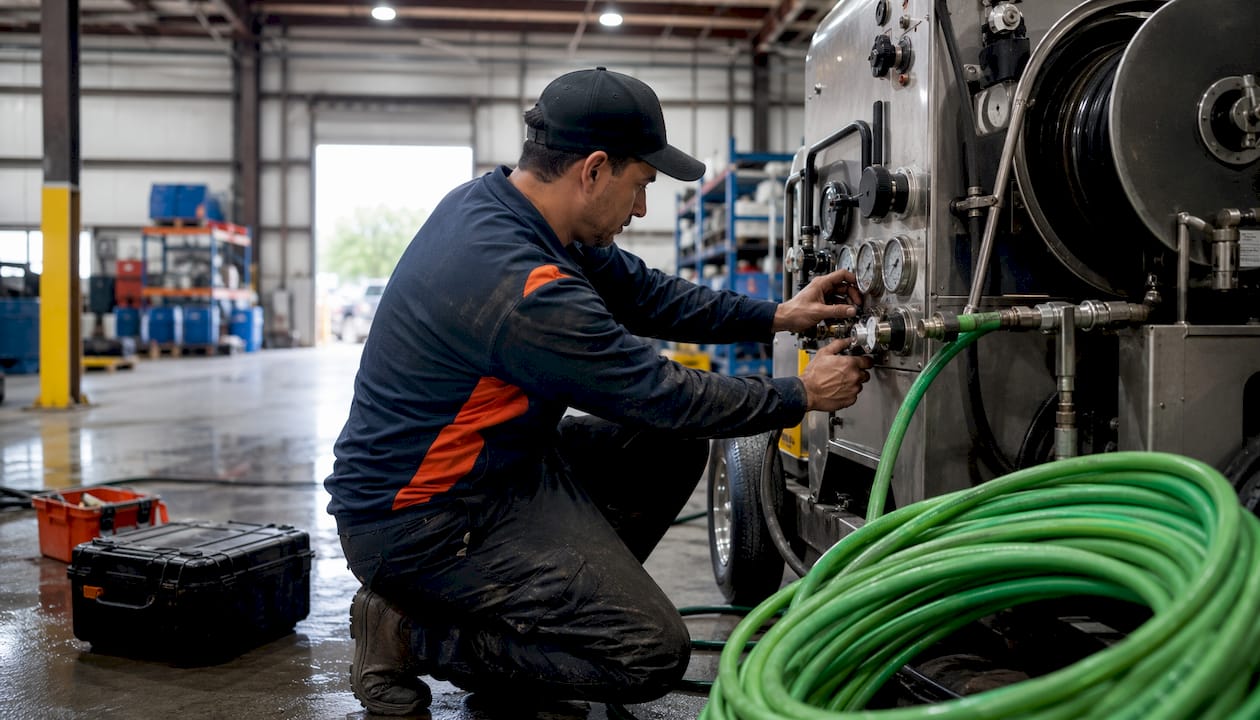
Pipe condition matters as much as clog type. Cracked, heavily corroded, or Orangeburg pipe can be damaged by high-pressure jetting, so a camera inspection before choosing a method is not optional on older or unknown lines.
| Factor | Snaking | Hydro Jetting |
|---|---|---|
| Effectiveness | Good for isolated, soft clogs | Excellent for buildup, grease, roots |
| Cleaning thoroughness | Opens a path through the clog | Cleans the full pipe wall interior |
| Best use cases | Hair, first-time clogs, fragile pipes | Recurring clogs, grease, scale, root intrusion |
| Cost per visit | Lower for professional snaking | Higher for hydro jetting depending on the line |
| Risk of pipe damage | Low when done professionally | Higher on compromised or fragile pipes |
| Suitability for recurring clogs | Temporary relief only | Often lasts significantly longer on grease-prone lines |
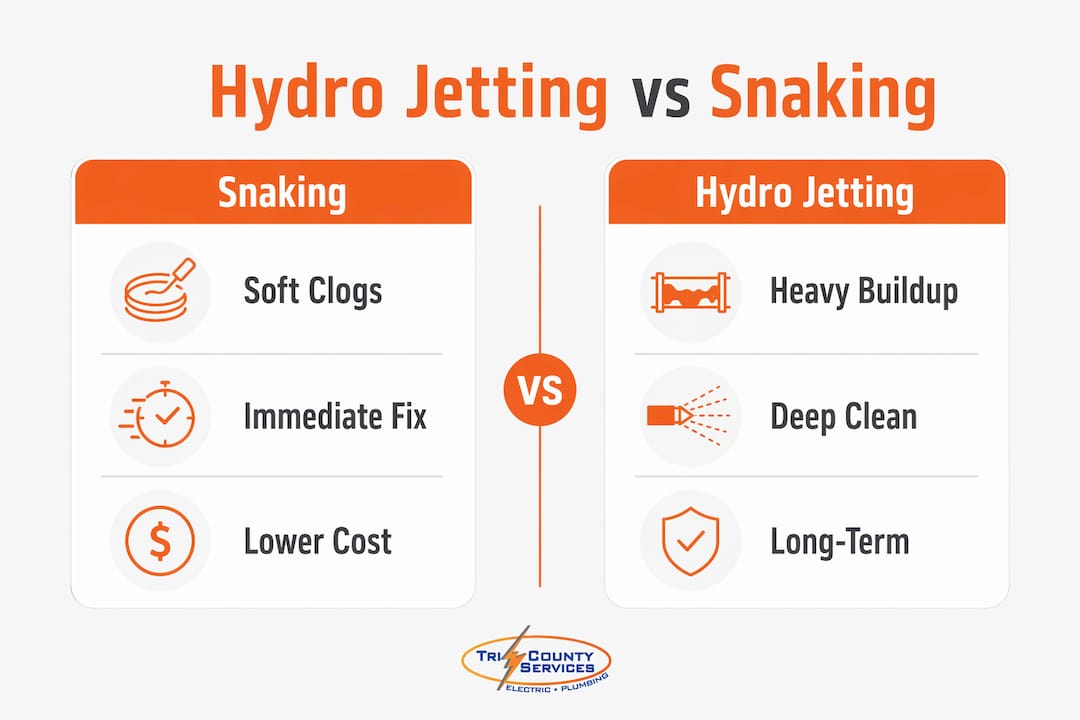
Pro Tip: If the same drain has been snaked and clogged again within about a year, snaking is managing the symptom. That pattern calls for a camera inspection and likely hydro jetting.
What you should know about snaking before calling it a fix
Snaking is a mechanical method. A flexible steel cable, fitted with a cutting or corkscrew head, feeds into the drain line until it reaches the blockage. The plumber rotates the cable to break through or pull out the obstruction, restoring flow. It is fast, affordable, and genuinely effective for the right type of clog.
Advantages of snaking:
- Cost-effective, with professional snaking running $95–$175 for sink and shower lines and $175–$350 for main lines
- Gentle enough for older, fragile, or corroded pipes where high pressure poses a real risk
- Fast to mobilize and complete, often resolving a simple clog in a single visit
- Precise and safe when done by professionals using equipment matched to the pipe diameter and material
- The right first step for any new, one-time clog before escalating to more intensive methods
Limitations of snaking:
- Punches through a clog but leaves grease coating, mineral scale, and debris on the pipe walls
- Snaked grease lines often reclogs within weeks to months because the wall coating immediately catches new debris
- Repeated snaking without addressing wall buildup can create a recurrence cycle where clogs return every 6–12 months
- Cannot remove root masses, only cut through them temporarily
- Ineffective against hardened mineral scale
Snaking is the right first professional choice for a first-time stoppage, a hair clog in a shower or tub, or any line where pipe condition makes high-pressure jetting unsafe. It is a complete and permanent fix for those situations. For grease-coated kitchen lines or recurring main-line issues, it buys time rather than solving the problem.
Why hydro jetting outperforms snaking for stubborn or recurring clogs
Hydro jetting sends a high-pressure water stream through a specialized nozzle inserted into the drain line. The nozzle blasts forward to break through blockages while simultaneously spraying backward at angles that scour the pipe wall in all directions. The result is a pipe cleaned from the inside out, not just opened up.
Advantages of hydro jetting:
- Removes grease, sludge, mineral scale, soap scum, and debris from the full pipe interior, not just the center
- Prevents rapid reclogging by eliminating the wall buildup that catches new debris
- Cuts and flushes root intrusion more effectively than a cable alone
- Environmentally friendly since it uses only high-pressure water with no chemical agents
- Restores pipe flow capacity close to its original diameter
- Regular jetting removes organic material and scale that would otherwise accelerate corrosive buildup cycles, extending pipe lifespan
Disadvantages of hydro jetting:
- Higher cost per visit, ranging from $300–$500 for residential drains and $500–$800 for main sewer laterals
- Requires a camera inspection first on any pipe of unknown or questionable condition
- Can damage fragile or compromised pipe such as cracked, heavily corroded, or Orangeburg lines
- Not the right tool for a simple, first-time clog in a clean pipe
Hydro jetting is both an emergency fix for severe buildup and a proactive maintenance strategy. For kitchen drains with years of grease accumulation, it can restore flow from barely functional to near full capacity. On grease-prone lines, jetting lasts 2–5 years, compared to 3–6 months after snaking alone. That gap is what makes the higher upfront cost worth it for the right situation.
How to choose between snaking and hydro jetting
The decision comes down to three questions: Has this drain been snaked before and clogged again? What kind of buildup is in the line? And what does the pipe condition actually look like?
A camera inspection before choosing a method is the most reliable way to answer all three. It shows whether the pipe walls are coated with grease or scale, whether roots have entered the line, and whether the pipe is structurally sound enough for jetting. Without that footage, drain history is the best guide.
Choose snaking when:
- It is the first time this drain has slowed or blocked
- The clog is hair, soft food debris, or a one-time obstruction
- The pipe is older, fragile, or in questionable condition
- Budget is the primary concern and the problem is straightforward
Choose hydro jetting when:
- The same drain has been snaked and clogged again within about a year
- A camera shows grease, scale, or root intrusion coating the pipe walls
- It is a kitchen drain with heavy, ongoing grease use
- Multiple fixtures are draining slowly, suggesting main-line buildup
- You want the pipe fully cleaned rather than just passable
Cost trade-offs are real. Professional snaking runs less per visit, but if a grease line needs snaking twice a year versus jetting every two years, the total cost often favors jetting over time. The cheaper option per visit is not always cheaper over time.
Pro Tip: Skip the consumer-grade drain snake from the hardware store. Without a camera and professional training, you cannot confirm the pipe is safe to work on, and the wrong tool in a compromised line can cause real damage. Call a professional first.
Homeowners planning bathroom or kitchen updates can also factor drain condition into their renovation cost planning since addressing buildup before a remodel prevents expensive surprises later.
What Tri-County Services Electric & Plumbing recommends for Northeast Ohio homeowners
Calling a professional plumber before attempting any drain cleaning is not overcautious. It is the decision that protects your pipes and your wallet. Consumer-grade tools lack the torque, reach, and diagnostic capability of professional equipment, and a DIY attempt on a compromised line can turn a cleaning job into an excavation.
Tri-County Services Electric & Plumbing has served Northeast Ohio since 1975, and the team now brings that same standard of care to drain cleaning and hydro jetting across the region. Here is what that professional approach looks like in practice:
- Camera inspection first. Before recommending snaking or jetting, Tri-County technicians inspect the line to confirm pipe condition and identify the actual cause of the problem, whether that is a grease coating, root intrusion, or a localized soft clog.
- Method matched to reality. If snaking is the right tool, that is what gets used. If the camera shows wall buildup on a sound pipe, hydro jetting addresses the cause rather than the symptom.
- Safety checks on older pipe. Northeast Ohio homes often have cast iron or clay lines that require careful pressure calibration. Tri-County’s hydrojetting and descaling work on cast iron sewer lines reflects that experience.
- Proactive maintenance. Routine hydro jetting on kitchen and main lines interrupts the buildup cycle before it becomes an emergency, extending pipe lifespan and reducing the frequency of service calls.
- No DIY shortcuts. Chemical drain cleaners pose real corrosion risks and often fail to address the underlying buildup. Professional inspection and cleaning resolve the cause, not just the symptom.
If your drain keeps coming back after snaking, or if you have not had a camera inspection on an older home’s main line, that is the right place to start. Tri-County Services Electric & Plumbing brings the equipment and the judgment to get it right the first time.
Get professional drain cleaning from Tri-County Services Electric & Plumbing

Slow drains and recurring clogs do not fix themselves. Tri-County Services Electric & Plumbing serves homeowners and property managers across Northeast Ohio with professional camera inspections, snaking, and hydro jetting on both residential and commercial lines. The team has been doing this since 1975, and plumbing is now part of the same trusted service.
Contact Tri-County Services at (440) 325-0136 to schedule a drain inspection or cleaning. Get the right method for your pipe, not a guess.
Key Takeaways
Snaking is the right first step for isolated clogs, while hydro jetting is the better investment when grease or scale keeps bringing the problem back.
| Point | Details |
|---|---|
| Snaking suits first-time clogs | Use snaking for hair, soft debris, or any new, one-time blockage in a fragile or unknown pipe. |
| Hydro jetting lasts longer on grease lines | Jetting lasts 2–5 years on grease-prone lines versus 3–6 months after snaking alone. |
| Camera inspection guides the choice | A camera confirms pipe condition and wall buildup before any method is selected. |
| Hydro jetting cost is higher per visit | Professional jetting runs $300–$800 depending on the line; snaking runs $95–$350. |
| DIY risks outweigh the savings | Without professional equipment and diagnostics, drain cleaning can damage compromised pipe. |
FAQ
Is hydro jetting better than snaking?
It depends on the clog. Hydro jetting is superior for recurring grease, scale buildup, and root intrusion because it cleans the full pipe wall rather than just boring through the blockage. For a first-time, isolated clog, snaking is often the complete and correct answer.
How much does hydro jetting usually cost?
Hydro jetting costs roughly $300–$500 for a residential drain and $500–$800 for a main sewer lateral, with small jobs starting around $150 and severely clogged pipes reaching up to $1,000.
Why does hydro jetting cost more than snaking?
Hydro jetting requires specialized high-pressure equipment, a camera inspection to confirm pipe safety, and more time on the job. The higher upfront cost reflects a more thorough cleaning that lasts significantly longer on grease and scale-prone lines.
Is hydro jetting worth it for my pipes?
For pipes with confirmed grease coating, recurring clogs, or root intrusion, yes. A jetted grease line stays clear 2–5 years versus 3–6 months after snaking, making it more cost-effective over time despite the higher per-visit price.
When should I call a professional instead of trying to snake it myself?
Call a professional first, before any attempt. Consumer tools lack the reach and torque of professional equipment, and without a camera you cannot confirm whether the pipe can safely handle any cleaning method at all.