

Most whole-house repipes land between about $4,500 and $12,000 for a typical home, and the price swings mostly on home size, pipe material and how hard the walls are to reach. A national average of $6,500 for a 2,000-square-foot house is a fair starting point, but only a professional walk-through of your plumbing can turn it into a real number. At Tri-County Services Electric & Plumbing, our plumbers work with Northeast Ohio homeowners on plumbing upgrades and pipe leak repair, and we can tell you whether you need a full repipe or a smaller fix. Call our office at (440) 253-0332.
TL;DR
- Forbes Home puts replacing the plumbing in a typical 2,000-square-foot home at $3,000 to $16,000, averaging $6,500.
- For a 1,500-square-foot house, HomeLight cites an average of $6,750, and the total scales with square footage.
- Pipe material, number of fixtures, wall and floor access, and permits move the price more than anything else.
- A repipe means days without water and drywall patching, so ask how the crew sequences the work before you sign.
- Call (440) 253-0332 and a professional plumber from our office can look at your pipes and tell you whether a full or partial repipe makes sense.
Table of Contents
- What a house repipe costs in 2026
- Cost by home size
- What drives the price up or down
- Do you need a full repipe or a partial one?
- What a repipe quote should include
- How long a repipe takes and what living through it is like
- Why hiring a professional first beats guessing
- Promo: talk to Tri-County Services Electric & Plumbing
- Our perspective
- FAQ
- Sources
What a house repipe costs in 2026
Repiping means replacing the supply lines that carry water to your faucets, showers, toilets and appliances. It is not the same as the drain lines that carry waste out of the house, though the two are often discussed together.
The published ranges are wide because homes are different. Forbes Home reports that replacing plumbing in a typical 2,000-square-foot house runs $3,000 to $16,000, with an average of $6,500. Its component figures show where the money goes: labor at $50 to $200 per hour, PEX tubing at $1.50 to $4 per linear foot, copper at $4 to $12 per foot, and permits at $50 to $500 per project (Forbes Home).
One figure you may see quoted is a $1,800 median for interior water-pipe work. That comes from the 2023 American Housing Survey, and an analysis of it by RapidEye explains that the survey counts partial jobs and remodel additions, not only whole-house repipes. Do not use it as a benchmark for a full repipe quote.
Prices are published for a given year. Material and labor costs move, so treat every number here as a range to test against a written estimate for your own house.
Cost by home size
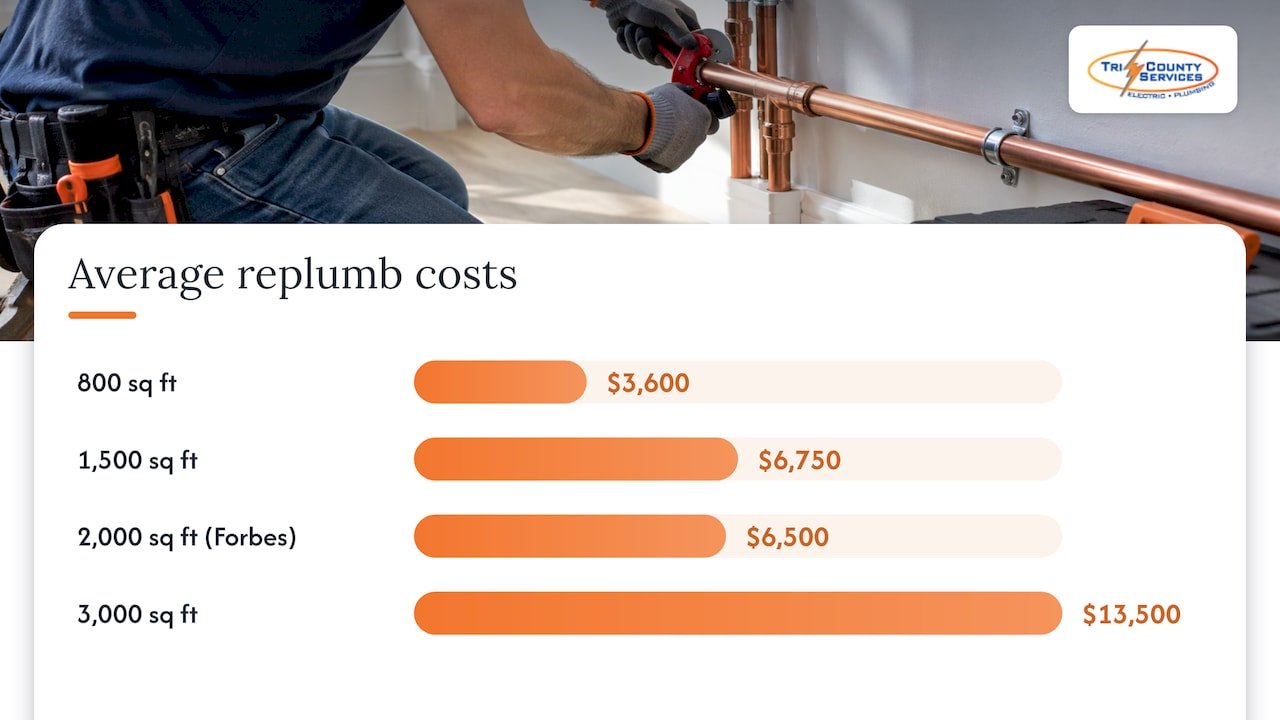
Square footage is the easiest way to get a first estimate, because bigger homes have more pipe, more fixtures and more walls to open. HomeLight, citing HomeAdvisor data in a January 2025 article, lists the average cost to replumb a house at $3,600 for 800 square feet, $6,750 for 1,500 square feet and $13,500 for 3,000 square feet (HomeLight).
| Home size | Average whole-house replumb cost |
|---|---|
| 800 sq ft | $3,600 |
| 1,500 sq ft | $6,750 |
| 2,000 sq ft | $6,500 (Forbes Home average; range $3,000 to $16,000) |
| 3,000 sq ft | $13,500 |
The 2,000-square-foot row comes from a different source than the others, which is why it does not sit neatly between them. That gap is a good reminder: averages from different publishers use different methods, so they describe a range, not a price.
A rough way to read this table for a 1,500-square-foot, two-bath home: expect the low thousands at the bottom end for a straightforward PEX job and a good deal more for copper or a hard-to-reach layout. Your plumber’s written estimate replaces any of these averages.
What drives the price up or down
Pipe material
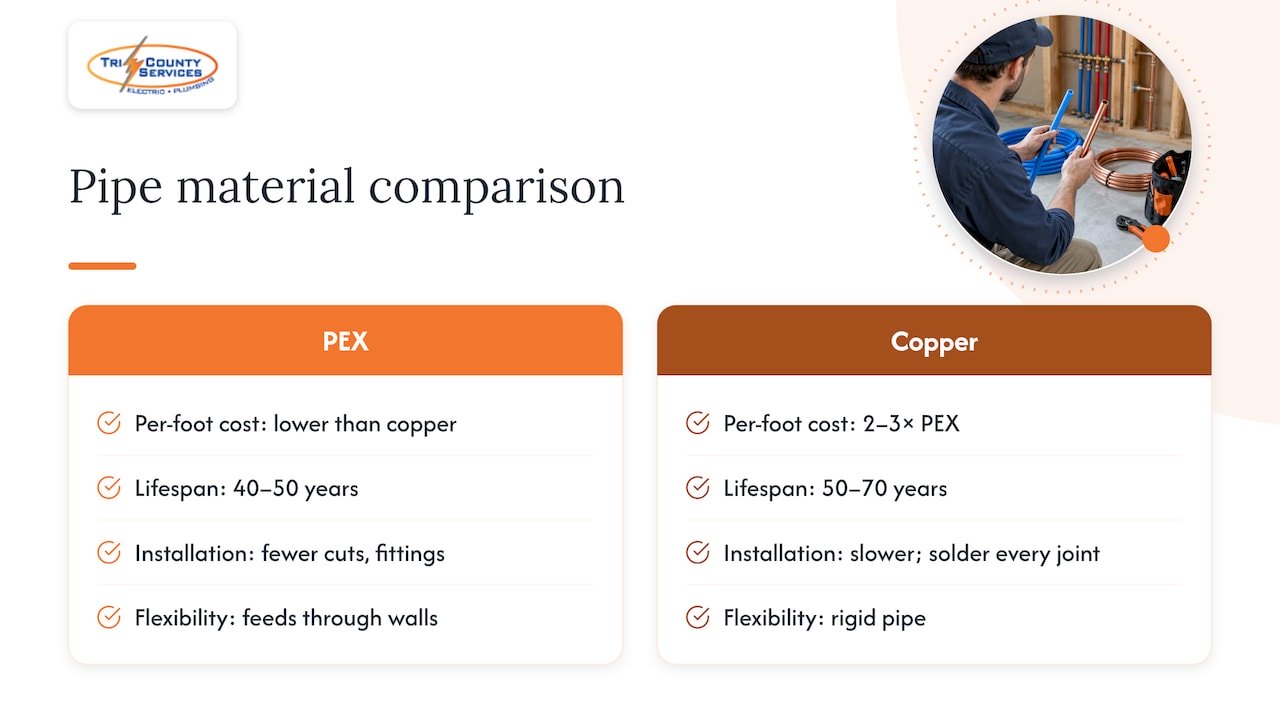
The two common choices for a repipe are PEX, a flexible plastic tubing, and copper. Per the Forbes figures above, copper costs roughly two to three times as much per linear foot as PEX, and it is also slower to install because every joint is soldered. PEX is flexible, so it can be fed through walls with fewer cuts and fewer fittings.
Copper has a longer expected lifespan on paper. One engineering firm puts it at roughly 50 to 70 years versus 40 to 50 for PEX, and notes that your local water chemistry affects how either one ages. PEX also tolerates a freeze better than rigid pipe, which matters in a Cleveland winter. Your plumber can talk through which fits your house and water.
Number of fixtures and bathrooms
A repipe is priced around how many places water has to reach. A home with three bathrooms, a laundry room, a kitchen with an ice maker and outdoor spigots needs far more tubing and more connections than a one-bath ranch. When you compare quotes, count fixtures with each contractor so everyone is pricing the same house.
Access to the pipes
Labor is the biggest piece of the bill. A cost model from CostTo.Build estimates that labor, trade services and removal make up about 87% of the average repipe estimate, while materials are around 7%. That is why two homes with the same square footage can price very differently.
Homes built on a slab, with pipes under concrete, cost more. PermitDeck says slab-on-grade access adds 30 to 50% and two-story homes add 15 to 25%. Many Northeast Ohio homes have basements or crawl spaces, where plumbers can often run new lines below the floor joists and open fewer walls. Finished basement ceilings and plaster walls in older homes raise the labor.
Permits and inspection
A repipe generally needs a permit, and the local building department inspects the work. Forbes lists permits at $50 to $500 per project. Fees and rules vary by city and township, so ask your plumber how permits are handled in your community and whether the quote includes them.
Your location
CostTo.Build notes that installed prices run roughly 50% higher in the costliest metros than in the cheapest. A national average will not match any specific town, which is another reason to get a local estimate.
Do you need a full repipe or a partial one?
Many homeowners start by searching for the price of a repipe when what they have is a leak, low pressure or discolored water. The right fix depends on the cause.
A full repipe usually makes sense when the whole system is failing, not one spot. Typical signs are:
- Leaks in several different places over a short period
- Rusty or brown water from most taps
- Pressure that has dropped throughout the house
- Old galvanized steel pipes, which corrode from the inside
A single leak under a sink or in a basement ceiling is often a pipe leak repair, not a repipe. Replacing one section costs a fraction of a whole-house job. Our plumbing team can inspect the leak and the lines around it, so you know whether you are looking at one failure or the first of many.
If you suspect galvanized pipes, our guide to replacing galvanized pipes covers the costs and risks. Ohio homeowners with a lead service line should also read about lead water service replacement, since that is the pipe between the street and your home, priced separately from interior repiping.
This is a job for a professional plumber, not a weekend project. Cutting into walls, working with pressurized lines and passing inspection require trained hands. A mistake behind drywall can mean a slow leak that damages framing and floors long before you notice it.
What a repipe quote should include
Two quotes with the same bottom line can cover very different work. Ask each contractor to put these items in writing:
- Pipe material and brand. PEX or copper, and the pipe type for hot and cold lines.
- Scope. Which fixtures, appliances and outdoor connections are included.
- Permits and inspection. Who pulls the permit and whether the fee is in the price.
- Wall and ceiling repair. Whether drywall patching and paint are included, or only the cuts.
- Old pipe removal. Whether abandoned pipe is removed or left in the walls.
- Schedule. How many days the water will be off and how the crew sequences the work.
- Warranty. What covers the labor and what covers the materials.
The item homeowners most often miss is drywall. A clean job still involves opening walls, and PermitDeck’s guide says to expect 15 to 40 drywall patches even then. A quote that says nothing about repairs may leave you hiring a second contractor.
For the same reason, compare quotes on scope first and price second. A lower number that leaves out patching, permits or half the fixtures is not lower at all.
How long a repipe takes and what living through it is like
PermitDeck describes a typical job as three to seven days of work. Day one is demolition and access cuts, days two through four are installation, and days four and five are pressure testing and inspection. The final days are drywall patching. Code calls for pressure testing at 1.5 times working pressure or 100 psi held for 15 minutes, per the same guide, and the water is off for most of the work.
Plan for it. Fill a few jugs for drinking, line up a place to shower on the worst days, and move furniture and valuables away from walls and ceilings the crew will open. Tell the plumber about pets, small children or anyone who works from home so the schedule can be built around you.
Our approach to scheduling is built around minimizing disruption. We offer flexible service times, and our technicians respect your home as they work.
Why hiring a professional first beats guessing
Searching for the price of a repipe often leads to a bigger question: could I do some of this myself? For supply lines the answer is almost always to call a professional plumber first. Here is why:
- The cost is mostly judgment, not parts. Materials are around 7% of the average estimate in the CostTo.Build model. What you are paying for is knowing where to cut, how to route lines and how to avoid damaging the structure.
- Mistakes hide. A bad connection can hold during a quick test and leak weeks later inside a wall.
- Inspection is part of the job. The permit process exists so a second set of eyes checks pressure tests and fittings.
- Water damage costs more than the plumbing. Repairing flooring, drywall and mold dwarfs the labor you thought you saved.
If you are not sure what is wrong, a plumber can find out before you spend anything on pipe. Our sewer camera inspection ($250 to $400) looks inside drain lines, and our plumbing team can examine your supply lines too. The upfront look often prevents an expensive wrong guess. For a wider sense of what plumbing visits cost, see our breakdown of 2026 plumbing costs for homeowners.
Promo: talk to Tri-County Services Electric & Plumbing
Tri-County Services Electric & Plumbing is a family-owned Northeast Ohio business that has served homes and businesses since 1975, and we now offer plumbing alongside our electrical work. Our plumbing services include pipe leak repair, plumbing upgrades, water heater repair and replacement, drain cleaning and sewer camera inspection. You can see our published plumbing prices on the plumbing pricing guide.

If your pipes are leaking, rusting or losing pressure, call our office at (440) 253-0332 and describe what you are seeing. We will tell you what the right next step is, and you can schedule a plumbing visit at a time that suits you.
Our perspective
A repipe is one of the largest plumbing decisions a homeowner makes, and most people come to it after a scare: a burst line, a ceiling stain, water that runs brown. In that moment the number on the quote matters less than whether you trust the person giving it.
We have been a family-owned business in Northeast Ohio since 1975, and that history shapes how we work. We want long-term relationships with the families we serve, so we explain what we find, give clear upfront pricing and respect your home while we are in it. Our technicians are skilled and certified, and we build our schedule to minimize disruption.
Our advice is to bring in a professional plumber before you guess. Many leaks are a single repair. Some are the first sign of a failing system. Telling them apart takes an experienced eye, and getting it right the first time protects your walls, your floors and your budget.
If you are weighing a repipe, call us at (440) 253-0332.
Lindsay Paramore
FAQ
How much does it cost to repipe a 1,500-square-foot house?
HomeLight, citing HomeAdvisor data, lists an average of $6,750 for a 1,500-square-foot house. Your price depends on pipe material, how many fixtures you have and how easy the pipes are to reach. A professional plumber can give you a written estimate for your exact layout.
Is PEX or copper cheaper for repiping?
PEX is cheaper. Forbes Home lists PEX at $1.50 to $4 per linear foot and copper at $4 to $12. PEX is also faster to install, which lowers labor, and both materials are used in whole-house repipes.
How long does a repipe take?
PermitDeck’s guide describes three to seven days of work, with the water off for most of that time. Drywall patching comes at the end, so plan for some finishing work after the pipes are in and tested.
Does a repipe need a permit?
A whole-house repipe generally does, and the work is inspected. Forbes Home lists permits at $50 to $500 per project. Rules vary by city, so ask your plumber how it is handled in your community.
Sources
- Average Cost To Install Or Replace Plumbing, Forbes Home
- Leaky Pipes? Here’s the Average Cost to Replumb a House, HomeLight
- Interior Water Pipe Replacement and Repipe Cost Statistics, RapidEye
- Whole-House Repipe in 2026: Cost, Timeline, and What to Expect, PermitDeck
- House Repiping Cost Calculator, CostTo.Build
- Copper vs PEX, Bazini Engineering