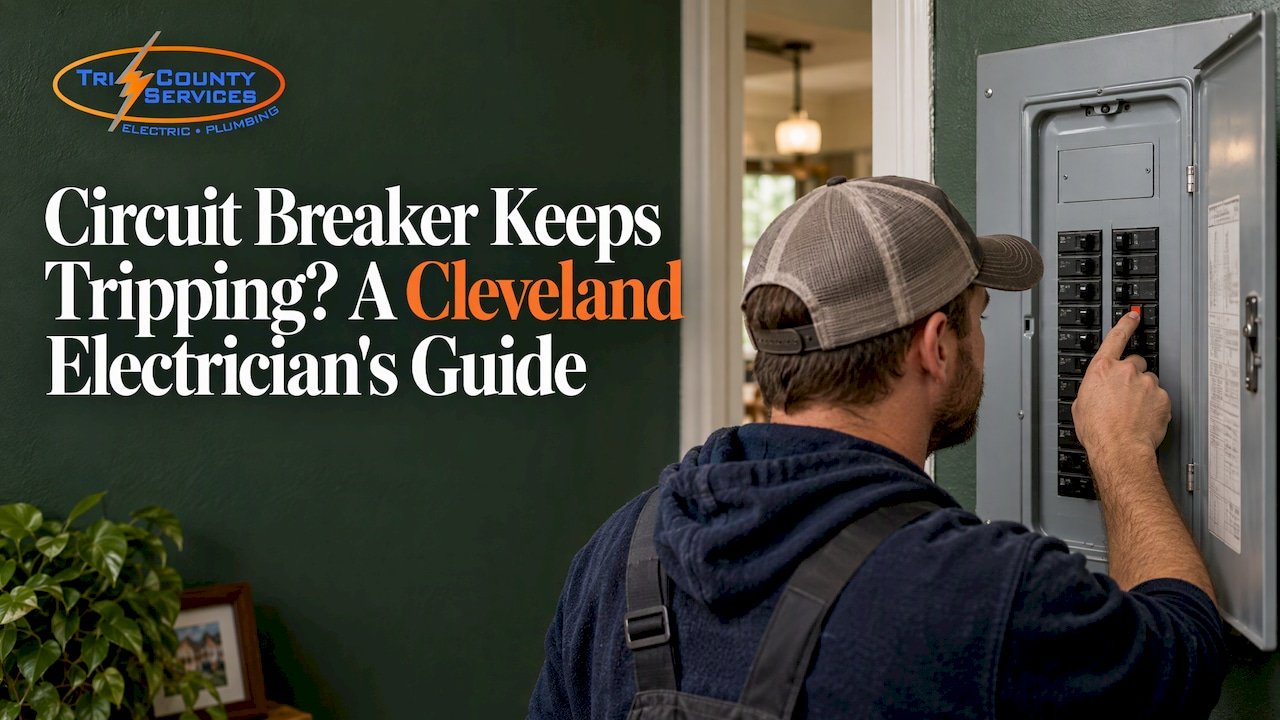

A breaker that keeps tripping is your electrical system telling you something is wrong. Sometimes the circuit is simply carrying too much. Sometimes there is a damaged wire, a loose connection or a failing breaker behind the wall. You can’t tell which from the outside, and the difference matters. If your breaker keeps tripping, the safest move is to stop resetting it and have a professional electrician find the cause. At Tri-County Services Electric & Plumbing, we have served Northeast Ohio homes as a family-owned company since 1975, and you can reach our office at (440) 253-0332.
TL;DR
- A breaker trips to stop a circuit from overheating. A breaker that trips again and again means the circuit has a problem that needs to be found, not just reset.
- Overloads and short circuits cause most breaker-trip service calls, followed by arc faults, ground faults and, rarely, a defective breaker.
- Stop resetting the breaker and call an electrician if it trips right away, if you smell burning plastic, or if the breaker or panel feels hot.
- Electrical failures cause tens of thousands of U.S. home fires each year, and cold-weather months are the busiest, which is a good reason not to put the call off.
- Our electrical troubleshooting is published at $300-$500 one-off. Call (440) 253-0332 to schedule it.
Table of Contents
- What a tripping breaker is actually doing
- The most common causes, in order of how often they show up
- Signs that mean stop and call now
- Why waiting is not a good bet
- Why a professional electrician should be your first call
- When the answer is a panel upgrade
- What Cleveland’s electrical code means for repairs
- Questions to ask before the visit
- Our electrical repair service
- Our perspective
- FAQ
- Sources
What a tripping breaker is actually doing
Every breaker in your panel is built to cut power when a circuit carries more current than its wiring can safely handle. That is its whole job. When it trips, it has done what it was designed to do, and the question is why it needed to.
One trip after you plugged in a space heater and a hair dryer on the same circuit is an ordinary event. A breaker that trips again after you reset it, or trips every few days, is different. Cleveland Public Power, the city’s utility, says a frequently tripping breaker usually signals trouble: the circuit may be overloaded or the breaker may be faulty, and it advises having an electrician inspect and troubleshoot.
The same utility warns that a breaker that trips immediately after you reset it points to an electrical problem. It also says that repeatedly pressing a tripping breaker is likely to cause a fire, and its advice is to stop resetting and call an electrician.
The most common causes, in order of how often they show up
The Electrical Safety Foundation International surveyed 100 electrical contractors in Massachusetts in 2022. It found that 59% of their weekly service calls involved tripped breakers or fuses. Within those breaker-trip calls, the contractors reported this split:
| Cause | Share of breaker-trip calls |
|---|---|
| Overloads and short circuits | 68% |
| Arc faults | 18% |
| Ground faults | 10% |
| Defective breaker | 4% |
The survey covers one state, but these causes are the same in Ohio houses. Here is what each one means in plain terms.
Overloads
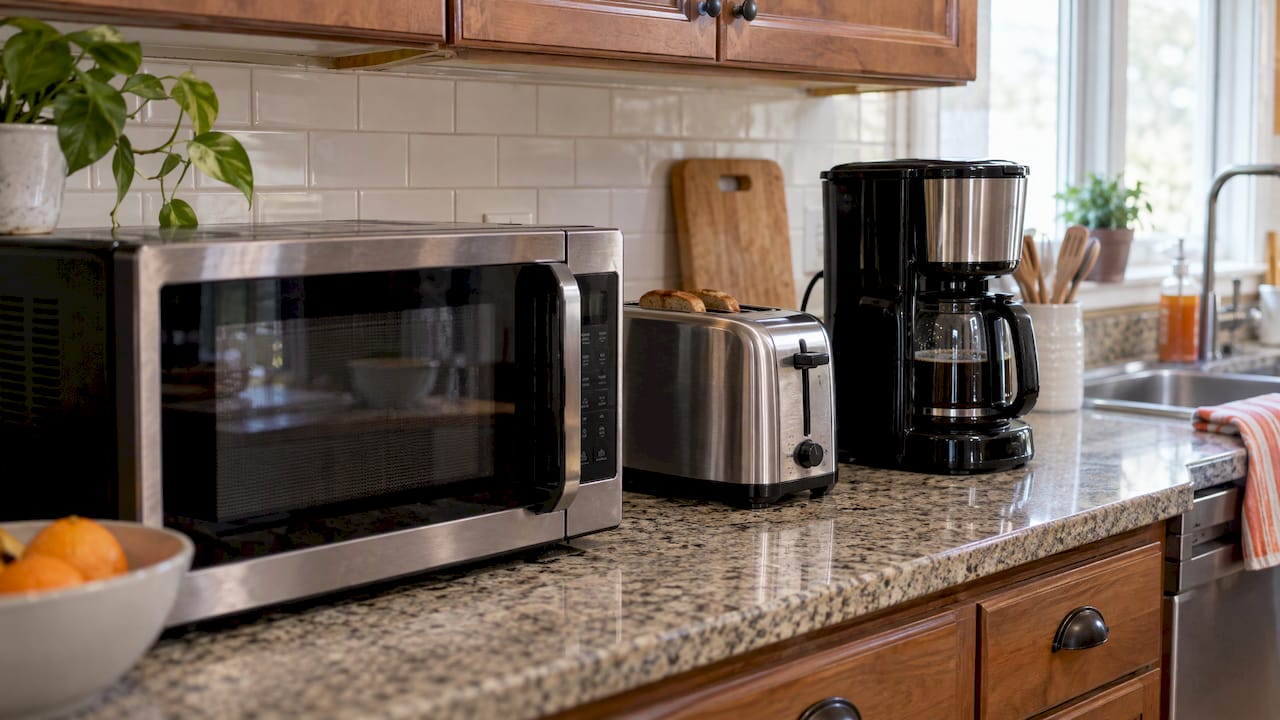
An overload means too much is plugged into one circuit. Think of a kitchen circuit running a microwave, a toaster and a coffee maker at once, or a bedroom circuit feeding a space heater. The breaker trips because the wires are heating up.
The fix is not always a bigger breaker. Swapping in a higher-rated breaker on wiring that can’t carry it removes the protection and creates the very hazard the breaker was preventing. The real fix is usually a dedicated circuit for the heavy appliance, or a panel with enough capacity for how your household uses power today.
The same logic applies to any high-draw equipment sharing a line with other loads. Kitchens full of heavy appliances are a good example, and the problem of commercial oven tripping comes down to matching the load to the circuit.
Short circuits
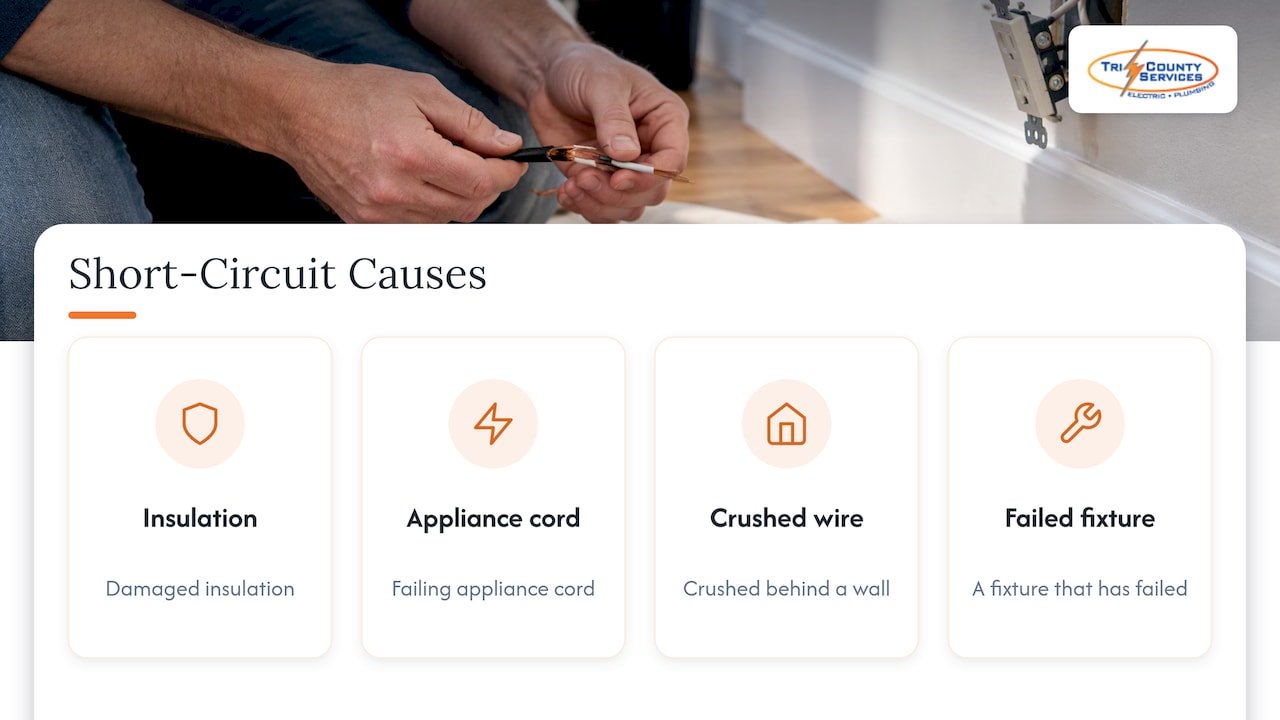
A short circuit happens when a hot wire touches a neutral or another hot wire, so current surges far past normal. The breaker trips instantly, often with a pop. Causes include damaged insulation, a failing appliance cord, a crushed wire behind a wall, or a fixture that has failed. If the breaker trips the moment you reset it, a short is a likely suspect, and it should not be reset again.
Arc faults
An arc fault is a small, unintended spark between conductors. It can come from a nail through a cable, a frayed cord or a loose connection. Arcing generates intense heat in a tiny spot, and it often goes unnoticed because the current is too low to trip an ordinary breaker. NFPA research says home fires involving electrical failure or malfunction primarily involve arcing from damaged conductors, frayed appliance cords, loose outlet connections, or faulty switches and junction boxes. Newer homes have arc-fault breakers that sense this. If one of those keeps tripping, it is detecting something real.
Ground faults
A ground fault is current leaking along an unintended path, such as through water or a person. Ground-fault protection is why bathroom and kitchen outlets have test-and-reset buttons. Cleveland Public Power describes these devices as constantly monitoring current and tripping immediately on any imbalance, which protects against potentially fatal shock and fire. If a ground-fault outlet or breaker keeps tripping in a damp area, moisture in a box or a failing appliance is a common reason. A professional should trace it.
A defective breaker
Breakers do wear out, and the survey puts this at the smallest share of calls. A breaker that is old, hot, or loose in its slot can trip without a real fault on the circuit. But you can’t tell a bad breaker from a bad circuit by looking. Replacing a breaker without testing the circuit can cover up the actual problem.
Signs that mean stop and call now
Some situations are not worth waiting out. According to an electrical company’s guide to breaker problems, the signs that need a professional include:
- The breaker snaps off immediately after reset, even with nothing plugged in.
- A sharp smell of burning plastic or ozone near the panel or an outlet.
- A breaker or panel cover that feels unusually warm or hot.
Add to that list: buzzing or crackling from the panel, scorch marks or discoloration on an outlet or switch plate, lights that flicker when a large appliance starts, and any breaker that has tripped more than once in a week without an obvious reason.
If you see smoke or flames, or smell burning that is getting stronger, leave the house and call 911 first. Then call an electrician.
Why waiting is not a good bet
It is tempting to flip the breaker back on and carry on. The numbers on home electrical fires explain why that is a gamble. NFPA data shows that in 2024 there were 48,757 home fires involving electrical failure or malfunction, with 594 civilian deaths, 1,583 injuries and $2.632 billion in property damage.
Timing matters too. NFPA’s 2019 report found that 39% of these fires happen between November and February, when heaters, holiday lights and closed-up houses push circuits harder. It also found that 24% of electrical-distribution fires occurred between midnight and 8 a.m. but accounted for 60% of deaths, because people are asleep. For a Cleveland household heading into winter, a breaker that keeps tripping is worth a visit before the cold weather peaks.
Why a professional electrician should be your first call
The tripping breaker is only the symptom. Finding the cause takes testing the circuit, checking connections at the panel, outlets and fixtures, and judging whether the wiring and the panel can handle the load. Opening a live panel is dangerous work that carries a risk of shock and arc flash, and it is not a place for guesswork.
There is also a risk in fixing the wrong thing. Replace a good breaker and the real fault stays in the wall. Upsize a breaker and you remove the safety margin. Move an appliance to another outlet and you may just shift the problem to a circuit that is in worse shape.
A professional troubleshooting visit looks at the whole circuit, not only the part that tripped. Here is the practical order of events:
- You describe what happened. Which breaker, how often, what was running, whether it trips at once or after a while. Write this down before the visit, because it shortens the search.
- The electrician identifies the circuit. That means knowing what each breaker actually feeds, which is often different from the panel’s handwritten label.
- Testing and inspection. The electrician checks for overloads, shorts, arc faults, ground faults, loose terminations and signs of heat damage at the panel and along the circuit.
- A repair that matches the cause. That might be a new dedicated circuit, a tightened or replaced connection, a damaged cable or fixture replaced, a new breaker, or a recommendation to upgrade the panel.
- A safety check at the end. The circuit is confirmed to hold its load without tripping.
Our electrical troubleshooting service is published at $300-$500 one-off. The final cost depends on what the visit finds, and we price clearly upfront.
When the answer is a panel upgrade
Sometimes the circuits are fine and the panel is the limit. Older Northeast Ohio homes were wired for a time when a house ran a few lights, a refrigerator and a television. Today’s households add electric vehicles, window air conditioners, home offices, induction ranges, and in the winter, space heaters. When the total demand is more than the panel and its circuits were designed for, breakers trip, lights dim, and you end up running extension cords.
A panel upgrade adds capacity and replaces worn components. It also gives you room for the dedicated circuits that heavy appliances need. If you are planning an EV charger, a generator or whole-home surge protection, the panel conversation is the right place to start. We have a page on why to upgrade your panel before winter if you want the seasonal reasoning.
What Cleveland’s electrical code means for repairs
Work on your wiring in the city of Cleveland is covered by the local code. It requires electrical wiring and equipment to conform to NFPA 70, the National Electrical Code, and it calls for final inspection and approval by the Commissioner before work is placed in service. Using a professional who knows this process keeps your repair on the right side of it.
The code also does not force you to replace electrical work done before July 1, 1979, unless the Commissioner finds a definite and serious hazard, meaning wiring that is demonstrably fire-hazardous or likely to cause injury or death from shock. In that case correction is required, within at least 30 days or immediately for an immediate hazard. A tripping breaker in an older house is just the kind of symptom worth having examined before it gets that far. If an inspection turns up items that need fixing, our code corrections page explains how we help.
Questions to ask before the visit
A few details speed up the diagnosis and help you describe the problem accurately:
- Does it trip when a particular appliance turns on, or at random?
- Is the tripped breaker the same one every time?
- Does anything feel warm: the outlet, the plug, the breaker, the panel cover?
- Did anything change recently: a new appliance, a renovation, a storm, a leak?
- How old is the panel, and has it been inspected?
Share the answers with the electrician. Don’t open the panel cover yourself to look around.
Our electrical repair service
If your breaker keeps tripping, we can help. Tri-County Services Electric & Plumbing is a family-owned company that has served Northeast Ohio since 1975. Our certified technicians handle electrical repairs, troubleshooting, panel upgrades, dedicated circuits, whole-home surge protection, EV charger installation, generators and inspections, with emergency repairs available. We offer a flexible service schedule to minimize disruption in your day, we respect your home, and we stand behind our work with satisfaction guarantees.
You can read about our circuit breaker repair service in Cleveland, see our electrical pricing guide, or just call the office at (440) 253-0332.

If your problem involves water as well as power, we also offer plumbing, including drain cleaning, leak repair and water heater work, so one company can handle both.
Our perspective
The calls we hear most often start the same way: “I keep flipping the breaker back on.” People are not careless. They are trying to get the lights back on and get on with their day. But a breaker that trips again is asking for a closer look, not a stronger hand.
What we have built since 1975 is a family business that treats the panel as the heart of the home. When a breaker keeps tripping, we want to find the reason, explain it in plain words, and fix the cause so that you do not think about that circuit again. Our certified technicians respect your home, work around your schedule, and give you clear, upfront pricing.
That is why we recommend a professional visit first, before anyone replaces parts or opens a panel. A diagnosis done right protects your family, and it often shows that a panel upgrade or a dedicated circuit is the lasting answer. If you are not sure whether your situation can wait, call us and we will help you decide.
Lindsay Paramore
FAQ
Why does my circuit breaker keep tripping?
The most common reasons are an overloaded circuit or a short circuit, followed by arc faults, ground faults and, less often, a faulty breaker. Each of these needs testing to confirm. A professional electrician can trace the cause and make the right repair rather than only resetting the breaker.
Is it safe to keep resetting a tripped breaker?
No. Cleveland Public Power says repeatedly pressing a tripping breaker is likely to cause a fire. If a breaker trips more than once, stop resetting it, leave that circuit off, and call an electrician at (440) 253-0332.
Will a breaker trip before a fire starts?
A breaker is designed to trip before wiring overheats, but it cannot catch every hazard. Loose connections and small arcs can generate heat without drawing enough current to trip an ordinary breaker. That is why warning signs such as burning smells, warm panels or scorch marks deserve a prompt inspection.
How much does a tripping-breaker visit cost with Tri-County Services Electric & Plumbing?
Our electrical troubleshooting is published at $300-$500 one-off. The repair itself, whether a new circuit, a replaced breaker or a panel upgrade, depends on what the diagnosis finds. Call (440) 253-0332 to schedule a visit.
Sources
- Cleveland Public Power: Safety and Prevention
- Cleveland Public Power: More Electrical Tips To Keep You Safe In Your Home
- ESFI 2022 AFCI and GFCI Performance Survey
- NFPA: Home fires caused by electrical failure or malfunction, supporting tables
- NFPA: Home Electrical Fires (Campbell)
- Cleveland Codified Ordinances, Chapter 3137 Electrical Wiring
- Cleveland Codified Ordinances, Section 3137.09
- APG&E: When to Call an Electrician for Breaker Issues
- Commercial oven tripping