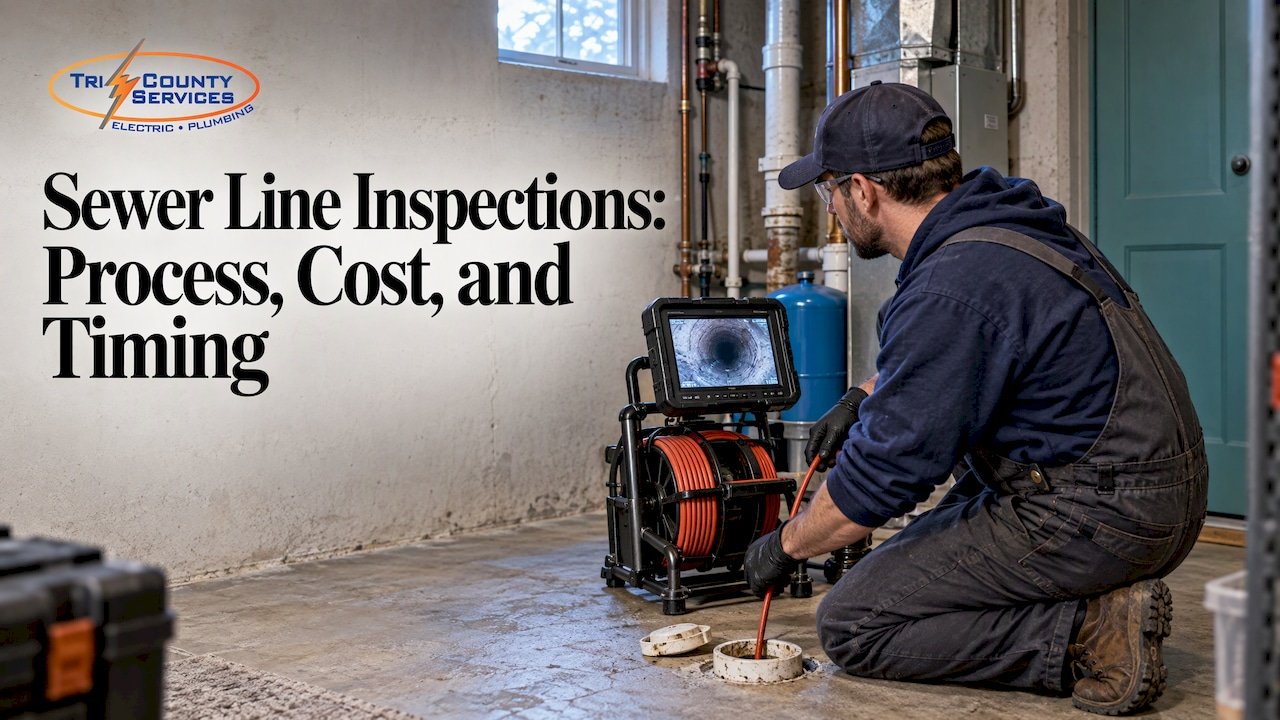

A sewer line inspection sends a waterproof camera through the pipe that carries wastewater from your house to the street, so you can see cracks, roots, sags and blockages on video instead of guessing. The camera is only half of the job. The other half is reading what it shows, and that takes experience. At Tri-County Services Electric & Plumbing, our Sewer Camera Inspection is listed at $250 to $400, and you can reach our office at (440) 253-0332 to schedule one anywhere we serve in Northeast Ohio.
TL;DR
- A camera goes in through a cleanout (a capped access pipe) and travels toward the street. A typical inspection runs 30 to 60 minutes and should end with a written report.
- Our Sewer Camera Inspection is $250 to $400. Cost depends on pipe length, access and whether the line must be cleared first.
- Book one before buying a home, when drains slow down or gurgle, when roots grow near the line, or when your pipes are old.
- Reading the footage correctly matters as much as getting it. A professional knows a sag from a blockage and a joint offset from a shadow.
- Call (440) 253-0332 and our team will schedule your inspection.
Table of Contents
- What a sewer line inspection actually is
- Why it matters before something fails
- When to schedule an inspection
- What happens during the inspection
- What the camera can show
- What a sewer line inspection costs
- Why a pro, not a rented camera
- If the camera finds a problem
- How to prepare for your appointment
- Promo: sewer camera inspection from Tri-County
- Perspective
- FAQ
- Sources
What a sewer line inspection actually is
Your house drains into a lateral, the underground pipe that runs from your foundation to the public sewer main. You own it and you maintain it, even though most of it is buried under your yard or driveway. Cities use different names for it: side sewer, building sewer, private lateral. It is the same pipe.
A camera inspection (also called a sewer scope) uses a small camera head on a flexible cable. It has an LED light and sends live video to a monitor. The camera is fed through a cleanout and pushed downstream toward the public sewer. The technician watches the screen, records the run and notes the distance from the entry point wherever something appears.
The point is simple. Nothing in your house tells you how the buried pipe looks. A toilet that flushes and a sink that drains do not prove the line is sound. They only prove water is still getting through.
Why it matters before something fails
A failed sewer line is not a quiet problem. A broken side sewer can push sewage back into sinks, toilets and bathtubs, which is both a health issue and an expensive mess. The same guidance says that a simple inspection can catch failures before they become serious, especially in sewers more than 25 years old or not made of PVC.
The cost gap is the real argument. Tacoma puts side sewer repair or replacement at an average of $5,000 to $15,000. A camera inspection costs a small fraction of that. The EPA also notes that knowing the condition of a sewer lets owners avoid emergency repair costs and premature replacement, because maintenance and repairs get scheduled on your terms instead of in the middle of a backup.
Many Northeast Ohio homes have older lines, so this matters here. Clay tile, cast iron and aging joints are all common in established neighborhoods. Tree roots find the weak spots in all of them.
When to schedule an inspection
There is no single national schedule, and the guidance varies with the age of the pipe and the trees around it. Two useful reference points:
- Seattle’s utility recommends inspecting a side sewer at least every 8 to 10 years, every 2 to 3 years if large trees or shrubs grow nearby, and when you are considering buying a home.
- One home inspection company suggests scoping newer homes every 5 to 10 years and older or tree-lined properties every 1 to 2 years, and right away when slow drains, gurgling, sewage odors or repeat blockages show up.
In practice, book an inspection in these situations:
- You are buying a house. Even a newer home can have a crushed lateral or a line that was never properly connected. A standard home inspection does not look inside the sewer pipe.
- Drains slow down in more than one fixture. One slow sink is usually local. A slow tub, a gurgling toilet and a slow laundry drain together point to the main line.
- The same clog keeps coming back. Clearing it treats the symptom. A camera shows why it returns.
- Mature trees stand near the line. Roots enter through joints and cracks.
- Your house has older pipe. Homes with cast iron pipes in particular deserve a look, because that material corrodes and scales over decades.
- You are planning a landscaping, driveway or addition project over the line’s path.
If you already see sewage backing up, stop using water and call us. Our guide to main sewer clog signs and when to stop water explains what to do while you wait.
What happens during the inspection
A good inspection follows a sequence. Here is what it takes at each step and where it goes wrong.
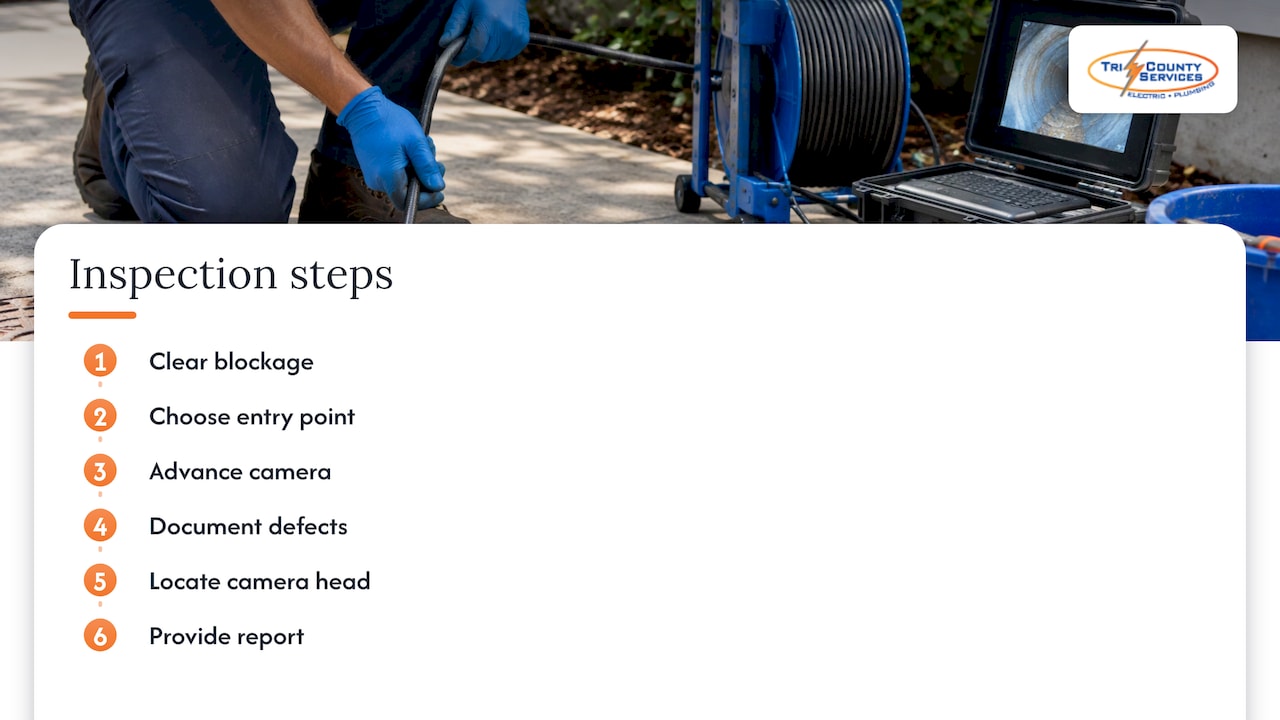
1. Clearing the line if it is blocked
A camera cannot see past a blockage. A proper inspection starts by clearing a blocked line so the camera can travel. If the line needs cleaning first, that is a separate task from the scope. Our Drain Cleaning is listed at $250 to $600, and Hydro Jetting is also available for heavier buildup.
2. Choosing the entry point
The best entry is a cleanout, the capped pipe usually found in the basement, crawlspace or outside near the foundation. If there is no accessible cleanout, the camera can go in through the roof vent stack or by temporarily removing a toilet. A wrong entry choice can mean the camera never reaches the main, or that it is forced through a fitting it should not pass.
3. Pushing the camera slowly
The technician zeros the distance counter and pushes the camera steadily while recording. Training material for plumbers notes that short-radius elbows, sanitary tees entered from the wrong direction and P-traps are hard to pass, and that pushing too hard can jam the head or damage the cable. Experience with these fittings is what keeps a routine inspection from becoming a stuck camera.
4. Pausing at every defect
Inspection guidance calls for pausing 5 to 10 seconds at defects to document them and for not running water in the house during the scope. If you are home, hold off on laundry, showers and flushing until the technician says the run is done.
5. Locating the camera head
When the camera finds a problem, the technician locates its position from the surface so you know where in the yard the trouble sits. That depth and location is what turns a video into a repair plan.
6. Getting the report
The results should come to you in writing. Portland’s guidance for property owners says to expect a copy of the video, a written findings report, a map of the lateral’s location and an assessment of its condition. That package is what you use to plan, to compare repair options and to share with a buyer or insurer.
What the camera can show
EPA documentation lists what camera inspection data capture: sediment, debris, roots, sags, offset joints, leaks and the condition of service connections. The same document notes that defect identification depends on the operator’s interpretation and picture quality, which is why the person reading the screen matters.
Here is how common images translate, based on a plumbing training lesson on defect interpretation:
| What you see on camera | What it usually means |
|---|---|
| Roots coming through a joint | A cracked pipe or loose joint, common in clay and older cast iron |
| Standing water in the pipe | A sag or “belly” where the line has settled |
| A step at a joint | Offset: two pipe sections no longer line up |
| Oval or flattened pipe | Deformation |
| Soil or gravel visible | A collapse or separated joint |
One caution applies to every inspection. The camera sees the inside surface of the pipe above the waterline. A belly full of water, a partial blockage and a real defect can look similar to untrained eyes, which is the reason a plumber who handles both cleaning and repair is useful to have on the call. We can clear what is clearable and tell you plainly what needs more.
What a sewer line inspection costs
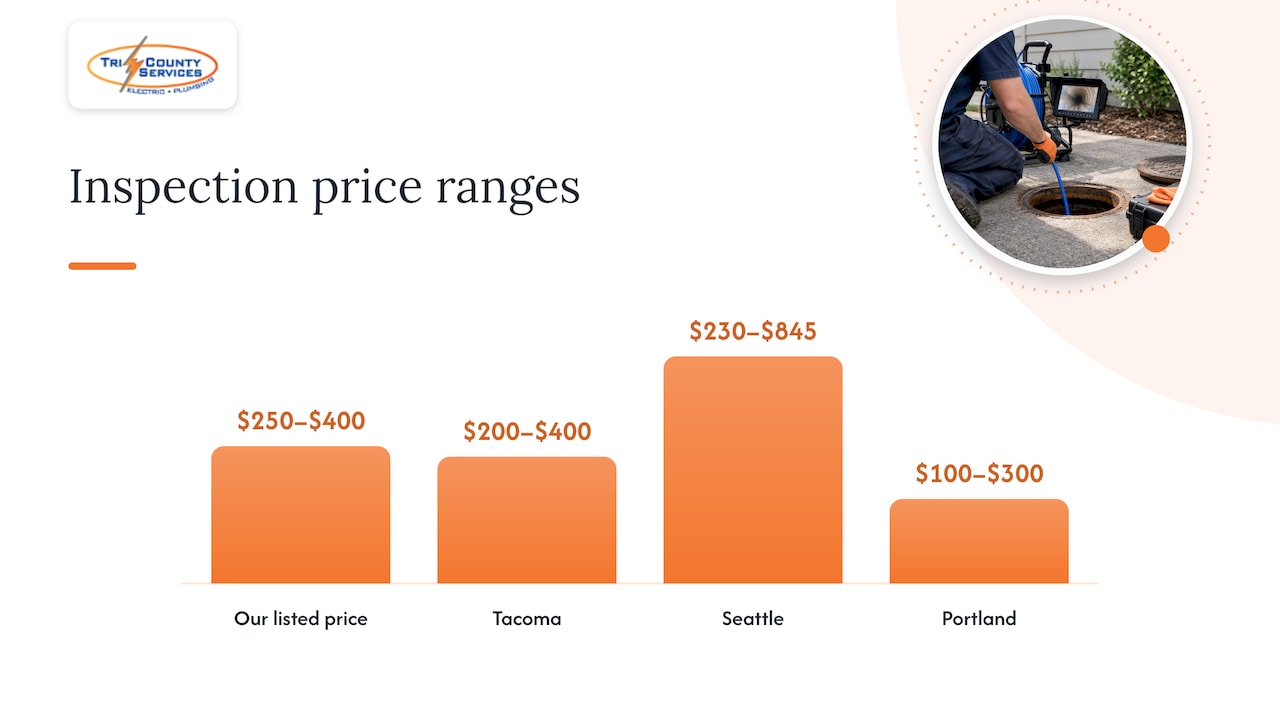
Our listed price for a Sewer Camera Inspection is $250 to $400. Here is how that compares with published figures from public agencies:
- Tacoma says a side sewer inspection averages $200 to $400, varying with pipe length and how hard the line is to reach.
- Seattle’s utility says a sewer video inspection generally costs $230 to $845, depending on the pipe’s condition.
- Portland’s property-owner guidance gives $100 to $300 for a scope and locate in that city.
Three things move the price in any market: how long the line is, how easy it is to reach, and whether the line must be cleared first. If there is no cleanout, entry through a roof vent or a pulled toilet takes more labor. A heavily clogged line takes cleaning before the camera can go in.
Against the repair figures above, the inspection is the cheapest step in the whole process. For a broader view of what plumbing work runs in our area, see our guide to 2026 plumbing costs.
Why a pro, not a rented camera
It is tempting to think a camera is just a camera. In practice, the equipment is the easy part. Three things go wrong when an untrained person runs a line:
- Damage. A camera forced through a tight fitting can jam or break the cable, and a stuck head means digging.
- Misreading. A shadow, a belly and a partial blockage look alike on a small screen, and a wrong call can lead you to dig up a pipe that only needed cleaning or to ignore one that needed repair.
- No usable record. Without distance-marked notes, a located defect and a written report, you have nothing to hand a buyer, an insurer or a repair crew.
The skill is learned over many inspections, and training programs say as much about interpreting drain camera footage. Our technicians run these inspections routinely, and we are a family-owned business that has served Northeast Ohio since 1975. Our flexible scheduling is built to keep disruption to your day small.
The same logic applies when you are tempted to snake a stubborn drain and call it done. Clearing without looking leaves you guessing about the cause. Our post on why camera first can save a $10,000 repair walks through that reasoning in detail.
If the camera finds a problem
Not every defect is an emergency. Tacoma’s tip sheet says owners are not required to make immediate repairs for cracks, debris, holes or roots in the pipe, but they should plan for repair or replacement. Treat it like a roof or furnace: a known, scheduled expense is far easier to manage than a surprise.
Your options generally fall into three groups:
- Cleaning or jetting, when the problem is buildup, grease or roots in an otherwise sound pipe.
- Rehabilitation, which repairs the pipe in place. The EPA’s rehabilitation handbook reports that rehabilitation costs are significantly less than replacement.
- Replacement or excavation, when the pipe has collapsed, separated or deformed beyond repair.
To understand what each path looks like, read what to expect from sewer line repair or replacement, our guide to new sewer line costs and options and the signs a line needs excavation before it collapses.
If the water issue you are chasing is inside the house, such as a leaking shower, the sewer scope will tell you whether the main line is part of the story or not.
How to prepare for your appointment
A little preparation makes the visit faster and the footage better:
- Locate your cleanout if you can, and clear a path to it.
- Avoid running water, flushing or doing laundry during the scope.
- Tell the technician about slow drains, odors, past backups and any earlier repairs.
- Mention nearby trees, additions or driveway work done over the line.
- If you are buying, share the inspection report with your agent.
Promo: sewer camera inspection from Tri-County
Our Sewer Camera Inspection is listed at $250 to $400 and covers the line from the point of access toward the street. If the camera shows a clog, we also offer drain cleaning and hydro jetting, and the same team handles pipe leak repair and other plumbing work. You can see all of our listed plumbing services and prices on our plumbing pricing guide. Call (440) 253-0332 to schedule an inspection.

Perspective
Most of the sewer emergencies we hear about started as small, quiet problems that nobody could see. A slow drain, a gurgle, a damp spot in the yard. By the time the basement floods, the pipe has usually been telling the story for months.
That is why we believe in looking first. A camera lets us show you the actual pipe, explain it in plain terms and put a price on the right fix instead of the biggest one. We have been a family-owned business in Northeast Ohio since 1975, and the relationships we have built come from treating homes with respect and quoting clear, upfront prices.
If you are weighing a DIY approach, our advice is to call a professional first. The risk is not the camera, it is the interpretation and the decisions that follow from it. You deserve a clear answer and a plan you can trust.
Lindsay Paramore
FAQ
How long does a sewer line inspection take?
Most take 30 to 60 minutes. That is the average cited by one county’s sewer lateral program. A line that needs clearing first, or one with no cleanout, takes longer.
How much does a sewer line inspection cost?
Our Sewer Camera Inspection is $250 to $400. Cost depends on pipe length, access and whether the line must be cleared before scoping. Call (440) 253-0332 for details on your property.
Do I need a sewer inspection when buying a house?
It is a smart step. A standard home inspection does not look inside the buried sewer line, and a camera can reveal root intrusion, sags or a failing pipe before closing. Seattle’s utility recommends an inspection when considering buying a home.
How do I know if my sewer line has a problem?
Watch for multiple slow drains, gurgling, sewage odors, repeat clogs or wet spots over the line. Any of these is a reason to schedule a camera inspection. If sewage is backing up, stop using water and call right away.
Can I see the video afterward?
You should receive the footage and a written report. Portland’s guidance for owners lists a copy of the video and written findings among the items to expect.
Sources
- Private Sewer Lateral Program FAQ, Pinellas County
- Inspecting your side sewer, City of Tacoma
- Side Sewers 101, Tacoma Permits
- Taking Care of Your Sewer Pipe, Seattle Public Utilities
- Guidance for property owners when hiring a sewer contractor, City of Portland
- Innovative Internal Camera Inspection and Data Management, EPA
- Sewer System Infrastructure Analysis and Rehabilitation Handbook, EPA
- Camera inspection and locating, HSM University
- Sewer Scope Inspections for Home Inspectors, InterNACHI
- What Is A Sewer Scope Inspection, HomeCheck Inspection Service