

Size your commercial generator to the calculated running kW, converted to kVA at the correct power factor, with allowances added for motor starting current and site derating. Before you buy, verify that target with professional load logging over a full operating cycle rather than nameplate math alone, and plan to exercise the unit monthly at 30% of standby capacity to avoid wet-stacking.
TL;DR:
- For mixed commercial loads without equipment power factor data, use 0.8 as a planning assumption, then add a 10% to 20% engineering margin.
- Motor inrush can reach five to seven times running current; obtain the motor’s actual starting curve and consider soft starters or staggered starts.
- A clamp logger or power quality analyzer used for 14 to 30 days can capture peak demand, seasonal loads, and motor starts that nameplates miss.
- Standby ratings cover outages and lack overload capacity, while prime ratings support variable loads for unlimited hours and continuous ratings suit constant, unchanging demand.
- Altitude above roughly 500 feet and temperatures above 77°F can reduce output, so apply the selected model’s manufacturer derating chart before ordering.
Table of Contents
- Step-by-step commercial generator sizing checklist
- How to calculate running kW and convert kVA, with a worked example
- Motor starting, inrush currents, and transient performance
- Generator duty ratings and what they mean for sizing
- Site derating: altitude, temperature, and fuel considerations
- Practical workflow: logging, calculators, and when to call a professional
- Tri-County Services Electric & Plumbing: how we approach commercial generator sizing
- Author perspective: lessons from commercial sizing projects
- Local commercial generator services and next steps
- FAQ
- Sources
Step-by-step commercial generator sizing checklist
Getting from a rough estimate to a specified genset follows a predictable sequence. Skipping steps is how facilities end up with equipment that trips offline the first time three compressors start together.
- Inventory every load and separate essential circuits (life safety, process-critical equipment) from nonessential ones you can shed during an outage.
- Pull nameplate data for each load and confirm your service is single-phase or three-phase at the correct voltage.
- Decide on duty type: standby power for occasional outages or prime/continuous for regular off-grid operation.
- Apply diversity and demand factors to your connected load total, then add a separate allowance for motor starting current.
- Log actual consumption where possible and cross-check your math against manufacturer derating charts before finalizing a model.
Each step feeds the next, and the biggest sizing errors happen when someone jumps straight from a load list to a generator model number without working through starting current and derates in between.
How to calculate running kW and convert kVA, with a worked example
Running kW is the sum of actual power draw from every load you expect online at once. For single-phase circuits, kW equals volts times amps times power factor, divided by 1,000. For three-phase, multiply by the square root of 3 (1.732) as well. Generators are rated in kVA, the apparent power the alternator must supply, so you convert kW to kVA by dividing by power factor: kVA = kW ÷ pf.
- Use nameplate power factor when it is listed on individual motors or equipment.
- For mixed commercial loads with no nameplate pf, an assumed 0.8 lagging power factor is a common planning figure until logged data refines it.
- Lighting and resistive heating loads run close to unity power factor, while motors and electronics pull it lower.
- Add an engineering margin, often 10 to 20%, on top of the running total before layering in transient allowances for motor starts.
A worked example: say a small commercial building runs 15 kW of lighting and office loads at 0.95 pf, a 20-ton rooftop HVAC unit drawing 18 kW at 0.85 pf, and a 10 kW process motor at 0.82 pf. Summed running kW is 43 kW. Converting each load to kVA and summing gives roughly 52 kVA of apparent power. Manufacturer sizing guidance stresses that engine brake kW and generator kVA are not interchangeable figures, and both need to be checked against the genset’s rating sheet before you add starting allowances.
Motor starting, inrush currents, and transient performance
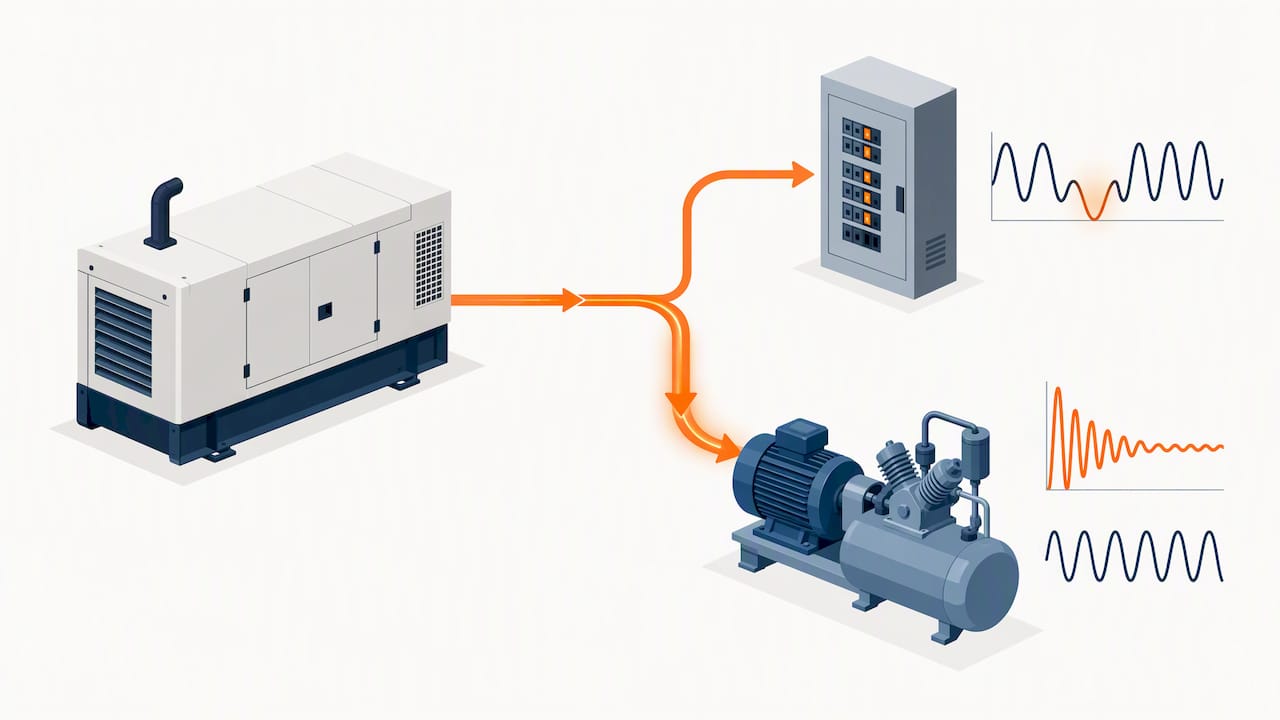
A motor’s locked-rotor or inrush current can run five to seven times its running current for a brief moment at startup, and that spike is what actually determines whether a generator stalls or holds voltage. Sizing for running load alone and ignoring this transient demand is one of the most common causes of underperforming commercial installations.
- Identify the largest motor or combination of simultaneous starts and calculate its locked-rotor kVA separately from running load.
- Consider soft starters or variable frequency drives to cut inrush current at the motor controller rather than the generator.
- Stagger motor starts through sequencing controls so the generator never faces more than one large inrush event at a time.
- Reduced-voltage starters lower starting current at the cost of starting torque, useful where load characteristics allow it.
- Keep load shedding logic ready so nonessential circuits drop off automatically if voltage sags during a start event.
Pro Tip: Ask your equipment supplier for the motor’s actual starting current curve instead of relying on a generic multiplier, since real inrush profiles vary by motor design and load.
Verifying these starting profiles with logging equipment or manufacturer motor data, rather than assumptions, is the difference between a generator that rides through a compressor start and one that drops the whole panel.
Generator duty ratings and what they mean for sizing
Not every generator is rated the same way, and the rating you choose changes how much continuous load the unit can legally and reliably carry. Manufacturer and ISO-aligned definitions break ratings into four categories.
- Emergency Standby Power (ESP) covers limited hours of backup during utility outages, with no overload capacity built in.
- Standby ratings are similar to ESP and sized for variable load during an emergency, not sustained full output.
- Prime power ratings allow unlimited running hours with a variable load and typically permit a limited overload for a defined duty cycle.
- Continuous ratings supply a constant, unchanging load for unlimited hours, common in off-grid or baseload applications.
Choosing standby when your facility actually needs prime power, or the reverse, changes the required kW and kVA figure and affects maintenance intervals. Confirm the rating type printed on the nameplate before finalizing any purchase, since a generator sized correctly for one duty class can be undersized for another.
Site derating: altitude, temperature, and fuel considerations
A generator’s nameplate output assumes standard conditions, and most commercial sites do not sit at those conditions. Altitude above roughly 500 feet and ambient temperatures above 77°F typically reduce output, and the correct multiplier comes from the manufacturer’s own derating chart rather than a rule of thumb.
- Pull the specific altitude and temperature derating curve for your chosen engine and alternator model rather than estimating.
- Account for enclosure ventilation and exhaust backpressure, since restricted airflow reduces effective output even at sea level.
- Fuel type affects available energy content: diesel, natural gas, and propane units derate differently under identical conditions.
- Rooftop or tightly enclosed installations may also face fire-rating and clearance requirements worth checking with a commercial roofing resource when siting an exterior unit.
Apply these derates to your running and starting kVA figures before ordering equipment, not after, since a unit that looks adequate on paper can fall short once site conditions are factored in.
Practical workflow: logging, calculators, and when to call a professional
Nameplate arithmetic gives you a starting estimate, but logged data tells you what a facility actually draws. A clamp logger or power-quality analyzer left in place for 14 to 30 days captures real peak demand, motor inrush events, and the diversity between circuits that a spreadsheet can’t predict.
- Run a logging campaign across a full operating cycle, including any seasonal peak like summer HVAC load.
- Use manufacturer or online sizing calculators as a sanity check on your math, not as a replacement for logged data.
- Call a professional when the facility carries mission-critical loads, has complex or simultaneous motor starts, requires generator paralleling, or has an unclear existing service configuration.
- Treat any uncertainty about transfer switch type or utility interconnection as a trigger to bring in an engineer before ordering equipment.
A homeowner swapping a small portable unit is one thing. A commercial facility with three-phase service, multiple large motors, and code-driven transfer switch requirements is a different project, and getting the sizing wrong there means downtime, tripped breakers, or an oversized unit that wet-stacks from chronic light loading.
Tri-County Services Electric & Plumbing: how we approach commercial generator sizing
We start every commercial generator project with an on-site survey to review your electrical system and motor loads before recommending a size. When logged data exists, we review it; when it doesn’t, we can suggest logging to capture real peaks and starting events instead of guessing from nameplates.
- We calculate running and starting kVA, apply site derates, and consider the duty rating appropriate for your operation.
- We plan the automatic transfer switch and service panel work alongside the generator itself to help avoid common mismatches.
- We factor in exercise requirements and help set a maintenance schedule that keeps the unit loaded enough to avoid wet-stacking.
- We handle full installation services according to code, not just equipment delivery.
Getting a commercial generator installation right from the start saves you from a return visit to fix an undersized or misconfigured system.
Author perspective: lessons from commercial sizing projects
The projects that go wrong almost always start with someone adding up nameplate amps and stopping there. Motor inrush, power factor, and site derates routinely push the real number well past that first estimate. A short logging period before you buy costs far less than an oversized genset or a system that drops load on its first real test.
— Lindsay Paramore
Local commercial generator services and next steps
If your facility is weighing a backup power project in Northeast Ohio, we handle the full path from survey to commissioning, and we can coordinate any panel or circuit work your sizing turns up along the way.

- Site survey and load review to establish your actual running and starting demand.
- Generator sizing calculations, duty rating selection, and site derate application.
- Automatic transfer switch installation and panel coordination.
- Commissioning, NFPA-aligned exercise scheduling, and ongoing maintenance planning.
| Service step | What we handle |
|---|---|
| Survey and logging | On-site load review and short-term data logging |
| Sizing and selection | Running/starting kVA calculations, duty rating, derates |
| Installation | Transfer switch, panel coordination, code-compliant wiring |
| Maintenance | Exercise scheduling and wet-stacking prevention |
If your project also touches panel capacity, a panel upgrade may need to happen alongside the generator install. Call us at (440) 253-0332 or visit our generator installation page to schedule a site visit or request a load-analysis quote.
FAQ
What is the 20/20 rule for generators?
The “20/20 rule” is an informal shorthand some installers use for sizing margin, not a formal standard, and definitions vary between sources. Rather than relying on an informal rule, size to your calculated running kW plus a verified motor-starting allowance and site derate, then confirm with logged data.
What is the 80% rule for generators?
The separate NFPA minimum-load guidance is to exercise diesel units at no less than 30% of standby capacity to prevent wet-stacking.
How big of a generator do I need to run a 2,000 sq ft house?
House size alone doesn’t determine generator capacity; what matters is the sum of the specific appliances, HVAC equipment, and circuits you want powered during an outage. A detailed load inventory, similar to the commercial sizing steps outlined for residential service panels, gives a far more accurate answer than square footage.
How long will a 5,000 W generator run on 5 gallons of gas?
Runtime depends on the generator’s fuel consumption rate at the load level you’re drawing, which varies by model and manufacturer, so there’s no single figure that applies across units. Check the specific generator’s fuel consumption chart at your expected load percentage rather than assuming a fixed runtime.
When should I call a professional instead of estimating generator size myself?
Call a professional whenever your facility has three-phase service, multiple large motors, mission-critical loads, or an unclear existing electrical configuration, since sizing errors in those situations can cause real downtime. A professional survey and load analysis catches starting current and derating issues that nameplate math alone tends to miss.
Sources
- NFPA 110 — Standards and statements on EPSS exercise and minimum load
- Electric power applications, engine & generator sizing (Cat/EMC technical guide)