


Under the National Electrical Code, every receptacle in a dwelling-unit bathroom area needs GFCI protection, per NEC 210.8(A)(1), no matter how far it sits from the sink or tub. The Consumer Product Safety Commission backs that protection for wet areas. We’re Tri-County Services Electric & Plumbing, and we help Northeast Ohio homeowners confirm theirs is installed and working.
TL;DR:
- Measure tub and shower distance along the shortest cord path, around rather than through barriers; adjoining room outlets within 6 feet need protection.
- Place receptacles within 3 feet horizontally of each basin, no more than 12 inches below its top, and never face countertop outlets upward.
- The required 20 ampere, 120 volt branch circuit generally cannot serve hallway or bedroom outlets, though limited same bathroom or multiple bathroom allowances apply.
- Test each GFCI monthly with TEST and RESET; if it fails to trip or will not reset, stop using it and call an electrician.
- Older wiring is not automatically subject to newer requirements, but replacing a receptacle or modifying its circuit generally triggers current protection rules for that work.
Table of Contents
- What the NEC requires for bathroom receptacles
- Which outlets in and near a bathroom need GFCI protection
- How the code measures 3 feet, 6 feet and restricted zones
- Circuit and amperage rules every homeowner should know
- GFCI receptacle or GFCI breaker: how to provide protection
- Testing and maintenance: how often and what failure looks like
- GFCI protection for hardwired bathroom fixtures beyond receptacles
- New installations versus existing bathroom wiring
- Common compliance issues and tips for code-compliant installs
- What the NEC counts as a bathroom area
- Why a professional inspection matters
- How we can help with your bathroom GFCI work
- FAQ
- Sources
What the NEC requires for bathroom receptacles
The legal basis for the rule is NEC Section 210.8(A)(1). It requires GFCI protection for all 125-volt through 250-volt receptacles installed in dwelling-unit bathroom areas. There is no “close enough to water” test in that language. If a receptacle lives in the bathroom, it is covered.
The code doesn’t dictate how you deliver the protection. GFCI protection may come from either a GFCI receptacle or a GFCI circuit breaker, as long as the device is readily accessible and installed per the manufacturer’s instructions and the code. Your electrician picks the approach that fits your panel, your wiring and how many outlets the bathroom has.
Recent code cycles tightened the wording. The 2023 clarifications confirmed that bathroom-area coverage doesn’t depend on distance to fixtures, and committee notes from the NFPA 70 process list bathrooms among the dwelling locations that must be GFCI-protected. Earlier editions left room for arguments about outlets “far enough” from the water. That room is gone.
Why does the code care so much? A GFCI watches the current going out and coming back on a circuit. If current takes an unintended path, the device can cut power quickly. Water, metal fixtures and bare skin make bathrooms the place where that matters most. Because hidden wiring mistakes can defeat the protection, we recommend a professional handle the work rather than a first attempt at home.
Which outlets in and near a bathroom need GFCI protection
Use this checklist to sort the outlets in and around your bathroom:
- Every receptacle in the bathroom area. The rule covers all of them, not only the one beside the sink.
- Receptacles within 3 feet of a basin. NEC places a receptacle within 3 feet horizontally of each basin’s outside edge, and that outlet must be protected.
- Receptacles within 6 feet of a tub or shower. Outlets within that distance need GFCI protection, including ones in an adjacent room if the cord path puts them inside the 6-foot reach.
- Outlets feeding other fixtures in the room. Plug-in heaters, towel warmers and vanity lighting outlets count if they are 125-volt through 250-volt receptacles.
- Outlets just outside the door. A hallway or bedroom outlet isn’t automatically exempt. Whether it needs protection depends on the cord path, so have a professional check it.
There are narrow exceptions. A receptacle installed at the factory inside an exhaust fan is treated differently from a wall outlet, and the committee notes explain that it doesn’t need GFCI protection unless the listing or installation instructions require it. Don’t read that as a loophole for ordinary wall receptacles.
If you’re unsure about any outlet, don’t guess and don’t open the wall yourself. A quick inspection tells you which outlets are protected, which share a protected circuit and which have nothing at all.
How the code measures 3 feet, 6 feet and restricted zones
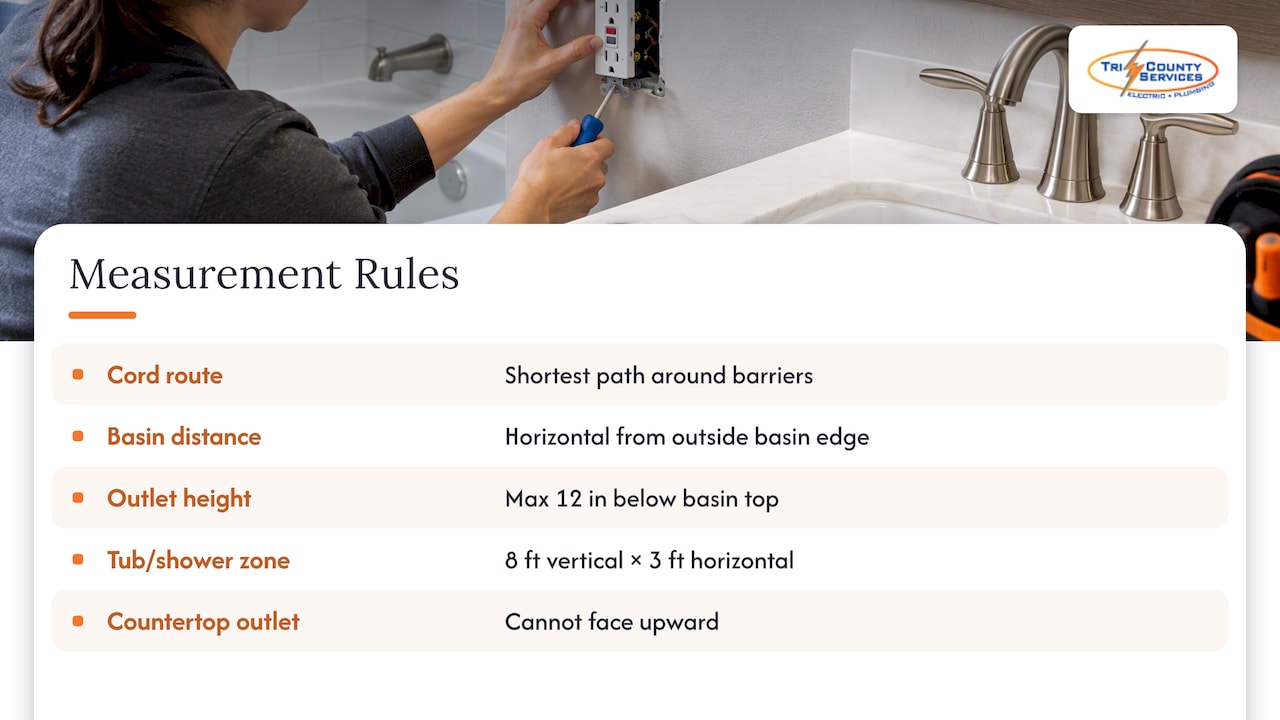
Distance isn’t measured in a straight line through the wall. The shortest path an appliance cord would follow without piercing a barrier is the yardstick. A hair dryer cord can’t go through a wall, but it can go around a doorway, which is why an outlet in the adjacent room may fall inside the range.
For the sink, measure horizontally from the outside edge of the basin. The receptacle sits on an adjacent wall or countertop, and no more than 12 inches below the top of the basin. Countertop-mounted receptacles can’t face up, where spills and splashes land directly in them.
Around tubs and showers, the 2020 edition introduced restricted zones, such as an 8-foot vertical by 3-foot horizontal zone where receptacles are prohibited or limited to listed devices. The 2023 edition then refined the measurement and installation guidance to settle earlier ambiguity.
Practical checks start with the basin edge, then trace the cord’s real path, then look for any outlet that sits in a zone around the tub or shower. Layout mistakes are expensive to fix after the tile is up, so we like to review placement before the wall is closed.
Circuit and amperage rules every homeowner should know
NEC 210.11©(3) requires at least one 20-ampere, 120-volt branch circuit to supply bathroom receptacle outlets. That circuit generally has no other outlets on it. There are limited allowances: it can serve multiple bathrooms, or serve equipment inside the same bathroom under specific conditions.
A circuit shared with a bedroom may not be suitable for bathroom receptacles. Ask a professional to assess the wiring and applicable code. A hair dryer, a space heater and a curling iron can draw a lot at once, which is why the code wants a circuit sized for bathroom loads.
A common mistake is a bathroom receptacle circuit that also runs out to a hallway or another room. It might pass unnoticed for years and then fail an inspection when you sell or remodel. Another is assuming that a GFCI outlet replaces circuit capacity: it adds protection, not amperage.
If your bathroom wiring is old or you can’t tell what feeds it, a professional can trace the circuit and tell you whether it meets the rule. That’s far safer than flipping breakers and guessing.

GFCI receptacle or GFCI breaker: how to provide protection
Two options satisfy the code, per EC&M’s code explainer:
- A GFCI receptacle at the outlet. One device can protect itself and downstream outlets, and the test and reset buttons sit right in the room.
- A GFCI circuit breaker at the panel. It protects the whole circuit, including every outlet on it, though resetting means a walk to the panel.
Renovation work is the usual trigger for upgrades. When a remodel replaces receptacles or modifies a circuit, current-edition protection generally applies to the work, so tell your electrician about any planned changes up front.
Pro Tip: A GFCI that looks powered can still be wired wrong, so have it tested after installation. The CPSC recommends regular testing of every GFCI in wet areas.
Testing and maintenance: how often and what failure looks like
The CPSC recommends testing GFCI receptacles monthly. Plug in a lamp or nightlight, press TEST and confirm the light goes out, then press RESET and confirm it comes back. A consumer survey from the CPSC found many homeowners never test, and some GFCIs are blocked or hard to reach.
Call us at (440) 253-0332 if:
- The device doesn’t trip when you press TEST.
- It won’t reset, or resets and trips again right away.
- The outlet is dead with no tripped breaker.
- It feels warm or smells scorched.
A device that fails these checks may be defective or wired wrong. Leave it unused until a professional looks at it.
GFCI protection for hardwired bathroom fixtures beyond receptacles
Most of the rule’s language targets receptacles, but a bathroom holds more than outlets. Exhaust fans, heated floors, whirlpool tubs, towel warmers and lighting are often hardwired, and whether they need GFCI protection depends on the fixture, its listing and the installation instructions. The rule that matters for receptacles doesn’t automatically answer the question for them.
Take the exhaust fan with a built-in receptacle. As the committee notes explain, the factory-installed internal receptacle isn’t covered unless the listing or instructions say it is. A fan with a night-light and heater, a whirlpool tub pump or a heated floor mat each comes with its own manufacturer instructions, and those instructions can call for GFCI protection even where the base code is silent.
We never treat that as a coin flip. Read the label and the installation sheet, then have a professional confirm what the fixture needs before it’s wired. Water exposure is the whole point of the rule, and hidden wiring mistakes are hard to spot once the ceiling or floor is closed. A fixture that tests fine today can still be one wet day away from trouble if it was never protected.
If you’re planning a new fan, floor heat or soaking tub, bring us in before demolition, not after the drywall goes up. Tell us what the fixture is, and we’ll tell you what protection it needs and how to provide it. Call (440) 253-0332 to talk it through.
New installations versus existing bathroom wiring
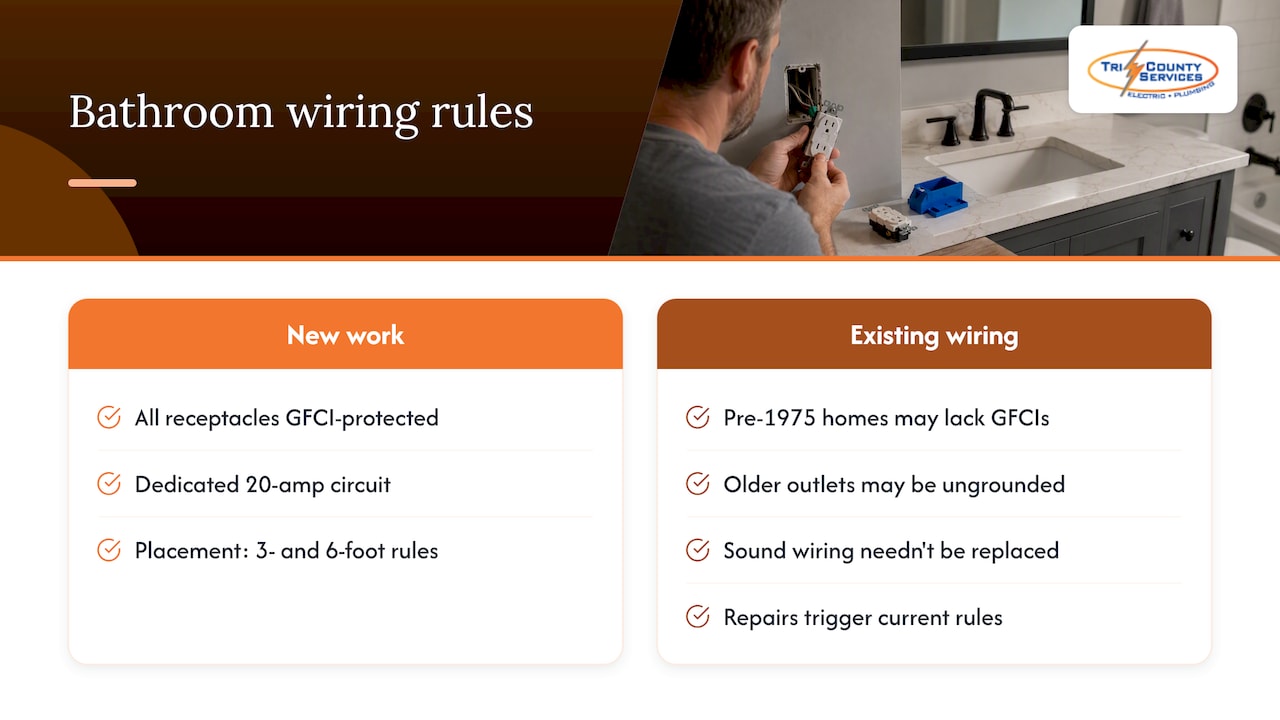
New work has to meet the current code. When we install a bathroom circuit in new construction or an addition, every receptacle is GFCI-protected, the dedicated 20-amp circuit is in place and placement follows the 3-foot and 6-foot measurements.
Existing wiring is a different story. Homes built before 1975 may lack GFCIs, and an older bathroom often has a lone ungrounded outlet on a shared circuit. Code generally doesn’t force a homeowner to rip out sound existing wiring just because the code changed. Remodeling and repair are where the line moves: replace a receptacle or modify a circuit, and current protection rules typically apply to that work.
CPSC calls updating electrical systems during renovation an important safety upgrade, and we agree. Adding GFCI protection to an old bathroom is one of the most valuable improvements you can make, even if no inspector requires it today.
Retrofitting is rarely as simple as swapping a device. Ungrounded wiring, shared circuits and old panels can complicate it, and a wrong fix can leave a GFCI that looks right and protects nothing. That’s why we start with an inspection of what’s behind the wall.
Common compliance issues and tips for code-compliant installs
These are common problems:
- Unprotected outlets in the bathroom area. One protected outlet may not protect the others unless they are wired downstream of it.
- Shared circuits. A bathroom circuit that also feeds a hallway or bedroom breaks the 210.11©(3) rule.
- Poor placement. Countertop receptacles facing up, outlets more than 12 inches below the basin top or devices inside a tub or shower restricted zone.
- Wrong wiring. Line and load swapped, which can leave a device that looks powered but doesn’t protect.
- Never tested. Plenty of installed GFCIs have never been pressed, and failures go unnoticed for years.
Tips for getting it right: plan receptacle locations before the walls close, confirm the circuit before choosing a device, test every GFCI after installation and again each month, and keep a record of what’s protected. Skip the weekend experiment with live wiring. When water, metal and electricity share a room, mistakes carry real consequences, and a professional installation is the safer first call.
What the NEC counts as a bathroom area
For this rule, a “bathroom” isn’t just a room with a tub. The code treats a bathroom area as an area including a basin and one or more of a toilet, urinal, tub, shower, bidet or similar plumbing fixture. A powder room with only a toilet and a basin qualifies. So does a half bath in a basement.
That definition matters because the GFCI requirement attaches to the area, not the room’s label. An outlet in a dressing area that opens directly into a bathroom without a door can fall within it, and a laundry room with a basin and a toilet may too. The wording is about fixtures and layout, so a floor plan with a creative name doesn’t change the answer.
Related locations such as kitchens, garages, basements, outdoors, laundry areas, sinks within 6 feet and bathtubs or showers within 6 feet have their own GFCI requirements, listed separately in the code. AFCI protection works differently and isn’t generally required for bathroom receptacles in the base NEC.
Not sure how your layout counts? Our team can walk the space and tell you what the code covers. For deeper reading on placement, see our bathroom outlet electrical code requirements post.
Why a professional inspection matters
GFCIs can appear to work but fail to provide protection, and bathroom circuits can be connected to other areas. Professional inspection catches wiring faults, bad grounds and missed receptacles that a quick look can’t. If you’re renovating or buying an older home, have the wet areas checked before you trust them. We inspect and fix them, and you can reach our office at (440) 253-0332.
— Lindsay Paramore
How we can help with your bathroom GFCI work

Our team can help with safe, code-compliant bathroom wiring. We’re family-owned in Northeast Ohio, and we’d rather you call a professional first than chase a hidden fault later. Here’s what we offer:
- GFCI receptacle and breaker installation
- Circuit evaluation and tracing
- Code-compliance inspections
- Related work such as electrical panel upgrades when a circuit needs more capacity
Many homeowners ask what jobs cost, and our electrical pricing guide lays out estimates. For a deeper look at the process, read how to install a GFCI outlet, or see our electrical repair service page.
| What you need | Our service |
|---|---|
| Check existing bathroom protection | Inspection and circuit evaluation |
| Add or replace GFCI protection | GFCI receptacle or breaker installation |
| More capacity on the bathroom circuit | Panel upgrade |
Call (440) 253-0332 to schedule an inspection or service.
FAQ
What GFCI code is required for a bathroom?
NEC 210.8(A)(1) requires GFCI protection for all 125-volt through 250-volt receptacles in dwelling-unit bathroom areas. NFPA’s guidance says this applies regardless of distance to sinks, tubs or showers.
Does a bathroom need a 15 or 20 amp GFCI?
The branch circuit is what the code sizes: at least one 20-ampere, 120-volt circuit must supply bathroom receptacle outlets under NEC 210.11©(3). A professional can confirm your circuit and match the device to it.
What are the GFCI requirements for 2026 according to the NEC?
The 2023 NEC clarifications remain the basis of the bathroom rules discussed here, and local jurisdictions adopt code editions on their own schedules. Ask your inspector or electrician which edition applies to your project.
Does every bathroom require a GFCI?
Yes. Every dwelling-unit bathroom area needs GFCI protection for its receptacles, including half baths and powder rooms. Protection can come from a GFCI receptacle or a GFCI breaker.
How often should I test a bathroom GFCI?
Test monthly, as the CPSC recommends, by pressing TEST and RESET with a lamp plugged in. If it fails either step, call a professional.