
TL;DR:
- Multiple signs like persistent backups, foul odors, and soggy yard patches indicate a possible main sewer line failure. A professional sewer camera inspection is necessary to accurately assess the issue and determine whether trenchless repair or excavation is required. Early detection reduces costs and prevents emergencies caused by delayed repairs.
If your home has multiple slow drains, sewage backing up at the lowest fixture, foul sewage odors inside or in the yard, soggy or unusually lush patches of grass, and persistent gurgling across several fixtures, those five signs together often point to a structural main-line failure that may require excavation. The right next step is not a bottle of drain cleaner. It is a professional sewer camera inspection.
The short version:
- Multiple slow drains at once — main-line obstruction or sag, not a branch clog
- Sewage backup at the lowest fixture — complete or near-complete blockage deep in the line
- Foul sewage odors indoors or in the yard — cracked or separated pipe letting gas escape
- Soggy, lush, or sunken yard patches — active underground leak or pipe breach
- Persistent gurgling across fixtures — trapped air from a partially collapsed or bellied line
Any two of these showing up together is a reason to call a professional today, not next week.
Table of Contents
- 5 signs your sewer line may need excavation — and what each one means
- Why these signs are not ordinary clogs — and why DIY fixes make things worse
- How professionals decide between trenchless repair and open excavation
- What to do right now to limit damage while you arrange an inspection
- What to expect next: timelines and cost factors for sewer excavation
- Key Takeaways
- What homeowners should actually expect — a perspective on sewer line repairs
- Sewer inspection and repair services from Tri-County Services Electric & Plumbing
- Useful sources
- FAQ
5 signs your sewer line may need excavation — and what each one means
1. Multiple slow drains throughout the house
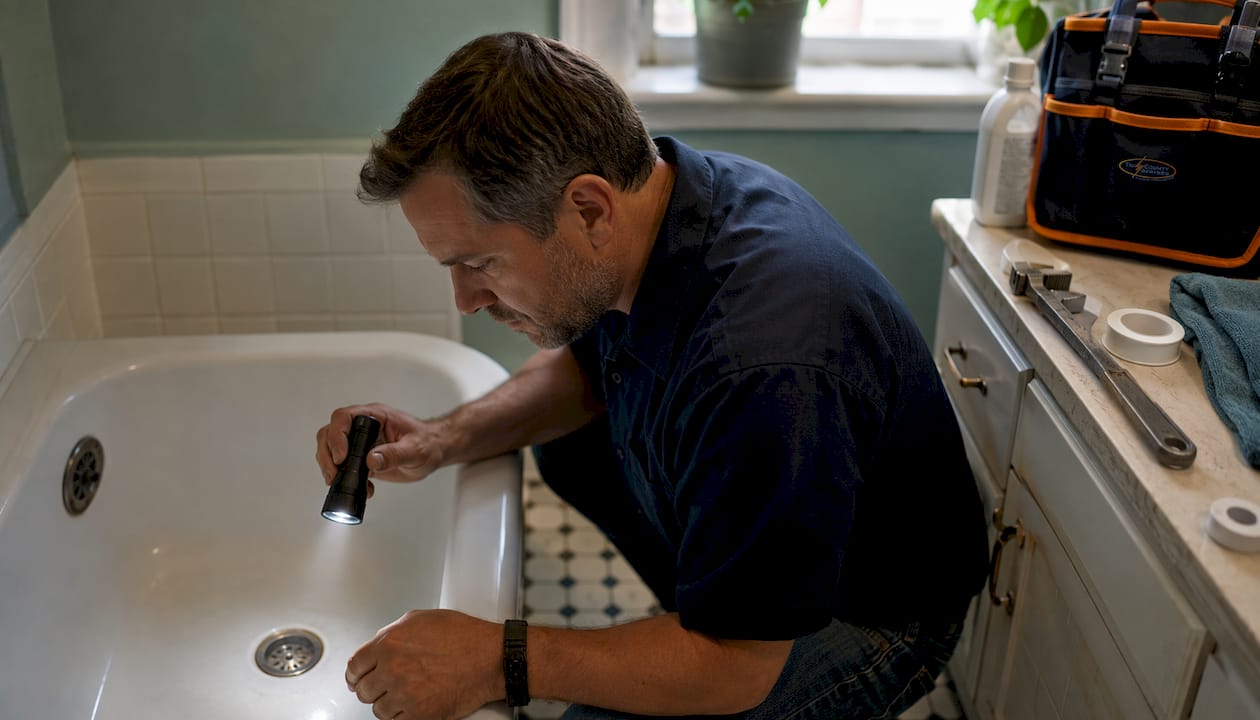
One slow drain is almost always a local clog. When the kitchen sink, the bathroom tub, and the basement floor drain are all sluggish at the same time, the problem is past every individual fixture and somewhere in the main lateral. Simultaneous slow drainage across multiple fixtures is a primary indicator of a main-line obstruction rather than a branch-level clog. Underground causes range from a heavy root mass to a pipe belly — a low spot where solids accumulate — to a partially collapsed section. A belly is a structural defect, not an obstruction, so no amount of snaking will fix it permanently.
2. Sewage backup at the lowest fixture
When wastewater has nowhere to go, it finds the path of least resistance: the lowest drain in the house. That is usually a basement floor drain or a ground-floor toilet. If flushing an upstairs toilet causes the basement drain to gurgle or overflow, the blockage is deep in the main line. Sewage coming up through floor drains is rated a critical-severity sign, requiring prompt response to prevent further damage. At that stage, the line is either completely blocked or partially collapsed.
3. Foul sewage odors inside or around the yard
A properly functioning sewer system is airtight below the vent stacks on your roof. If you smell rotten eggs or raw sewage near a drain, in the basement, or while walking across the yard above where your lateral runs, a crack or separated joint is venting gas into your living space or soil. Outside, the smell near the cleanout is a strong indicator of a break in the line between the house and the street. That kind of joint failure or lateral crack often shows up on camera as a grade-4 or grade-5 defect, the range that typically pushes a job toward replacement rather than lining.
4. Soggy, unusually lush, or sunken yard patches
Grass that is inexplicably greener in one strip, soft ground that gives underfoot, or a small sinkhole along the path of your lateral are all telling you the same thing: sewage is leaking into the soil. Surface saturation and localized overgrowth commonly track directly above a failing lateral. A visible sag in the yard over a known lateral run is rated critical severity. Sinkholes form when soil washes through a crack repeatedly, eventually leaving a void. Left alone, that void can undermine a driveway, a sidewalk, or even a foundation. Tree roots near the line accelerate this process — they follow the moisture and widen every crack they find. The connection between underground leaks and foundation seepage is well documented, and it is one reason early detection matters so much.
5. Persistent gurgling or bubbling across fixtures
A healthy plumbing system is quiet. Gurgling happens when air gets trapped in the line and pushes back up through the nearest fixture. If your toilet bubbles after a flush, or the shower drain gurgles when the kitchen sink empties, your main line is partially blocked, cracked, or bellied. Gurgling sounds that appear across multiple fixtures — not just one — point to a restriction downstream in the lateral, not a localized issue.
Pro Tip: Symptoms alone cannot tell you whether trenchless repair is still an option or whether excavation is the only path. A sewer camera inspection is the only way to see what is actually happening inside the pipe and to get a PACP grade that drives the repair decision.
Why these signs are not ordinary clogs — and why DIY fixes make things worse
Most sewer-line failures develop over weeks or months. By the time you notice backups, the underlying structural deterioration — root intrusion, shifting soils, corrosion — has typically been building for some time. A plunger or a bottle of chemical cleaner addresses none of that. Worse, aggressive snaking can dislodge debris that was partially sealing a crack, turning a slow leak into an active one.
The health risks are real. Sewage exposure carries bacterial and viral hazards. Chronic moisture from a seeping lateral feeds mold growth on lower-level walls. Structurally, a leaking lateral erodes the soil around it, which can cause foundation settlement and surface sinkholes.
Professionals consistently advise homeowners to skip extended DIY attempts when multiple fixtures are affected. Store-bought chemicals are formulated for grease and hair in branch lines — not for root masses, pipe bellies, or collapsed sections in a main lateral. Calling a professional for a camera inspection before attempting any repair is the step that prevents a manageable problem from becoming an emergency excavation.
Waiting until raw sewage appears inside the home typically forces emergency, higher-cost excavation. Diagnosing earlier allows scheduled, non-emergency work and meaningfully lower overall costs. Tri-County Services Electric & Plumbing follows an inspection-first approach precisely because the camera run is what separates a repair that can stay trenchless from one that genuinely requires a dig.
How professionals decide between trenchless repair and open excavation
Camera footage reveals pipe integrity, joint condition, root mass, bellies, and PACP grades — the standardized scoring system that drives the repair decision. Grade-2 and grade-3 defects are often trenchless candidates. Grade-4 and grade-5 defects, which include sections with 50% or greater diameter reduction or missing wall sections, typically push toward replacement or excavation. A belly cannot be corrected by lining because lining does not restore slope.
Excavation becomes necessary when the defect type, access conditions, or repair scope require open access to the line. Physical obstacles like driveways, mature trees, or utilities can push a job toward open excavation even when trenchless options exist in theory.
| Method | Best fit | Surface impact | Slope correction |
|---|---|---|---|
| Trenchless lining (CIPP) | Grade-2/3 defects, intact pipe shape | Minimal | No |
| Pipe bursting | Deteriorated pipe, consistent grade | Minimal | Limited |
| Open excavation | Grade-4/5, collapse, belly, access constraints | Significant | Yes |
What to expect during a professional inspection:
- Camera run through the cleanout or a pulled toilet to map defects and measure footage
- Above-ground pipe marking with a locating transmitter
- 811 utility marking request before any scheduled excavation
- Permit pull from the local authority having jurisdiction
- Written repair options with method rationale based on PACP findings
The standard inspection workflow — camera, locate, 811, permit, repair plan — is what separates an evidence-driven repair from a guess.
What to do right now to limit damage while you arrange an inspection
- Stop flushing repeatedly if backups are occurring. Every gallon adds pressure and increases overflow risk.
- Photograph or video any backup, wet yard patches, or sinkholes before cleanup. That documentation helps the technician narrow the problem area before the camera goes in.
- Avoid barefoot contact with any sewage-affected area and ventilate the space.
- Stop using chemical drain products. They can obscure camera results and will not fix a structural defect.
- Locate your sewer cleanout and keep the access clear. If your property lacks one, adding a permanent cleanout is often the first step a technician will recommend.
- Note the time, frequency, and which fixtures are affected. That pattern tells the technician a lot before the camera even enters the pipe.
- Call a professional for a sewer camera inspection and confirm that 811 utility marking is requested before any scheduled dig.
Pro Tip: Review the pre-call checklist from Tri-County Services Electric & Plumbing before your service appointment. Having the cleanout location, symptom timeline, and yard observations ready cuts diagnostic time significantly.
What to expect next: timelines and cost factors for sewer excavation
| Stage | Typical duration | Why it matters |
|---|---|---|
| Camera inspection | 1–3 hours | Confirms defect location, extent, and repair method |
| 811 utility marking is required before any excavation by law and usually takes a few business days | ||
| Permit pull times vary by jurisdiction and are mandatory for structural lateral repair | ||
| Physical excavation and repair typically takes a few days for a standard residential lateral | Actual pipe replacement or section repair | |
| Surface restoration timing depends on surface type and repair extent after backfill |
Cost factors for open excavation vary widely. Depth and length of the lateral, surface type (concrete driveway versus lawn), presence of mature trees or utilities, required grade correction, local permit fees, and whether the job is scheduled or emergency all affect the final number. Early detection allows scheduled, non-emergency diagnostics and meaningfully lower costs compared with emergency excavation.
Precise estimates require an on-site camera inspection and written quotes. Any contractor who quotes excavation without a camera run first is guessing.
Key Takeaways
The five warning signs of a sewer line that may need excavation are multiple simultaneous slow drains, sewage backup at the lowest fixture, foul odors indoors or in the yard, soggy or sunken yard patches, and persistent gurgling across fixtures — and a professional camera inspection is the only way to confirm whether excavation is required.
| Point | Details |
|---|---|
| Five signs to watch for | Slow drains, sewage backup, foul odors, soggy yard patches, and persistent gurgling signal main-line failure. |
| Camera inspection is required | Symptoms alone cannot determine whether trenchless repair or excavation is the right method. |
| Grade-4/5 defects mandate excavation | PACP grades from the camera run are the deciding factor; bellies cannot be corrected by lining. |
| Act before it becomes an emergency | Early inspection allows scheduled work; waiting until sewage surfaces indoors forces higher-cost emergency excavation. |
| Tri-County Services Electric & Plumbing | Serves Northeast Ohio with an inspection-first approach to sewer diagnostics and repair planning since 1975. |
What homeowners should actually expect — a perspective on sewer line repairs
The conversation around sewer line problems tends to jump straight to the worst-case scenario—a torn-up yard, a week without plumbing, and a bill that wrecks the budget. This fear is understandable, but it often leads homeowners to delay calling a professional, which is exactly what turns a manageable repair into that worst-case scenario.
What gets missed in most of the advice out there is that excavation is not a default. It is a targeted decision driven by what the camera actually shows. A grade-2 root intrusion in an otherwise intact clay pipe is a very different job from a grade-5 collapse under a concrete driveway. Treating them the same way — either by panicking or by ignoring the symptoms — serves nobody.
Northeast Ohio adds its own complications. The freeze-thaw cycles here are hard on older clay and Orangeburg pipe. Mature trees are everywhere, and their roots do not respect property lines or lateral paths. Soil movement from frost heave shifts joints that were perfectly aligned when the house was built in the 1960s. These are not exotic problems — they are the routine findings on a camera run in this region.
The homeowners who come out of a sewer repair with the least disruption and the lowest cost are almost always the ones who called early, got the camera in the pipe, and made a decision based on what the footage showed rather than what they feared or hoped. That is the only sequence that works.
Sewer inspection and repair services from Tri-County Services Electric & Plumbing
Northeast Ohio homeowners dealing with any of the five signs above have a straightforward next step: schedule a professional sewer camera inspection before the problem forces an emergency call.

Tri-County Services Electric & Plumbing has served the region since 1975 with an inspection-first approach to every sewer and drain problem. The team handles the full scope: sewer camera inspection, hydrojetting and descaling, trenchless lining, open excavation and lateral replacement, utility locating and permit coordination, and surface restoration planning. Whether the job turns out to be a targeted spot repair or a full lateral replacement, the camera run is always the first step — because guessing costs more than knowing.
Scheduled appointments and emergency response are both available. To book a sewer camera inspection or speak with a technician about your symptoms, contact Tri-County Services Electric & Plumbing at tricountyelectricservice.com or call (440) 325-0136.
Useful sources
- Plumbing camera inspections: how they work and why they matter — Tri-County Services Electric & Plumbing
- Top 5 signs you need emergency plumbing service — Tri-County Services Electric & Plumbing
- Hydrojetting and descaling: a cast-iron sewer line case study — Tri-County Services Electric & Plumbing
- 7 warning signs your sewer line is broken — TID Trenchless
- When is sewer excavation necessary? — Mountain West Hydrojetting
- Diagnosing sewer line problems: signs and methods — Sewer Repair Authority
FAQ
What are the first signs of a failing sewer line?
The earliest signs are usually slow drains across multiple fixtures, gurgling toilets, and a faint sewage smell that comes and goes. These symptoms can appear weeks or months before a full backup.
Can a sewer line collapse without any warning?
Rarely. Most collapses are preceded by repeated slow drains, gurgling, or odors that homeowners attribute to minor clogs. A camera inspection often catches structural deterioration before a full collapse occurs.
How do I know if I need excavation or trenchless repair?
You cannot know from symptoms alone. PACP grades from a camera run determine the method: grade-4 and grade-5 defects, collapsed sections, and pipe bellies typically require excavation, while lower-grade defects are often trenchless candidates.
How long does sewer line excavation take?
Physical excavation and repair on a standard residential lateral typically takes 1–2 days. Add 2–3 business days for 811 utility marking and up to 5 business days for permit processing, plus 1–3 days for surface restoration depending on what was disturbed.
Should I try to fix a sewer backup myself before calling a professional?
No. If multiple fixtures are affected or backups are recurring, the problem is almost certainly in the main lateral, where chemical cleaners and consumer-grade snakes cannot reach the actual defect. Calling a professional for a camera inspection first protects both your health and the pipe.