

Lights flicker when an A/C turns on because the compressor motor creates a sudden voltage drop across your home’s electrical system. The technical term for this is inrush current, and it describes the brief surge of power a motor demands the moment it starts. Startup surge runs 3–5 times the running load, lasting under one second in a healthy system. That brief dim is normal physics. What is not normal is flickering that lingers, worsens, or comes with strange sounds or smells. Understanding the difference protects your home and your wallet. If your lights are flickering more than usual or you suspect an electrical issue, call our team at (440) 253-0332 for a professional inspection and peace of mind.
Why do lights flicker when the A/C turns on?
Inrush current is the root cause of flickering lights when HVAC starts. When your air conditioner’s compressor kicks on, it pulls a massive burst of electricity to overcome the motor’s initial resistance. That surge temporarily drops the voltage available to every other circuit in your home, and your lights respond by dimming or flickering for a fraction of a second.
Voltage drops spread from the main bus bars through connected circuits, so lights closest to your electrical panel often show the most noticeable flicker. This is not a sign of danger on its own. It is simply the physics of a large motor sharing a panel with your lighting circuits.
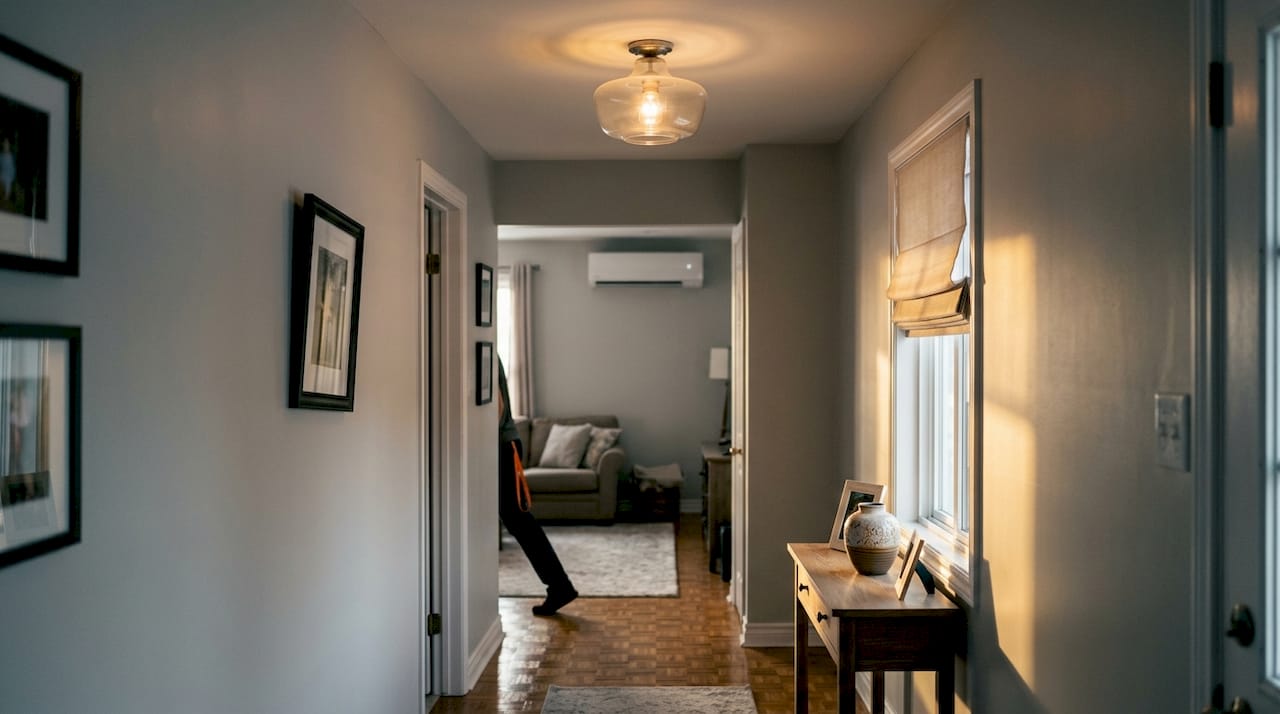
The key word is “brief.” A flicker that resolves in under one second and has been consistent since your A/C was installed is almost always normal. The moment that pattern changes, or the flicker stretches past one or two seconds, you are looking at something worth investigating.
How to tell if the flickering is normal or a problem
Flickering is considered problematic when it lasts longer than 1–2 seconds, dims lights by more than 20%, or continues while the A/C is running rather than only at startup. Those three criteria are your diagnostic baseline.
Signs the flickering is normal:
-
Lasts less than one second at the exact moment the compressor starts
-
Affects only lights near the panel or on the same circuit
-
Has been consistent since the A/C was installed with no change in severity
-
No accompanying sounds, smells, or breaker trips
Signs you have an electrical problem:
-
Flickering lasts more than 1–2 seconds or happens repeatedly during a single startup
-
Lights dim noticeably throughout the whole house, not just one area
-
Flickering occurs while the A/C runs, not just at startup
-
You hear buzzing or crackling near outlets, switches, or the panel
-
You smell burning plastic or notice warm outlet covers
-
Breakers trip when the A/C starts
A consistent flicker pattern since installation points to normal inrush current. A pattern that is getting worse over time points to a wiring or equipment issue that will not fix itself.
Pro Tip: Take a short video of the flickering on your phone. Note the time of day, which lights are affected, and whether you hear any sounds. This gives an electrician a concrete starting point instead of a vague description.
What are the common electrical causes of flickering lights with A/C?
Most flickering issues tied to A/C startup come from the electrical system, not the HVAC equipment itself. Here are the most common culprits, ranked from most to least frequent.
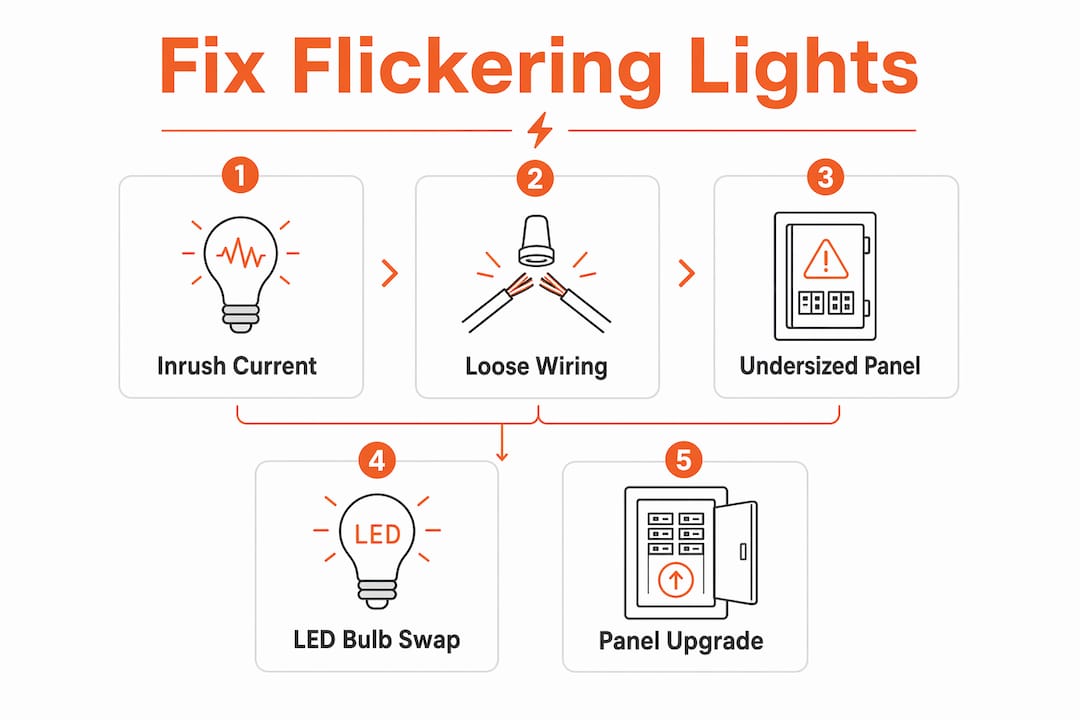
1. Inrush current on a shared circuit The compressor’s startup surge pulls power from every circuit connected to the same panel bus. If your A/C shares a circuit with lighting loads, the voltage drop is more severe. This is the most common cause and the easiest to fix with a dedicated circuit.
2. Loose or corroded wiring connectionsLoose wiring creates arcing, which generates heat and causes noticeable flickering alongside buzzing sounds, burning smells, or warm outlets. Arcing is a fire hazard. It does not resolve on its own and gets worse over time as connections oxidize further.
3. An undersized electrical panelOlder homes with 100-amp service panels often experience flickering with newer, high-demand A/C units because the panel simply lacks the capacity to handle the startup surge cleanly. Upgrading to a 200-amp panel is the standard fix for homes with this limitation. Northeast Ohio has a large stock of pre-1980 housing, and many Cleveland-area homes still run on panels that were sized for a fraction of today’s electrical loads.
4. A failing A/C start capacitor Flickering that worsens after A/C service or appears suddenly in a previously stable system often points to a failing capacitor. The capacitor’s job is to give the compressor motor an extra boost at startup. When it weakens, the motor draws even more inrush current than normal, making the flicker more severe and prolonged.
5. Incompatible LED bulbs or dimmersLED and dimmer mismatches cause flickering that has nothing to do with your A/C or electrical panel. If only certain fixtures flicker and they use dimmable LEDs on a standard dimmer, swap the bulb or replace the dimmer with an LED-compatible model before calling an electrician. This simple check prevents unnecessary service calls.
Statistic to know: The compressor’s startup surge runs 3–5 times its normal running load. On a 5-ton residential unit, that can mean a momentary draw of 100 amps or more hitting your panel at once.
What are the most effective fixes to stop flickering lights with A/C?
Installing a dedicated circuit for the A/C is the most effective professional solution to prevent flickering caused by startup surges. It isolates the compressor’s inrush current from your lighting circuits entirely. Here is a practical breakdown of your options, from least to most involved.
Quick checks you can do yourself:
-
Swap incompatible LED bulbs for bulbs rated for use with dimmers
-
Replace standard dimmers with LED-compatible dimmer switches
-
Check that the A/C’s circuit breaker is the correct amperage for the unit
Professional fixes that resolve the root cause:
-
Dedicated A/C circuit: An electrician runs a separate circuit from the panel directly to the A/C unit. This is the single most effective fix for flicker caused by shared circuits.
-
Hard start kit installation: Hard start kits reduce compressor inrush current by providing an auxiliary energy boost at startup, which cuts the voltage drop your lights experience. They are cost-effective and require no major panel work.
-
Panel upgrade: Homes with older service panels that cannot handle modern loads need a capacity upgrade. Moving from 100 amps to 200 amps gives your system the headroom to absorb startup surges without affecting other circuits.
-
Wiring inspection and repair: An electrician checks all connections at the panel, switches, and fixtures for looseness, corrosion, or damage. This is non-negotiable if you have any of the warning signs listed above.
| Fix | Best for | Invasiveness |
|---|---|---|
| LED bulb or dimmer swap | Isolated fixture flicker | None, DIY |
| Hard start kit | Mild to moderate whole-home flicker | Low, HVAC tech |
| Dedicated A/C circuit | Persistent flicker at startup | Moderate, electrician |
| Panel upgrade | Older homes, severe or widespread flicker | High, professional electrician |
Pro Tip: Ask your electrician to inspect the main neutral connection while they are at the panel. A loose main neutral causes house-wide voltage imbalances and widespread flickering. It is one of the most dangerous and most overlooked causes of flicker in older homes.
When should you call a professional electrician for A/C flickering?
Most flickering issues linked to A/C startup stem from the electrical system, not the HVAC equipment. That means your first call should go to a professional electrician, not an HVAC technician, unless the flicker appeared immediately after A/C service.
Call an electrician immediately if you notice any of the following:
-
Burning smell near the panel, outlets, or switches
-
Buzzing or crackling sounds from walls or fixtures
-
Breakers that trip when the A/C starts
-
Flickering that affects the entire house at once
-
Outlets or switch covers that feel warm to the touch
-
Flickering that has gotten noticeably worse over weeks or months
Call an HVAC technician if the flicker appeared right after A/C maintenance, if the A/C struggles to start or cycles off quickly, or if the compressor makes grinding or clicking sounds. A failing capacitor is an HVAC repair, not an electrical one. For complex cases, scheduling both an electrician and an HVAC technician at the same time saves time and prevents misdiagnosis.
Severe, rapid strobe-like flickering accompanied by buzzing or burning smells signals arcing connections that pose an immediate fire hazard. In that situation, cut power to the affected circuit at the breaker and call a professional electrician before restoring power.
Pro Tip: Before any professional visit, check your summer electrical safety basics. Confirm your panel’s breaker labels are accurate and note which circuits the flickering affects. Accurate information cuts diagnostic time significantly.
Key Takeaways
Lights that flicker when an A/C turns on are caused by inrush current, but persistent, worsening, or symptom-accompanied flickering signals an electrical problem that requires professional diagnosis and repair.
| Point | Details |
|---|---|
| Normal flicker is brief | A flicker lasting under one second at startup is normal inrush current behavior. |
| Know the warning signs | Flickering over 1–2 seconds, dimming above 20%, or whole-home flicker signals a real problem. |
| Causes vary by home age | Older homes with 100-amp panels are especially vulnerable to flicker from modern A/C loads. |
| Hard start kits are low-cost fixes | Installing a hard start kit reduces compressor inrush current without major electrical work. |
| Electricians come first | Most A/C-related flickering originates in the electrical system, so call an electrician before an HVAC tech. |
What I’ve learned after years of watching homeowners chase the wrong fix
Homeowners almost always blame the air conditioner first. The A/C just turned on, the lights flickered, so the A/C must be broken. That logic feels right but leads people to schedule HVAC service calls that find nothing wrong, because the problem was never in the A/C to begin with.
The electrical system is the silent partner in this situation. A panel that was adequate in 1978 was not designed for a modern 4-ton central air unit, a refrigerator with a compressor, an EV charger in the garage, and a home office full of electronics all running at once. The A/C startup just happens to be the event that exposes the gap.
What I find most telling is the pattern. Flickering that has been the same since day one is almost never an emergency. Flickering that is getting worse month by month is always worth investigating, even if it still resolves in a second or two. The wiring or connection that is slowly failing will eventually fail completely, and that failure is rarely convenient or cheap.
Routine electrical panel inspections catch these slow-developing problems before they become urgent. Northeast Ohio homeowners running older homes through another hot summer are exactly the people who benefit most from that kind of proactive check. The cost of an inspection is a fraction of the cost of an emergency repair or, worse, a fire investigation.
— Carla
Tri-County Services Electric & Plumbing can diagnose and fix your flickering lights
Flickering lights tied to your A/C are a signal your electrical system is telling you something. Tri-County Services Electric & Plumbing has been diagnosing and repairing exactly these problems for Northeast Ohio homeowners since 1975.
The professional electricians at Tri-County Services Electric & Plumbing handle electrical repair and diagnosis for flickering lights, loose connections, panel overloads, and dedicated circuit installations. If your Cleveland or Akron area home needs a panel upgrade to handle modern A/C loads, the team can assess your current capacity and recommend the right solution. Tri-County Services Electric & Plumbing works around your schedule and treats your home with care. Call (440) 325-0136 to book an inspection before the next heat wave hits.
FAQ
What causes lights to flicker when the A/C turns on?
The A/C compressor’s startup draws 3–5 times its normal running current, creating a brief voltage drop that causes lights to dim or flicker. This is called inrush current and is normal if it lasts under one second.
Is it dangerous when lights flicker with the A/C?
Brief flickering at startup is not dangerous. Flickering that lasts more than 1–2 seconds, worsens over time, or comes with buzzing sounds or burning smells indicates a wiring or panel issue that requires immediate professional attention.
Can LED bulbs cause flickering when the A/C starts?
Yes. Incompatible LED bulbs or dimmers can cause flickering that mimics electrical problems. Replacing the bulb with a dimmer-rated LED or swapping the dimmer for an LED-compatible model often resolves isolated fixture flicker with no electrician needed.
Will a hard start kit stop my lights from flickering?
A hard start kit reduces the compressor’s inrush current by providing an auxiliary boost at startup, which lowers the voltage drop your lights experience. It is a cost-effective fix for mild to moderate flickering and does not require panel work.
When should I upgrade my electrical panel to fix A/C flickering?
Homes with 100-amp service panels running modern high-demand A/C units often need an upgrade to 200 amps. If flickering is severe, affects the whole house, or your panel is more than 30–40 years old, a panel capacity upgrade is the right long-term solution.