


If your basement floor drain is backing up, stop using every faucet, toilet, and appliance in the house immediately, keep everyone away from the standing water, and check whether it smells like sewage. That smell, or water rising from more than one drain, means the problem is deeper than the drain itself and calling a professional should be your next move, not your last resort.
- Stop all water use in the house right now, including laundry, dishwashers, and showers.
- Keep people and pets out of the affected area until you know what’s in the water.
- Photograph the water level, the drain, and any damage before you touch anything.
- Shut off the main water supply if the water keeps rising.
- Find the sewer cleanout, but don’t open it if you suspect pressure is building behind it.
Don’t wade into the water barefoot, don’t pour chemical drain openers into standing sewage, and shut off electricity to any outlets or appliances the water has reached.
Key Takeaways
A basement floor drain backup is almost always a symptom of a blocked main sewer line, tree roots, or a failed sump pump, not a problem with the drain itself.
| Point | Details |
|---|---|
| Act fast, stay safe | Stop water use, avoid contact with standing water, and check for sewage odor before doing anything else. |
| Know the top cause | Main sewer line clogs account for roughly 45% of basement floor drain backups in contractor data. |
| Limit your DIY attempts | Try a plunger or hand auger only on isolated, sewage-free clogs; stop if multiple drains are affected. |
| Call a pro for recurring issues | Camera inspection and hydro-jetting find and fix problems that cabling and chemicals cannot. |
| Check your insurance now | Standard policies often exclude sewage backup unless you carry a specific endorsement. |
| Tri-County handles diagnostics and repair | Tri-County Services Electric & Plumbing offers camera inspection, hydro-jetting, and repair for Northeast Ohio homes. |
Table of Contents
- How a Basement Floor Drain Backup Starts in Your Plumbing System
- What’s Really Causing Your Basement Drain to Back Up?
- Step-By-Step: Your First 30 Minutes During a Backup
- Safe DIY Steps and Where They Stop Working
- When Should You Call a Professional Plumber?
- Preventing the Next Basement Drain Backup
- Cleaning Up Safely After a Sewage Backup
- Why Professional Diagnostics Beat Guesswork Every Time
- Does Your Yard’s Soil or Landscaping Affect Basement Backups?
- Will Insurance Cover Your Basement Floor Drain Backup?
- Get Your Basement Drain Fixed the Right Way
- Sources
- FAQ
How a Basement Floor Drain Backup Starts in Your Plumbing System
A floor drain sits at the lowest point of your basement plumbing, which is exactly why it’s usually the first place trouble shows up. Every other drain in the house feeds into a main line that eventually connects to the municipal sewer or a septic system. When something blocks that path downstream, water has nowhere to go but back up through the lowest opening it can find.
- Branch drains (sinks, tubs, washing machine) → main lateral pipe → municipal sewer or septic tank
- The floor drain sits at the bottom of this chain, acting like a pressure valve
A trap under the drain holds a small amount of water to block sewer gas from entering your home. If that trap dries out from disuse, you’ll smell sewage without any actual backup. Clean groundwater seeping in during heavy rain usually has no odor and only affects the floor drain, while sewage backups smell foul and often coincide with slow drains elsewhere in the house.
What’s Really Causing Your Basement Drain to Back Up?
Most basement floor drain backups trace back to one of a handful of culprits, and the pattern of symptoms usually tells you which one you’re dealing with.
- Main sewer line clog: the most common cause by far. One contractor sample found main sewer line clogs behind about 45% of basement floor drain backups, often signaled by multiple slow or gurgling drains throughout the house.
- Tree root intrusion: roots seeking moisture crack into aging clay or cast-iron lines. That same sample tied roughly 25% of backups to root intrusion, typically a slow, worsening problem rather than a sudden one.
- Municipal surcharge or heavy rain: the public sewer main gets overwhelmed and pushes water back into your line. This shows up right after or during a storm.
- Sump pump failure: groundwater has nowhere to go and floods the drain area, especially with no sewage smell involved.
- Localized floor-drain trap clog: hair, debris, or sediment stuck right at the drain, affecting only that one fixture.
- Septic system trouble: for homes on septic, a failing tank or drain field can push wastewater back through the lowest drain in the house.
Pro Tip: If more than one fixture is acting up at the same time, that’s almost never a coincidence. It usually means the blockage sits in the main line, not at any single drain, and no amount of plunging that one drain will fix it.
Step-By-Step: Your First 30 Minutes During a Backup
Speed matters here, but so does doing things in the right order. Rushing to clean up before you understand what you’re dealing with can make things worse.
- Stop using water anywhere in the house.
- Rope off or block access to the affected area so kids and pets stay clear.
- Put on rubber boots and gloves before you get anywhere near the water.
- Take photos of the water level, affected surfaces, and any belongings that got wet.
- Shut off electricity to the area if water has reached outlets, cords, or appliances.
- Locate your main water shutoff and the sewer cleanout for later use.
If the backup is isolated to the one floor drain, the water is clear (not sewage), and there’s no smell, a plunger sealed over the drain opening or a hand auger fed into the trap can sometimes clear a shallow, localized clog. If you get resistance you can’t push through, or the water doesn’t drain after a few honest attempts, stop. You’re likely looking at something beyond the trap.
Locating the sewer cleanout matters, but opening it while the line is under pressure can send sewage shooting back at you. That’s a step best left to someone who does it for a living.
- Do not pour chemical drain cleaners into standing sewage. They rarely reach a main-line blockage and can create dangerous fumes for anyone cleaning up afterward.
- Do not put your bare hands in the water, ever, regardless of how clear it looks.
- Do not run a motorized drain machine yourself unless you have training. These tools can crack old pipes or send debris flying if used wrong.
Safe DIY Steps and Where They Stop Working
There’s a small, honest list of things worth trying yourself, and it only applies when the backup is minor and clearly isolated to one drain with no sewage smell involved.
- Remove the drain grate and check for visible debris or a stuck trap plug.
- Try a plunger sealed tightly over the opening.
- Feed a hand auger a few feet into the trap to break up a shallow clog.
- Use baking soda followed by vinegar as a mild flush for light buildup. It’s not a fix for anything beyond surface grime, and it won’t touch a main-line clog.
- Run a wet/dry vacuum rated for water pickup to clear standing liquid once the source is addressed.
Gear up first: gloves, rubber boots, eye protection, and a work light. The moment you notice a sewage odor, more than one slow fixture, or water rising faster than you can remove it, put the tools down. That’s your signal this isn’t a floor-drain problem anymore.
When Should You Call a Professional Plumber?
Certain signs mean it’s time to stop troubleshooting and pick up the phone. Sewage odor, water rising from more than one drain, backups that keep recurring, or backups that show up specifically during heavy rain (a sign of municipal surcharge) all point past what a homeowner should tackle alone. Visible soggy patches or sinkholes in the yard, or a sump pump that’s stopped keeping up with a high water table, are equally strong signals.
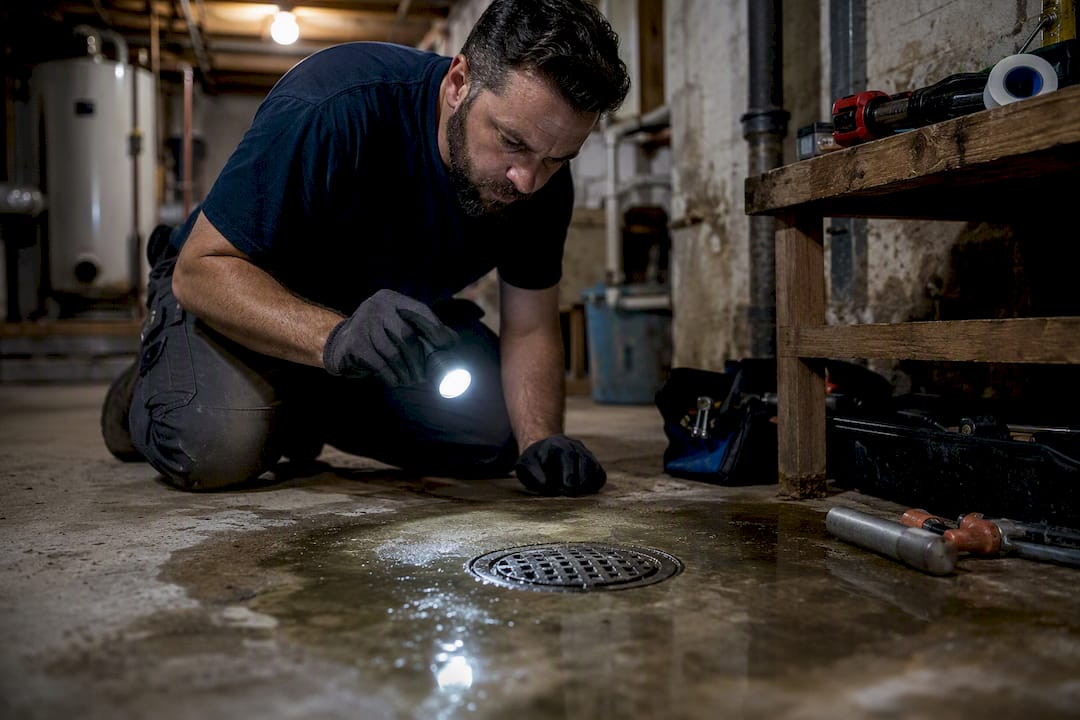
Professionals bring tools homeowners simply don’t have access to. A camera inspection threads a scope through the line to spot collapsed sections, bellies, or root mats. From there, motorized cabling clears temporary blockages, while hydro-jetting uses high-pressure water to scour the full width of the pipe and remove grease or root buildup that cabling leaves behind.
Typical timeline and cost ranges (U.S. averages, your job may vary):
- Emergency response to stop an active backup: usually within a few hours of the call
- Camera inspection: same day to within 24 hours
- Cabling or hydro-jetting: often same-day if scheduling allows
- Spot repair or trenchless lining: days to a couple of weeks depending on scope
Pro Tip: If a backup keeps coming back every few months, a camera inspection isn’t optional anymore. It’s the only way to see whether you’re dealing with a simple clog or a structural break that cleaning alone will never fix.
Preventing the Next Basement Drain Backup
A little routine maintenance beats another flooded basement every time. Build these habits into your calendar and most backups never get the chance to start.
- Schedule a camera inspection annually if you’ve had even one prior backup.
- Have your line hydro-jetted every couple of years if roots or grease are a recurring issue in your area.
- Never flush wipes, paper towels, or grease down any drain, even ones labeled flushable.
- Test your sump pump every few months and keep a battery backup ready for power outages.
- Keep gutters and downspouts clear and grade soil away from your foundation.
For homes that deal with recurring municipal surcharge, a backwater valve installed on the main line closes automatically when sewage tries to flow backward, keeping it out of your house entirely. Pair that with a properly sized sump pump and battery backup, and most groundwater-driven backups become a non-issue. If a camera inspection turns up a cracked or bellied section, targeted spot repair or trenchless lining fixes the actual damage instead of just buying you a few more months.
Sample schedule: check the sump pump monthly, inspect gutters and grading each spring and fall, and book a professional line inspection once a year if backups have happened before.
Pro Tip: Mature trees near your sewer lateral are one of the most overlooked backup risks. If you’re landscaping near that line, ask a professional where it actually runs before you plant anything with an aggressive root system.
Cleaning Up Safely After a Sewage Backup
Once the water’s gone, the real health risk starts. Sewage carries bacteria that don’t care how quickly you want your basement back to normal.
Gear up with gloves, an N95 mask at minimum, eye protection, rubber boots, and a shop vacuum with a water-safe filter.
- Remove all standing water first.
- Discard anything porous that touched sewage, including carpet, cardboard, and drywall that’s soaked through.
- Disinfect hard surfaces with a bleach solution or an EPA-registered disinfectant.
- Dry the space completely with fans and a dehumidifier running for several days.
Call a restoration specialist if the contamination is extensive, insulation or drywall is soaked, or you notice mold starting within 24 to 48 hours. Document everything with photos and receipts before you throw anything away. Your insurance adjuster will want proof of what was lost.
Why Professional Diagnostics Beat Guesswork Every Time
A camera inspection finds what no amount of plunging ever will, cracked pipe, a bellied section holding standing water, or a root mat choking the line. Hydro-jetting clears grease and roots that a standard cable pushes past instead of removing. Motorized cabling handles the quick, temporary clear when jetting isn’t yet warranted, and trenchless lining repairs damaged pipe without tearing up your yard.
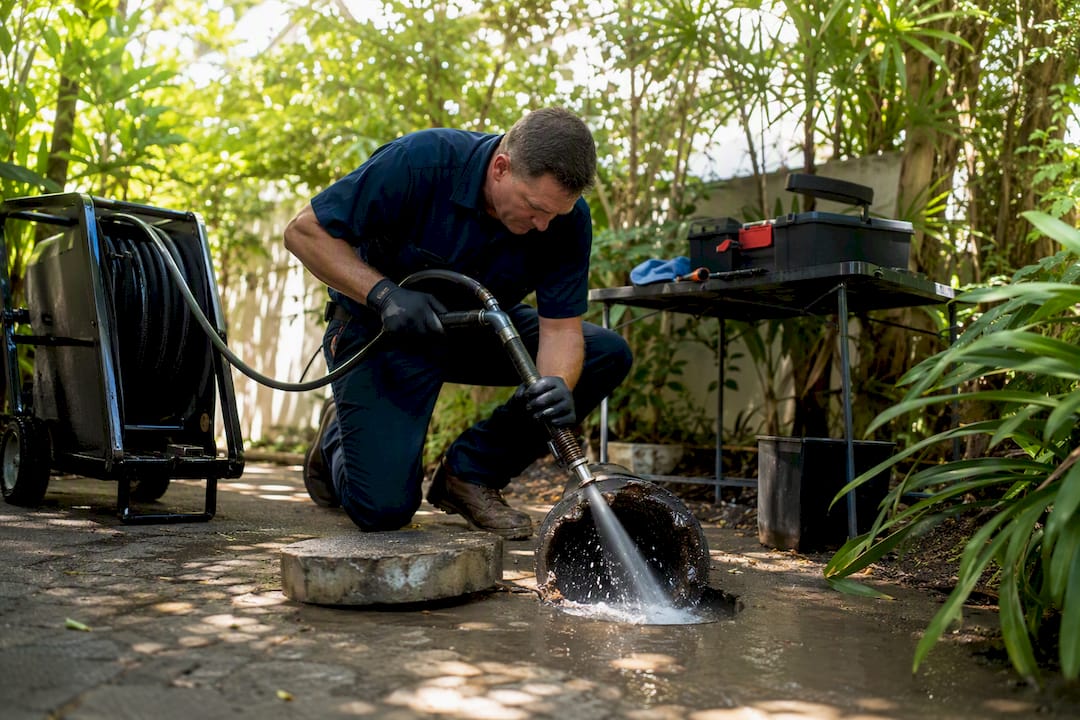
Tri-County Services Electric & Plumbing has worked in Northeast Ohio since 1975, and that history includes plenty of old cast-iron lines that needed more than a quick fix. One project involved hydrojetting and descaling an aging cast-iron sewer line back to functional condition instead of replacing it outright. That’s the kind of judgment call that comes from doing this work daily, not from a weekend spent with a rented auger.
Does Your Yard’s Soil or Landscaping Affect Basement Backups?
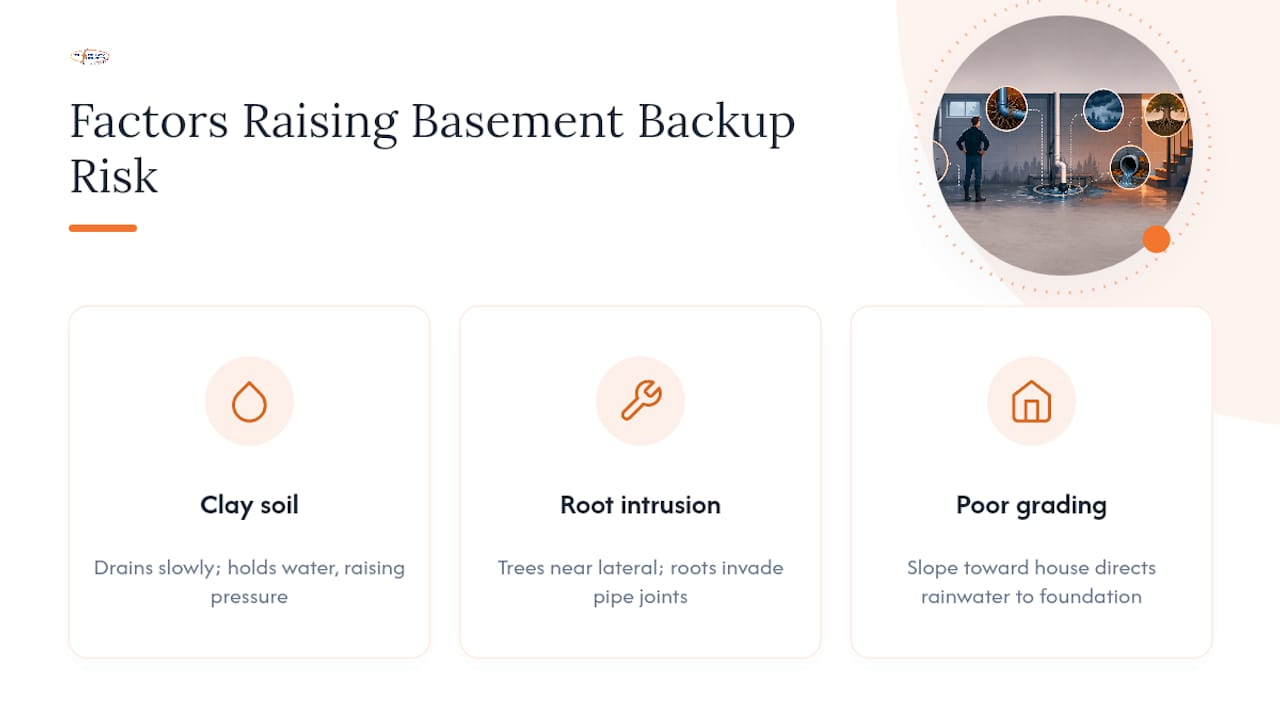
Soil type and what’s growing in your yard have more influence on your basement drain than most homeowners realize. Clay-heavy soil, common across a lot of Northeast Ohio, drains slowly and holds water against your foundation longer after a storm. That extra hydrostatic pressure pushes groundwater toward any weak point in your foundation drainage or sewer lateral, and a floor drain is often the first place it shows up.
Sandy or well-draining soil moves water away faster, which generally reduces pressure on your foundation drains, but it’s not a guarantee against backups tied to the sewer main itself.
Landscaping plays its own role, and often a bigger one than soil composition alone. Mature trees planted near a sewer lateral send roots searching for moisture, and older clay or cast-iron pipe joints are exactly the kind of gap those roots exploit. Once roots get a foothold inside a pipe, they trap debris and slow flow long before a full blockage develops, which explains why root intrusion shows up as a recurring, worsening problem rather than a sudden one.
Grading matters just as much. If the ground slopes toward your foundation instead of away from it, every heavy rain sends more water toward your basement than your drainage system was built to handle. Combine poor grading with clogged or disconnected downspouts, and you’ve built a setup where any rainstorm can overwhelm a floor drain that would otherwise be fine. Fixing the grading and drainage around your home is often cheaper than repeated basement cleanups, and it addresses a cause a lot of homeowners never think to check.
Will Insurance Cover Your Basement Floor Drain Backup?
Standard homeowners insurance policies typically exclude sewage backup damage unless you’ve purchased a specific sewer backup endorsement or rider. That’s the detail that catches most homeowners off guard right when they need coverage the most. Check your policy documents now, before anything happens, so you’re not learning this during a crisis.
If you do have a backup endorsement, coverage usually applies whether the cause was a clogged main line, tree root intrusion, or a municipal surcharge pushing water back into your home. Coverage limits on these riders tend to be lower than your dwelling coverage, so it’s worth asking your agent what the actual cap is and whether it covers cleanup, structural repair, and replacing damaged belongings separately.
Documentation makes or breaks a claim. Photograph the damage before you remove or discard anything, keep receipts for professional service calls and any materials you replace, and save the invoice from whoever performs the camera inspection or repair. That invoice often becomes the evidence that ties the damage to a specific, covered cause rather than general wear or neglect, which insurers will use as grounds to deny a claim if they can.
File your claim promptly. Most insurers set a window for reporting water damage, and delays can complicate an otherwise straightforward claim. If the adjuster’s assessment feels low relative to the actual damage and repair cost, a second opinion from an independent contractor can support your case with hard numbers.
A Publisher’s Note on Acting Fast
Waiting out a basement backup rarely saves money. It usually multiplies the damage. Help is available around the clock, and the steps above are designed to protect your home and health until it arrives.
Get Your Basement Drain Fixed the Right Way
You’ve read the emergency steps, but the real fix for a recurring basement floor drain backup isn’t another plunger session. It’s finding out exactly what’s happening inside that pipe. Tri-County Services Electric & Plumbing runs camera inspections that show the actual condition of your line instead of leaving you to guess, then follows up with hydro-jetting or targeted repair based on what that camera actually finds, not a generic worst-case estimate.

That matters most for older Northeast Ohio homes with cast-iron or clay lines, where root intrusion and pipe deterioration are common but not always obvious from the surface. Our team has handled everything from a quick cable-clear to full hydrojetting and descaling of an aging cast-iron sewer line, and we bring that same judgment to every service call. If your basement has backed up more than once, or you’re dealing with one right now, call Tri-County Services Electric & Plumbing to schedule a camera inspection and get a clear answer instead of another temporary fix.
Sources
FAQ
Why Is Water Coming Up Through My Basement Floor Drain?
Water rises through a floor drain when something downstream blocks its path, whether that’s a main sewer line clog, tree roots, a surcharged municipal main during heavy rain, or a failed sump pump letting groundwater build up.
Why Does a Basement Floor Drain Back Up in the First Place?
The floor drain sits at the lowest point in your plumbing system, so any blockage or overload anywhere downstream shows up there first, before it shows up anywhere else in the house.
My Basement Floor Drain Is Backed Up Right Now. What Should I Do?
Stop using water throughout the house, keep people and pets away from the area, and check for a sewage smell or slow drains elsewhere. If either is present, call Tri-County Services Electric & Plumbing rather than attempting to clear it yourself.
Does Insurance Cover Sewage Backup in a Basement?
Standard homeowners insurance typically excludes sewage backup damage unless you’ve added a specific sewer backup endorsement, so check your policy before you need it.