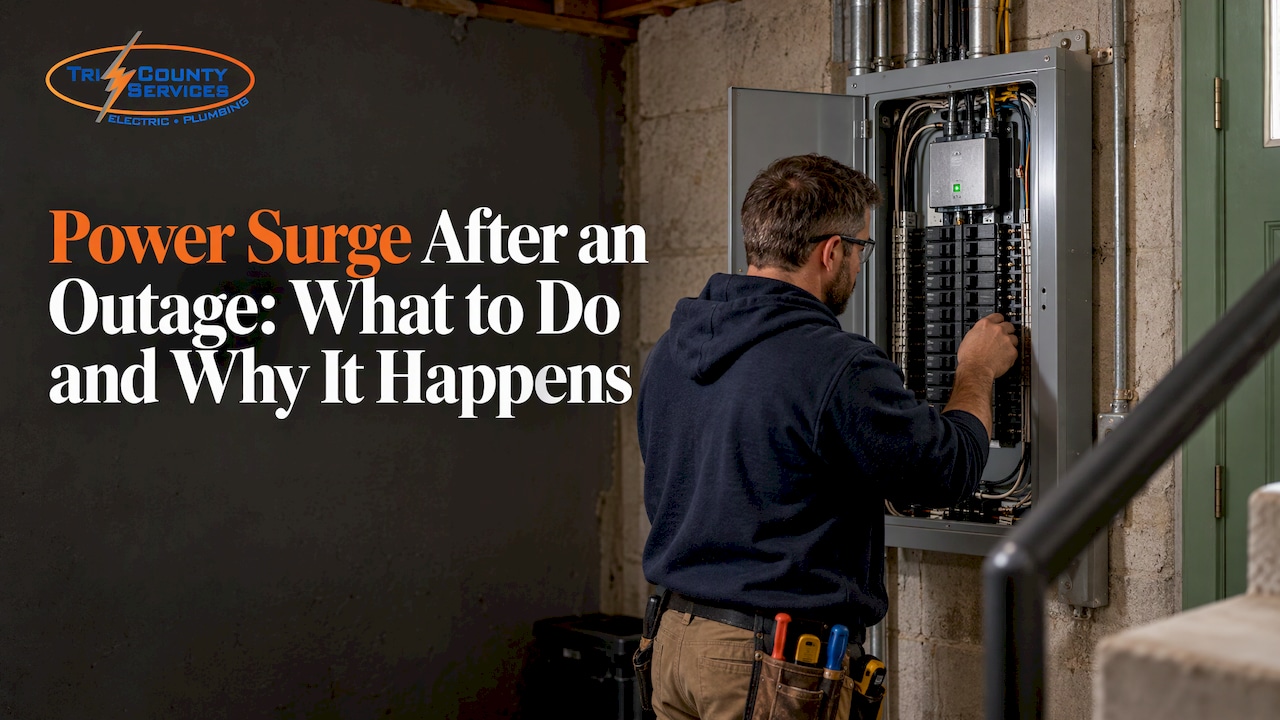

Yes, a surge can follow an outage, and the moment power returns is one of the most common times it happens. If an outlet is scorched, a breaker keeps tripping or an appliance went dead when the lights came back, stop using that circuit and call a professional electrician before you reset anything. At Tri-County Services Electric & Plumbing, that is the call our office takes every day: call us at (440) 253-0332 and we will talk you through what to do next.
This guide explains why restoration surges happen, how to tell whether your home took a hit, the safe order of steps in the first hour, and how to keep the next outage from costing you a refrigerator, a furnace board or a wall full of outlets.
TL;DR
- When the utility restores power, the sudden change in current can send a very fast high-voltage pulse through your home wiring. A surge and an outage are different problems, but one often follows the other.
- Unplug affected devices, stay away from anything hot, smoking or sparking, and shut off the main breaker if you smell burning or see sparks.
- A breaker that trips again right away, a scorched outlet or a buzzing panel needs an electrician, not another reset.
- Photograph the damage and keep receipts before you file a claim with your insurer or the utility.
- Whole-home surge protection plus plug-in protectors for electronics is the layered approach that guards against the next one. Call (440) 253-0332 to talk it over.
Table of Contents
- Why a surge follows an outage
- Signs your home took a surge
- What to do in the first hour
- Why the electrician comes before the repair shop
- Will insurance or the utility pay?
- How to protect your home before the next outage
- Get it checked by Tri-County Services Electric & Plumbing
- Our perspective
- FAQ
- Sources
Why a surge follows an outage
An outage is a loss of power. A surge is a brief spike in voltage. They are separate power-quality problems, but every unplanned outage produces short surge events both when power is removed and when it comes back, according to the National Electrical Manufacturers Association’s surge group.
The cause on the restoration side is physics. When the utility reconnects the lines, the sudden change in current flow as loads come back online induces a very fast high-voltage pulse, and the bigger the current change, the bigger the surge. NEMA compares it to a loose object in a car trunk: the harder the car accelerates or brakes, the harder that object hammers the walls. Every time your neighborhood blinks off and on, your wiring takes another knock.
How big can it get? The National Institute of Standards and Technology notes that normal 120-volt household power can jump to hundreds or even thousands of volts during a surge, and the event lasts only a few millionths of a second. That is shorter than a blink, and long enough to destroy or upset an appliance.
NIST also explains that household surges come from two places: lightning, and switching, which happens when loads turn on or off inside the home or when the power company does normal operations on the grid. A storm that knocks out power in Northeast Ohio and then flickers it back several times can deliver both kinds in one night.
Why it is not just the utility’s problem
A restoration surge starts outside, but what it does depends on what is inside your walls. Older wiring, a crowded panel, loose connections and no whole-home protection all give a surge an easier path to your appliances. That is why two neighbors on the same street can have very different results after the same outage.
Signs your home took a surge
Surge damage is not always dramatic. Insurer guidance lists these common signs, and the first ones are easy to miss:
- Tripped breakers, dimmed or flickering lights, digital clocks blinking or showing the wrong time, a burning smell or scorch marks on outlets, and humming from outlets.
- Wall outlets with reset buttons that have moved to the reset position. Those are usually GFCI outlets, the ones with test and reset buttons found in kitchens, bathrooms and garages.
- Devices that will not power on, run erratically or show blank or garbled displays.
- Melted plugs, frayed wires or scorched outlets.
A surge can also damage anything plugged in even when it is switched off, and in some cases it can start a fire. Smaller repeated surges can slowly erode component life, so a furnace board or a television that dies a month later may trace back to the storm.
What to do in the first hour
Work through this in order. The safety steps come before the paperwork.
- Look for danger first. Do not touch anything hot, smoking or sparking. If you see frayed wiring or sparks when power returns, or you smell something burning but see no fire, shut off the electrical system at the main circuit breaker right away. If there is smoke or flame, leave and call 911.
- Unplug what you think was affected. Pull the plug on visibly damaged devices, and on sensitive electronics, in case a second surge follows when the power flickers again.
- Leave the panel and surge protectors closed. The inside of a breaker panel carries live current even with the main off at some points. Opening it is a job for a professional.
- Do not keep resetting a breaker. The Red Cross advises that if breakers have tripped, contact an electrician to inspect them before turning them back on. A breaker that trips again immediately is telling you something is wrong on that circuit.
- Document everything. Take photos of burn marks, melted plugs and scorched outlets, and write down the make, model, age and receipt for each damaged item, as AAA recommends. Note the time and which circuits were affected.
- Find out whether the source was outside. Ask neighbors if they saw the same thing. If the surge came from the grid, report it to your power company: AAA notes that some utilities reimburse for equipment damage they caused.
- Bring devices back one at a time. Plug in one item, watch it, then the next. Check the heating and cooling system too, since its control boards are expensive and sensitive.
- Have the wiring checked. Electronics show visible damage. Wiring and outlets often do not, which is why the safest finish to this list is an inspection by a professional.
Who to call for what
The right call depends on what you see.
| What you see | Who to call |
|---|---|
| Smoke, flames or an active electrical fire | 911 |
| Downed power line | Stay far away, assume it is live, and call 911 (PG&E’s safety guidance says the same) |
| Whole neighborhood dark | Your utility |
| Breaker trips repeatedly, even with items unplugged | A professional electrician |
| Scorched or buzzing outlets, hot panel, burning smell | Main breaker off, then a professional electrician |
| Surge damage to electronics from the grid | Your utility and your insurer |
If your own house is dark but the neighbors have power, our guide on what to check when only your house loses power walks through the safe steps before the electrician arrives.
Why the electrician comes before the repair shop
Most people look at the dead microwave first. The more serious question is what happened to the wiring that feeds it.
A surge that is strong enough to kill a circuit board has also pushed that energy through your outlets, switches and panel connections. Heat from arcing can leave a damaged connection that looks fine and works fine until the next heavy load. A professional can trace a tripping circuit to its cause, test outlets and the panel, and tell you whether you have a one-time event or a recurring problem.
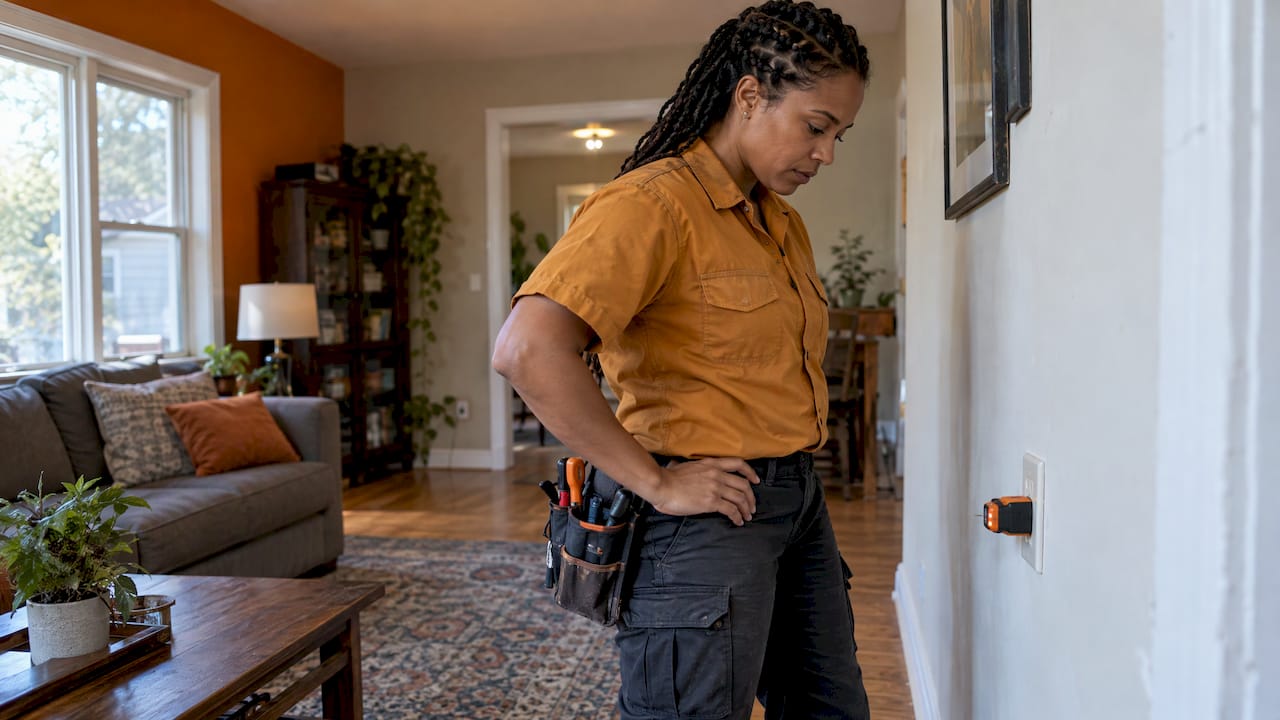
That is also the line between a surge and a wiring fault. A surge is a brief transient event. Loose neutrals, damaged conductors and incorrect bonding can create sustained dangerous voltage that feels like repeated surges: lights that go dim and bright, appliances that act strangely again and again. That pattern is not something to wait out or reset away.
Our electrical troubleshooting is published at $300 to $500 per visit, set against the cost of replacing a refrigerator, a furnace control board or a fire. We schedule around your day so the work disrupts your home as little as possible, and our technicians are certified and respect your home while they work.
Will insurance or the utility pay?
Sometimes. According to Insure.com, homeowners insurance covers surge damage when a covered peril such as lightning caused it, with damaged electronics paid under personal property coverage and food spoilage often covered up to about $500. Outages that start with the utility are often excluded, so the utility’s liability department may be the proper path for those claims.
Policies differ, so read yours or call your agent. Whichever route you take, the photos, receipts and notes from step five are what the claim runs on. A written electrician’s assessment of what failed can also help your case.
How to protect your home before the next outage
Power returns without warning, so protection works best when it is already in place.
During the outage
- Turn off or unplug appliances and electronics. Federal preparedness guidance says to disconnect equipment during an outage to protect it from quick power surges.
- Leave one light switched on so you know when power is back. Utility guidance from PECO suggests this too.
- Use flashlights instead of candles. If you want to keep a phone charged while the house is dark, a portable power bank for outages means you do not have to plug a phone into a wall outlet that may surge when power returns.
- Wait a few minutes after power returns before reconnecting things, and bring them back one at a time.
In the walls: layered protection
Unplugging works only when you are home and awake. Storms do not wait for that. State Farm describes a two-tier approach: plug-in surge protectors with failure indicators for electronics, plus a whole-house device at the panel for hardwired items like motors, lights and outlets. The whole-house device lowers surges from the utility line before they reach the plug-in protectors, so using both works better than either alone.
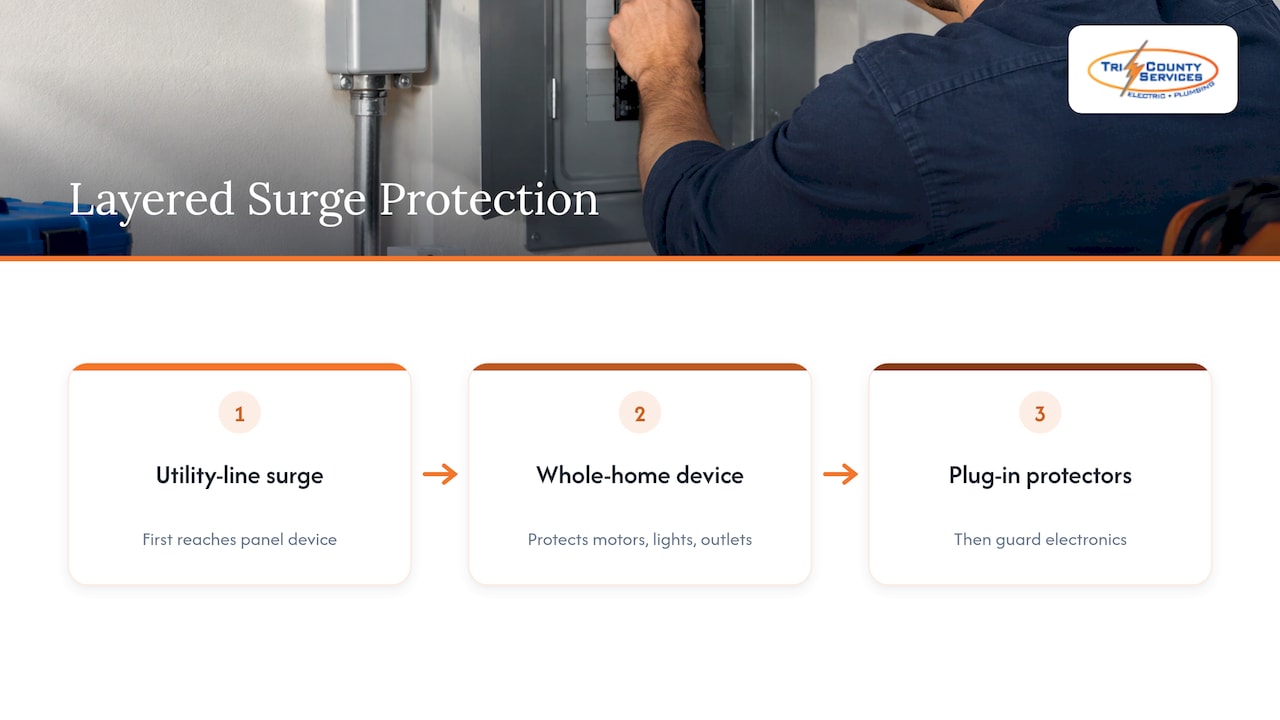
NIST frames the choice as risk against cost: weigh the likelihood and size of each surge source rather than assuming one device solves everything. In Northeast Ohio, with summer thunderstorms and ice and wind in winter, outages and restoration surges are routine rather than rare.
We install whole-home surge protection. If you want to understand how it works before you decide, read what a whole-house surge protector is, the benefits of whole-home surge protection before storm season and our overview of power surges at home. For what to do while the power is out, see our power outage safety steps.
At the panel
The panel is where a whole-home device connects, and where an overloaded or aging system shows its age. If breakers trip often or the panel is warm, an inspection tells you whether it can handle your load. Our guide to signs your panel needs an inspection lists what to look for, and our panel upgrades page explains the work.
Get it checked by Tri-County Services Electric & Plumbing
We are a family-owned business that has served Northeast Ohio since 1975. Our technicians inspect carefully, because safety comes first, and we offer emergency electrical repairs, panel upgrades, dedicated circuits and whole-home surge protection for homes and businesses. We also keep our pricing clear and upfront.
If an outage left you with tripping breakers, scorched outlets or electronics that will not run, start with a call: (440) 253-0332. See our electrical services and pricing guide for what we do.
We also handle plumbing, so if a storm and outage left you with a flooded basement, a sump issue or a water heater that will not restart, you can call the same number.
Our perspective
Most homeowners we talk to after an outage ask about the television or the refrigerator. We want them to ask about the wiring first. A device is replaceable. A damaged connection inside a wall or a panel is the thing that can turn into a fire months later.
That is why our advice is simple: after a surge, stop resetting and start asking why. A breaker that trips is protecting you, and an outlet that smells hot is a warning. Please do not open the panel or try to trace it yourself. Call a professional who can test the circuit and tell you what is safe to use.
The best surge is the one that never reaches your appliances. We believe in whole-home protection at the panel, paired with plug-in protectors for the electronics you care about most. It is a small project compared with replacing a furnace board, a refrigerator and a home office in one night, and it can be scheduled at a time that suits your family.
Lindsay Paramore
FAQ
Is a power surge the same as a power outage?
No. An outage is a loss of power that can last seconds to days, while a surge is a very brief spike in voltage. They are linked, though, because unplanned outages create surge events when power is removed and when it is restored. Surge protection guards against the spike, not the loss of power itself.
Can a surge damage things that were turned off?
Yes. AAA notes a surge can damage anything plugged into the home’s electrical system even if it is not turned on. That is why unplugging sensitive items before power returns helps, and why a whole-home device protects the rest of the house.
Should I reset the breaker after a surge?
If breakers tripped, have an electrician inspect them before you turn them back on, as the American Red Cross advises. If a breaker trips again right away, leave it off and call us at (440) 253-0332.
Why do I keep getting surges?
Repeated flickers can come from utility switching, storms or loose or damaged wiring in your home. A professional can tell which it is by testing your circuits and panel. Our electrical troubleshooting is published at $300 to $500 per visit.
Who pays for damage from a surge after an outage?
It depends on the cause. Homeowners insurance may cover surge damage from a covered event like lightning, while outages that start with the utility are often excluded and may go to the utility’s liability department. Photos, receipts and notes help either claim.
Sources
- NEMA: Rolling Blackouts and the need for surge protection
- NEMA: Are All Power Quality Problems Surges?
- NIST Recommended Practice Guide: Surges Happen!
- State Farm: Are Power Surges Damaging Your Electronics?
- AAA: What to Do When Your Home Experiences a Power Surge
- AAA: What If a Power Surge Damages My Electronics?
- CDC: Protect Yourself From Electrical Hazards
- American Red Cross: Power Outage Safety
- Ready.gov: Are You Ready? Citizen Preparedness Guide
- PECO: Electric Safety
- PG&E: Electricity Safety
- Insure.com: Does homeowners insurance cover power surges and outages?