
When a single drain stops moving, most homeowners can work through four quick steps before picking up the phone: clear visible debris (2 minutes), run the hottest tap water available (5 minutes), plunge with the right plunger (5–10 minutes), then either snake the drain or pull the P-trap (10–20 minutes). That covers the vast majority of single-fixture clogs. Stop immediately if more than one fixture is slow, you smell sewage, or flushing the toilet causes water to bubble up in the tub — those are main-line signals that need a professional, not another DIY attempt.
A few honest caveats before you start. Mechanical methods clear most household clogs without chemicals, and Wirecutter recommends that sequence specifically because it avoids the pipe and septic risks that chemical cleaners introduce. But the fastest path to a cleared drain is often a phone call. Tri-County Services Electric & Plumbing has handled Northeast Ohio clogs since 1975, and a professional visit typically resolves in one trip what a weekend of DIY attempts cannot.
Pro Tip: Before touching anything under the sink, place a towel and a bucket nearby. You will almost certainly need both.
- Clear visible debris: 2 minutes, bare hands or a hair snake
- Hot-water flush: 5 minutes, free
- Plunging: 5–10 minutes, requires the right plunger type
- Snaking or P-trap cleaning: 10–20 minutes, requires basic tools
- Stop-and-call rule: multiple slow fixtures, sewage odor, or toilet backup = call a pro now
Key Takeaways
A single-fixture clog usually responds to mechanical methods — but the moment multiple fixtures are involved or sewer signs appear, professional help is the faster and safer path.
| Point | Details |
|---|---|
| Start mechanical, not chemical | Clear debris, flush with hot water, plunge, then snake before considering any chemical product. |
| Match the plunger to the fixture | Cup plungers for sinks and tubs; flange plungers for toilets — the wrong type reduces suction significantly. |
| Stop-and-call rule | Multiple slow fixtures, sewage odor, or toilet backup means a main-line problem — stop DIY immediately. |
| Never mix chemical cleaners | Combining drain products or adding bleach can generate toxic gas; use one product or none. |
| Tri-County Services Electric & Plumbing | Offers camera inspection, hydro-jetting, and powered drain cleaning for Northeast Ohio homeowners when DIY methods fall short. |
Table of Contents
- How do you know if your clog is a DIY fix or a main-line problem?
- What are the least-invasive first steps to try on a clogged drain?
- Which tools actually work for tougher clogs?
- When do chemical drain cleaners actually make sense?
- When should you stop DIY and call a professional?
- What does a professional plumber actually do that you cannot?
- How do you prevent drain clogs from coming back?
- A plumber’s honest take on DIY drain fixes
- Tri-County Services Electric & Plumbing handles what DIY tools cannot
- Sources
- FAQ
How do you know if your clog is a DIY fix or a main-line problem?
Diagnosis takes about two minutes and determines everything that follows. Run the clogged fixture and watch the rest of the house. That single observation separates a local fixture clog from a downstream problem.
According to PlumbingByTheBook, if two or more fixtures are slow simultaneously, or if using one fixture causes gurgling or backups in another, the blockage is likely downstream in the main line. DIY tools cannot reach it, and pushing further risks making the problem worse.
| Symptom | Likely cause | DIY recommended? |
|---|---|---|
| One sink drains slowly | Hair, soap, or grease near the fixture | Yes — start with steps below |
| Shower slow, sink fine | Hair clog at shower drain | Yes — hair snake first |
| Multiple fixtures slow at once | Downstream or main-line blockage | No — call a professional |
| Gurgling when toilet flushes | Venting issue or partial main-line clog | No — call a professional |
| Sewage odor from drains | Sewer gas or main-line backup | No — call immediately |
| Toilet backup with other fixtures | Main sewer line blockage | No — call immediately |
The WonderHowTo Housekeeping guide notes that a two-minute observation test reliably distinguishes DIY-safe clogs from main-line problems. If your symptom maps to the bottom half of that table, skip the DIY steps entirely.
What are the least-invasive first steps to try on a clogged drain?
The stepwise escalation recommended by plumbing professionals moves from free and fast to slightly more involved. Work through these in order and give each step a fair attempt before moving on.
Step 1: Remove visible debris
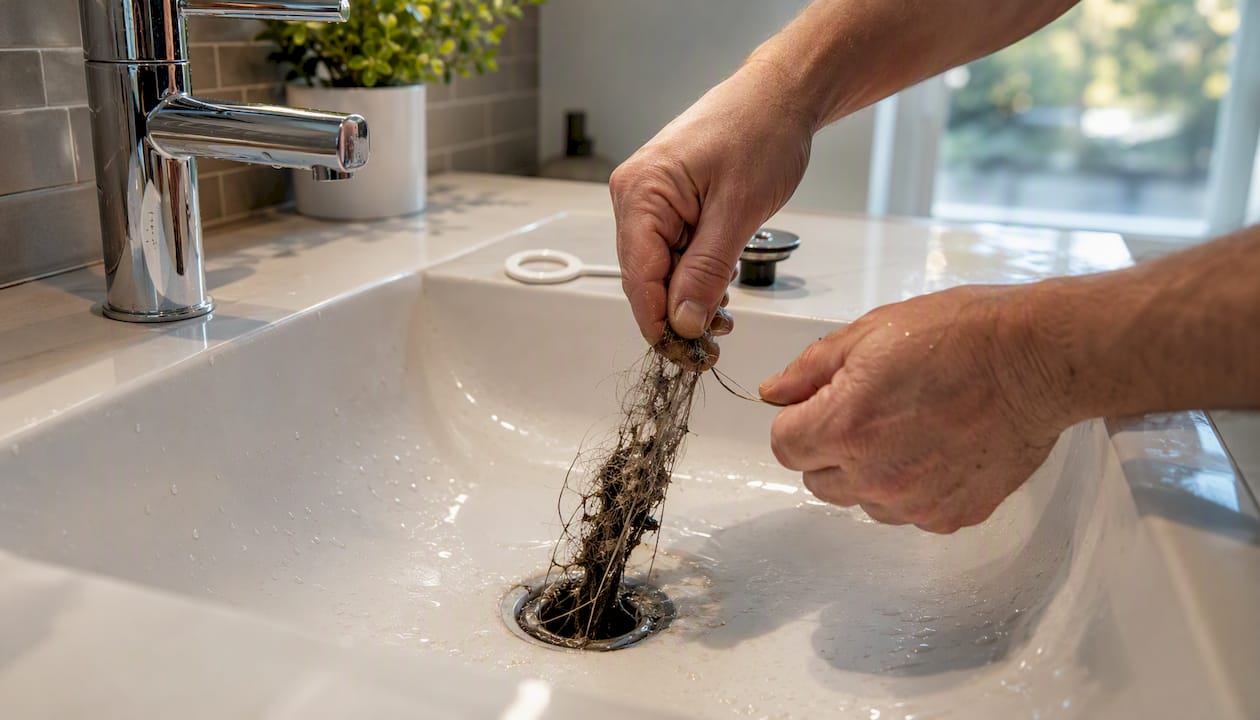
Pull the drain stopper out — most bathroom stoppers lift straight up or unscrew with a quarter-turn. What you find underneath is usually a dense mat of hair and soap. Pull it out with your fingers or a cheap hair snake (sometimes called a Drain Weasel). This takes two minutes and clears a surprising number of bathroom sink and shower clogs entirely.
Step 2: Hot-water flush
Boil a kettle or run the tap as hot as it goes. For metal pipes, a slow pour of near-boiling water directly down the drain can dissolve soap scum and light grease. For PVC or plastic pipes, skip the kettle entirely — 212°F softens plastic joints and can cause failures. The hottest tap water is safe for any pipe material and still effective on grease and soap buildup.
Pour slowly in two or three stages, giving the water 30 seconds to work between pours. If the drain clears, you are done. If it slows but does not clear, move to step 3.
Step 3: Baking soda and vinegar (or salt and hot water)
Pour half a cup of baking soda directly into the drain, followed immediately by half a cup of white vinegar. The fizzing reaction can break up light organic buildup. Cover the drain opening with a rag or stopper to push the reaction downward rather than up. Wait 15–20 minutes, then flush with hot water.
The salt variation: pour half a cup of table salt down the drain, follow with boiling water (metal pipes only), and wait 5 minutes before flushing. Both methods work on soft, organic clogs. Neither will move a solid obstruction like a toy, a bottle cap, or a dense hair mass deeper in the pipe.
Step 4: Plunging
A cup plunger works on sinks and tubs. A flange plunger is for toilets. Using the wrong type reduces suction significantly. Before plunging a bathroom sink, stuff a wet rag into the overflow hole (the small opening near the top of the basin) — that seals the system so pressure goes toward the clog instead of escaping upward.
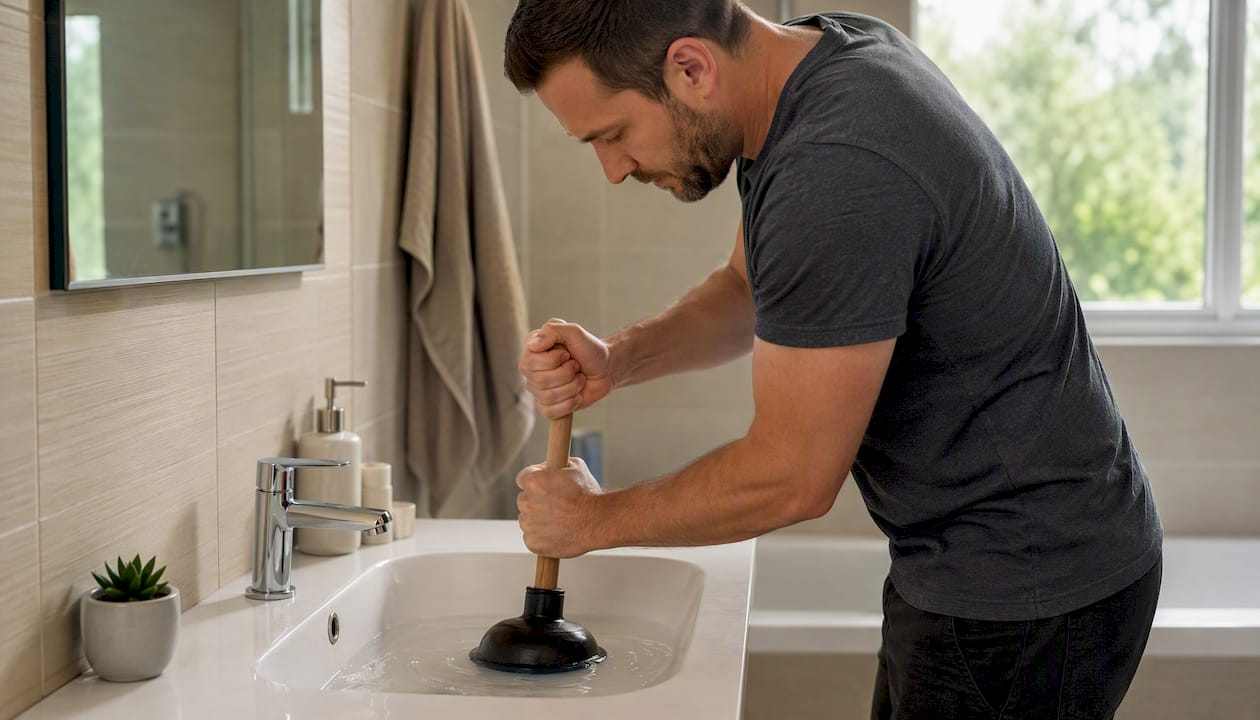
Fill the basin with enough water to cover the plunger cup, press it firmly over the drain, and pump with short, sharp strokes for 20–30 seconds. Pull up sharply on the last stroke. Repeat two or three times. If water drains freely after, run hot water for a minute to flush debris through.
Which tools actually work for tougher clogs?
When the first steps fail, the problem is usually deeper than a plunger can reach. These tools handle what hot water and plunging cannot.
Wirecutter and plumbers both recommend keeping an inexpensive hair snake on hand because it removes near-surface clogs without any chemical risk. For clogs that sit deeper, a hand auger reaches past the trap and into the drain line.
How to snake a drain
Feed the auger cable into the drain opening slowly, rotating the handle clockwise as you push. You will feel resistance when the cable hits the clog. Keep rotating and pushing gently — a soft, elastic resistance usually means you are working through the clog. Hard, immovable resistance means you have hit a pipe bend or something solid. Stop there. Forcing past hard resistance risks puncturing or cracking the pipe.
How to clean the P-trap
The P-trap is the curved pipe section under the sink. Place a bucket directly beneath it. Loosen the two slip nuts by hand or with channel-lock pliers — they usually turn counterclockwise. Slide the trap off and empty it into the bucket. Rinse it with water, check for debris, and reinstall. Hand-tighten the slip nuts, then give them a quarter-turn with pliers. Run water slowly to check for leaks before declaring victory.
Pro Tip: Take a photo of the P-trap assembly before you remove anything. Reassembly is much easier when you can see exactly how it came apart.
For a deeper look at when snaking is the right call versus a more powerful approach, the hydro-jetting vs. snaking guide from Tri-County Services Electric & Plumbing breaks down the difference clearly.
When do chemical drain cleaners actually make sense?
The short answer: after mechanical methods have failed, and only for organic clogs in metal pipes. CNET’s lab testing of eight chemical cleaners found that some liquid formulas do outperform others on stubborn clogs, but the same testing confirmed that mechanical methods should come first. Chemicals are a last resort, not a starting point.
Never mix chemical drain cleaners with each other or with household bleach. Combining products can generate toxic chlorine gas. Use one product, follow the label exactly, ventilate the area, and wear gloves and eye protection. If a product fails to clear the clog after the label’s recommended wait time, do not add a second product — call a professional instead. (WonderHowTo Housekeeping)
Avoid chemical cleaners entirely if you have:
- PVC or plastic pipes (many formulas generate heat that softens joints)
- A septic system (chemicals kill the beneficial bacteria the system depends on)
- A complete blockage with standing water (the cleaner sits on top and does nothing)
- Already used a different chemical product recently
If you do use a chemical cleaner and it does not work, flush the drain thoroughly with water and wait at least 24 hours before attempting any mechanical method. Residual chemicals on a snake or your hands are a serious safety hazard.
For a non-chemical approach to stubborn clogs, the guide to unclogging without chemicals covers mechanical alternatives in detail.
When should you stop DIY and call a professional?
Some situations look like a simple clog but are not. Continuing to DIY past these warning signs can turn a $150 service call into a much larger repair.
Stop and call a professional when you see any of these:
- Multiple fixtures draining slowly at the same time — this points to a blockage downstream of where any homeowner tool can reach
- Gurgling sounds when you flush the toilet or run the washing machine
- Sewage odor coming from any drain, which signals sewer gas entering the home
- Water backing up into a tub or floor drain when you flush the toilet
- Hard, immovable resistance while snaking that does not yield after gentle pressure
- The same fixture clogs repeatedly within a few weeks, even after clearing
PlumbingByTheBook is direct on this: when multiple fixtures are involved, the blockage is downstream and requires professional equipment or camera inspection. A homeowner’s hand auger reaches 15–25 feet at most. Main sewer lines run much deeper and farther.
The risks of pushing past these signs include cracked or punctured drain pipes, sewage exposure (a genuine health hazard), and converting a partial blockage into a full sewer backup. A professional with a camera can locate the exact problem in minutes, which is faster than another round of DIY guessing.
For a practical checklist to run through before scheduling a service call, the 3 things to check before calling a plumber resource from Tri-County Services Electric & Plumbing is worth a quick read.
What does a professional plumber actually do that you cannot?
A professional visit is not just a stronger version of what you already tried. The tools and diagnostics are categorically different.
A drain camera inspection finds what no snake can. The camera travels the full length of the drain line and transmits live video, showing root intrusion, pipe collapse, offset joints, and grease buildup that are invisible from above. Without that image, any repair is a guess. (Tri-County Services Electric & Plumbing)
Professional services available for drain problems include:
- Camera inspection — locates the exact position and cause of the blockage
- Powered drain snaking — motorized augers that reach the full length of a drain line with far more torque than a hand tool
- Hydro-jetting — high-pressure water that scours pipe walls clean, removing grease, scale, and root intrusion that a snake only punches through
- P-trap and drain line repairs — replacing damaged sections rather than repeatedly clearing the same spot
- Sewer line diagnosis — identifying whether a problem is in the home’s lateral line or the municipal connection
The practical difference is depth and diagnosis. A hand auger punches a hole through a clog. Hydro-jetting removes the clog and the buildup that caused it. Camera inspection tells you whether the pipe itself is the problem. That combination is why a professional visit often ends a recurring clog cycle that DIY attempts keep restarting.
Tri-County Services Electric & Plumbing offers all of these services for Northeast Ohio homeowners. Their local drain-clearing guide covers what to expect from a professional visit.
How do you prevent drain clogs from coming back?
Prevention costs almost nothing and takes less than five minutes a month. These habits address the three most common clog sources: hair, grease, and soap buildup.
- Install mesh drain screens on every shower and bathroom sink drain. Empty them after each shower. A $3 screen prevents the majority of hair clogs.
- Monthly hot-water flush: once a month, run the hottest tap water down every drain for 60 seconds. It keeps soap and light grease from accumulating into a blockage.
- Monthly enzymatic drain treatment: enzyme-based drain treatments (available at most hardware stores) introduce bacteria that digest organic buildup. They are safe for septic systems and plastic pipes, unlike chemical cleaners. Pour them in at night so they have time to work undisturbed.
- Never pour grease down the sink. Pour cooled grease into a jar, seal it, and throw it in the trash. Even a small amount of grease coats pipe walls and catches everything that follows.
- Clean stoppers and P-traps every 3–4 months. Soap scum and hair accumulate on stoppers faster than most homeowners expect. A quick pull and rinse takes two minutes.
Pro Tip: Enzymatic treatments work best when the drain has been flushed clean first. Run hot water for 30 seconds before pouring the treatment in, then leave it overnight.
For a broader set of prevention strategies, the 10 tips for preventing drain clogs covers additional habits worth building into a regular home maintenance routine.
A plumber’s honest take on DIY drain fixes
Most single-fixture clogs are genuinely simple. A hair snake and five minutes of effort clear a large percentage of bathroom sink and shower drain problems. That is real, and there is no reason to call a professional for a clog you can see and reach.
The part that gets homeowners into trouble is the escalation. A plunger does not work, so they try a chemical cleaner. The chemical cleaner does not work, so they try a second one. Two products mix in the drain, or the chemical sits in a PVC trap long enough to soften a joint. Now a $15 clog has become a $400 repair. The stop-and-call rule exists precisely to prevent that sequence.
The other underestimated risk is the recurring clog. If the same drain clogs every few weeks despite clearing it each time, that is not a maintenance problem. It is a diagnostic problem. Something in the pipe is causing repeated buildup, and a camera inspection is the only way to find it without guessing. Calling a professional after the third recurrence is faster and cheaper than clearing it a fourth, fifth, and sixth time.
Try the first steps. Use the stop-and-call rule. And when the signs point to a main-line problem or a recurring issue, call early rather than late.
Tri-County Services Electric & Plumbing handles what DIY tools cannot
When the first steps fail or the red-flag symptoms appear, Tri-County Services Electric & Plumbing is the call that ends the cycle. As a family-owned Northeast Ohio business serving homeowners since 1975, the team brings camera inspection, powered snaking, and hydro-jetting to every job that needs more than a plunger.

A typical service call starts with a diagnosis: the technician identifies whether the problem is at the fixture, in the drain line, or in the main sewer. From there, you get a clear explanation of what was found, what the repair options are, and what each costs before any work begins. No guessing, no surprise charges.
Services include clog clearing, camera inspection, hydro-jetting, P-trap and drain line repairs, and full sewer line diagnosis for problems that run deeper. The schedule is flexible, and the work is done by skilled technicians who treat your home with care.
If you are past the DIY steps or simply prefer to have it handled right the first time, schedule a service call with Tri-County Services Electric & Plumbing today.
Sources
The sources below informed the guidance in this article. Each is worth bookmarking for reference.
- Best Chemical Drain Cleaners of 2026: After Testing 8 Cleaners, Here Are 3 That Work – CNET
- How to Unclog a Drain: Diagnosis, Tools, and Safe Fixes << Housekeeping :: WonderHowTo
- What Plumbers Wish You Knew Before Unclogging Your Sink | Reviews by Wirecutter
- Drain Repair Guide: Clear Any Clog & When to Call a Pro 2026
- The Ultimate DIY Guide to Unclogging Any Drain (And When to Call a Professional)
For local help in Northeast Ohio, contact Tri-County Services Electric & Plumbing directly for a professional assessment.
FAQ
What is the fastest way to unclog a drain?
Remove visible debris by hand or with a hair snake, then run the hottest tap water available for several minutes. Those two steps clear the majority of bathroom sink and shower clogs in under five minutes.
What do plumbers recommend instead of Drano?
Plumbers consistently recommend mechanical methods first: a hair snake or hand auger to physically remove the clog. Wirecutter notes that mechanical removal avoids the pipe and septic risks chemical products introduce, and it works on obstructions that liquids simply cannot dissolve.
Does pouring boiling water down a drain help unclog it?
It can help with soap scum and light grease in metal pipes, but never use boiling water on PVC or plastic plumbing. At 212°F, boiling water softens plastic joints and can cause failures; use the hottest tap water instead, which is safe for all pipe materials.
Can I pour vinegar down the drain to unclog it?
Yes, as part of the baking soda and vinegar method: pour half a cup of baking soda followed by half a cup of white vinegar, cover the drain for 15–20 minutes, then flush with hot water. It works on light organic buildup but will not move a solid obstruction or a dense hair clog deeper in the pipe.