

Most homeowners pay between $1,200 and $2,700 for a complete Level 2 EV charger installation when their electrical panel already has room to spare, with a realistic midpoint landing around $1,800. Jobs that need a panel or service upgrade typically add $1,500 to $3,500 more, pushing the total past $4,000. Long conduit runs, outdoor trenching, and finished-wall work drive most of the variation between quotes, which is exactly why a professional should assess your panel and run length before you commit to a number.
TL;DR:
- Most installations cost between $1,200 and $2,700 if no panel upgrade is necessary, but complex jobs with upgrades can exceed $4,000.
- Run length, wall access, and existing panel capacity primarily determine the total cost, with longer outdoor trenches and older panels increasing expenses.
- A full bid should itemize hardware, labor, permits, and panel work, with specific questions needed to compare quotes accurately.
- Federal and local rebates or incentives can reduce costs, but homeowners should verify current eligibility and stacking rules before budgeting.
- Hiring a licensed professional ensures safety, code compliance, and proper system assessment, which is critical for avoiding fire hazards and insurance issues.
Table of Contents
- How Much Does a Level 2 Charger Cost to Install?
- What Actually Goes Into an EV Charger Install Price?
- Do You Need a Panel Upgrade Before Installing a Charger?
- What Should Be Included in a Level 2 Installation Quote?
- Are There Still EV Charger Rebates and Tax Credits in 2026?
- Three Real-World Level 2 Installation Budgets
- Why Hiring a Professional Matters for EV Charger Installation
- Is a Level 2 Charger Actually Worth the Cost?
- Get a Level 2 Charger Estimate From Tri-County Services Electric & Plumbing
- Sources
- FAQ
How Much Does a Level 2 Charger Cost to Install?
The honest answer depends on three things: your panel’s available capacity, how far the charger sits from that panel, and whether the run travels through finished walls or outdoors. Once you know which category your home falls into, the level 2 charger cost stops feeling like a mystery and starts looking like a line-item budget.
Simple installs run about $800 to $1,700 total. This covers a garage that already has an open breaker slot near the panel, a run under 25 feet, and no wall repair. Many suburban garages with the panel mounted on the same wall as the parking spot fall into this tier.
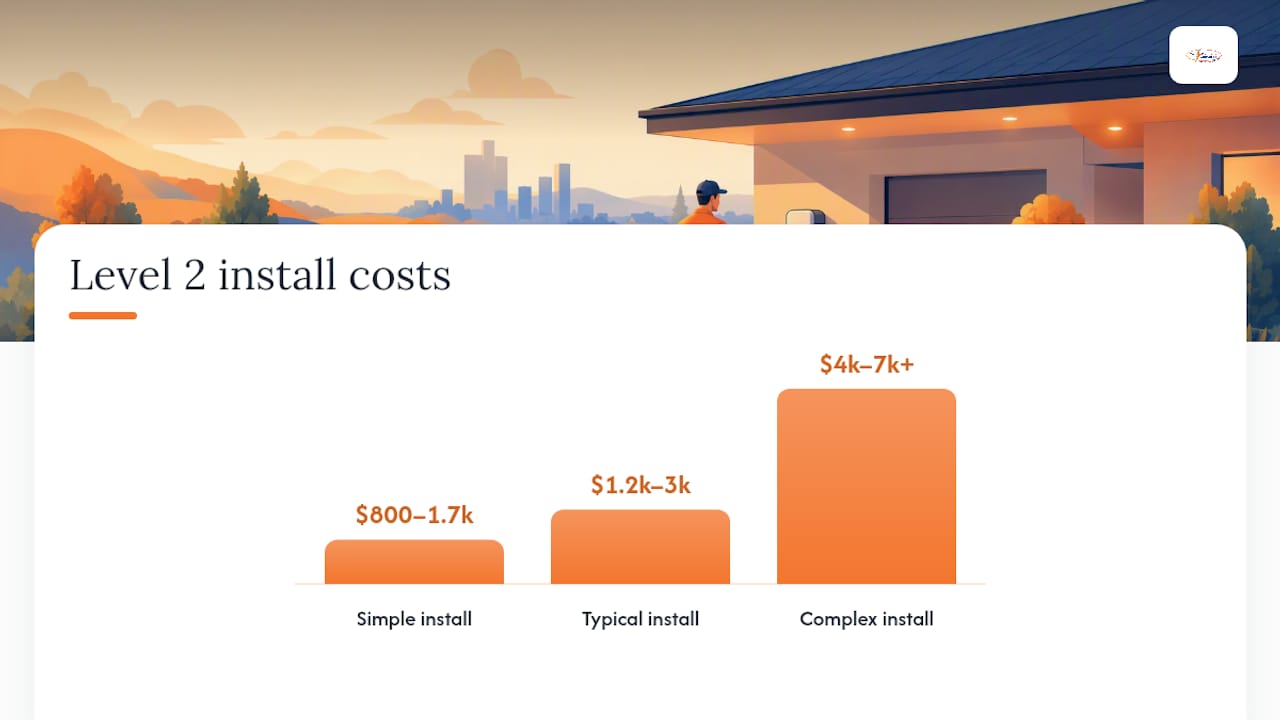
Typical installs land between $1,200 and $3,000. This is the most common scenario: a 30 to 50 foot run, some drywall patching, possibly a short outdoor stretch to reach a detached garage, and a standard permit pull. Most homeowners researching home EV charger cost end up somewhere in this band.
Complex installs climb to $4,000 to $7,000 or more. This tier almost always involves one of three things:
- A panel that’s full or too old to safely add a 40 to 60 amp circuit
- Trenching under a driveway or through landscaping to reach a detached structure
- A main service that needs to be upgraded from 100 amps to 200 amps before any charger work can start
A national cost survey groups projects into these same three planning bands, and the pattern holds across most regions: the charger itself rarely drives the price. The electrical infrastructure around it does.
What Actually Goes Into an EV Charger Install Price?
Ask five contractors for a quote and you’ll get five different numbers unless you know what should be itemized. A complete bid breaks down into four categories, and each one moves independently.
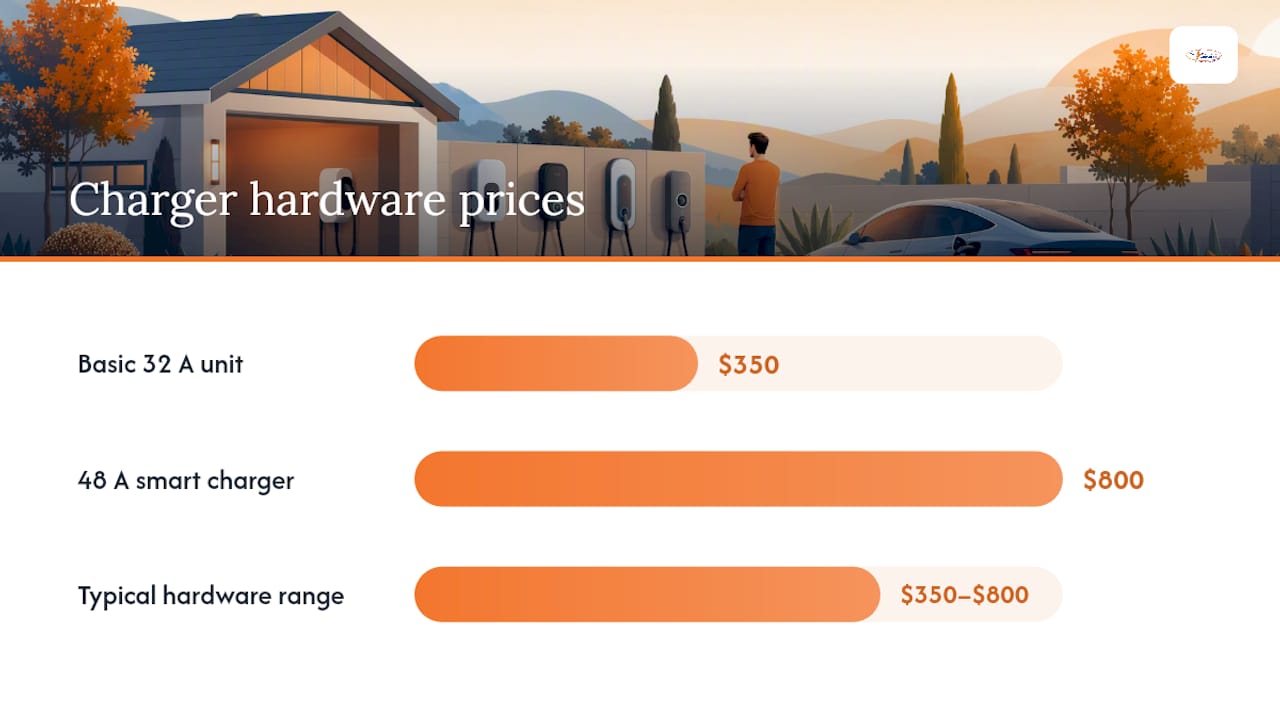
Hardware. A Level 2 charging station typically costs $350 to $800 depending on amperage and features. A basic 32 amp unit with no app connectivity sits at the low end. A 48 amp smart charger with Wi-Fi, load management, and a weatherproof NEMA-rated enclosure for outdoor mounting sits at the high end. Connector type matters too: a hardwired unit is usually cheaper than a plug-in model that requires an additional outlet installation.
Labor and materials. Excluding the charger itself, labor and materials commonly range from $400 to $1,500, and this is where run length really shows up. Fishing wire through a finished basement ceiling or drilling through masonry costs far more than an open-stud garage wall. A short run with exposed framing might take two hours. A 60 foot outdoor run with trenching can take a full day or more.
Permits and inspection. Any new 240 volt circuit needs a permit in nearly every jurisdiction, and fees typically run $50 to $300. Skipping this step to save money creates real problems later, since an uninspected electrical circuit can complicate a home sale or an insurance claim after an electrical fire.
Panel or service work (if needed). Covered in detail below, but this is the line item that turns a typical install into a complex one.
| Cost Component | Typical Range | What Drives It Higher |
|---|---|---|
| Charger hardware | $350 to $800 | Amperage, smart features, outdoor rating |
| Labor and materials | $400 to $1,500 | Run length, finished walls, outdoor trenching |
| Permit and inspection | $50 to $300 | Local jurisdiction fees |
| Panel or service upgrade | $1,500 to $3,500+ | Full panel, old wiring, insufficient amperage |
Do You Need a Panel Upgrade Before Installing a Charger?
A Level 2 charger continuously draws substantial current for several hours, which older home electrical systems may not be equipped to handle. Panel upgrades are often the largest cost variable in installation quotes, so obtaining a load calculation beforehand is advisable.
A few signs point toward needing one:
- Your panel is rated at 100 amps and already runs an electric range, central air, and a water heater
- Your panel has no open breaker slots and no room for a tandem breaker
- Your home still has a fuse box instead of a modern breaker panel
- An electrician’s load calculation shows your existing service can’t handle the added draw without exceeding safe capacity
Common upgrade costs break down like this: moving from 100 amp to 200 amp service generally falls within the $1,500 to $3,500 range cited by installer cost guides, while adding a subpanel near the garage to avoid a full service upgrade can sometimes cost less, depending on distance from the main panel. Main breaker replacement without a full panel swap is usually the cheapest of the three options.
Pro Tip: Ask for the load calculation in writing before you approve any panel work. It’s a simple worksheet that shows exactly how close your existing service is to its limit, and it protects you from being upsold on an upgrade you don’t actually need.
Panel upgrades can extend the overall project timeline. While a typical level 2 charger installation might be completed within a day from permit to inspection, panel upgrades often require additional utility coordination and inspections, potentially adding weeks depending on local processes.
Homeowners weighing this decision often start by reviewing panel upgrade requirements before requesting a full EV charger quote, since knowing your panel’s condition upfront makes every other estimate more accurate.
What Should Be Included in a Level 2 Installation Quote?
Avoid accepting vague single-line quotes, as they often lead to unexpected charges mid-project. A detailed bid should itemize labor, materials, permits, panel work, hardware, and warranties to allow proper comparison among contractors.
- Labor hours and rate, broken out separately from materials so you can see what you’re actually paying for the work itself.
- Parts list, including wire gauge, breaker size, conduit, and any junction boxes needed for the specific run.
- Permit fees, stated as a pass-through cost rather than buried inside the labor line.
- Panel or service work, itemized separately if a load calculation shows it’s needed.
- Charger hardware, listed with the exact model and amperage so you’re not comparing a 32 amp unit against a 48 amp one.
- Warranty terms, covering both the hardware manufacturer’s warranty and the contractor’s labor warranty.
When you call around, ask each contractor the same set of questions: What amperage circuit are you running, and does my panel support it without upgrades? How long is the run from the panel to the charger location, and does it cross any finished walls or go outdoors? Will the charger be hardwired or plug-in, and does that change the price? Who pulls the permit, and is that fee included in your quote?
Watch for a few red flags. A contractor who won’t mention a permit at all is either planning to skip it or hasn’t thought through the job. A quote with vague line items like “electrical work” and no breakdown makes it impossible to compare against a competing bid. And a price that comes in dramatically lower than every other quote you’ve received often means something’s been left out, whether that’s the permit, the panel assessment, or proper wire gauge for the run length.
Are There Still EV Charger Rebates and Tax Credits in 2026?
Incentive programs can meaningfully shrink your net cost, but the landscape has shifted and the rules matter more than ever. The federal Section 30C credit historically covered 30% of installation costs up to $1,000, though eligibility windows and cutoff dates have changed heading into 2026. Because this credit is nonrefundable, it only offsets what you actually owe in federal tax. If your tax liability for the year is smaller than the credit, you don’t get the difference back as a refund.
Many utilities and states offer rebates ranging roughly from $250 to $1,500 depending on the program and income eligibility, and these can often stack with federal incentives to meaningfully lower net cost, according to installation cost research.
Before you assume a rebate applies to you, check three things:
- Your utility’s specific EV charging rebate page, since many require enrollment in a time-of-use rate plan
- Your state energy office’s current incentive list, since these programs change year to year and sometimes pause when funding runs out
- Whether stacking rules apply, since some utility rebates explicitly reduce or exclude eligibility if you’ve already claimed a state incentive
Don’t build your entire budget around a rebate you haven’t confirmed is still active. Programs get paused, funding caps get hit, and application windows close faster than most homeowners expect.
Three Real-World Level 2 Installation Budgets
Numbers on a page are easier to trust when you can see how they add up. Here are three realistic scenarios based on the cost ranges covered above.
Example A: Simple indoor install. A homeowner with an attached garage and an open breaker slot 15 feet from the panel installs a 40 amp hardwired charger.
- Charger hardware: $450
- Labor and materials: $500
- Permit and inspection: $100
- Total: $1,050
Example B: Typical suburban install with outdoor run. A homeowner needs a 45 foot run from the panel through the garage wall and along an exterior wall to a driveway-mounted charger, with a weatherproof enclosure.
- Charger hardware: $650
- Labor and materials: $1,100
- Permit and inspection: $175
- Total: $1,925
Example C: Complex job with panel upgrade and trenching. A homeowner’s 100 amp panel is already at capacity, and the charger location requires 12 feet of trenching to reach a detached garage.
- Charger hardware: $700
- Labor and materials: $1,400
- Panel upgrade (100A to 200A): $2,800
- Permit and inspection (two inspections): $250
- Total: $5,150
| Scenario | Hardware | Labor/Materials | Panel Work | Permit | Total |
|---|---|---|---|---|---|
| A: Simple indoor | $450 | $500 | None | $100 | $1,050 |
| B: Typical outdoor run | $650 | $1,100 | None | $175 | $1,925 |
| C: Complex with upgrade | $700 | $1,400 | $2,800 | $250 | $5,150 |
Why Hiring a Professional Matters for EV Charger Installation
Running a dedicated 240 volt circuit isn’t a weekend project, and it’s not the place to save money by cutting corners. Industry guidance consistently recommends professional installation for safety and code compliance, since a miswired high-amperage circuit is a fire and shock hazard that homeowner’s insurance may not cover if it wasn’t inspected.
A family-owned business since 1975, professional electricians routinely handle EV charger installations as part of their electrical services. A proper install includes a load calculation on your existing panel, correct wire gauge and breaker sizing for the charger’s amperage, a permit pulled before work starts, and a final inspection to confirm everything meets code. You should expect clear, upfront pricing before any work begins, not a surprise invoice after the fact.
Is a Level 2 Charger Actually Worth the Cost?
For most EV owners, yes. Charging at home costs a fraction of public fast-charging rates over the life of the vehicle, and the convenience of a full charge every morning is hard to put a price on once you’ve had it. The math works best if you’re keeping the car more than three or four years and you have off-street parking.
It’s a harder sell if you rent, plan to move soon, or already have reliable access to free or cheap public Level 2 charging nearby. In that case, the upfront cost may not pay itself back before your circumstances change.
Either way, the only way to know your real number is a local quote. Panel condition and run length vary too much house to house for any online estimate to replace an actual assessment.
— Lindsay Paramore
Get a Level 2 Charger Estimate From Tri-County Services Electric & Plumbing
Level 2 charger installations are offered with an upfront pricing approach consistent across electrical work, including assessments of panel capacity, run length to the preferred charger location, and the need for any panel or service upgrade.

If your garage or driveway is ready for home EV charging, call (440) 253-0332 to schedule an estimate, or review the EV charger installation page to see what’s included before you book. Flexible scheduling means the visit fits around your day instead of the other way around.
Sources
- EV Charger Installation Cost: 2026 Guide | InstallerEV
- Getting started with electric vehicles | PG&E
- Level 2 EV Charger Installation Cost USA 2026: Real Budget Ranges – MaxEvCharge
- How much does an EV charger installation cost? | EnergySage
FAQ
How much does it cost to install a Level 2 charger?
Most homeowners pay $1,200 to $2,700 for a complete installation when no panel upgrade is needed, with jobs requiring panel work often reaching $4,000 to $7,000. Your exact price depends on run length, wall access, and your panel’s available capacity.
Is installing a Level 2 charger worth it?
For most EV owners who plan to keep their vehicle several years and have off-street parking, yes. Home charging is generally far cheaper over time than relying on public fast-charging stations, though the payback period depends on how much you drive.
Are Level 2 chargers cheaper than Level 1?
The charger hardware itself is more expensive, typically $350 to $800 compared to a Level 1 cord that often comes free with the vehicle. But Level 2 charges roughly five to seven times faster, which makes it the better value for daily driving.
How much does a Level 2 Tesla charger cost?
A Tesla-compatible Level 2 charger falls within the same general hardware range as other Level 2 units, roughly $350 to $800, plus installation costs that depend on your panel and run length. An exact quote can be provided by professionals after assessing your panel and garage layout; contact their office to schedule an assessment at (440) 253-0332.
Do I need a permit to install a home EV charger?
Yes, nearly every jurisdiction requires a permit for a new 240 volt circuit, and fees typically run $50 to $300. Skipping the permit can create problems later with insurance claims or home resale.