
If your service line turns out to be lead, full replacement is the recommended fix, and full replacement, not a partial patch, is what protects your water. Start today by looking up your address on your water utility’s service line map or calling the utility directly. Many municipal and federal programs can cover some or all of the cost, so check before hiring anyone privately.
TL;DR:
- Full lead service line replacement is the safest option, but most utilities only replace the section from the main to the property line, leaving private-side work for homeowners or programs.
- Costs for private-side replacement typically reach around $5,000 unless homeowners qualify for free or subsidized programs, such as those offered by Toledo or New York City.
- Utility inventories and maps usually classify service lines as lead, galvanized, copper, or unknown, and visual inspection should be confirmed by a professional.
- The EPA recommends full replacement because partial fixes can temporarily increase lead levels and do not eliminate the ongoing risk.
- Neighborhood-wide programs backed by federal funding significantly accelerate lead removal efforts and are crucial to reducing collective exposure.
Table of Contents
- How to check whether your service line is made of lead
- What full lead service line replacement actually involves
- Costs and funding: where homeowners find free or subsidized replacement
- Regulatory timeline and utility obligations homeowners should know
- Preparing for the work and immediate post-replacement precautions
- Practical checklist from Tri-County Services Electric & Plumbing: when to call a professional and what to ask
- Health risks of lead service lines and the case for removal
- Common challenges and pitfalls during replacement projects
- Environmental considerations and disposal of removed lead materials
- Why coordinated municipal replacement programs are important
- How Tri-County Services Electric & Plumbing can help
- Sources
- FAQ
How to check whether your service line is made of lead
Most water utilities now maintain a public service line inventory or map that shows the material running from the street to your home, and checking it is the fastest way to find out where you stand. These maps typically classify each line as lead, galvanized (requiring replacement), copper, plastic, or unknown, and an “unknown” listing usually means the utility still needs to verify your property.
A visual check can add information, but a professional should confirm what you’re looking at rather than you attempting it alone. Lead pipe is dull gray, scratches easily to reveal a shiny surface, and is not magnetic, while galvanized steel is duller and magnetic.
- Search your address on the utility’s online service line map or inventory tool.
- Look at the exposed pipe entering your home, usually near the water meter or where the line enters the basement.
- Ask your water utility about scheduling a professional inspection if the map shows “unknown.”
- Request tap water testing if you have concerns about lead exposure while you wait for verification.
- Check whether your street is already listed in a planned municipal replacement zone, which could reduce your cost significantly.
What full lead service line replacement actually involves
Full replacement means removing the entire lead line, from the water main to the interior shutoff valve, rather than swapping out only the section under public ownership. The EPA’s planning guidance treats full replacement as the preferred approach because partial replacements can temporarily raise lead levels in drinking water.
- The utility typically owns and replaces the section from the main to the curb stop or property line.
- The homeowner is usually responsible for the private-side portion, from the curb stop to the house, though many programs now cover this too.
- Crews use open trench excavation or trenchless methods like pipe bursting, with trenchless work reducing yard disruption but sometimes costing more.
- Restoration of lawns, driveways, or sidewalks follows, and a single-property job often takes one to several days depending on the method and site conditions.
Water service is interrupted during the work, so utilities generally schedule around your availability once the project is confirmed.
Costs and funding: where homeowners find free or subsidized replacement
Private-side replacement costs vary with pipe length, excavation method, and restoration needs, but Ohio estimates commonly land around $5,000 per property when homeowners pay out of pocket. That figure assumes standard trenching and restoration, and costs climb with longer runs or harder-to-access lines.
Several Ohio and national programs remove that burden for qualifying properties. The City of Toledo has offered full private-side replacements at no cost to registered residents, funded through public financing rather than individual homeowner payments. New York City’s Department of Environmental Protection runs a comparable model through its Lead Service Line Replacement Program, where the utility inspects, schedules, and completes replacement, then provides certified filters while final landscaping restoration catches up over the following weeks.
A 2026 Ohio analysis found that removing lead service lines can return between $32 and $45 in public benefit for every $1 invested, which helps explain why lawmakers and utilities are pushing to fund these projects rather than leaving costs to individual homeowners.
Funding for these programs generally flows through a few channels:
- The Drinking Water State Revolving Fund, which the EPA confirms can pay for full lead service line replacement projects.
- Bipartisan Infrastructure Law allocations directed to state and local water systems.
- State-level programs such as Ohio’s drinking water assistance funds, which utilities use to finance local projects.
- Municipal capital budgets supplementing federal and state dollars for accelerated replacement schedules.
If your utility contacts you with a registration letter or an eligibility notice, respond promptly. That outreach is usually your ticket into a subsidized or free program, and missing the window can mean paying privately later.
Regulatory timeline and utility obligations homeowners should know
Federal rules now push utilities toward faster, more transparent lead pipe removal, and knowing the framework helps you understand why your utility is contacting you, or why it hasn’t yet. The Lead and Copper Rule Improvements set a general expectation that utilities work toward full replacement of remaining lead lines, with the EPA’s final rule announcement tying that effort to a roughly ten-year replacement horizon for most systems.
- Utilities must maintain and publicly post a service line inventory identifying lead, galvanized, and unknown lines.
- Homeowners with lead or unknown lines typically receive notification letters describing risk and next steps.
- Some systems can request deadline extensions under specific conditions, which can shift local timelines.
- After replacement, utilities commonly provide filters and schedule follow-up water sampling to confirm results.
Ask your utility directly where your street falls in its published timeline if you haven’t received a notice yet. Inventories are public records, and reviewing them can tell you more than waiting for a letter.
Preparing for the work and immediate post-replacement precautions
Clear access to your water meter and the exterior wall where the line enters your home before the crew arrives, and move landscaping, vehicles, or pet enclosures out of the work zone. This is not a project to attempt yourself. Disturbing a lead line without proper handling can release particles into your water, and a professional should always confirm the line’s material and manage removal.
- Keep pets and children away from excavation areas during the work.
- Ask the utility or contractor for a written flushing schedule before you resume normal water use.
- Request a certified NSF 53 lead-reducing filter if your utility offers one, and use it until follow-up testing confirms your water quality.
- Schedule follow-up sampling roughly three to six months after replacement, a timeframe utilities like Toledo commonly recommend.
- Save copies of every notice, signed agreement, and sampling result in case questions come up later.
Pro Tip: Run cold water for several minutes before drinking or cooking with it for the first few weeks after replacement, since flushing helps clear any loosened particles from the new connection.
Practical checklist from Tri-County Services Electric & Plumbing: when to call a professional and what to ask
Partial replacements done without proper coordination can disturb sediment and temporarily raise lead exposure, which is exactly why this isn’t a project to piece together yourself. A professional can verify pipe material, coordinate the private-side work with your utility’s public-side schedule, and pull the right permits before any digging starts.
Before hiring anyone, ask:
- Will you coordinate directly with the water utility to confirm the public-side timeline?
- Who handles permits, and who restores the landscaping or driveway afterward?
- What’s the projected timeline from start to final restoration?
- Can you provide proof of insurance and references from similar jobs?
- Will I receive a written estimate covering scope, materials, and warranty terms?
Professional services typically start with an inspection of the private-side line, coordinate timing with your utility where needed, and manage restoration once the new line is in. Call (440) 253-0332 to talk through your situation before signing anything.
Health risks of lead service lines and the case for removal
Lead exposure from drinking water accumulates gradually, and children and pregnant women face the greatest concern because lead can affect brain development and nervous system function even at low exposure levels. There’s no fully safe level of lead in drinking water, which is why the EPA’s guidance treats full replacement as the goal rather than a temporary fix.
Older homes and older neighborhoods, particularly those with plumbing installed before the mid-1980s, carry the highest likelihood of lead service lines. Corrosion inside these pipes releases lead into the water supply gradually, sometimes without any visible or noticeable change in taste or clarity, which is part of why testing and utility inventories matter more than a visual check alone.
Removing the lead line entirely eliminates the ongoing source, rather than managing it indefinitely with filters. Filters and flushing help reduce exposure in the meantime, but they depend on consistent use and maintenance. Full replacement removes that dependency and, according to the EPA, is the approach that actually reduces exposure rather than temporarily suppressing it. For households with young children or anyone pregnant, that difference carries real weight, and it’s a reasonable factor in deciding whether to move up a planned replacement rather than wait.
Common challenges and pitfalls during replacement projects
Coordination gaps between the utility’s public-side work and a homeowner’s private-side contractor cause some of the most frustrating delays. If the two sides aren’t scheduled together, a property can end up with a brand-new public connection joined to an old private line, or the reverse, which defeats the purpose of the project.
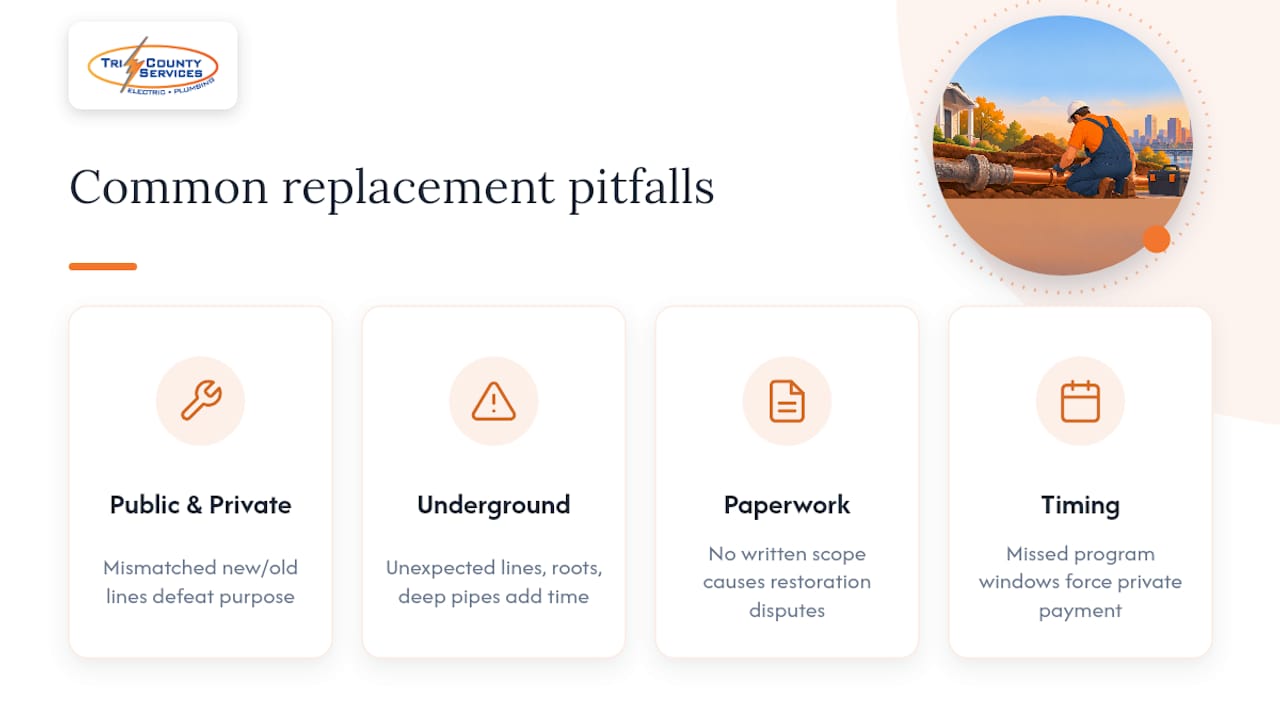
Underground surprises also slow projects down. Unexpected utility lines, tree roots, or unusually deep pipe runs can extend timelines and add cost, particularly with open trench methods. Trenchless techniques reduce some of this risk but aren’t always suitable for every property layout.
Paperwork gaps create disputes later. Homeowners who skip a written scope of work, skip confirming who handles restoration, or don’t get documentation of utility coordination sometimes find themselves arguing over responsibility for landscaping repair or unexpected charges. Requiring a clear, written agreement before work starts avoids most of this.
Program timing can also catch people off guard. Municipal programs like Toledo’s have had registration windows, and missing a signup deadline can mean paying privately for a job that would otherwise have been covered. Watching for utility mailings and checking program pages directly, rather than relying on word of mouth, helps homeowners avoid missing these windows entirely.
Environmental considerations and disposal of removed lead materials
Removed lead pipe cannot simply go into a regular trash pile or general construction debris bin. Lead is a regulated material, and contractors and utilities handling replacement projects are expected to manage removed sections as they would other lead-containing waste, following applicable state and local disposal rules rather than standard demolition disposal.
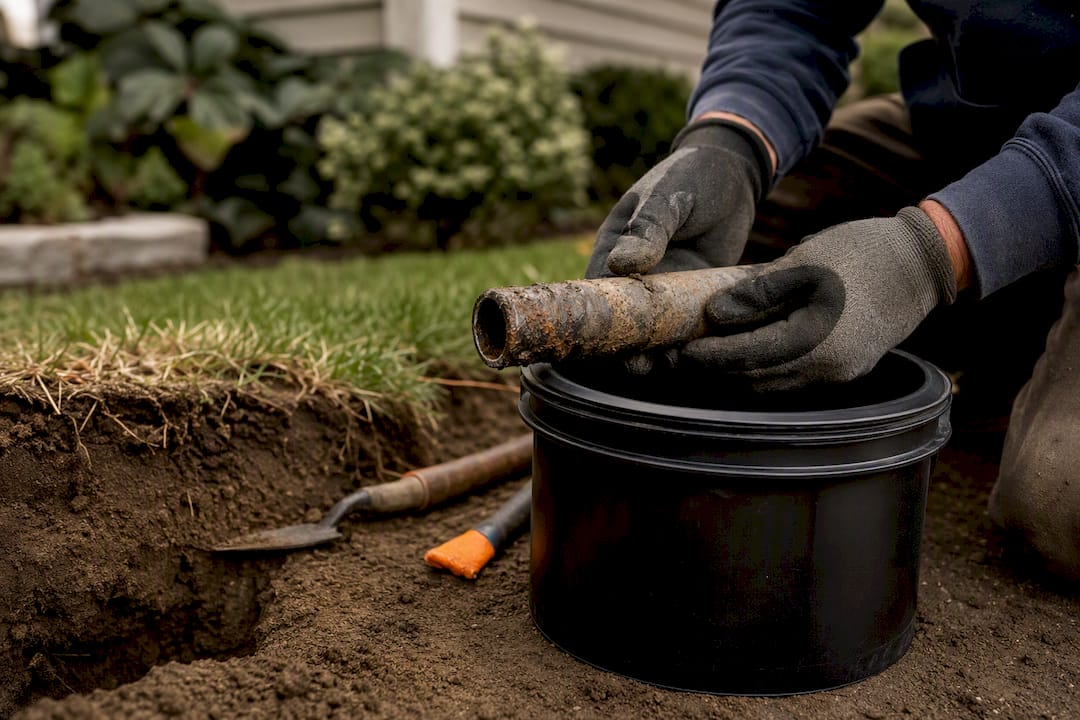
Municipal programs typically build proper disposal into their project scope, since the utility or its contractor manages removal as part of the replacement itself. When a private contractor handles the private-side portion outside a municipal program, ask directly how they plan to transport and dispose of the old line. A professional handling this work regularly should have an established process, and that’s a reasonable question to include alongside permit and insurance questions.
Soil disturbance during excavation is another consideration, particularly on older properties where lead may have leached into surrounding soil over decades. Reputable contractors and municipal crews typically follow standard excavation practices that limit spread, but homeowners with young children who play in yard areas near the old line’s path may want to ask whether any soil testing or precautions are part of the project.
Why coordinated municipal replacement programs are important
Lead pipes don’t stop being a risk once one household replaces its line. Neighborhood-wide removal, backed by federal and state funding, moves faster and reaches more homes than individual homeowners acting alone ever could. The strongest argument for these programs isn’t convenience, it’s that leaving lead in the ground anywhere upstream keeps risk alive for everyone downstream. Watch your utility’s inventory and program announcements closely. That’s often the difference between paying privately and getting the work done at no cost.
— Lindsay Paramore
How Tri-County Services Electric & Plumbing can help
Figuring out whether your line is lead, coordinating with a municipal program, and managing the private-side work yourself can turn into a lot of back-and-forth. Professional service providers can handle the private-side portion so you’re not managing contractors, permits, and utility coordination alone.

We offer water line installation and repair for properties throughout our Northeast Ohio service area, including inspection to help confirm what’s running to your home before you commit to a full project. Our team also handles related plumbing work if your inspection turns up other aging pipe, including galvanized line replacement where it applies.
- Private-side inspection to help identify pipe material before you contact your utility.
- Coordination support so your private-side timeline lines up with any municipal public-side work.
- Restoration handling once the new line is in place.
Check our plumbing pricing guide for a sense of related project costs, or call (440) 253-0332 to schedule a consultation and get a written estimate for your property.
This article is general information, not a substitute for advice from a qualified doctor. Consult a qualified healthcare professional about your own circumstances before acting on anything here.
Sources
- Planning and Conducting Lead Service Line Replacement (EPA)
- City of Toledo lead service line replacement announcement
- Lead Service Line Replacement Program – NYC DEP
- Ohio Capital Journal: Ohio lawmakers want to replace all lead service lines (2026)
FAQ
Is it possible to replace lead water pipes for free?
Yes, in some cases. Municipal programs like Toledo’s have covered full private-side replacement costs for eligible, registered residents using public funding rather than billing homeowners directly.
What are they replacing lead pipes with?
Utilities generally replace lead service lines with copper or approved plastic piping, both of which don’t corrode and release lead the way older lead lines do. The specific material used often depends on local utility standards and site conditions.
How much to replace a lead water line?
Private-side replacement costs vary, but Ohio estimates commonly cite figures around $5,000 per property when paid out of pocket. Municipal or federally funded programs can reduce or eliminate that cost for qualifying homeowners.
Will my water utility replace my lead pipe?
Many utilities are actively working toward replacing lead service lines under federal requirements tied to the Lead and Copper Rule Improvements, and some offer full replacement programs covering the private-side portion at no cost to eligible residents. Check your specific utility’s service line map or contact them directly to confirm what applies to your property.