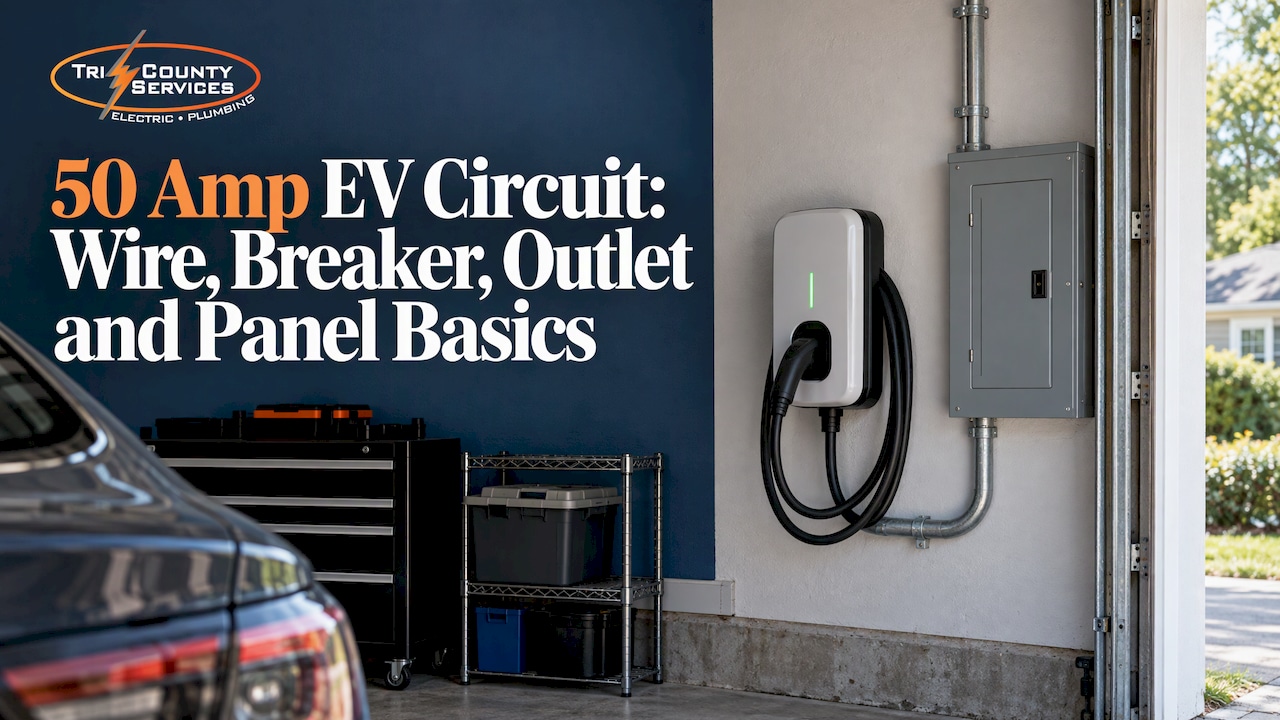


A 50 amp EV circuit is a dedicated 240-volt line with a 2-pole 50-amp breaker, 6-gauge copper wire and either a NEMA 14-50 outlet or a hardwired charger. It lets your car draw up to 40 amps continuously, which is the right match for most home Level 2 charging. Whether your home can carry it safely depends on your panel, the length of the wire run and local code. Those are the parts Tri-County Services Electric & Plumbing handles for Northeast Ohio homeowners, so the circuit is built, permitted and inspected correctly the first time.
This guide explains what the circuit is made of, why “50 amps” really means 40 amps of charging, how the outlet compares with hardwiring, and what to check about your panel before anyone cuts a hole in a wall.
TL;DR
- A 50 amp EV circuit supports a 40 amp continuous charging load, because EV charging is a continuous load and the code requires the breaker to be 125% of it.
- The standard build is a dedicated 4-wire circuit: 2-pole 50-amp breaker, minimum 6 AWG copper wire and a heavy-duty NEMA 14-50 receptacle, or a hardwired charger.
- Your main panel size and open breaker slots decide whether you need a panel upgrade or garage subpanel first.
- Long runs, such as to a detached garage, can need 4 AWG wire to limit voltage drop.
- New EV circuits involve permits and inspections, so the work belongs with a professional electrician. Call (440) 253-0332 to talk it through.
Table of Contents
- What a 50 amp EV circuit actually delivers
- What goes into the circuit
- NEMA 14-50 outlet or hardwired charger
- Can your panel handle another 50 amps?
- Wire size, distance and voltage drop
- Permits, inspections and the code
- Using a 50 amp EV circuit safely
- Why a professional should build it first
- Our EV charger installation in Northeast Ohio
- Our point of view
- FAQ
- Sources
What a 50 amp EV circuit actually delivers
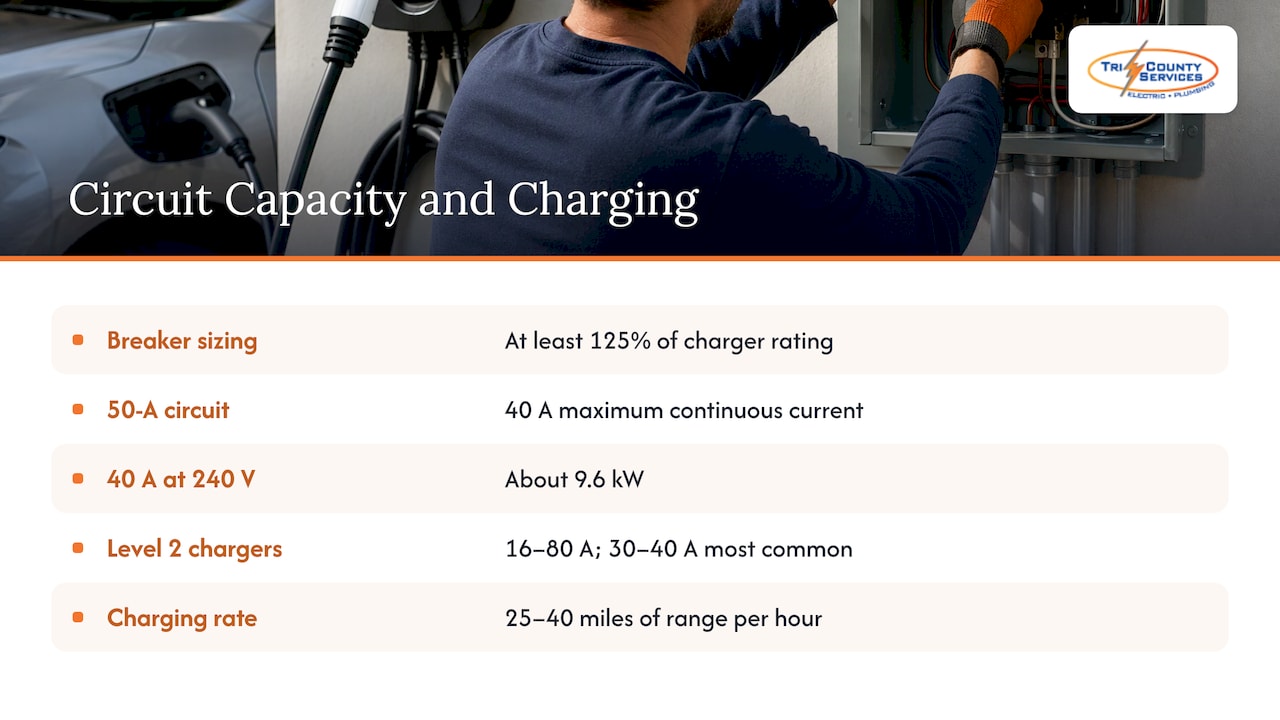
The number on the breaker is not the number your car sees. The U.S. EPA explains that the breaker must be sized at least 125% of the charger, so a 40-amp Level 2 charger needs a dedicated 50-amp circuit. Turn that around and a 50-amp circuit supports a 40-amp charger.
The reason is heat. A car plugged in overnight pulls near-full current for hours, and the National Electrical Code (NEC), the model safety standard most U.S. jurisdictions adopt, treats that as a continuous load. Charged EVs describes the 80% continuous-load limit: a 50-amp breaker allows a maximum of 40 amps continuous, and a circuit on a 50-amp breaker needs at least 6-gauge wire.
At 240 volts, 40 amps is about 9.6 kilowatts. The EPA says Level 2 chargers typically range from 16 to 80 amps, with 30 to 40 amps the most common, adding roughly 25 to 40 miles of range per hour of charging. For most drivers that means a full recharge overnight, which is why the 50-amp circuit is the most common home choice.
Why this matters when you shop for a charger
If a charger is rated 40 amps, you need a 50-amp circuit. If it is rated 48 amps, you need a 60-amp circuit. Our guide to EV charger breaker size and the 125% rule walks through the 40 to 60 amp range. Buying the charger first and the circuit second is how homeowners end up with equipment their wiring cannot support, so it helps to settle the circuit before you buy.
What goes into the circuit
A 50 amp EV circuit is more than a breaker and a plug. Each part has a specification, and a mismatch in any of them creates a heat problem inside a wall where you will never see it.
| Component | What it should be | Why it matters |
|---|---|---|
| Circuit type | Dedicated 4-wire: two hots, neutral, equipment ground | EV equipment must sit on its own branch circuit, separate from other loads |
| Breaker | 2-pole, 50 amp, with GFCI protection where code requires it | Protects against overload and ground faults |
| Wire | Minimum 6 AWG copper | Aluminum or copper-clad wire is not recommended for this device |
| Receptacle | Industrial-grade NEMA 14-50, rated for continuous use | Standard residential outlets can overheat under hours of load |
| Ground wire | 10 AWG copper equipment grounding conductor | Gives fault current a safe path |
These specifications come from Electrical Technology’s NEMA 14-50 wiring guide, which also lists the receptacle as a 3-pole, 4-wire device at 125/250 volts rated for 75°C continuous use. The U.S. EPA’s Building America Solution Center adds that NEC Article 625 requires EV charging equipment on a dedicated branch circuit with listed wiring methods and ground-fault protection.
Can I use my dryer outlet?
A dryer outlet is also 240 volts, which makes it tempting. The wiring, receptacle type and load rating are different, and adapters add a failure point. We cover it in Dryer Outlet EV Charging: What Works And What Doesn’t. A professional looks at the existing circuit and tells you what it can safely do.
NEMA 14-50 outlet or hardwired charger
A NEMA 14-50 is the 240-volt outlet most plug-in chargers use. The alternative is a hardwired charger connected directly to the circuit with no outlet in between. Both sit on the same 50 amp circuit, and the right choice depends on the charger and how you use it.
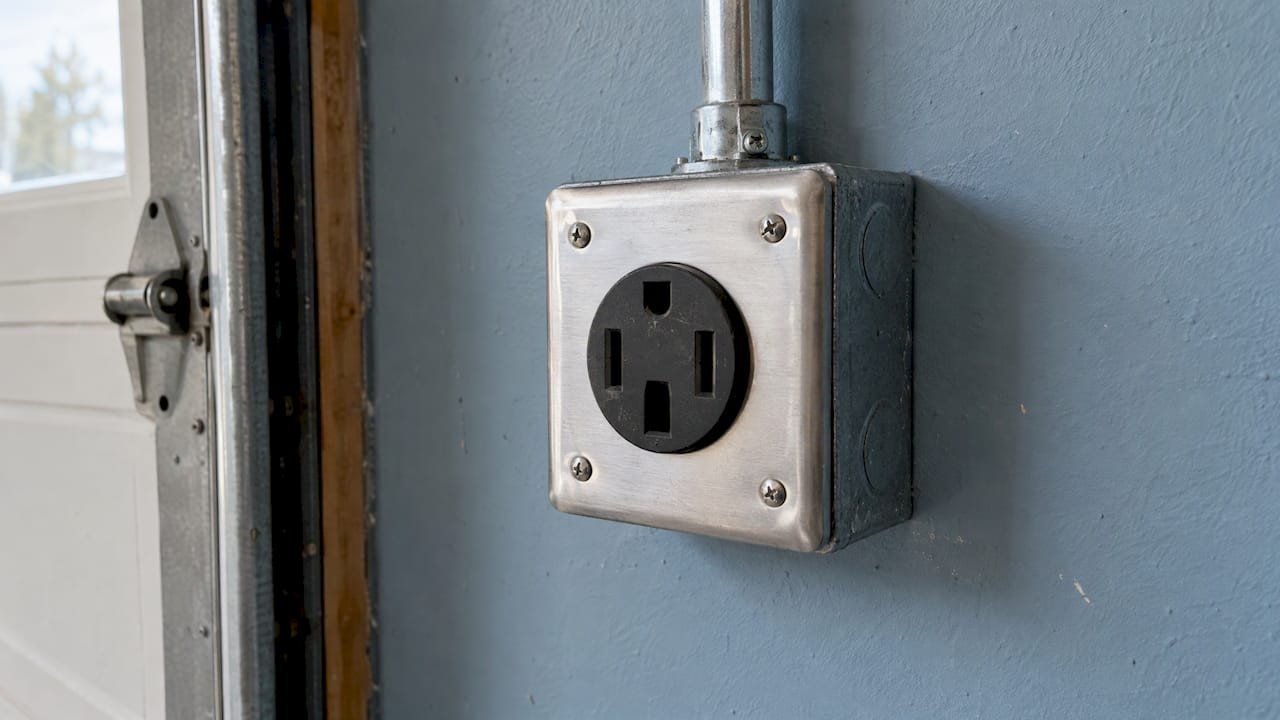
According to EnergySage, hardwired chargers generally deliver up to 48 amps, while plug-in units are limited to 40 amps, and hardwiring avoids nuisance tripping. The EPA says chargers rated 48 amps or higher are usually required to be hardwired, and it describes hardwiring as the safer option at that rating.
Here is how we think about the decision:
- Outlet: works well for a 40-amp plug-in charger on a 50-amp circuit, and gives you the flexibility to swap or unplug the unit. The receptacle must be industrial grade and rated for continuous use.
- Hardwired: removes the receptacle, which is the part that wears from repeated plugging and sustained heat. It is the right path if you want a higher-amperage charger now or later.
If you might upgrade to a faster charger in a few years, wiring for it now avoids reopening the walls. Our team can lay out both options for your garage and your vehicle on the first visit.
Can your panel handle another 50 amps?
This is the question that decides your project cost and scope. A 50-amp breaker is a big addition to a home electrical system, comparable to an electric range.
ENERGY STAR says an electrical panel upgrade may be needed if you have a 65-, 100- or 125-amp main breaker and very few or no empty breaker slots. An upgrade may not be needed with a 200- or 225-amp main and several empty slots. It also notes that older homes without central air conditioning may have a 100-amp panel, while newer homes tend to have 200-amp panels.
Many Northeast Ohio homes were built decades ago, so it is common to find older panels that are full or close to it. The main breaker label is only the start. A professional performs a load calculation that adds up what your home already draws, such as the furnace blower, range, dryer, water heater and air conditioning, and checks whether 40 more amps of continuous load fits.
Three common outcomes
- The panel has room. A new 2-pole breaker, the wire run and the outlet or charger are all that is needed.
- The panel is full but the service is large enough. A garage subpanel can feed the EV circuit without crowding the main. See when to install a garage subpanel for 30 to 60 amp EV charging.
- The service itself is too small. A 200 amp panel upgrade solves the capacity problem for the EV and gives the house room for future loads.
If your panel is old, hums, trips often or has no free slots, an inspection before the EV circuit is the smart first move. Our electrical panel upgrade service covers that work.

Wire size, distance and voltage drop
Six-gauge copper is the minimum for a 50-amp breaker, but distance can push you higher. Voltage drop is the gradual loss of voltage along a wire, and it grows with length. Charged EVs notes that keeping voltage drop under 3% may require 4-gauge wire for runs beyond roughly 100 feet. The author points out that it is an often-overlooked factor: the 80% rule is the legal limit, but voltage drop can force a bigger wire even when the breaker rating would allow the smaller one.
This matters for homes where the panel is in the basement and the garage is across the house, or where the car parks in a detached garage. The longer the run, the more the wire size, conduit and trenching affect the project. The same principle of gauge and length is why extension cord gauge and length choices matter for any high-draw appliance. For an EV, extension cords are never the answer. A permanent circuit sized for the distance is.
Permits, inspections and the code
A new 50 amp EV circuit is a permitted project in most places. The EPA advises that a new EV charging circuit involves electrical system changes best left to a professional, who should perform a load calculation, obtain permits and inspections and size the breaker at least 125% of the charger. The Building America Solution Center similarly says the contractor should obtain a local permit before installation if required, and that hardwired installation should be done by a qualified professional familiar with the codes.
Requirements vary by city and township, and your local building department confirms the current rules. Typically an inspection happens after the wiring is in place and again once the circuit is energized and protected. Having the permit pulled and the inspection passed protects you in two ways: the work is verified, and your insurer and a future buyer see a documented installation.
Using a 50 amp EV circuit safely
Once the circuit is in, a few habits keep it safe:
- Keep water out. The U.S. Fire Administration advises a qualified electrician install a new dedicated circuit, a charger certified by a nationally recognized testing laboratory, and a cover on the outlet to keep water out. In Ohio winters, garage and exterior outlets see moisture and salt, so protection matters.
- No extension cords or adapters. They are not built for hours of continuous 40-amp load.
- Watch for warning signs. A warm or discolored outlet, a melted plug, a buzzing sound or a breaker that trips repeatedly means stop charging and call an electrician.
- Choose the right equipment. Look for a charger with a recognized laboratory listing and an industrial-grade receptacle rated for continuous duty.
A sustained load is what stresses an outlet, not a single burst. That is why continuous-duty rating on the receptacle matters as much as the breaker.
Why a professional should build it first
It can look like a weekend wiring job: run a cable, land it on a breaker, mount a plug. The reality is a high-current, always-on circuit inside your walls, and the mistakes do not show up on day one. An under-sized wire, a loose lug, a wrong receptacle or an overloaded panel can run warm for months before it fails.
The EPA and the Building America Solution Center both place this work with qualified professionals for good reason. A professional electrician:
- runs the load calculation that tells you whether the panel can take the load at all,
- selects the wire gauge for your actual distance,
- pulls the permit and meets the inspector,
- and stands behind the finished work.
If a circuit has already been installed by someone else, such as a previous owner or a handyman, a professional inspection is the right first step before you plug a car in for the first time. Our electrical repair service handles that, and our electrical troubleshooting runs $300 to $500 as published on our electrical pricing guide.
Our EV charger installation in Northeast Ohio
Tri-County Services Electric & Plumbing is a family-owned Northeast Ohio company that has served homes and businesses since 1975. EV charger installation is one of our listed services, and we also handle panel upgrades, dedicated circuits and whole-home surge protection, so the whole job stays with one team. Our technicians are skilled and certified, we schedule flexibly to limit disruption in your home, and we price clearly upfront. See the electrical pricing guide for our services, and our Cleveland EV charger installation guide and Level 2 charger cost guide for budgeting.
Call our office at (440) 253-0332 to set up your 50 amp EV circuit.

Our point of view
Most of the EV calls we hear start with the charger. The better starting point is the house. A 50 amp circuit is a serious, continuous load, and the panel, the wire run and the receptacle all have to be right together.
We build the circuit around your home: how much capacity the panel has, how far the garage is, and whether a plug-in outlet or a hardwired charger suits the way you drive. Doing it that way means no surprises for you, and no heat problems hiding in a wall.
Since 1975 our family-owned team has believed in long-term relationships with the homeowners we serve. We show up on a flexible schedule, respect your home and explain what we are doing. Charging your car at home should feel as easy as plugging in a phone, and a properly built circuit is what makes that true.
Lindsay Paramore
FAQ
What size wire do I need for a 50 amp EV circuit?
The minimum is 6 AWG copper for a 50-amp breaker, according to Electrical Technology, which warns against aluminum or copper-clad wire with the receptacle. Long runs may need 4 AWG to keep voltage drop low. A professional measures your run and chooses the gauge.
How many amps can an EV draw on a 50 amp breaker?
Up to 40 amps continuously. EV charging counts as a continuous load, so the breaker has to be at least 125% of the charger’s current, as the EPA explains. That works out to roughly 25 to 40 miles of range per hour at typical Level 2 rates.
Do I need a NEMA 14-50 outlet or should I hardwire?
Both run on a 50 amp circuit. An outlet suits a 40-amp plug-in charger, and hardwiring is the usual route for chargers rated 48 amps or higher. We can look at your charger and garage and recommend the better fit.
Will I need a panel upgrade for a 50 amp EV circuit?
It depends on the main breaker size and free slots. ENERGY STAR says a 65-, 100- or 125-amp main with few open slots often needs an upgrade, while a 200- or 225-amp main with space may not. A load calculation gives the real answer, and you can reach us at (440) 253-0332 to schedule one.
Sources
- Getting Started with Home EV Charging | US EPA
- Make Your Home Electric Ready | ENERGY STAR
- Electric Vehicle Charging for Single-Family Homes | Building America Solution Center
- Electric Vehicle Charging Safety Tips | U.S. Fire Administration
- A closer look at minimizing AC charging losses | Charged EVs
- Hardwire vs. Plug-In EV Charger | EnergySage
- How to Wire a 50A, NEMA 14-50 Heavy-Duty EV Receptacle | Electrical Technology
- Extension cord gauge and length | Kitchenware Compare