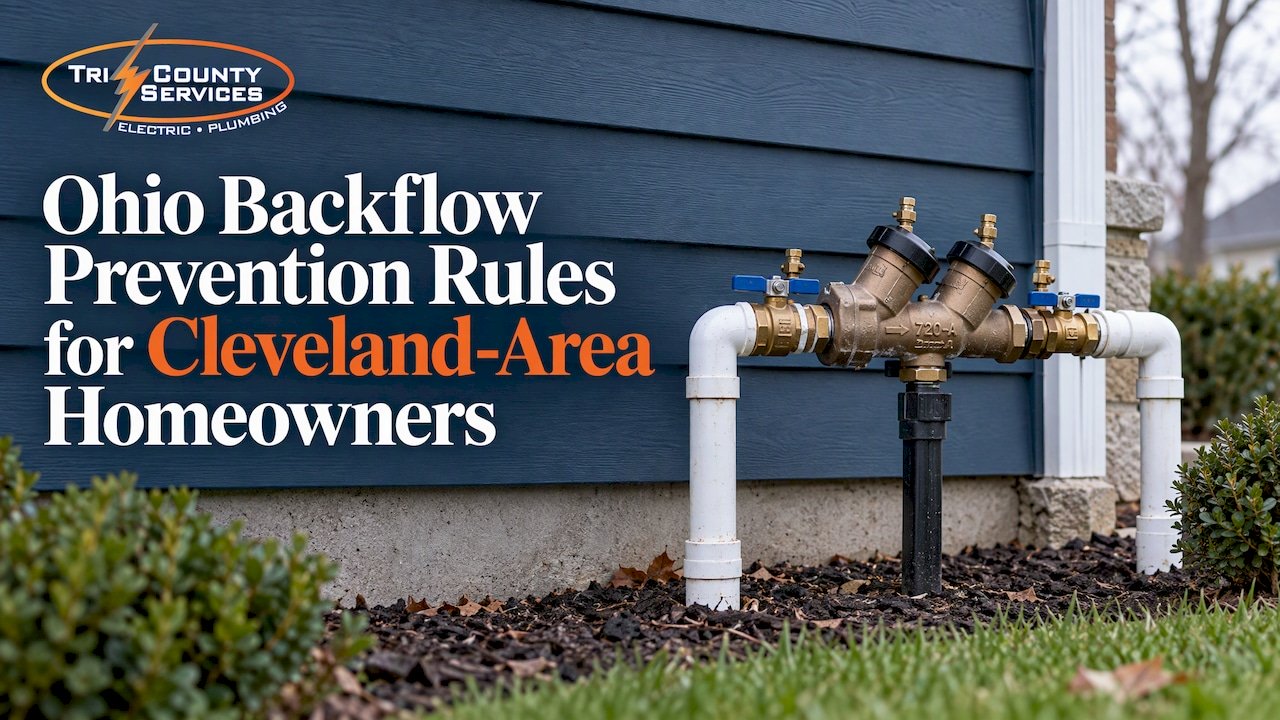

In Ohio, the rule is simple: wherever your plumbing could let used or contaminated water flow backward into the drinking supply, an approved backflow preventer has to be in place. Whether your home needs one depends on what is connected to your water line: a lawn irrigation system, a pool or hot tub with an automatic fill, a fire sprinkler system, or a hose connection. This is a question for a professional plumber, not a weekend project. Call Tri-County Services Electric & Plumbing at (440) 253-0332 and we will look at how your water system is set up.
TL;DR
- Ohio’s cross-connection rules (Ohio Administrative Code Chapter 3745-95) require an approved backflow preventer wherever a real or potential hazard to drinking water exists.
- In Cleveland, residential connections with irrigation systems, fire sprinklers, or pools and hot tubs with automatic fill valves need a device. Other Northeast Ohio communities set their own details.
- Your water supplier surveys properties, but the rule still leaves you responsible for knowing what is connected to your own plumbing.
- Backflow protection sits next to pressure, water line condition and leaks. A professional plumber looks at all of it in one visit.
- Call (440) 253-0332 to have a Tri-County Services Electric & Plumbing technician review your home’s plumbing.
Table of Contents
- What backflow is and why Ohio regulates it
- What the Ohio rule says
- Which Cleveland-area homes are most likely to need a device
- Why call a professional plumber before you touch anything
- Pressure, water lines and leaks: the parts that sit next to backflow
- A worked example: the irrigation system added in 2019
- Costs to plan around
- Questions to ask your water provider
- Why homeowners choose Tri-County Services Electric & Plumbing
- Ready for a plumbing review?
- FAQ
- Sources
What backflow is and why Ohio regulates it
Backflow means water moving the wrong way through your pipes. Normally, pressure from the city main pushes clean water into your home. If that pressure drops, for example during a main break or heavy firefighting demand, water can be pulled backward from a hose, a sprinkler head, a pool or a boiler loop into the lines that feed every tap.
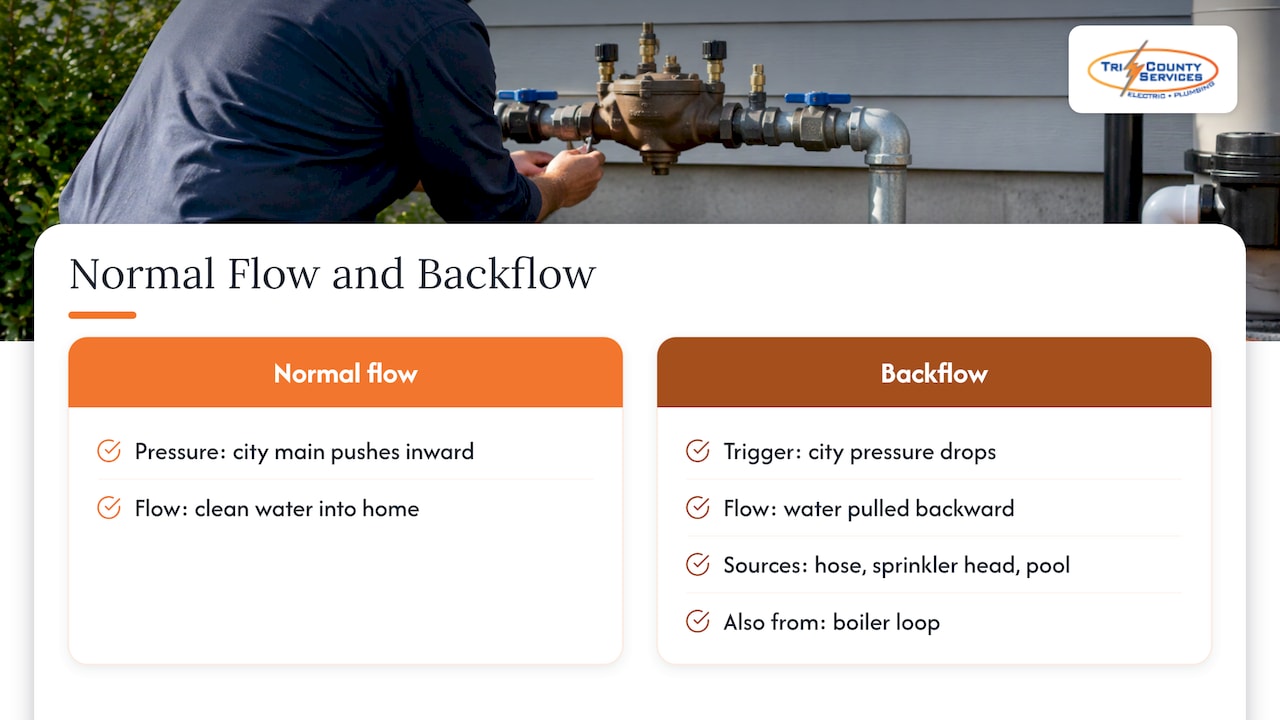
That matters because of what the water may have touched. Clermont County Public Health explains that water drawn back into the supply may be contaminated and can stay in the lines until it is drained from another fixture. A garden hose sitting in a bucket of fertilizer solution is the classic example. So is an irrigation system with lawn chemicals in the soil around its heads.
Any spot where drinking water could meet something that is not drinking water is called a cross-connection. Ohio EPA’s rules are built around finding and controlling those points.
What the Ohio rule says
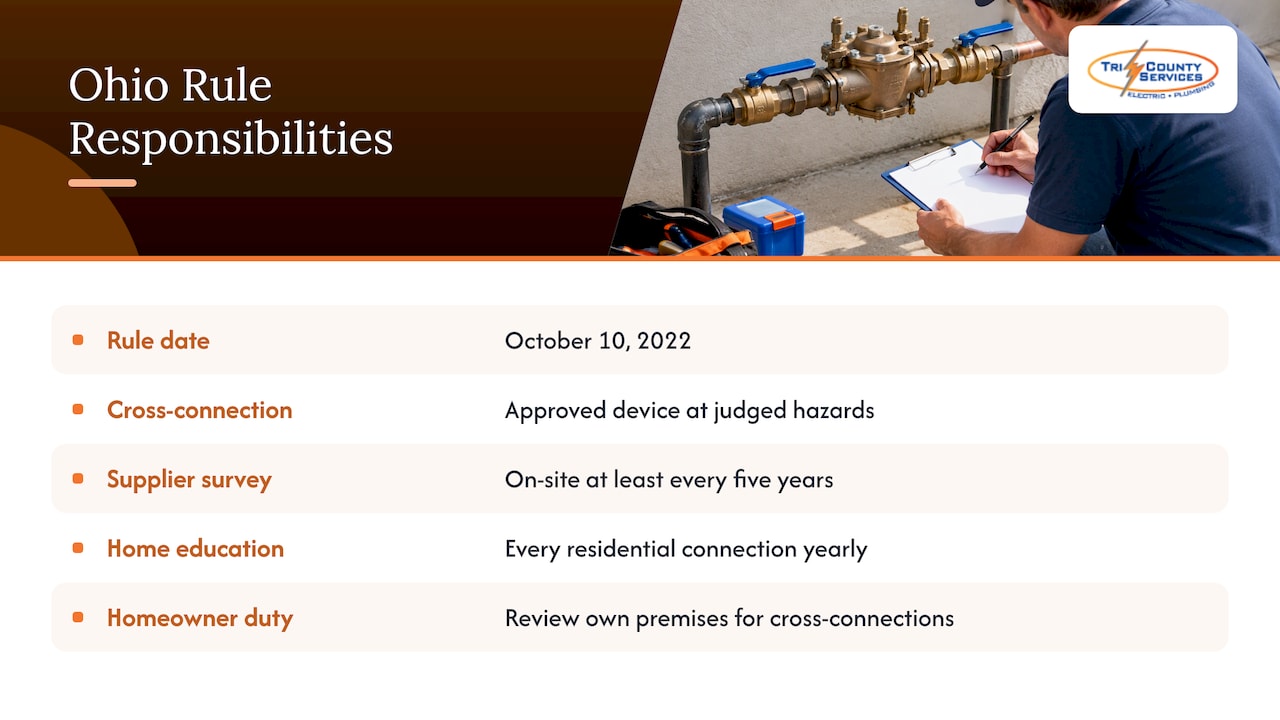
The state’s cross-connection control rules are in Chapter 3745-95 of the Ohio Administrative Code, effective October 10, 2022. In plain terms, they require an approved backflow preventer at any actual or potential cross-connection where the water supplier or the Ohio EPA director judges that a pollution, system, health or severe health hazard exists. That includes any situation where process fluids could flow back into the supply.
Two parts of this matter most to a homeowner.
Your water supplier is watching, but not for you. Under rule 3745-95-03, suppliers must survey premises on site at least every five years to find new or increased hazards. For homes, they may instead run an education campaign that puts backflow-prevention information in front of every residential service connection each year. If a letter or flyer from your water department arrives, it is part of that program.
The responsibility stays with you. The same chapter says the supplier’s surveys do not relieve the consumer of responsibility for reviewing water use on their own premises to find cross-connections. In practice, you are the one who knows that a sprinkler system was added in 2019, that a basement utility sink has a threaded faucet, or that a hot tub was hooked up with a hose. A professional plumber is the person who can tell you what each of those means under the rule.
Which Cleveland-area homes are most likely to need a device
Requirements are enforced by your local water provider, and providers differ. Here is how a few Northeast Ohio and Ohio utilities describe their rules.
| Provider | What it says about residential homes |
|---|---|
| Cleveland Water | Devices are required on all commercial service connections and on residential connections with irrigation systems, fire sprinkler systems, or pools and hot tubs with automatic fill valves. |
| City of Aurora | Ohio EPA requires backflow prevention when you have an irrigation system or own a commercial building, and the city may inspect residences and require devices as needed. |
| Clermont County Public Health | Recommends vacuum breakers approved to the ASSE 1011 standard on hose and sprayer connections, and a proper backflow device on lawn irrigation systems. |
The pattern across all three is the same. The setups that raise the most concern in a typical house are:
- Lawn irrigation. Sprinkler heads sit at ground level, surrounded by soil, fertilizer and pet waste. This is the most common reason a Cleveland-area home needs a device.
- Pools and hot tubs with automatic fill valves. If the fill line can feed from the house supply, water in the pool is a potential source of backflow. Our pool and hot tub wiring page covers the electrical side of those installations.
- Fire sprinkler systems. Standing water in sprinkler piping can contain additives and sit for months.
- Hose bibs and utility sinks. A threaded faucet invites a hose to be attached and left in something. The usual protection is a small vacuum breaker, which Clermont County Public Health recommends for these connections.
- Boilers and heating loops. Any system filled from the house supply and holding treated or heated water should be reviewed.
- Commercial properties. Business owners should expect the strictest treatment, since Cleveland Water, for one, requires devices on all commercial service connections.
If none of these describes your home, you may have nothing to do. But “I think I don’t” is a guess. A technician who walks the house and the yard will know.
Why call a professional plumber before you touch anything
Backflow protection looks like a small brass fitting. In reality it is a decision about hazard level, device type, location and code. Getting any of those wrong leaves the drinking water exposed while giving you the feeling that it is protected.
Here is where homeowners run into trouble when they try to handle it themselves:
- Choosing the wrong device. Different hazards call for different devices. A hose-end vacuum breaker is not a substitute for what an irrigation system needs. Ohio’s rule requires an approved preventer, and the local utility decides what counts as a hazard.
- Installing it in the wrong place. Position, height above the ground and access all matter, and a device that is buried, flooded or capped by a fence section cannot do its job.
- Missing the real cause. A pressure swing that pulls water backward often comes from somewhere else: a failing pressure reducing valve, an aging water line, or a leak you cannot see.
- Cutting into the water line without the right tools. An incorrect cut on a pressurized line can mean a flood in your basement or a service interruption for the street.
- Creating a code problem you find out about later. Utilities can inspect residences and require devices. A correction after a utility letter costs more than getting it right once.
The water that comes out of your tap is the one system in your house you cannot afford to experiment on. A professional plumber has seen how these setups go wrong across hundreds of homes, and that experience is what you are paying for.
Pressure, water lines and leaks: the parts that sit next to backflow
Backflow rarely shows up alone. When we are asked about water protection, three related questions come up on almost every visit.
Water pressure
High street pressure strains fittings, appliances and the water heater. A pressure reducing valve keeps the pressure inside your home at a safe level. Our guide to pressure reducing valve settings explains what the valve does and why a professional should set it.
The water line from the street
Older Northeast Ohio homes may still have aging service lines. Water utilities in many places run programs to renew household water connections. One example is a renewal of household water connections tender, which shows how widely this work is treated as a serious infrastructure job. For your home, our water line installation and repair service covers new lines and leaking ones.
Hidden leaks
A slow leak near the meter or in a wall can hide a drop in pressure and a possible entry point for contamination. Our leak detection and plumbing repair service is built to find those leaks before they become damage.
If you want to see how these pieces fit together through the year, our seasonal plumbing maintenance guide walks through a Northeast Ohio calendar, including fall shutdown of outdoor lines and spring startup.
A worked example: the irrigation system added in 2019
Imagine a homeowner in a Cleveland suburb who had a sprinkler system installed years ago. The water bill is steady, the lawn is green, and nothing seems wrong. Then a letter arrives from the water department about cross-connection control.
What the homeowner needs to know:
- The irrigation system is exactly the kind of connection Cleveland Water lists as requiring a device, and other Northeast Ohio communities treat it the same way.
- The homeowner, not the utility, is responsible for knowing what is attached to the home’s plumbing.
- The right first call is to a professional plumber who can look at the whole water entry: the meter, shutoff, pressure, the irrigation tie-in, the hose bibs and the water heater.
That single visit answers the letter and also catches pressure and line problems that were never on the homeowner’s radar. This is how we like to work, with one set of eyes on the whole system rather than a single part.
Costs to plan around
Backflow work is priced by the device and the job, so we do not quote it as a flat number. What we can publish are the surrounding plumbing services homeowners often combine with a water system review. These are the figures from our plumbing pricing guide:
| Service | Published range |
|---|---|
| Drain cleaning | $250 to $600 |
| Sewer camera inspection | $250 to $400 |
| Faucet installation | $500 to $900 |
| Toilet installation | $500 to $800 |
For anything the guide does not list, our office can walk you through what the job involves. Call (440) 253-0332.
One cost to know about on the utility side: some Ohio providers add administrative fees for tracked devices. Columbus, for example, charges $25 per device each year on top of what a contractor charges. Your own provider’s fee schedule is the one that applies to you.
Questions to ask your water provider
Because the details change from city to city, a short phone call to your utility saves time. Ask:
- Does my address have a record of any device or a cross-connection on file?
- Do you consider my irrigation system, pool, hot tub or fire sprinkler a hazard that needs a device?
- Has the department sent, or will it send, a survey or an educational mailing?
- Are there fees, forms or deadlines attached to devices in my community?
Write the answers down and share them with the plumber who visits. It makes the visit faster and the recommendation more precise.
Why homeowners choose Tri-County Services Electric & Plumbing
We are a family-owned business based in Northeast Ohio since 1975. We have skilled, certified technicians, we work on a flexible schedule designed to minimize disruption in your day, and we respect your home while we are in it. Our pricing is clear and upfront, and our work comes with a satisfaction guarantee. We started in electrical work and now offer plumbing too, so a single company can look at the pipes, the water heater and the wiring that powers them.
If you live in the city, our Cleveland plumbing services page explains what we handle there, and our residential plumbing page shows the full range of home services.
Our view
After decades of working in Northeast Ohio homes, our belief is simple: water safety is a whole-house question. A device on a sprinkler line matters, and so does the pressure behind it, the pipe that feeds it and the leak nobody has noticed yet.
That is why we would rather send a technician to look at the entire system than sell a single part. Our technicians are certified, we schedule around your life, and we treat your home the way we would want ours treated. We also keep our pricing clear and upfront, so you know what to expect before work begins.
When a homeowner calls us about a letter from the water department or a worry about their yard, we start by understanding how the house is plumbed. From there, we recommend what makes sense and explain why. Our experience says that is the approach that leaves people with a safe, dependable water system and no surprises.
Lindsay Paramore
Ready for a plumbing review?
When a homeowner wants a clear picture of their water system, we start with the basics: how water enters the home, what is attached to it, and whether the pipes, pressure and fixtures are in good shape. From there we can handle repairs, upgrades and new installations, including drain cleaning, sewer camera inspections, water heater work and pipe leak repair. You can see the details on our plumbing pricing guide or call our office at (440) 253-0332 to schedule a visit.

If your concern is a clog or slow drain rather than the supply side, our drain cleaning, hydro jetting and sewer inspection service is the place to start.
FAQ
Are backflow preventers required in Ohio?
Yes, wherever there is a hazard to the drinking supply. Ohio’s rule in OAC Chapter 3745-95 requires an approved preventer at any cross-connection that the water supplier or the state judges to be a hazard. Which homes that covers depends on your provider and on what is connected to your plumbing.
Does my house need a backflow preventer?
It depends on your setup. Irrigation systems, fire sprinklers and pools or hot tubs with automatic fill valves are the common triggers in Cleveland, according to Cleveland Water. A professional plumber can look at your home and tell you where you stand. Call (440) 253-0332 to set up a visit.
Who is responsible for finding cross-connections in my home?
Both you and your water supplier have a part. Suppliers must survey premises at least every five years or run an annual education campaign for homes, but the rule also leaves the consumer responsible for reviewing water use on their own premises, as stated in OAC 3745-95-03.
Can a hose cause backflow?
Yes. A hose left submerged in a bucket, pool or tub can draw that water back into your pipes if pressure drops. Clermont County Public Health recommends ASSE 1011-approved vacuum breakers on hose and sprayer connections. A plumber can confirm which of your outdoor and basement faucets need one.
Why should I call a professional instead of fixing it myself?
The device has to be the right type, in the right place, and acceptable to your local utility, and the work involves a pressurized water line. A mistake can leave your drinking water exposed or cause a leak. A Tri-County Services Electric & Plumbing technician can look at the whole system in one visit, so call (440) 253-0332.
Sources
- Chapter 3745-95, Ohio Administrative Code
- Rule 3745-95-03, Ohio Administrative Code
- Backflow Prevention, Cleveland Water
- Backflow Prevention, Clermont County Public Health
- Backflow Prevention, City of Aurora
- Consumer’s Page, Cross Connection and Backflow, City of Columbus
- Renewal of household water connections tender