
Commercial plumbing maintenance is a scheduled program of inspections, drain cleaning, water heater service and leak checks that catches small problems before they become shutdowns. The most reliable way to run one is to hand it to a professional plumbing team that knows your building, keeps the records and shows up on a schedule that does not disrupt your tenants or customers. Tri-County Services Electric & Plumbing serves commercial and residential properties across Northeast Ohio, and this guide lays out what a good program includes and what to watch for between visits.
TL;DR
- Preventive plumbing maintenance covers leaks, pressure, valves, water heaters, drains and sewer lines, on a building-specific schedule.
- Staff can spot trouble on daily walk-throughs, but every warning sign should go to a professional plumber for diagnosis and repair.
- Drains and sewer lines are the most common source of surprise downtime. Cleaning and camera inspection are published at $250 to $600 and $250 to $400.
- Ohio winters make pre-freeze pipe protection part of any maintenance plan.
- Keep written records of every visit. Call our office at (440) 253-0332 to set up a maintenance schedule.
Table of Contents
- What commercial plumbing maintenance actually includes
- Why a professional plumber should lead the program
- What your staff should watch between visits
- Drains and sewer lines: where downtime usually starts
- Water heaters: the system that fails on a Monday morning
- Fixtures: small leaks, big water bills
- Cold-weather preparation for Northeast Ohio
- Building a schedule that fits your property
- Our approach to commercial plumbing
- Our perspective on preventive plumbing
- FAQ
- Sources
What commercial plumbing maintenance actually includes
A commercial building is not a large house. It has more fixtures, longer pipe runs, bigger water heaters, floor drains, and more people using all of it at once. Maintenance has to be organized around that.
Trade guidance recommends a building-specific checklist with daily, weekly, monthly and annual work, following each equipment manufacturer’s maintenance instructions. That same guidance lists the core areas: leaks and relief-valve discharge, corrosion and scale, water pressure, shutoff valves, water heaters and drains.
In practice, a solid program for an office, retail space, restaurant or multi-unit property covers these systems:
- Supply piping and fittings: visible corrosion, weeping joints, stained ceilings and walls, and pipe insulation condition.
- Fixtures: restroom faucets, toilets, urinals and sinks, where worn seals and parts waste water long before anyone files a complaint.
- Water heaters: tank condition, relief valves, temperature settings and, for older units, a replacement plan.
- Drains and sewer lines: slow drains, odors, floor drains and the main line leaving the building.
- Shutoff valves: the ones you will need in an emergency, and whether they still move.
- Water pressure: whether it stays in a healthy range throughout the building.
Facility-specific rules also exist. For example, Maryland’s state facilities program sets requirements such as annual cleaning and disinfection of water tanks and five years of record retention for the buildings it manages. That is one state’s rule for its own properties, but it shows how seriously organized records are treated.
Why a professional plumber should lead the program
Most of what goes wrong in a commercial plumbing system is invisible until it fails: a corroded fitting behind a wall, a partly blocked main line, a relief valve scaled shut. Spotting a symptom is easy. Knowing what it means and fixing it without creating a bigger problem is the professional’s job.
A professional team brings three things a building owner or maintenance staff cannot easily replicate:
- Diagnosis. A wet ceiling tile could be a supply leak, a drain leak, condensation or a roof problem. Tracing the right cause the first time saves repeat visits.
- Equipment and access. Camera inspection, hydro jetting and pressure testing take purpose-built tools and training.
- Continuity. A team that services your building repeatedly knows where the shutoffs are, how the system was piped and what has been repaired before.
That last point is where our approach as a family-owned Northeast Ohio company, in business since 1975, matters. We focus on long-term relationships with the properties we serve, with flexible scheduling designed to minimize disruption to your operations and technicians who respect your space.
What your staff should watch between visits
Your team does not need to fix anything. They need to notice things and report them. The EPA’s WaterSense program recommends that facilities tour the building daily wherever water is used: restrooms, kitchens, mechanical spaces and cooling towers. The things to listen and look for are continuously running fixtures, unexpected floor-drain discharge and wet spots.
The same guidance suggests two paper-trail habits that cost nothing:
- Read the water meter during off-peak hours. If it keeps moving when nobody is using water, something is leaking.
- Compare each monthly water bill to the prior month and to the same month last year.
EPA frames leak detection as a daily operational habit rather than an occasional event, and says detected leaks should be repaired quickly to avoid water and monetary losses. When the walk-through turns something up, the next step is a call to a professional plumber, not a workaround.
Warning signs that need a call right away
- Water pooling or discoloration on floors, walls or ceilings
- A water meter that moves when the building is empty
- Water bills that climb with no change in occupancy
- Slow drains in more than one fixture, gurgling or sewer odor
- Hot water that runs out or fluctuates
- Water discharging from a water heater relief valve
- Pressure that suddenly drops or spikes
Pressure deserves special mention. Trade guidance notes that pressure above 80 psi can waste water and damage fixtures, valves, pipes and fittings. If you notice banging pipes, leaking fixtures or fast wear on valves, have a plumber measure and correct it. Relief valves and shutoff valves are the same kind of item: they are safety components, and the same source says defective ones need prompt attention and that shutoff valves should be exercised so they work during an emergency. A plumber should do that work and confirm the result.
If you see an active leak, our leak detection and plumbing repair service is built for exactly this. Our guide to what plumbing companies fix during emergency leaks explains what happens when you call.
Drains and sewer lines: where downtime usually starts
A backed-up main line closes restrooms, kitchens and sometimes entire businesses. It is also one of the most preventable plumbing failures when drains are cleaned on a schedule rather than after the backup.
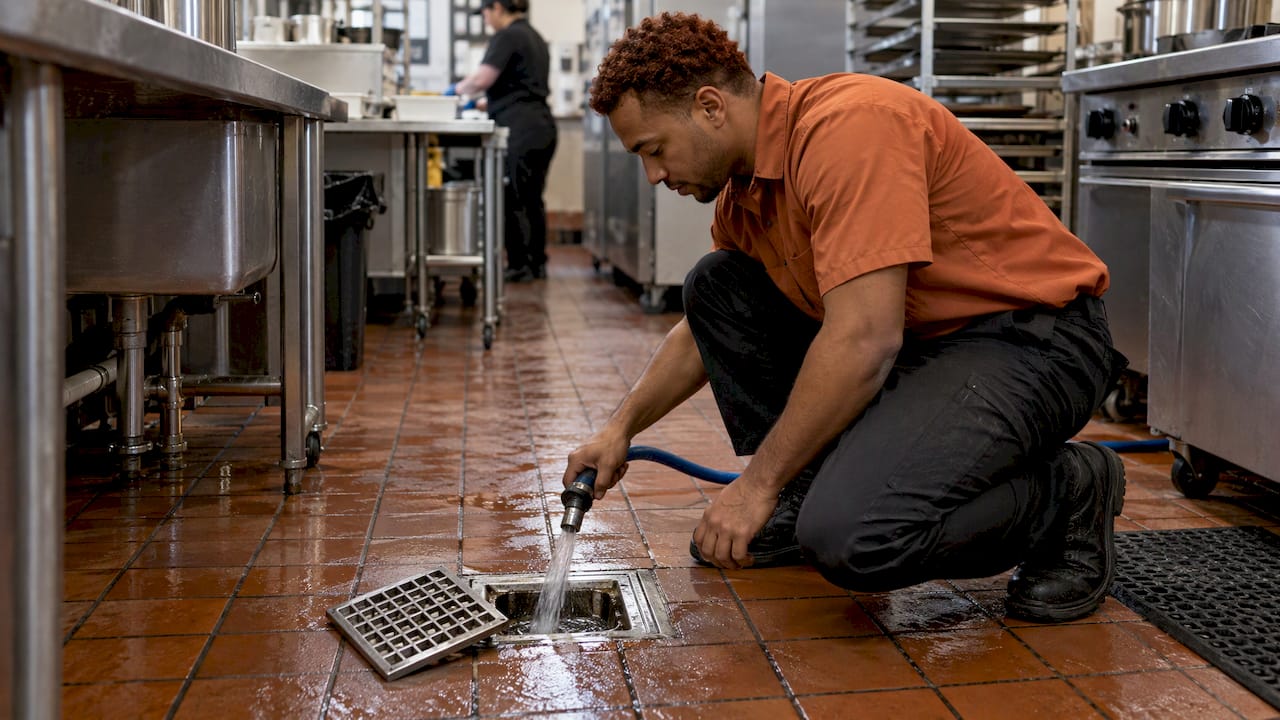
The EPA’s guidance on sewer system upkeep describes preventive maintenance as planned, systematic, scheduled inspections and cleaning based on past history, and says a good program protects the capital investment and prevents service interruptions, overflows and backups. That guidance is written for municipal collection systems, but the logic carries straight over to a building’s drain lines: clean on a schedule, inspect what you cannot see, repair what is deteriorating, and write it all down.
Three services do the heavy lifting here, with our published one-time price ranges from our plumbing pricing guide:
| Service | What it does | Published price |
|---|---|---|
| Drain cleaning | Clears blockages and buildup from drain lines | $250 to $600 |
| Sewer camera inspection | Shows the actual condition of the line so repairs target the right spot | $250 to $400 |
| Hydro jetting | High-pressure water scouring of heavily built-up lines | Quoted per job |
A camera inspection is the best way to turn guesswork into a plan. Instead of replacing a line because it keeps clogging, you see whether the cause is grease, roots, a belly in the pipe or a cracked joint. Restaurants and other food service properties, where grease builds up fast, tend to benefit from the shortest cleaning intervals.
The final cost of any job depends on the building, so call for an estimate rather than relying on a range alone.
Water heaters: the system that fails on a Monday morning
A commercial water heater that quits affects restrooms, kitchens, cleaning and in some businesses the product itself. Maintenance means checking the unit’s condition, its relief valve and its temperature settings on a schedule, so that replacement is a planned project and not an emergency.
If your heater is aging, a planned swap also lets you compare options. We handle water heater repair, installation and maintenance, traditional water heater replacement and tankless water heater installation. Maryland’s facilities rules mention hot water storage above 140°F and circulating water above 120°F for the buildings that program manages, which is a good example of why temperature settings belong on the maintenance record.
Fixtures: small leaks, big water bills
A toilet that runs after flushing or a faucet that drips all day is easy to ignore in a busy building. Multiply it by twenty fixtures and it is a line item on your water bill and a growing risk of damage to the surrounding structure.
Worn parts should be replaced promptly, and fixtures that have reached the end of their life are better replaced than patched. Our published one-time price ranges are $500 to $900 for faucet installation and $500 to $800 for toilet installation. A plumbing professional also makes sure the fixture is connected correctly and that the shutoff beneath it works.
Cold-weather preparation for Northeast Ohio
Frozen pipes are a real risk for buildings in our region, particularly in unheated spaces, exterior walls, attics and crawl spaces. The VA’s plumbing design manual says freeze-prone piping outside the building, in attics, crawl spaces or exterior walls should have insulation or heat tracing. Industry reporting on winter maintenance likewise recommends insulating pipes in exposed areas and following manufacturer instructions and periodic inspection when heat tape is used.
A fall plumbing visit should check:
- Insulation on pipes in cold or exposed spaces
- Heat tracing, where installed
- Exterior and hard-to-reach shutoffs
- Roof drains and leaders, which the VA manual notes should be insulated against condensation damage
- Any pipes that froze or sweated in prior winters
Older buildings sometimes have older supply piping materials too. If you own an older property and want to understand one such material, here is some background on polybutylene pipes and your options.
For more on protecting pipes, see our guides on ways to protect pipes from freezing, whether pipe insulation prevents frozen pipes and our winter plumbing checklist.
Building a schedule that fits your property
There is no single calendar that suits every building. A restaurant, a medical office and a small warehouse stress their plumbing in different ways. A sensible structure looks like this:
- Daily: staff walk-throughs for running fixtures, wet spots and drain problems, reported the same day.
- Monthly: a look at the water bill against prior months and the meter during quiet hours.
- Seasonal: a professional visit ahead of winter, plus drain cleaning at intervals matched to how hard your drains work.
- Annual: a full professional review of piping, valves, water heaters and drains, with camera inspection of the sewer line where the building’s history calls for it.
The point of the schedule is that nobody has to remember it. Our plumbing maintenance plans are designed for preventive care, and our article on minimizing repair disruption covers how facility managers can keep work from interrupting operations.
What to record
Keep a simple log: date, location, what was found, what was done and who did it. The EPA’s sewer guidance stresses that timely, relevant information moving from field staff to managers, on paper or on a computer, is the key to an effective program. In a plumbing context, that log shows patterns: the same restroom clogging every spring, the same joint weeping each winter. Patterns tell you where a repair will pay off.
Our approach to commercial plumbing
We built our plumbing service on the same principles as our electrical work: clear, upfront pricing, skilled and certified technicians, flexible scheduling and satisfaction guarantees. We serve commercial and residential properties across Northeast Ohio, and we offer drain cleaning, sewer camera inspection, hydro jetting, water heater service, pipe leak repair and fixture installation.
If your building needs a scheduled maintenance program, or you are dealing with a clog, leak or water heater problem today, call our office at (440) 253-0332. You can also review our plumbing pricing guide before you call.

Because we also handle electrical work, one team can look after the water heater and the circuit that powers it, or the sump and the panel behind it, which keeps your maintenance relationships simple.
Our perspective on preventive plumbing
Most of the emergency calls property managers make could have been a routine visit a few weeks earlier. A slow drain becomes a backup. A weeping fitting becomes a ceiling collapse. A water heater that was never looked at becomes a cold shower for a whole building.
We think the best maintenance is relationship-based. When the same team returns to your building, they learn its quirks, they remember what was repaired and they can tell the difference between a normal sound and a problem. That is how we have worked since 1975 as a family-owned company in Northeast Ohio.
Staff awareness helps, and daily walk-throughs are a good habit. But the walk-through is the start of the process. The diagnosis, the repair and the record belong with a professional plumber, and we would rather you call early than late.
Call us at (440) 253-0332 and we will talk through your building and the right schedule for it.
Lindsay Paramore
FAQ
How often should commercial plumbing be serviced?
It depends on the building and how heavily the plumbing is used. A good baseline is daily staff observation, a seasonal professional visit before winter and a full professional review each year. Restaurants and other high-use properties often need more frequent drain service. Call us at (440) 253-0332 and we will recommend a schedule.
How much does commercial drain cleaning cost?
Our published one-time range for drain cleaning is $250 to $600, and a sewer camera inspection is $250 to $400. The final price depends on the line, the access and how much buildup is present. Hydro jetting is quoted per job.
What should I do if I find a leak in my building?
If it is safe to do so, shut off the water to the affected area using the nearest shutoff valve, keep people away from wet floors and call a plumbing professional right away. Do not wait for the next scheduled visit. Our office number is (440) 253-0332.
Why does winter matter for commercial plumbing maintenance?
Pipes in unheated or exposed areas can freeze and burst, and the damage is often hidden until thawing. A professional check of insulation, heat tracing and key shutoffs before cold weather arrives is the best way to lower that risk.
Sources
- WaterSense at Work Section 2.2: Leak Detection and Repair (EPA)
- Plumbing Maintenance and the Code (PHCPPros)
- Optimizing Operation, Maintenance, and Rehabilitation of Sanitary Sewer Collection Systems (EPA)
- Water Management (Maryland DGS)
- PG 18-10 Plumbing Design Manual (U.S. Department of Veterans Affairs)
- Winter Maintenance: Preventing Costly Cold-Weather Failures (CRE Insight Journal)
- Selling a House With Polybutylene Pipes: Your Options