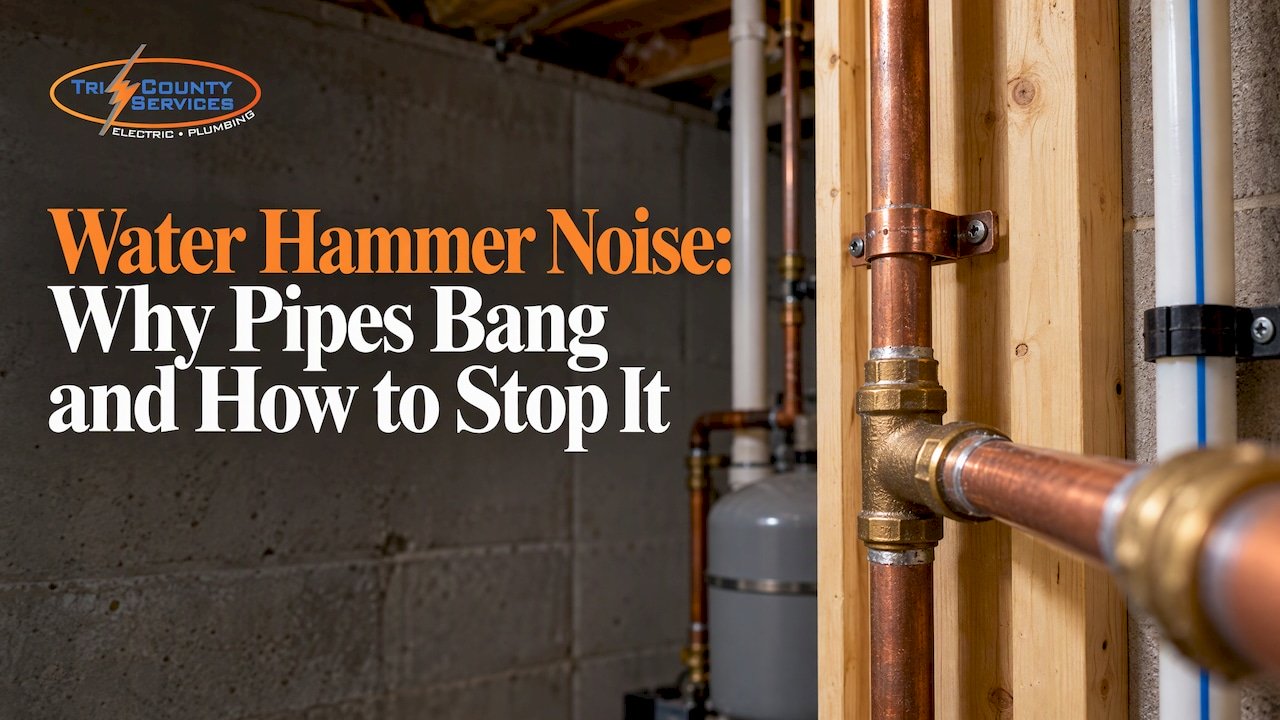


That bang in the wall right after you shut off a faucet or the washing machine finishes filling is called water hammer. It is a pressure shock, not just a noise, and the lasting fix is usually a professional diagnosis of your home’s water pressure and pipe supports, followed by the right arrestor in the right place. At Tri-County Services Electric & Plumbing, we would rather you call us at (440) 253-0332 when the banging starts than wait for a joint to loosen and leak.
TL;DR
- Water hammer is a shock wave created when fast-moving water is stopped suddenly, usually by a quick-closing valve in a faucet, dishwasher or washing machine.
- The noise is a warning. The shock can loosen pipe supports and stress joints, fittings, valves and your water heater, and it can happen even when you hear nothing.
- The usual causes are high water pressure, loose pipes and missing shock absorbers (water hammer arrestors). Which one is behind your noise has to be confirmed before anything is changed.
- Fixes that change pressure or open walls are best handled by a professional, because a pressure-reducing valve can create a second problem if it is not paired correctly.
- Call (440) 253-0332 and our office will get a plumbing professional scheduled.
Table of Contents
- What water hammer actually is
- How to tell if your noise is water hammer
- Why banging pipes are worth taking seriously
- The four usual causes
- What actually stops it
- How long arrestors last
- What it costs
- Why call a professional first
- Water hammer in Northeast Ohio homes
- Fixing it with Tri-County Services Electric & Plumbing
- Our perspective
- FAQ
- Sources
What water hammer actually is
Water hammer, also called hydraulic shock, is a pressure surge that travels through your pipes when moving water is suddenly stopped or forced to change direction. Oatey describes it as exactly that: a shock wave moving through the line. A. O. Smith explains that the wave surges back and forth between the point where the water was stopped and the point where pressure relieves itself, until the energy has dissipated. That back-and-forth is the knocking you hear.
Think of the water in your pipes as a moving mass. When a valve snaps shut, all that mass has nowhere to go. PlumbingSupply.com notes that a suddenly closed valve can create a shock wave at pressures up to 10 times normal.
How to tell if your noise is water hammer
The pattern is more reliable than the sound. Water hammer shows up as a sharp bang, thud or rattle:
- right after a faucet is shut off, especially a single-lever faucet,
- when the dishwasher or washing machine valve closes between fill cycles,
- when a toilet finishes filling,
- or as a series of knocks in the walls that fades after a second or two.
A. O. Smith lists single-lever faucets and the automatic solenoid valves on dishwashers and washing machines as the most common triggers.
The logic is simple: hammer happens when a valve closes, not when it opens. PlumberCalc’s team points out that if the banging happens with no valve closing at all, the cause is more likely loose pipes, a failing pressure-reducing valve or thermal expansion in a closed system. Different causes call for different repairs, which is why a guess is expensive.
Two cautions about the sound itself:
- It can fool you about location. Oatey’s professional guidance says the sound may appear to come from a valve when the real source is an unsecured pipe inside the wall cavity.
- Silence does not mean safety. The industry standard for arrestors, PDI-WH201, states that water hammer can occur without audible sound and that quick valve closure always creates some degree of shock.
If your pipes only bang at night, think about what runs on a timer: an ice maker, a dishwasher, a washing machine or an irrigation system. A timed valve closing in a quiet house is often the culprit. A plumbing professional can trace it quickly.
Why banging pipes are worth taking seriously
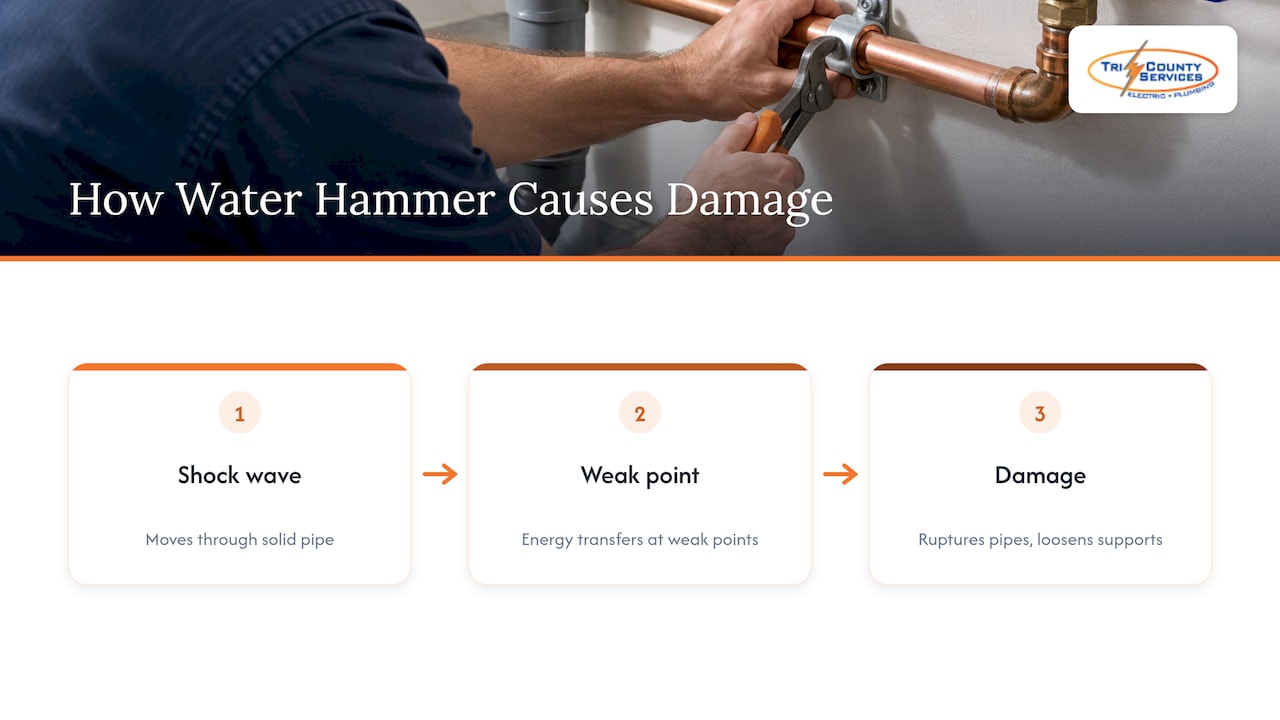
A bang that lasts a fraction of a second may seem harmless. The repeated stress is what does the damage. According to the PDI standard, the shock can rupture piping, leak or weaken connections, damage valves and other equipment, and loosen pipe supports.
The damage tends to land at the weak points. PlumbingSupply.com explains that the wave travels down a solid pipe fairly smoothly, then transfers its energy to the weakest point, such as a solder joint or fitting, when it meets something different. That is why even PEX plumbing is susceptible.
Your water heater is one of those points. A. O. Smith’s technical bulletin lists expanded tank shells, collapsed flue tubes that choke combustion venting, and deformed tank heads among the damage that water hammer can cause. Faucets, fittings, pressure-reducing valves and the hangers and brackets that hold pipes in place are also in the path, according to an engineer’s report on water hammer control.
If a banging pipe is already showing a drip or stain, treat it as a leak first. Our guide to stopping damage in the first five minutes of a pipe leak walks through what to do while you wait for help, and it helps to know where your main water shut-off valve is before you ever need it.
The four usual causes
1. High water pressure
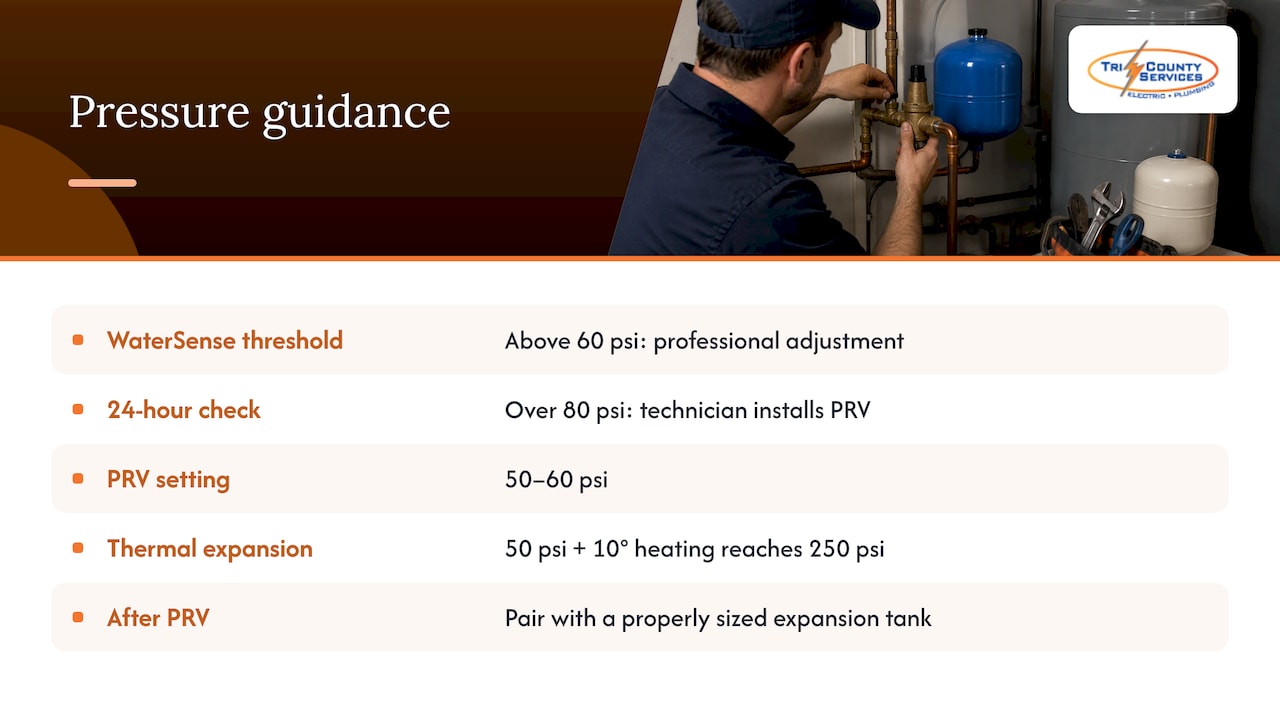
This is the most common underlying cause, and the one people most often overlook. The EPA’s WaterSense program recommends incoming service pressure of 45 to 60 psi, notes that supply mains can run above 100 psi, and says most U.S. plumbing codes require a pressure-regulating valve where pressure exceeds 80 psi. Higher pressure means faster-moving water, and faster water hits a closing valve harder.
High pressure rarely announces itself with noise alone. The City of San Diego’s guidelines list banging or whistling pipes when water is turned off, higher-than-expected flow, and frequent toilet or faucet leaks as symptoms. If your toilets run on and your faucet washers wear out early, the noise and the wear may share a cause.
2. Loose or unsupported pipes
When a pressure surge arrives, a pipe that is not firmly secured jerks and thuds against the wall framing. Professionals check for loose supply lines and add supports, or expandable foam where lines pass through holes in framing. Because the pipes are often behind drywall, finding the loose run is a job for someone who can trace sound and know where to open a wall.
3. Missing or failed arrestors
A water hammer arrestor is a small shock absorber that sits on the line. Watts describes its residential model as a permanently sealed, pre-charged air chamber that absorbs the shock, with a piston as its only moving part. Older homes often have the old trapped-air chambers that fill with water over time and stop working, or no protection at all.
4. Fast-closing appliance valves and small or mismatched pipes
PlumbingSupply.com lists small-diameter pipes (under 3/4 inch) and valves sized smaller than their pipe among the conditions that encourage water hammer. Adding a new dishwasher or washer to a line that was never designed for it can start a problem that was not there before.
What actually stops it
A sound repair follows the diagnosis, in this order.
Confirm and correct the pressure
A pressure gauge on an outdoor hose bibb gives a reading. The EPA’s WaterSense home-maintenance page says pressure much above 60 psi warrants having a professional adjust or install a pressure-reducing valve. State Water Heaters’ guidance says that if a 24-hour gauge check shows pressure over 80 psi, a service technician should install a pressure-reducing valve and set it to 50 to 60 psi.
There is a second step that makes this a professional job. A pressure-reducing valve closes your plumbing system, so heated water has nowhere to expand. A. O. Smith’s bulletin on thermal expansion says that in a closed system, water heated just 10 degrees at 50 psi can reach 250 psi, and recommends pairing the valve with a properly sized expansion tank between the valve and the water heater. WaterSense also warns that local code on thermal expansion has to be consulted. Fixing hammer while creating a pressure problem at the water heater is the exact trap that a professional installation avoids. Our overview of pressure-reducing valve settings explains why the setting matters.
Secure the pipes
Once the sound is verified, loose lines get supports and cushioning where they touch framing. This is often the quickest improvement, and it matters even when arrestors go in later.
Install arrestors where the shock starts
A. O. Smith states that the only effective means of controlling the shock itself is installing arrestors as close as possible to the source. Placement is where details count:
- For appliances, Bob Vila’s guidance is one arrestor on the hot and one on the cold supply line next to the washing machine.
- PlumberCalc advises installing arrestors within about six pipe diameters of the quick-closing valve, on both lines for a washer and on the hot line for a dishwasher.
- Watts’ placement rules for branch lines place the arrestor at the end of the run between the last two fixtures, with an additional unit when the branch is longer than 20 feet.
An arrestor placed in the wrong spot, or sized for the wrong fixture load, will not quiet the line. And when the end of a pipe run is inside a finished wall, the install involves access work that should not be improvised.
How long arrestors last
A frequent question is how long a water hammer arrestor lasts. Manufacturers describe sealed units as maintenance-free, but the units are not permanent. Watts’ installation instructions for its residential unit call for annual inspection of the water system’s safety and control valves to maintain function and life. If hammer comes back after months or years of quiet, a worn arrestor, a change in pressure or a newly added appliance are the first things to look at. A plumbing professional can tell which.
What it costs
The price of fixing water hammer depends on what is behind it. Two published cost guides give a sense of scale:
| Item | Typical U.S. range | Source |
|---|---|---|
| Arrestor part | $15 to $50 | Family Handyman, 2024 |
| Professional arrestor installation | $250 to $500, up to $1,000 if walls must be opened | Family Handyman, 2024 |
| Total to stop water hammer in a typical single-family home | $500 to $2,000, most often $800 to $1,400 | One and Done Prep, June 2026 |
These are national ranges, not our quotes, and actual prices depend on the house and local labor. The spread tells its own story: the part is cheap and the diagnosis, placement and access are what you pay for. Doing it right once costs less than replacing a fitting, a faucet or a water heater that a long run of hammering has worn out. We stand behind clear, upfront pricing, and our office can explain what applies to your home.
Why call a professional first
The temptation with a banging pipe is to try something and see. We would ask you not to, for three reasons.
- The sound misleads. As noted, a bang that seems to come from a faucet may come from a loose line inside a wall. Changing the wrong thing leaves the real problem running.
- Pressure changes have side effects. A pressure-reducing valve without thermal expansion control can push pressure at your water heater higher than before. A diagnosis looks at the whole system.
- The hidden damage is the expensive part. A dripping T&P valve, a failing faucet or toilet valve and a slow leak at a joint are often hammer damage showing up later. Our guide to what counts as a plumbing emergency and the signs you need emergency plumbing service will help you recognize when a noise has become a leak.
If you already see water, shut it off at the main and call right away. If the valve is stuck, stop before you snap it and call us.
Water hammer in Northeast Ohio homes
Many homes in the Cleveland and Akron area are decades old, with a mix of original copper or galvanized lines and later additions. A new dishwasher on an older branch or a finished basement that hid a loose run are typical ways hammer appears. Because the problem is rarely one thing, a walk-through of the supply lines, pressure and appliance connections is the right first step, and it applies whether your house is a century-old Cleveland colonial or a newer build in Canton.
Fixing it with Tri-County Services Electric & Plumbing
We are a family-owned company that has served Northeast Ohio since 1975, and we now offer plumbing alongside our electrical work. Our certified technicians respect your home, and our flexible scheduling is designed to minimize disruption to your day. If your pipes are banging, knocking or shuddering, call our office at (440) 253-0332 and we will schedule a professional to look at it. You can see how we handle related work on our plumbing services and pricing page.

If the banging comes with a drip, a stain or a wet floor, our pipe leak repair guidance explains what to do while we are on the way.
Our perspective
Water hammer is one of those problems homeowners live with for years because the noise comes and goes. We would rather see it handled early, because the noise is the cheap part of the story. The expensive part is a joint that finally gives way in a wall, or a water heater that has been taking the shock for a decade.
What we have learned over the years is that the fix is rarely a single part. Pressure, pipe supports, appliance valves and the water heater all talk to each other, and an adjustment in one place changes the others. That is why we look at the whole system rather than putting an arrestor on the nearest faucet and leaving.
We built our business on long-term relationships with families in Northeast Ohio. When you call (440) 253-0332, you are calling a local, family-owned team that wants to be the first number you dial the next time something in your home needs attention, with clear pricing up front and respect for your home while we work.
Lindsay Paramore
FAQ
How do I know if I have water hammer?
Listen for a bang, thud or rattle right after a faucet, dishwasher or washer shuts off. Hammer follows valves closing, not opening. Because the noise can come from a different spot than the cause and can occur silently, a plumbing professional should confirm it before any repair.
How much does it cost to fix water hammer?
National guides put the total at $500 to $2,000 for most single-family homes, with most jobs at $800 to $1,400, and arrestor installation at $250 to $500 unless walls must be opened. Your cost depends on the cause. Call (440) 253-0332 to talk through your situation.
How do I reduce water pressure?
Pressure is reduced with a pressure-reducing valve, which a plumbing professional should install and set, along with an expansion tank where the system becomes closed. WaterSense recommends 45 to 60 psi at the home, and most U.S. plumbing codes require a valve above 80 psi.
How long does a water hammer arrestor last?
Sealed arrestors are built to be maintenance-free, but they are not permanent, and manufacturers call for annual checks of the system’s safety and control valves. If knocking returns after a quiet stretch, have the arrestors and your pressure checked.
Can water hammer damage my pipes?
Yes. Repeated shock can loosen pipe supports and stress joints, fittings, valves, faucets and water heaters, even when the noise is mild. Addressing it early protects the rest of your plumbing.
Sources
- Oatey: Banging Pipes, What the Pros Should Know
- A. O. Smith Technical Bulletin #11: Water Hammer
- A. O. Smith Technical Bulletin #45: Thermal Expansion
- PlumbingSupply.com: About Water Hammer
- PlumberCalc: How to Prevent Water Hammer
- PDI Standard WH-201, revised 2017
- Water Hammer Control engineer’s report
- EPA WaterSense: Home Maintenance
- City of San Diego: Residential PRV guidelines
- State Water Heaters: High Water Pressure and Thermal Expansion
- Bob Vila: Water Hammer in Home Plumbing
- Watts Series 15M2 arrestor documentation
- Watts residential arrestor installation instructions
- Family Handyman: What Are Water Hammer Arrestors?
- One and Done Prep: Water Hammer Repair Cost Guide