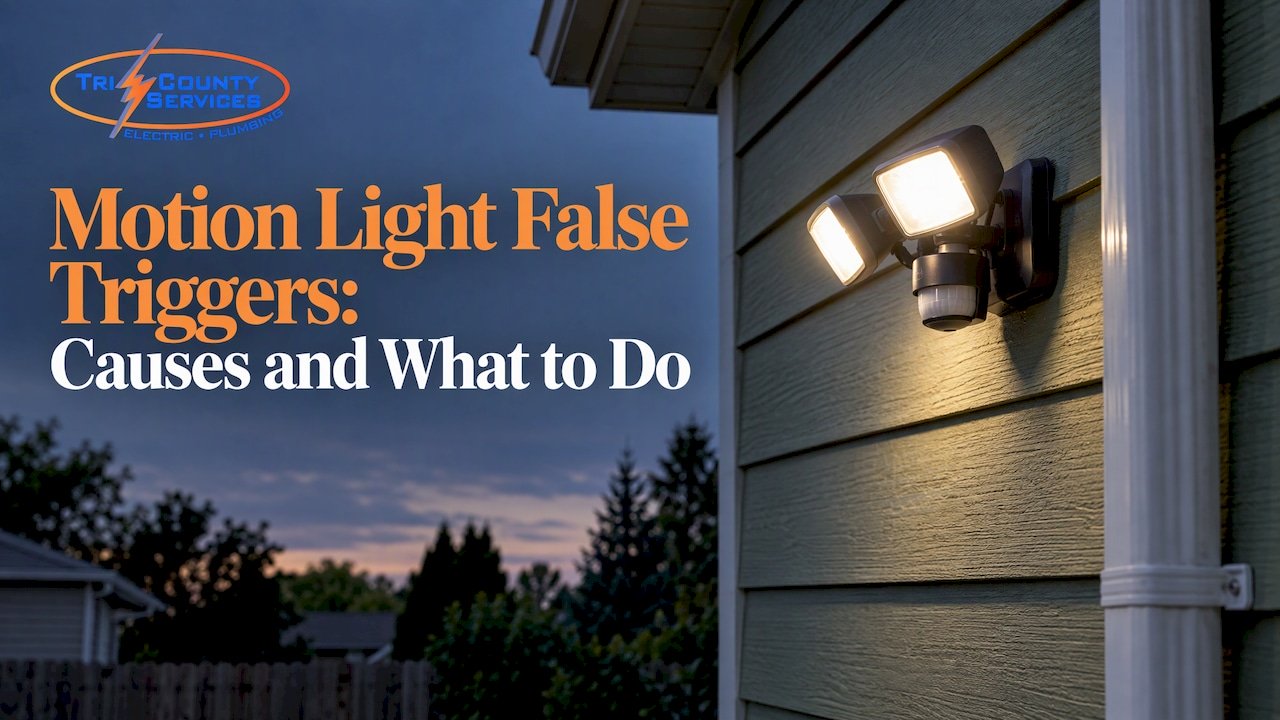


A motion light that keeps turning on with nobody there is usually reacting to something real: a heat source, moving plants, a reflection, a timer that restarts itself, or a wiring or power problem. The pattern tells you which one. If the light flickers, buzzes, trips a breaker or stays on no matter what, treat it as an electrical issue and call a professional. At Tri-County Services Electric & Plumbing, we diagnose these calls across Northeast Ohio, and you can reach our office at (440) 253-0332.
TL;DR
- Most motion light false triggers come from heat, moving objects, reflections, or settings that cause the light to re-trigger itself.
- Flickering, buzzing, dim starts, or breaker trips point to a power or wiring problem. That is work for a professional electrician, not a sensor adjustment.
- Before anyone touches a fixture, write down when the light comes on and what else is happening. It speeds up the diagnosis.
- Outdoor fixtures sit on live household circuits, often on ladders and in wet weather. A professional visit is the safer first step.
- Call Tri-County Services Electric & Plumbing at (440) 253-0332 to have us find the cause.
Table of Contents
- Why a motion light comes on when nobody is there
- Common causes at a glance
- Does the sensor type matter?
- When a false trigger is really an electrical problem
- Why call a professional first
- What to note before we arrive
- How we approach a motion light call
- Our perspective
- Get your motion light checked
- FAQ
- Sources
Why a motion light comes on when nobody is there
To understand a false trigger, it helps to know what the sensor is reading. Most home motion lights use passive infrared (PIR) sensors. A PIR sensor reads the heat given off by people, animals and other warm bodies, and it fires when a warm body moves across its sensing zones and the heat pattern in front of it changes, as Eufy’s guide to motion detection explains. The same guide notes that rapid heat changes, such as a draft or direct sunlight falling on the sensor, can also register as movement.
The sensor is not looking for a person. It is looking for a fast change in infrared energy. HowStuffWorks describes the electronics as watching for a fairly rapid change in the infrared energy in the field of view, which is why a person standing still often goes unseen while a gust of warm air can look like a visitor.
That is also the short answer to a common question: ordinary light does not usually set off a PIR sensor, but sudden heat from sunlight hitting the sensor can.
Heat sources near the sensor
Heat is the most common culprit. Leviton’s instruction sheet for its motion-activated light controls tells installers to check that the device is not near a heat source such as a stove, lights or heat vents, or picking up motion from an adjacent area such as hallway traffic. The same Leviton instruction sheet says that if problems continue, you should consult an electrician.
In a Northeast Ohio home, the usual suspects are:
- A dryer vent or grill exhaust near a porch or side-yard light
- Furnace or heat pump exhaust near a garage or basement fixture
- A south- or west-facing sensor that catches low winter sun or hot summer afternoons
- A bulb mounted too close to the sensor head
Moving objects and reflections
Outdoors, wind does a lot of the work. Branches, tall grasses, flags and hanging decorations can all pass through the sensor’s view, and passing cars on a nearby street can do the same. Reflective surfaces make it worse. Wet pavement, white garage doors, vehicle paint, windows and glossy siding can bounce light or heat changes back toward the sensor, according to Lightissues.
Eaton’s installation instructions for its Halo motion-activated fixtures speak to this directly. They tell installers to mount the fixture 8 to 12 feet above the ground, keep the sensor away from heat-producing sources, and avoid including windows, white walls, water, trees, large shrubs and street traffic in the detection zone. You can read them in the Halo MS180 installation instructions. A fixture that was aimed or placed poorly from day one will keep false triggering no matter how many settings are changed.

Settings that make the light re-trigger itself
Sometimes the light is not firing at nothing. It is firing at itself, or at something that outlasts the timer. Ampnerd points out that a light can stay on for a set interval after the last detection, so an empty yard at the moment you look does not prove a false trigger happened right then. Daylight thresholds, sensitivity and range settings also change when and how far the sensor responds.
Sensitivity matters too. The Home Depot notes that maximum sensitivity covers roughly 75 to 100 feet on most brands, while minimum covers about 15 feet. A sensor set to maximum will see a lot more of your neighborhood than you intended. The same page advises keeping the sensor at least 2 inches from bulbs and clearing the coverage zone of foot traffic and moving equipment such as air conditioners.
Common causes at a glance
| What you notice | Likely cause | Who should handle it |
|---|---|---|
| Light comes on at the same time of day | Sun on the sensor, or a heat vent or dryer exhaust cycling | Professional, who can reposition or replace the sensor head |
| Light comes on in wind or rain | Branches, grasses, wet surfaces in view | Professional for aiming and mounting; trimming plants is yard work |
| Light comes on when a car passes | Street or driveway inside the detection zone | Professional, to re-aim or shield the sensor |
| Light stays on constantly | Settings, dusk-to-dawn mode, a failed sensor or a wiring fault | Professional electrician |
| Light flickers, buzzes or starts dim | Power, wiring or fixture problem | Professional electrician, promptly |
| Breaker trips when the light fires | Overloaded or faulty circuit, moisture in the fixture | Professional electrician, right away |
Does the sensor type matter?
It does. PIR sensors respond to heat. Microwave sensors send out a signal and read what bounces back, so they respond to motion through thin materials and can be set off by reflections and electrical interference. Dual-technology units combine both to cut down on nuisance triggers. If you want a deeper look at how the two technologies differ, this explainer on PIR versus microwave sensor types covers the basics.
In practice, this means the right fix depends on which sensor you have and where it is mounted. A PIR light that trips from a dryer vent needs a different answer than a microwave unit that trips when a large appliance starts up. Guessing at the wrong one wastes weekends and can leave a fixture worse off than before.
When a false trigger is really an electrical problem
Not every “false trigger” is the sensor’s fault. Lightissues advises treating flicker, buzzing, dim starts or breaker trips as power symptoms, not motion symptoms. If the problem follows the weather, the heat or unstable brightness, the fixture, wiring and seal need inspection rather than more tweaking of the settings.
These are the signs we would not wait on:
- The light only misbehaves when a large load starts. Microwave sensors in particular can be thrown off by power noise when big appliances switch on or dimmers change, according to a diagnostic guide from Hi-Hyperlite. That points at the circuit, not the yard.
- Moisture in or around the fixture. Water and electricity do not mix. A fixture that fills with condensation or fails after rain needs to be checked by someone who can safely open it.
- Warm, discolored or crackling hardware. Shut off the circuit at the panel and call us.
- Several outdoor lights act up at once. That suggests a shared circuit, a loose connection or a panel issue.
If you want to understand why a fixture might lose power or act strangely, our guide on what to check when a light has power but won’t turn on walks through the causes we see in NE Ohio homes.
Why call a professional first
It is tempting to climb a ladder, spin the sensitivity dial and see what happens. We would rather you did not start there. Here is why.
- The cause is often not where you are looking. A light that seems oversensitive may have a loose neutral, a failing driver or water inside the housing. Turning down a dial will not fix any of those.
- The work happens on live household wiring. Outdoor fixtures are exposed to weather, and the box behind them may have been wired years ago by someone else.
- Repeated resets hide the problem. Even sources that suggest a reset note that doing it every night only clears the symptom for a while.
- A professional sees the whole picture. Placement, sensor type, bulb choice, circuit load and weatherproofing all affect false triggers. We check them together, so the fix lasts.
- Safety. A light that stays on with the sensor covered, or one that trips a breaker, can signal a fault that should not wait for a free weekend.
Our electrical troubleshooting visit is listed at $300 to $500 one-off on our electrical pricing guide. That covers finding the cause, so you are not paying to replace parts that were never the problem.
What to note before we arrive
You do not need to do any repairs to help us. A few observations save time on the visit.
- Keep a simple log. Write down when the light comes on and what else is happening: weather, time of day, the furnace or dryer running, a car passing, a pet outside. Ampnerd recommends this because a repeatable association gives a more useful clue than changing every setting at once.
- Note when it started. Did it begin after a storm, a new bulb, a new appliance, or work on the house? A change in the installation since it last worked properly is a strong lead.
- Note whether it ever turns off. A light that triggers and then shuts off behaves very differently from one that never shuts off.
- Take photos. Show the fixture, what the sensor faces and anything nearby such as vents, shrubs, windows or a driveway.
- Know the fixture. If you have the brand and model, or the box it came in, bring it up when you call.
One simple observation is worth passing along. Eaton’s instructions describe a check for a light that comes on at night for no apparent reason: with the lens covered, a light that stays off means something in the detection zone is triggering the sensor, and a light that stays on means the manufacturer should be contacted. That result is useful information for us, but you do not need to go further than that. Do not open the fixture or touch the wiring.
How we approach a motion light call
We start with the story you give us, then look at the fixture, the sensor’s view and the circuit behind it. Depending on what we find, the fix may be repositioning or re-aiming a sensor, replacing a worn sensor or fixture, correcting a wiring or connection fault, or upgrading the outdoor lighting setup so that coverage matches how you actually use the space. If you are planning bigger changes, our outdoor lighting installation and control systems page shows what is available.
We schedule flexibly to keep disruption low, and our technicians treat your home with respect. If your motion light trouble turns out to be part of a larger issue such as no power at an outlet or fixture, our guide on what to check when there is no electricity in your house can help you decide how urgent it is.
Our perspective
We get calls about motion lights that “have a mind of their own,” and the story is almost always the same. Someone adjusted the dial, reset the breaker, swapped the bulb, and the light still did the same thing a week later.
What we have learned since 1975 is that a false trigger is a symptom. Sometimes the symptom comes from heat or a bad aim, and sometimes it comes from a connection that is going bad inside a weathered box. From the driveway they look identical. That is why we would rather look at the fixture, the sensor’s view and the circuit together than guess at one piece.
Our approach is to find the cause once, explain it in plain words, and fix it so you are not thinking about that light again. If the answer is a simple re-aim, we will tell you. If it is wiring or moisture, we will deal with it safely. Either way, a professional looking at it first is the quickest path to a quiet porch.
Lindsay Paramore
Get your motion light checked
If your light keeps coming on for no reason, we can find out why and fix it properly. Tri-County Services Electric & Plumbing is a family-owned business serving Northeast Ohio since 1975, with certified technicians, flexible scheduling and clear, upfront pricing. Our electrical troubleshooting is a one-off $300 to $500 service, and you can see more of what we do on our electrical pricing guide.

If the problem is bigger, such as a repeat breaker trip or flickering across several fixtures, our electrical repair service page explains how we handle it. Call our office at (440) 253-0332 to schedule a visit.
FAQ
Why does my motion sensor light keep turning on for no reason?
Usually something is changing the heat or movement in front of the sensor: wind-blown branches, a dryer or furnace vent, sun on the lens, a passing car or a reflective surface. Settings can also make the light seem to come on randomly when its timer keeps restarting. If it flickers, buzzes or trips a breaker, it is likely an electrical problem, and you should call a professional at (440) 253-0332.
Can light itself trigger a motion sensor?
Ordinary lighting usually does not trigger a PIR sensor, because it reads heat rather than brightness. Direct sunlight falling on the sensor can cause a rapid heat change that registers as movement, as Eufy’s motion detection guide notes. A bulb mounted too close to the sensor can also heat it, which is one reason fixture placement matters.
Do I need to reset my motion light?
A single power reset can clear a one-time glitch, but it is not a repair. If you need to do it more than once, something is causing the problem. Please do not open the fixture or work on wiring yourself. Call us and we will track down the cause.
When is a motion light problem an emergency?
Treat it as urgent if the breaker trips, the fixture is hot, discolored or wet inside, you smell burning, or you hear crackling. Turn off the circuit at the panel if it is safe to reach, and call us. Our team can help with emergency electrical repairs across Northeast Ohio.
Does a motion light really deter thieves?
A light that turns on when someone approaches draws attention to the area, but it works best when it is reliable. A light that triggers constantly gets ignored, and one that fails leaves the area dark. Having it checked by a professional keeps it dependable.
Sources
- Motion Detection Working Mechanism: PIR, Microwave and Dual Technology (Eufy)
- How Do Motion Sensing Lights and Burglar Alarms Work? (HowStuffWorks)
- Leviton motion-activated light control instruction sheet
- Halo MS180 motion-activated sensor installation instructions (Eaton)
- How to Adjust Motion Light Sensor Settings (The Home Depot)
- Outdoor Motion Light Keeps Turning On and Off (Lightissues)
- Motion-Sensor Lights Turn On with No One There (Ampnerd)
- Diagnosing False Triggers on Microwave Motion Sensors (Hi-Hyperlite)