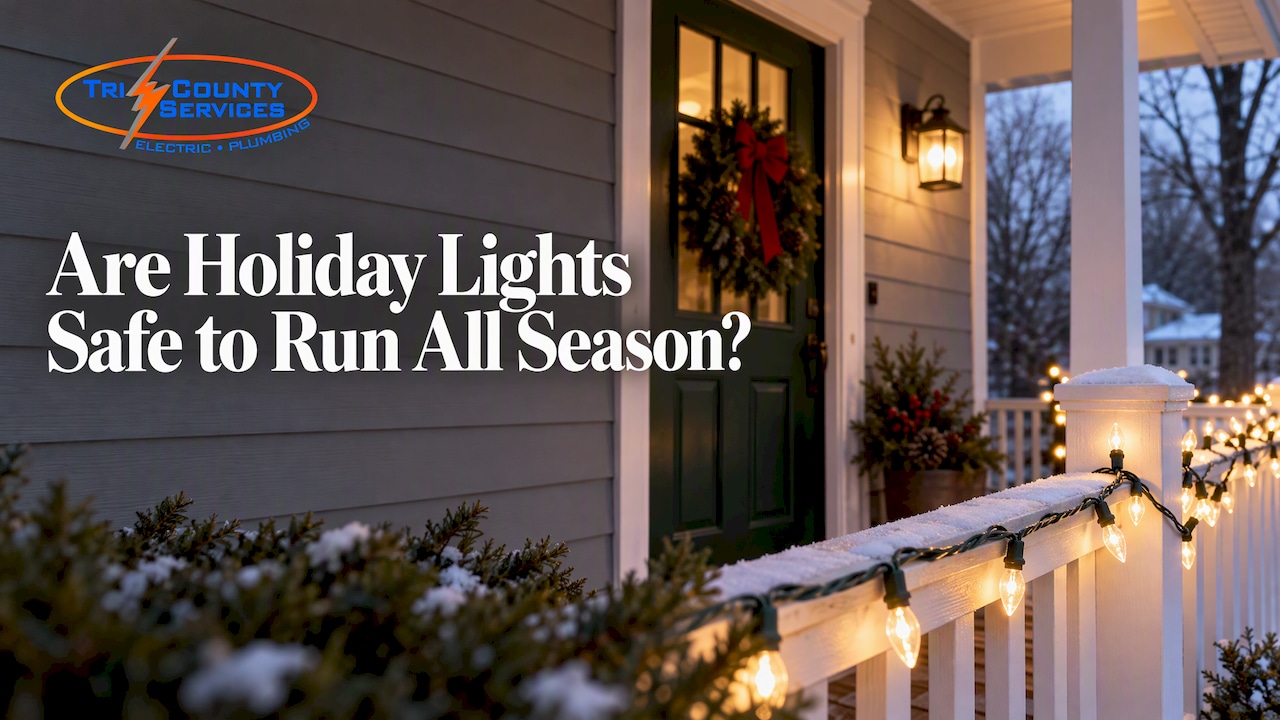


Yes, holiday lights can be run for the whole season, but only under conditions. The lights need to be in good shape and rated for where you hang them. Outdoor strings belong on a GFCI-protected outlet. Cords can’t be overloaded or pinched. And the display should be off when you sleep or leave the house. Most trouble starts with leaving a tired set of lights on for weeks, not with the season itself. Below is how long is too long, what to check each week, and when a pro should look at your wiring.
TL;DR
- The National Electrical Code treats holiday lighting as temporary and permits it for no more than 90 days, so a Thanksgiving-to-New-Year display fits, but a year-round one does not.
- The CPSC advises turning lights off when you go to bed or leave the house. A timer makes that automatic.
- Outdoor lights need a GFCI-protected outlet, a weatherproof rating and a quick inspection every week or two.
- Flickering, warm plugs, tripped breakers or a dead outlet mean stop and call a professional electrician.
Table of Contents
- What “all season” means for your lights
- The risks of leaving lights running for weeks
- Is it safe to leave lights on in rain or snow?
- A weekly safety check for lights that stay on
- Timers, extension cords and outlets
- Signs your lights or your wiring need a professional
- Our perspective: why we want a pro looking first
- When to bring in Tri-County Services Electric & Plumbing
- Taking lights down and storing them
- FAQ
- Sources
What “all season” means for your lights
Holiday lights are built and tested for temporary use. The NFPA notes that the NEC, in Section 590.3(B), allows holiday lighting to be installed for no more than 90 days. In Northeast Ohio, a typical display goes up in early to mid November and comes down in early January. That is well inside the window.
The trouble starts when lights go up in October for a long run and stay up through the January thaw, or when they never come down. Ice, wind, sun and repeated freezing and thawing wear on insulation and sockets. A set that was fine on day one can have a cracked socket by week eight.
There is one exception worth knowing. UL Solutions explains that products sold as “string lights” can be certified under a different category, Supplement SD of UL 588, for all-year use, while ordinary holiday strings are certified for temporary seasonal use. If you want lights that stay up in July, the box and the certification mark matter. A cheap seasonal set left up all year is not the same product.
The risks of leaving lights running for weeks
Most holiday light problems are slow ones. They build up over days of heat, moisture and strain, and then show up on a cold night when everything is plugged in at once.
Heat and damaged insulation
Older incandescent mini-lights run hot. Eversource, a New England utility, says LED holiday lights use less energy and run cooler, which lowers fire risk. A warm bulb pressed against a dry tree, a curtain or a wood railing for 12 hours a day, week after week, is exactly where you don’t want it.
Moisture and shock
Water and electricity do not mix, and winter in Ohio brings plenty of both. Snow piles up around plugs, and meltwater pools where cords meet. The ESFI advises keeping outdoor extension cords and light strings clear of standing water and snow. Lights marked for indoor use only should stay indoors. Outdoor lights should be used outdoors and meet additional safety standards.
Overloaded circuits
A whole season of use means every strand, inflatable and projector is drawing power for hours each night. Overload shows up as breakers that trip, outlets that feel warm or lights that dim when something else turns on. That is a sign the circuit is working too hard.
Unattended fire risk
The CPSC’s guidance is plain: turn off all holiday lights when you go to bed or leave the house, because lights could short out and start a fire. If a fault happens, you want to be awake and home when it does.
Is it safe to leave lights on in rain or snow?
Outdoor-rated lights are designed to handle weather. Rain and snow alone are not the problem. The problem is what they find: a cracked socket, a split in the wire jacket, a connection lying in a puddle, or an indoor-only string hung outside.
To get through a wet season:
- Use lights rated for outdoor use. The CPSC says holiday lighting should be tested by a nationally recognized lab such as UL or ETL, and conform to established safety standards. Look for the mark on the box or tag.
- Plug into a GFCI. Outdoor holiday decorations should be on circuits protected by a ground-fault circuit interrupter to guard against shock. If your outdoor outlet doesn’t have one, that is a quick fix for an electrician.
- Keep connections up and off the ground. Plugs and cord joins should not sit in snow or standing water.
- Secure everything. The CPSC recommends fastening outdoor lights firmly to trees, walls or other supports to protect them from wind. Use insulated hooks or clips, not nails or tacks that can pierce a wire.
Cable quality matters too. Sun, cold and moisture break down cheap cord jackets over time, which is why it is worth reading up on choosing UV-resistant cables for outdoor installations before you buy extension cords that will live outside for two months.
A weekly safety check for lights that stay on
If your lights are going to run for weeks, treat them like any other piece of equipment in the house. A five-minute walk-around once a week catches most problems early.
- Unplug first. Never handle a string while it is energized.
- Look at every set. Texas Department of Insurance guidance says to check for damaged sockets, wires or connections and discard damaged sets. Cracked sockets, loose connections and frayed or bare wire are all reasons to throw a string away.
- Feel the plugs. After lights have been on, a plug or power strip that is warm to the touch is a warning. A hot one is a reason to unplug it right away.
- Check cord routing. Cords shouldn’t be pinched under furniture or heavy objects, or squeezed in windows and doors. Eversource notes that pressure can damage the insulation inside the cord.
- Test the GFCI. Press the test and reset buttons on the outdoor outlet. If it won’t reset or won’t trip, have an electrician look at it.
- Look at the tree. A live tree dries out as the season goes on. Dry needles and warm lights are a bad pair, so water the tree daily. The CPSC also warns never to put electric lights on a metal Christmas tree, since faulty wiring can charge the whole tree.
Timers, extension cords and outlets
A timer is the simplest safeguard. Eversource recommends timers so lights aren’t accidentally left on, and they help control energy use and cost. Set the lights to run from dusk until you go to bed, and they will be off when you are asleep or away. Use an outdoor-rated timer for outdoor plugs.
Extension cords are where many displays go wrong. The NFPA says cords must not be affixed to structures or run through walls, ceilings or floors, or under doors or floor coverings. It also says an extension cord should plug directly into an approved receptacle and generally serve one appliance, and that power taps should never be daisy-chained.
In plain terms:
- Do not plug one extension cord into another to reach farther. Buy the right length.
- Do not run a power strip into a power strip.
- Do not tack or staple a cord to the house as a permanent route.
- Match the cord’s rating to the load. Several large inflatables on one thin cord is a problem waiting to happen.
When you use a ladder to hang lights, choose wood or fiberglass, not metal, so the ladder can’t conduct electricity if it touches a live line or a faulty string. Keep well away from overhead service lines.
Signs your lights or your wiring need a professional
Not every problem is the lights’ fault. Sometimes the display exposes a weakness that was already in the house. Call a professional electrician if you see any of these:
- Breakers that trip when the lights go on
- Outdoor outlets that don’t work, feel warm or lack GFCI protection
- Lights that flicker or dim when other appliances start
- Scorch marks, a burning smell or a buzzing sound at an outlet or plug
- A big display that needs more power than your existing outdoor circuits supply
Larger setups are a gray area for inspections. NFPA’s Dean Austin notes that whether a holiday lighting installation needs inspection often depends on the authority having jurisdiction, the complexity of the wiring and how long the display runs. A small display may not need one. An elaborate one might. Your local building department can tell you what applies where you live.
The CPSC also says seasonal lighting with undersized wiring, weak strain relief or missing fuses is a substantial product hazard. That is another reason not to trust bargain strings with no listing mark.
If you’re not sure whether a problem is serious, don’t test it by leaving the lights on. Our guide on when to call 911, your utility or an electrician can help you sort out who to call.
Our perspective: why we want a pro looking first
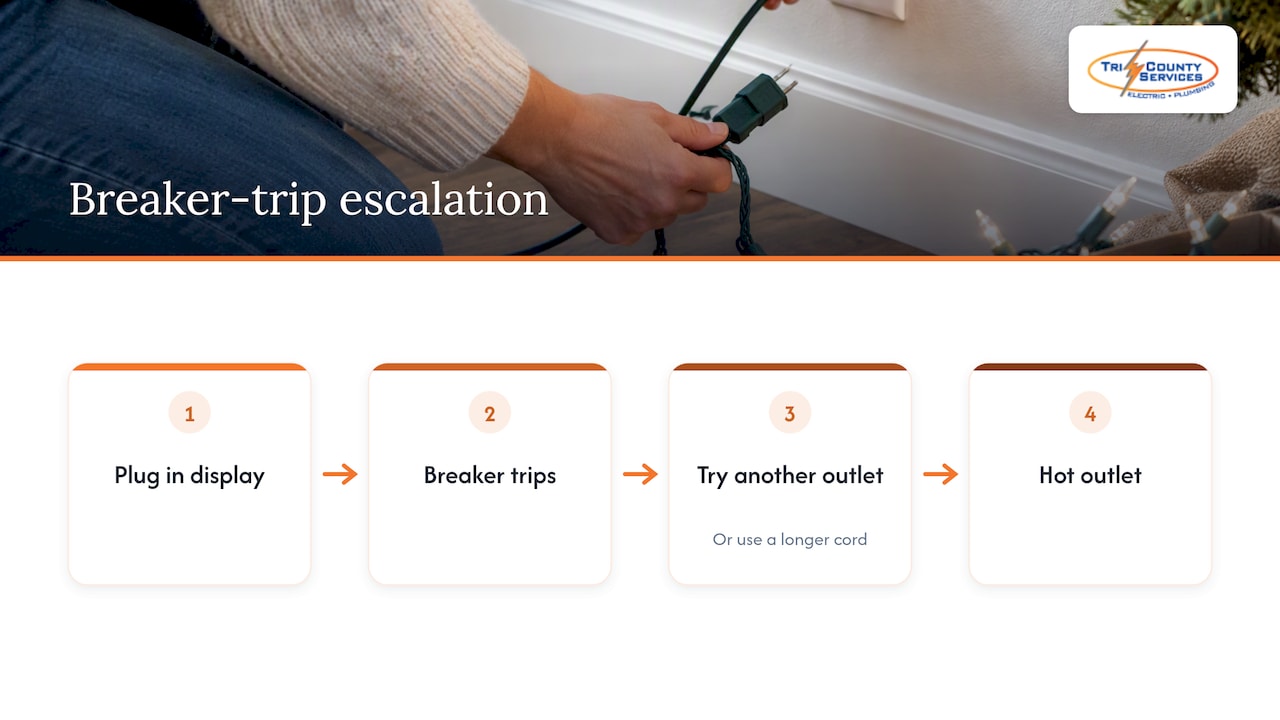
We have been serving Northeast Ohio homes since 1975, and the pattern in December is familiar. A homeowner plugs in a big display, a breaker trips, and the first instinct is to try another outlet or plug into a longer cord. That is how a minor issue becomes a hot outlet.
Our view is simple. Holiday lights themselves are low risk when they are the right product, on a protected circuit, on a timer and checked regularly. The wiring behind them is what decides whether the season goes smoothly. An outdoor outlet with no GFCI, an old circuit shared with half the house, or a panel that is already near capacity can’t be fixed with a better extension cord. Guessing at these problems by yourself is where people get hurt, because the cause is often hidden inside a wall or box.
That is why we suggest calling a professional before you hang a large display, not after something goes wrong. A short visit can confirm that your outdoor receptacles are protected, that your circuits can carry the load, and that nothing is warm that shouldn’t be. If you are thinking about a more permanent setup, we’ve written about what to know before you install permanent holiday lighting and whether to hire an electrician to install holiday lights. We schedule work around your day to keep disruption low, and we treat your home with care.
— Lindsay Paramore
When to bring in Tri-County Services Electric & Plumbing
Three situations are worth a call before the lights go up:
- Outdoor outlets without GFCI protection. Adding protection is a small job that makes a big difference in wet weather.
- A dedicated circuit for a larger display. If you run many lights, inflatables or a pump for a water feature, a separate circuit keeps the load off your kitchen or living room outlets.
- Frequent breaker trips or an older panel. A panel upgrade is the lasting answer when the system can’t keep up with modern demand.
If something is already acting up, our electrical troubleshooting is listed at $300 to $500 on our electrical pricing guide, and you can see our other electrical services there too. Tri-County Services Electric & Plumbing is a family-owned team with skilled, certified technicians and flexible scheduling.

Call our office at (440) 253-0332 to book an electrical safety check before you plug in this season.
Taking lights down and storing them
Plan the end date when you hang them. Since the NEC treats holiday lighting as temporary, aim to have everything down well before the 90 days are up. That usually means early January. Our winter electrical safety tips for Ohio homes cover the rest of the cold-weather load on your system.
When you take lights down:
- Unplug everything and remove strings gently. Pulling on a wire damages it.
- Check each set as you go, and discard any with cracked sockets or exposed wire rather than saving them for next year.
- Coil lights loosely on a spool or reel, and store them dry in a bin.
- Label outdoor and indoor sets so they don’t get mixed up next year.
This also tells you what to replace. If most of your strings fail after one season, it may be worth moving to LED and outdoor-rated sets. They cost more at first, but they use less power and run cooler.
FAQ
Is it safe to leave Christmas lights on all night?
No. The CPSC advises turning off holiday lights when you go to bed or leave the house, because a short circuit could start a fire. Put the lights on a timer so you never have to remember. If you want a nighttime glow, use a small LED nightlight instead.
Can holiday lights stay on in the rain or snow?
Outdoor-rated lights are made for wet weather, as long as they are undamaged and plugged into a GFCI-protected outlet. Keep plugs and connections off the ground and out of standing water or snow. Indoor-only lights should never be used outside.
How long can I leave my holiday lights up?
The NEC allows holiday lighting to be installed for no more than 90 days. That covers a typical November-to-January display. For lights meant to stay up all year, look for products certified for permanent use, and ask a professional electrician about installation.
Is it safe to use outdoor Christmas lights indoors?
Outdoor-rated lights are generally built to a tougher standard, so they are not the concern. The reverse is the problem: indoor-only lights should not go outside. Check the packaging or tag for the intended use, and look for a UL or ETL mark either way.
Why do my breakers trip when I plug in the lights?
The circuit may be overloaded, shared with other devices, or have a fault in a cord or outlet. Unplug the lights and don’t keep resetting the breaker. Call our office at (440) 253-0332 so a professional can find the cause.
Sources
- NFPA: Electrical and Fire Safety Considerations At Home During the Cold Winter Months
- UL Solutions: String Lights for All-Year Use, UL 588 Supplement SD
- CPSC: Holiday Season Decorating Safety Tips
- CPSC: Do’s and Don’ts of Holiday Decorating
- CPSC: Electrical Products (Household)
- ESFI: Outdoor Decoration Safety Tips
- Texas Department of Insurance: Decorating Safely with Lights
- Eversource: Holiday Light Safety
- NFPA: Holiday Lighting, to Inspect or Not to Inspect
- Electrical Safety Office Queensland: Christmas lights