
A burning electrical smell almost always points to overheating, arcing, or scorched insulation, and it belongs in the “treat it as a possible fire” category until proven otherwise. If you see smoke or flame, get everyone out and call 911. If there’s no visible fire, keep people away from the area, switch off the affected circuit if you can do it safely, and call a professional right away.
TL;DR:
- Sustained sparking, rapidly rising heat, or a wall or panel hot to the touch warrants evacuation and a 911 call from outside.
- Without visible fire, keep people and pets clear, unplug a device only if its plug and outlet are cool, and leave its breaker off.
- A smell from a wall, ceiling, or attic raises concern because hidden arcing can spread unseen and remains difficult to assess safely.
- Aluminum wiring connections can overheat and fail without warning, so a burning smell near an outlet calls for professional inspection, not opening the cover.
- A new appliance’s mild odor usually fades after a few uses, but recurring acrid smells, warm outlets, flickering lights, or repeated breaker trips need inspection.
Table of Contents
- What to Do in the First Few Minutes After You Smell Burning
- Common Causes Behind a Burning Electrical Smell
- How Urgent Is It? Reading the Warning Signs
- Things You Should Never Do When You Smell Burning Wires
- When to Call a Professional and What Happens Next
- Preventive Steps That Lower Your Risk Going Forward
- Can You Narrow Down the Source Yourself Before Calling?
- Does Weather or Humidity Affect Electrical Smells?
- Not Every Burning Smell Means Danger: How to Tell the Difference
- How the Smell Relates to Different Parts of Your Electrical System
- Why We Treat Every Burning Smell Call as Urgent
- Get a Professional Inspection Before a Small Problem Grows
- FAQ
- Sources
What to Do in the First Few Minutes After You Smell Burning
The first few minutes decide whether a problem stays small or turns into an emergency. Move fast, but move safely.
- Evacuate immediately if you see smoke, flame, hear sustained sparking, or notice heat rising quickly near a wall, outlet, or panel, and call 911 from outside the home.
- If there’s no visible fire, keep everyone, including pets, away from the suspected outlet, appliance, or panel area.
- Unplug the suspect appliance or device only if the plug and faceplate feel cool to the touch; never touch a warm or hot outlet.
- If you can safely reach your breaker panel without passing through smoke or heat, switch off the breaker feeding that circuit and leave it off.
- Open a window or door for ventilation if it’s safe to do so, but don’t linger in the area trying to air it out.
- Call a professional once the immediate scene is secured, even if the smell fades.
The U.S. Fire Administration’s electrical fire safety guidance advises stopping use of the affected outlet or appliance, keeping people away, and never removing covers or investigating inside walls or panels yourself. If there’s no visible fire, switch off the identifiable breaker and leave it off until a professional inspects it.
Pro Tip: Note the time you first noticed the smell and which room it was strongest in. That detail helps a technician narrow down the cause faster.
Common Causes Behind a Burning Electrical Smell
A burning odor usually traces back to one of a handful of culprits, and the signs around it often hint at which one you’re dealing with.
- Loose or damaged wiring: arcing inside walls or ceilings can produce a hot, acrid smell with no obvious source, and it’s especially risky because the damage is hidden.
- Overloaded circuits: too many devices on one circuit, daisy-chained power strips, or an undersized extension cord can heat wires beyond their rating.
- Faulty outlets or switches: aging components, loose connections, or worn contacts often show up as a warm, discolored, or slightly melted faceplate before the smell appears.
- Overheating appliances or motors: space heaters, dryers, and HVAC blower motors can overheat at the plug, cord, or internal windings, and portable heaters are a frequent source of these incidents.
- Post-renovation wiring issues: new electrical work that wasn’t terminated or sized correctly can produce a burning smell within days or weeks of the project.
Aluminum wiring deserves its own mention. CPSC Publication 516 warns that aluminum wiring connections can overheat and fail without any obvious warning signs beforehand, and that attempting a fix yourself raises both fire and shock risk. If your home has aluminum branch wiring, a burning smell near an outlet is a reason to call a professional, not to open the cover and look.
How Urgent Is It? Reading the Warning Signs
Some signals mean “call a professional this week.” Others mean “call 911 right now.” Knowing the difference matters.
Treat these as immediate emergencies requiring 911: visible smoke or flame, sustained sparking from an outlet or panel, heat that’s rising fast, or a panel or wall that’s hot to the touch. NFPA’s home electrical safety guidance lists burning or rubbery odors, warm or discolored outlets, flickering or dimming lights, sparks, and repeated breaker trips as warning signs that call for a qualified professional rather than continued use.
Location raises or lowers urgency too. A smell coming from a concealed space like an attic, wall cavity, or behind a ceiling is more dangerous than one from a visible appliance cord, because you can’t see how far damage has spread.
The scale of the risk is real: NFPA research estimates an annual average of about 46,652 home electrical structure fires between 2020 and 2024, with wiring and distribution equipment a common factor and many fires starting in kitchens, bedrooms, or concealed spaces.
Things You Should Never Do When You Smell Burning Wires
A few instinctive reactions make electrical hazards worse instead of better.
- Never remove an outlet cover or panel cover to look inside; energized components can shock or arc the moment you touch them.
- Don’t keep using a suspect outlet, cord, or appliance just because the smell seems to have faded.
- Avoid repeatedly flipping a tripped breaker back on to “see if it holds.” Each reset risks reigniting an arc.
- Don’t delay leaving the house if smoke thickens, heat increases, or the smell gets stronger while you’re deciding what to do.
OSHA’s electrical safety guidance reinforces the same principle professionals follow on job sites: stay clear of energized parts you aren’t trained to handle, and let a qualified person isolate and test the circuit.
When to Call a Professional and What Happens Next
A persistent burning smell, a warm outlet, visible arcing, or odors that started after recent electrical work all warrant a professional visit, not a wait-and-see approach.
When you call, it helps to have a few details ready:
- Which room or area the smell is strongest in, and when you first noticed it.
- Whether any outlet, switch, or faceplate felt warm or looked discolored.
- Whether a breaker tripped, and if so, which one.
- Whether any electrical work was done in that area recently.
A professional visit typically includes a visual inspection, safe circuit isolation, targeted testing of the suspect wiring or device, and a repair plan that might involve outlet replacement, rewiring a section, or addressing panel-level issues. Our technicians have handled this exact scenario and bring that experience to every inspection.
Pro Tip: Keep the affected breaker off and the area clear until the technician arrives, even if the smell seems to have gone away.
If you’re dealing with a burning smell right now, call (440) 253-0332 or check our electrical pricing guide for troubleshooting and panel service details.
Preventive Steps That Lower Your Risk Going Forward
Most burning-smell emergencies trace back to a handful of maintenance gaps that are simple to close before they become urgent.
- Install smoke alarms inside every bedroom, outside sleeping areas, and on every level of your home, and test them monthly; our guide on smoke alarm placement covers code-backed spacing.
- Replace any cord that’s frayed, cracked, or has exposed wire rather than taping over it.
- Avoid running cords under rugs or daisy-chaining multiple power strips off one outlet.
- Ask a professional about GFCI protection in kitchens, bathrooms, and garages, and AFCI protection for bedroom circuits, since both are designed to catch different types of electrical faults.
- Watch for the signs that point toward a panel upgrade, like frequent breaker trips or a panel that feels warm.
The USFA’s smoke alarm guidance recommends combining ionization and photoelectric alarms, or a dual-sensor model, for the broadest detection coverage.
Can You Narrow Down the Source Yourself Before Calling?
You can gather useful clues without touching anything energized. Walk the house room by room and note where the smell is strongest, since odor intensity usually points toward the source even when you can’t see it.
Check whether the smell tracks with a specific appliance running, such as a window AC unit, space heater, or dryer. If turning that device off makes the smell fade, that’s a strong clue for whoever inspects it. Feel faceplates and switch covers with the back of your hand rather than your palm, and only if they’re reachable without climbing or reaching into a tight space; a faceplate that’s warm or hot is a sign, not something to pry open.
A simple room-by-room sniff test combined with noting which breaker feeds that area gives a professional a head start. Our circuit breaker repair guidance explains how breaker behavior, like a breaker that trips the moment you flip it back on, often correlates with where the fault lives. What you shouldn’t do is open a panel cover or outlet to “follow” the smell further. That’s the line between gathering helpful information and creating a shock or arc-flash risk for yourself.
Does Weather or Humidity Affect Electrical Smells?
Seasonal conditions do influence how often burning smells show up and how severe the underlying fault might be. High humidity can accelerate corrosion on connections inside outlets, panels, and junction boxes, and a corroded connection resists current flow more than a clean one, which generates extra heat.
Cold snaps bring a different kind of stress: space heaters and other portable heating devices see heavy, sudden use, and CPSC’s portable electric heater assessment found that plug and cord connections are frequently implicated in heater-related incidents, with overheating connections able to melt housings and ignite nearby material.
Summer heat adds its own load, since air conditioning draws heavier current through circuits and connections that may already be marginal. A loose connection that was fine in spring can run hot enough in August to produce a noticeable smell. None of this means you need to diagnose the season, just that a burning smell appearing with a seasonal spike in appliance use is a predictable pattern worth mentioning when you call for an inspection.
Not Every Burning Smell Means Danger: How to Tell the Difference
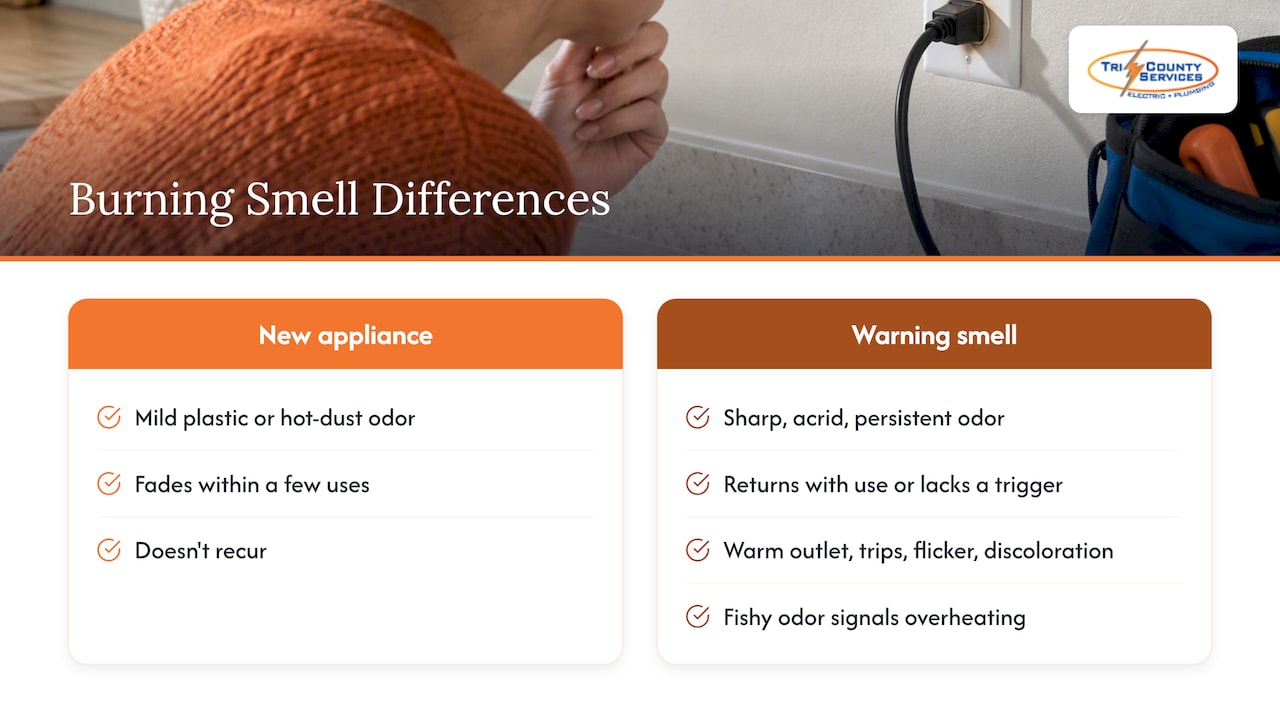
A new appliance, space heater, or oven often gives off a mild, short-lived plastic or “hot dust” smell the first few times you use it. That’s typically manufacturing residue or protective coating burning off, and it usually fades within a few uses and doesn’t recur.
A dangerous smell behaves differently. It tends to be sharper, more acrid, and persistent, returning every time a particular circuit or appliance is used, or showing up with no clear trigger at all. If the smell is accompanied by a warm outlet, a tripped breaker, flickering lights, or any visible discoloration on a faceplate, treat it as a warning sign rather than a new-appliance quirk.
A “fishy” odor is worth flagging separately. It’s a known indicator of overheating plastic or electrical components, distinct from ordinary dust burning off a heating element, and it shows up often enough in overheating wiring and overloaded devices that electricians treat it as a red flag rather than a false alarm. When in doubt about which category your smell falls into, the safer assumption is the dangerous one, especially if it’s not obviously tied to a brand-new device.
How the Smell Relates to Different Parts of Your Electrical System
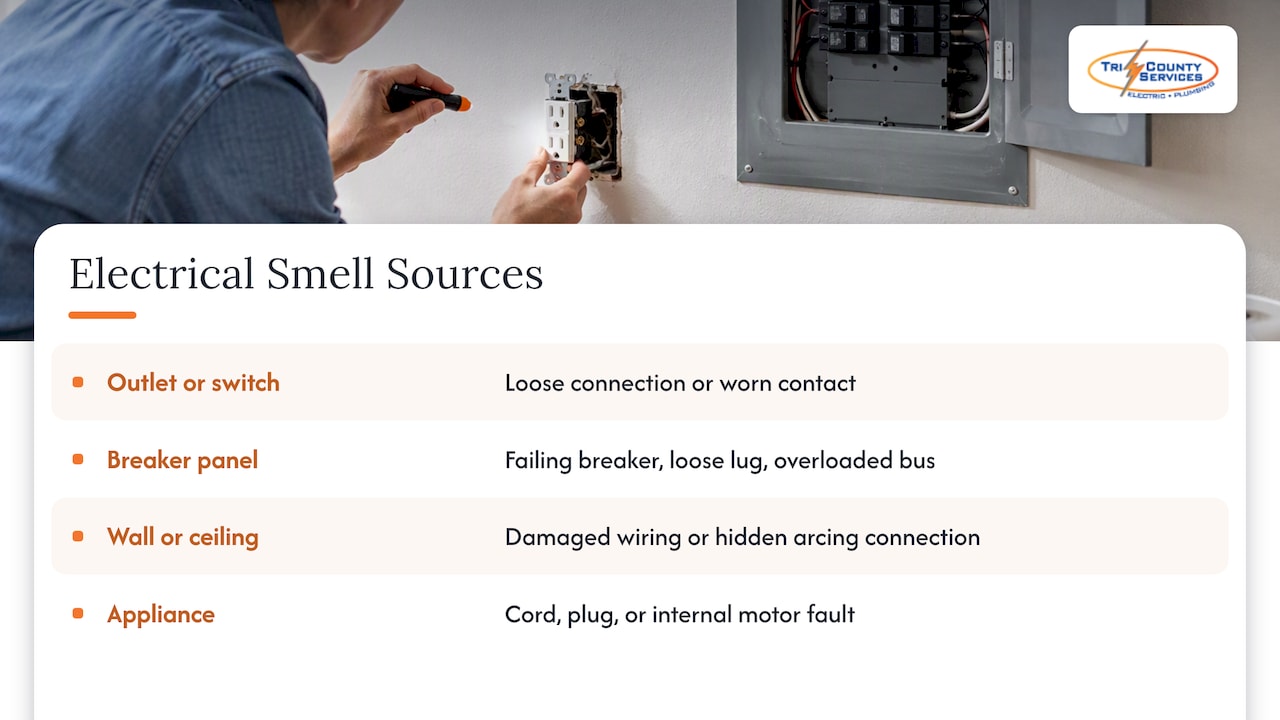
The specific smell and where it originates often point toward which component is involved, which helps a technician focus the inspection.
A smell from an outlet or switch usually means a loose connection or worn contact at that point, generating localized heat. A smell from the breaker panel itself is more serious, since it can indicate a failing breaker, a loose lug connection, or overloaded bus bar, and a hot panel exterior is one of the clearest signs covered under NFPA’s warning checklist. A smell that seems to come from inside a wall or ceiling, with no obvious outlet or fixture nearby, often points to damaged wiring or an arcing connection hidden in that cavity, which is also why concealed-space smells carry extra urgency.
Appliance-sourced smells, like a dryer, space heater, or window AC unit, usually point to the device’s cord, plug, or internal motor rather than your home’s wiring, though a failing appliance can still stress the outlet it’s plugged into over time. If you’re adding higher-draw equipment like an EV charger, panel capacity becomes part of this picture too; a comparison of 100 amp and 200 amp panels lays out why panel capacity limits matter before adding major new loads. Knowing roughly which component is involved doesn’t mean diagnosing it yourself. It means giving a professional a faster starting point.
Why We Treat Every Burning Smell Call as Urgent
Calls about a burning electrical smell are some of the ones we take most seriously, because the smell itself is often the only warning a homeowner gets before a bigger problem develops. Early inspection, even when the cause turns out to be minor, consistently prevents the kind of escalation that turns a loose connection into a repair bill for an entire section of wiring.
— Lindsay Paramore
Get a Professional Inspection Before a Small Problem Grows

When something smells like it’s burning, waiting rarely pays off. Our team has extensive experience working on electrical systems, and we send trained technicians to track down the source, test the circuit, and fix what’s actually wrong rather than guessing.
| Situation | What we check | Starting point |
|---|---|---|
| Warm or discolored outlet | Connection, wiring, load | Electrical troubleshooting, $300 to $500 |
| Frequent breaker trips | Breaker, panel, circuit load | Panel upgrade services |
| Post-renovation odor | New wiring terminations | Electrical pricing guide |
Call us at (440) 253-0332 or request an estimate through our electrical pricing guide and we’ll get a technician scheduled.
FAQ
Why do I randomly smell electrical burning?
A random burning smell usually comes from a loose connection, an overloaded circuit, or an appliance cord that’s starting to fail, and the smell can come and go as the connection heats up and cools down. If it keeps recurring with no obvious appliance trigger, NFPA’s warning signs list treats it as a reason to call a professional rather than wait it out.
What can be mistaken for a burning smell?
Dust burning off a heating element, residue from a brand-new appliance, or an HVAC system running for the first time in a season can all produce a mild, short-lived odor similar to burning. The real difference is persistence: a harmless smell fades after a few uses, while a dangerous one returns or intensifies.
What are the early warning signs of an electrical fire?
Early signs include a burning or rubbery odor, outlets or switches that feel warm or look discolored, flickering or dimming lights, visible sparks, and breakers that trip repeatedly. NFPA’s electrical safety guidance lists these as signs that call for a qualified professional rather than continued use.
Can electrical burning smell harm you?
Yes. The smell itself can signal overheating insulation or arcing that’s capable of igniting nearby materials, and the fumes from burning plastic or insulation can irritate your airway if you stay near the source. Keeping people away from the area and calling a professional protects you from both the fire risk and the fumes.
Sources
- Electrical Home Fire Safety | NFPA
- U.S. Fire Administration — Electrical fire safety guidance
- CPSC Publication 516 – Repairing Aluminum Wiring
- NFPA report on home electrical fires (2020–2024)