

Run a weekly visual check, exercise the unit monthly under load, handle wear items every quarter or two, and bring in a professional annually for full service and load-bank testing. Battery neglect and missed exercise cycles are major causes of no-start failures. Follow your manufacturer’s hour-based intervals alongside this calendar, and treat any fuel leak, coolant leak, or alarm as a reason to call a professional immediately.
TL;DR:
- Performing load testing at least once a year and documenting it is critical for NFPA 110 compliance and early fault detection.
- Monthly exercises should be at 30% load for 15 to 30 minutes to prevent issues like wet stacking and ensure proper engine health.
- Battery conductance testing twice annually offers a more accurate assessment of starting power than a voltage check alone.
- Visual inspections and listening during exercises can catch most issues early, but complex repairs or internal wiring must be handled by licensed technicians.
- Proper maintenance intervals depend on the generator’s use pattern, with standby units often scheduled by calendar date and prime units by running hours.
Table of Contents
- Generator Maintenance Schedule at a Glance
- What Should You Check on Your Generator Every Week?
- How Often Should You Run a Generator Under Load Each Month?
- What Quarterly and Semi-Annual Service Should You Schedule?
- Why Does Annual Service Include Load-Bank Testing?
- Should You Track Maintenance by Calendar Date or Running Hours?
- When Should You Call a Professional Instead of Doing It Yourself?
- Field Perspective on Sticking to the Schedule
- Book Your Generator Inspection Before the Next Storm Rolls In
- Sources
- FAQ
Generator Maintenance Schedule at a Glance
Most generator failures trace back to two things: a dead battery and a unit that sat too long without running under real load. A layered schedule fixes both, and it’s the framework most maintenance guides converge on once you strip away the marketing.
| Interval | Key tasks | Who typically handles it |
|---|---|---|
| Weekly | Visual walk-around, confirm auto-exercise ran, check for leaks | Owner |
| Monthly | 15–30 minute run at 30%+ load, battery terminal check, fluid levels | Owner |
| Quarterly | Air filter inspection, belt/hose check, coolant concentration test | Owner or technician |
| Semi-Annual | Battery conductance test, oil change (prime units), deeper fuel check | Technician recommended |
| Annual | Full inspection, load-bank test, ATS internal check, spark plugs | Technician |
| 25 hours | Break-in oil change | Owner or technician |
| 250 hours | Oil and filter service (portable/light-duty units) | Owner or technician |
| 500 hours | Oil, filter, and valve lash check (prime/continuous units) | Technician |
| — | Major service, injector or fuel system inspection | Technician |
Facilities under NFPA 110 must perform and document monthly load testing; simply noting that the unit “ran fine” is not sufficient. The UFC 3-540-07 typical maintenance schedule breaks tasks down the same way, by calendar frequency layered with hour milestones, which is why that structure shows up in nearly every serious maintenance program. Anything involving load-bank equipment or internal transfer switch wiring belongs on the technician side of that table, not the owner side.
What Should You Check on Your Generator Every Week?
A five-minute walk-around catches most problems before they become emergencies. Look at the unit the same way each time, and you’ll notice when something’s off.
- Check the enclosure for rodent nests, chewed wiring insulation, or standing water underneath.
- Look for fuel, oil, or coolant stains on the ground or housing.
- Confirm loose fasteners, panels, or exhaust connections haven’t rattled free.
- Verify the automatic exercise cycle actually fired if your unit is programmed for one.
Listen during the exercise run, not just watch. A healthy unit sounds steady, without knocking, surging, or excessive smoke after the first minute of warmup. If you hear grinding, see dense smoke past the initial startup, or catch a fault light, stop and call a professional rather than restarting it to “see if it clears.”
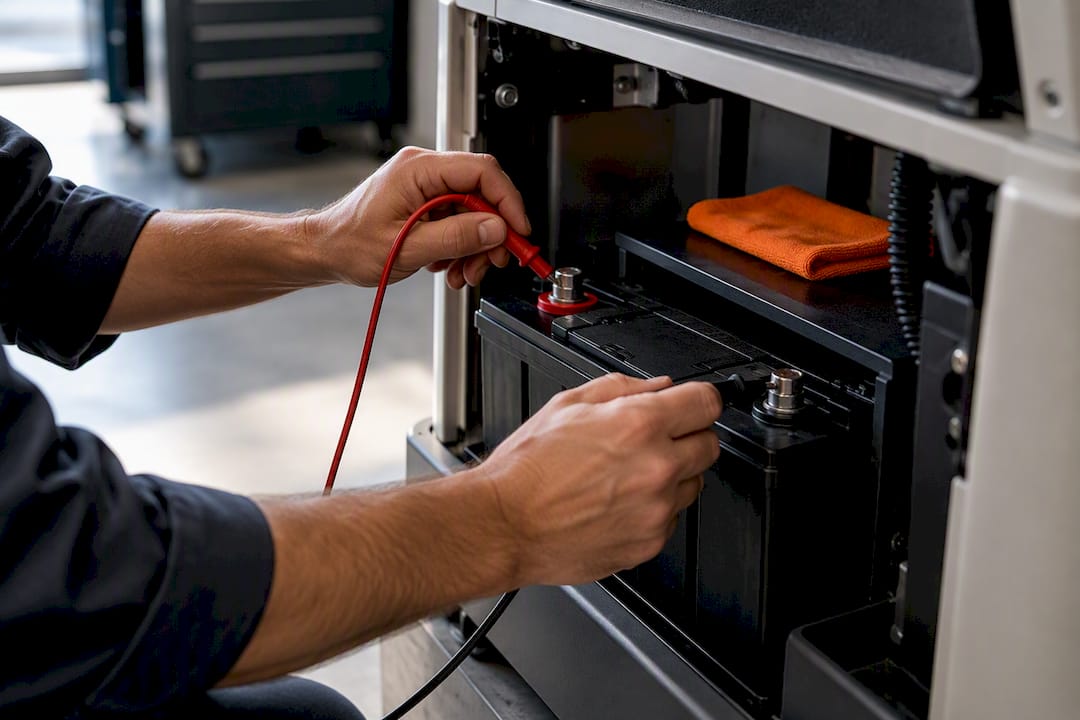
Battery terminals deserve a look too, but a resting voltage reading doesn’t reveal the battery’s true starting power. That’s why conductance testing is more reliable for assessing battery condition than just a voltage check.
Pro Tip: Keep a small notepad or phone note logging exercise run times and anything unusual you notice. A short pattern of rough operation notes helps a technician diagnose a problem quickly instead of guessing.
How Often Should You Run a Generator Under Load Each Month?
- Run the unit 15 to 30 minutes at 30% or more of its rated load, not just an idle cycle. Short, unloaded runs don’t get the engine hot enough to burn off condensation and can actually cause wet stacking, unburned fuel residue that fouls injectors and exhaust components, according to standby maintenance guidance.
- Exercise the automatic transfer switch (ATS) under that same load so it isn’t only ever tested on paper.
- Check oil level, coolant level, and fuel level, and drain any water separator on diesel units.
- Clean the battery terminals, inspect hold-downs for corrosion, and confirm the charger is maintaining proper float voltage.
- Clear vents, intake louvers, and the area around the enclosure of debris that restricts airflow.
If you notice the ATS hesitating, a battery that won’t hold charge between runs, or fuel that smells stale or shows sediment, that’s your signal to schedule service rather than wait for the next quarterly check.
What Quarterly and Semi-Annual Service Should You Schedule?
Wear items don’t fail on a strict monthly clock, but they don’t last a full year either. Air filters, belts, and coolant chemistry drift gradually, and catching them at the quarter mark prevents a small issue from becoming a breakdown during an actual outage.
- Inspect the air filter every quarter and replace it when it’s visibly dirty or per the manufacturer’s hour rating.
- Check belts and hoses for cracking, glazing, or soft spots, especially on units that see frequent exercise cycles.
- Test coolant concentration and supplemental coolant additive (SCA) levels to prevent corrosion in the block.
- Run a battery conductance or load test at least twice a year, and plan on proactive replacement every three to four years rather than waiting for a failed start, a cycle battery specialists commonly recommend.
- Shorten these intervals if the unit sits in a dusty, coastal, or extreme cold environment. Salt air and grit wear components faster than any manufacturer’s default schedule assumes.
Prime and continuous-duty units often need oil and filter changes on a semi-annual or hour-based basis well before a standby unit would, since they’re logging far more run time.
Why Does Annual Service Include Load-Bank Testing?
The annual visit is where a technician does what your monthly exercise run physically can’t.
- Full oil and filter change, plus air filter and spark plug replacement.
- Inspection of alternator windings, wiring connections, and voltage regulator output.
- Internal ATS inspection, checking contacts and control logic, not just the exterior switch action.
- Full or partial load-bank test, especially critical if your normal load never reaches 30% of rated capacity on its own.
NFPA 110 ties this kind of testing directly to compliance for Level 1 and Level 2 emergency power systems, and insurers or authorities having jurisdiction (AHJ) often want to see the paperwork. Keeping dated service records isn’t paperwork for its own sake. It’s what protects your warranty claim if a component fails early, and it’s often what an inspector asks for during a commercial facility audit.
Should You Track Maintenance by Calendar Date or Running Hours?
Standby generators, the kind sitting quiet most of the year waiting for an outage, are best tracked by calendar date. They rarely accumulate enough hours for hour-based intervals to trigger on their own. Prime or continuous-duty units are the opposite: they’re running enough that hours matter more than the calendar, with oil and filter changes commonly falling in the 250 to 500 hour range depending on the manufacturer’s specification.
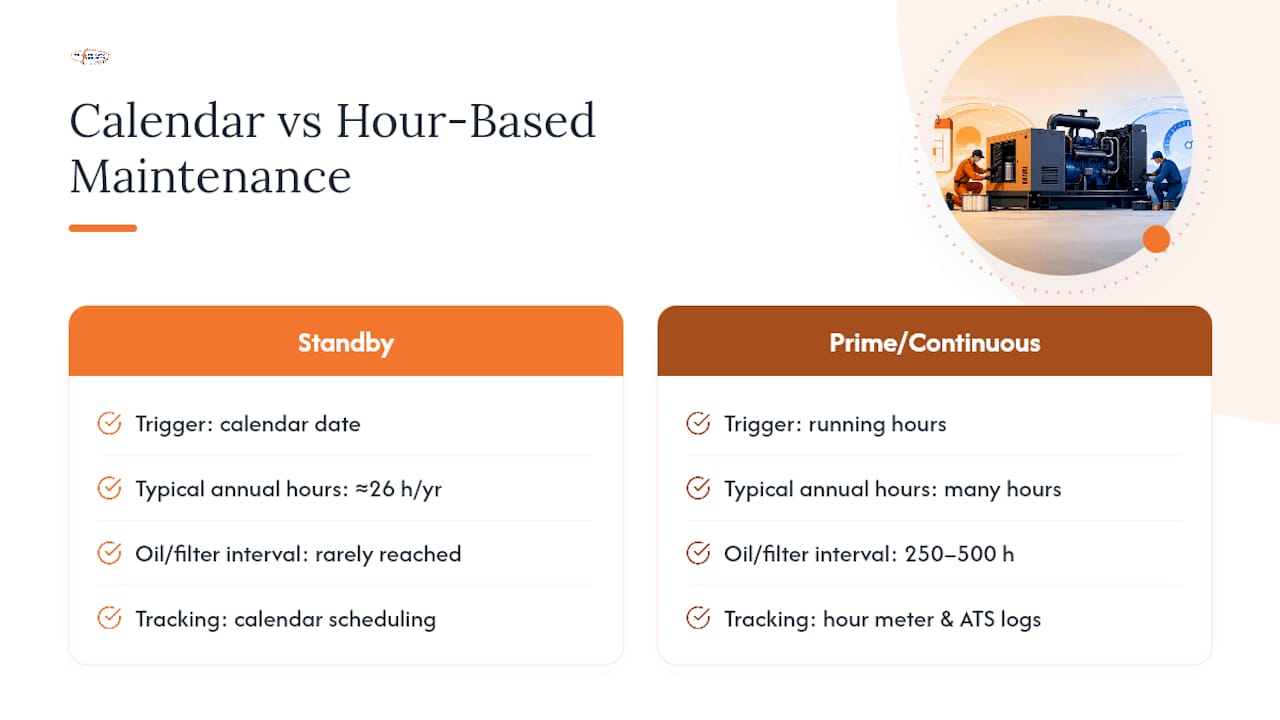
Your hour meter and any ATS event logs are the two easiest tools for tracking this without guesswork. If you’re only running weekly 20 to 30 minute exercise cycles, do the math. Fifty-two weeks at 30 minutes is roughly 26 hours a year, nowhere close to triggering most oil-change thresholds on its own.
Oil analysis programs can justify stretching intervals on prime units, but only when you’re actually sending samples to a lab and tracking wear-metal trends over time. Guessing that “it still looks clean” isn’t the same thing, and stretching intervals without data is how engines wear out early.
When Should You Call a Professional Instead of Doing It Yourself?
Owners can safely handle the visual walk-around, exercise monitoring, basic fluid checks, and terminal cleaning covered above. That’s where the safe DIY line ends.
- Valve lash adjustment, load-bank testing, and alternator or voltage regulator work require technician-grade tools and training.
- Internal ATS wiring and control logic troubleshooting can involve live electrical components you shouldn’t open without proper safety equipment.
- Fuel polishing, injector service, and major fuel-system repairs carry fire and contamination risks that aren’t worth a DIY attempt.
- Carbon monoxide exposure from improper placement or ventilation is a real hazard, and CDC and NIOSH guidance is blunt about how quickly it becomes dangerous.
If you’re hearing alarms, smelling fuel, or seeing coolant on the ground, stop and call a professional rather than troubleshooting further. Tri-County Services Electric & Plumbing handles exactly this kind of technician-level work, and you can reach the office directly at (440) 253-0332.
Field Perspective on Sticking to the Schedule
Most missed maintenance isn’t laziness. It’s owners not knowing which fifteen-minute tasks actually matter. Experienced local service providers have observed that generator units that fail during an outage almost always skipped either battery upkeep or a real load exercise, not something exotic. Book the annual professional inspection before storm season instead of after a failure. It costs less in every sense.
— Lindsay Paramore
Book Your Generator Inspection Before the Next Storm Rolls In
Qualified service providers give generator owners support beyond a checklist: a technician who can run the load-bank test, inspect the ATS internals, and catch a weak battery before it strands you mid-outage.

Annual service coordination covers the full technician scope, oil and filter changes, air filter and spark plug replacement, alternator inspection, ATS checks, and battery testing with proactive replacement recommendations, plus documentation you can hand to an insurer or inspector if needed. Winter is a smart time to lock this in before demand spikes; if you’re also buttoning up the house for the season, winterizing entry points is worth doing at the same time.
Call (440) 253-0332 to schedule your annual inspection, or visit the generator services page to see what’s included. For ballpark costs on related electrical work, the pricing guide is a useful starting point before your appointment.
Sources
- FEMA / NFPA 110 overview (training module)
- CDC / NIOSH: Carbon monoxide hazards and guidance
- Generator battery inspection requirements (HFMMagazine)
FAQ
What Maintenance Does a Generator Require?
A generator needs weekly visual checks, monthly exercise runs under load, quarterly filter and belt inspections, and an annual technician service that includes load-bank testing. Battery care and consistent exercise cycles prevent the majority of failures, according to maintenance checklist guidance.
What Is the 20/20 Rule for Generators?
There’s no universally recognized industry standard called the “20/20 rule” in generator maintenance literature. If you’ve seen it referenced, it likely refers informally to running a unit roughly 20 minutes under meaningful load, similar to the 15 to 30 minute exercise guidance most manufacturers recommend.
What Is the Average Cost to Service a Generator?
Service costs vary widely by unit size, service scope, and whether load-bank testing is included, and specific pricing depends on your equipment and location. Tri-County Services Electric & Plumbing’s pricing guide offers a starting reference, and current generator service pricing is available by calling (440) 253-0332.
How Many Hours Should a Generator Be Serviced?
Standby generators are typically serviced on a calendar basis since they rarely accumulate many running hours in a year. Prime or continuous-duty units usually need oil and filter service every 250 to 500 hours, with a break-in oil change around the 25-hour mark for newer units.
Recommended
- Whole Home Generator Installation: Your 2026 Guide
- When The Power Goes Out, A Portable Generator Can Feel Like A Lifesaver. Keeping Your Lights On, Your Refrigerator Running, And Your Home Comfortable During An Outage Brings Peace Of Mind When You Need It Most. But There’s One Critical Detail Many Homeowners Overlook: How You Connect Your Generator Matters Just As Much As Having One. The Hidden Danger Of Improper Connections
- $8,000–$16,000 Generator Installs: Homeowners’ Checklist A Pro Electrician Follows
- Generator Repair & Service