

Expect to pay a $50 to $200 service call, $75 to $200 an hour for labor, and $180 to $450 total for a typical repair visit in 2026. Most residential plumbing services quote flat-rate, not hourly, so the number on your invoice already bakes in labor, materials, and overhead. The single best move you can make before any work starts: get a written, line-item quote and read it before you sign.
TL;DR:
- Most residential plumbing jobs in 2026 cost between $180 and $450 for the entire service visit, with labor rates typically ranging from $75 to $200 per hour.
- The service call fee generally falls between $50 and $200, which may be waived or included if the repair is approved immediately, depending on the company.
- Flat-rate quotes are calculated using a formula that multiplies loaded labor and material costs by 2.0 to 2.5, covering overhead and business margins.
- Larger jobs, such as sewer repairs or repiping, depend heavily on home layout, age, and hidden conditions, leading to wide price variations from the baseline estimates.
- Homeowners should request detailed, written estimates including scope, labor, materials, permits, and warranties to avoid surprise costs and compare bids effectively.
Table of Contents
- 2026 Plumbing Pricing Guide: National Benchmarks and Common Job Ranges
- How Plumbers Calculate Price: Loaded Labor, Markup, and the Flat-Rate Formula
- Why Your Local Quote Might Not Match the National Average
- How to Read a Plumbing Quote Without Getting Burned
- Budgeting for Timing: Lead Times and Emergency Premiums
- Tri-County Services Electric & Plumbing on Transparent Pricing
- The Honest Take on Plumbing Pricing in 2026
- Get a Written Estimate From Tri-County Services Electric & Plumbing
- Where These Numbers Come From
- Sources
- FAQ
2026 Plumbing Pricing Guide: National Benchmarks and Common Job Ranges
Nationally, a plumbing service visit runs $180 to $450 once you include the diagnostic fee, labor, and basic parts, according to HomeAdvisor’s cost data. That range covers the bulk of what homeowners call in for: a running toilet, a slow drain, a leaking faucet. Bigger jobs, like a sewer line repair or a full repipe, push well past that ceiling.
The service call fee itself, sometimes called a trip charge or diagnostic fee, typically lands between $50 and $200. Plenty of companies waive it or roll it into the final bill if you approve the repair on the spot. It exists because a plumber’s truck, tools, and drive time cost money whether or not a wrench ever turns.
Hourly labor rates for residential work generally fall between $75 and $200 per hour, according to Housecall Pro’s 2026 pricing data. Rates climb toward the top of that band for master-level technicians, specialty work like gas line repair, or markets with tight labor supply. A newer technician working under supervision on a simple job will usually bill closer to the bottom.
Here’s how the most common residential jobs typically shake out, based on HomeAdvisor and EstimationPro’s fixture-level cost data:
A few things jump out in that table. Tankless water heaters cost more upfront than tank units, mostly due to venting and gas line modifications, but they also last longer and use less energy over time. Sewer repair ranges swing wildly because trenchless repair and traditional dig-and-replace carry very different price tags depending on pipe depth and yard access.
Small jobs cluster tight around the benchmark totals. Large jobs, sewer work, repipes, septic system repairs, spread out because they depend so heavily on your home’s layout, age, and what’s hiding behind the walls.
How Plumbers Calculate Price: Loaded Labor, Markup, and the Flat-Rate Formula
Most flat-rate quotes come from a formula, not a guess. Contractors typically calculate: (loaded labor cost + material cost) multiplied by 2.0 to 2.5, according to PipelineOn’s 2026 pricing breakdown. That multiplier isn’t padding your bill for fun. It covers overhead, insurance, vehicle costs, and the jobs that fall through, plus a margin the business needs to stay open.
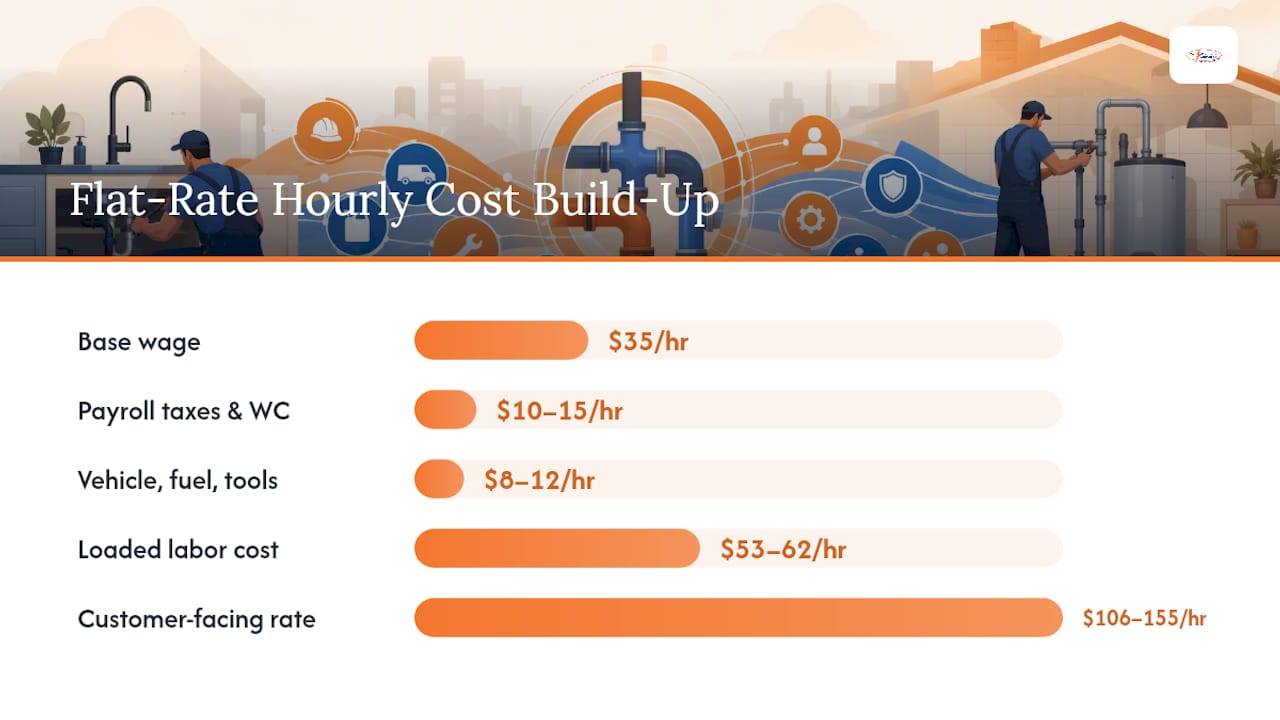
Loaded labor is the part homeowners rarely think about. A technician’s posted wage is only one slice of what it actually costs a company to put them on your job. BLS wage data for plumbers, pipefitters, and steamfitters tracks the base wage, but a company also carries payroll taxes, workers’ compensation insurance, vehicle costs, tools, and paid time when a technician is driving or waiting between calls rather than billing.
Here’s a simplified version of that math:
- Base wage: $35/hour
- Payroll taxes and workers’ comp: adds roughly $10 to $15/hour
- Vehicle, fuel, and tool costs: adds another $8 to $12/hour
- Loaded labor cost: somewhere around $53 to $62/hour
- Applied multiplier (2.0 to 2.5x): customer-facing rate lands between $106 and $155/hour
That’s why a $75/hour “sticker price” almost never survives contact with reality once overhead gets factored in.
Materials markup works differently depending on the item. Small parts, washers, fittings, wax rings, often carry a 1.5x to 2x markup because a company has to stock them, track them, and absorb the ones that get wasted on a job. Big-ticket items like water heaters or sump pumps usually carry thinner margins, since the unit cost itself is already high and competitive pricing pressure is stronger.
Permit fees and administrative time for pulling permits typically show up as a separate line item rather than getting buried in the multiplier, since permit costs vary by jurisdiction and job type.
Pro Tip: Ask whether your quote is flat-rate or time-and-materials before work begins. Flat-rate protects you from a job running long; time-and-materials can save money on straightforward jobs but exposes you if complications surface once the wall comes open.
Time-and-materials billing tends to make more sense for open-ended diagnostic work, like tracking down an intermittent leak, where nobody knows the scope until the pipe is exposed.
Why Your Local Quote Might Not Match the National Average
Several factors push a quote above or below the benchmarks above, and most of them have nothing to do with the plumber trying to overcharge you.
Labor-market pressure matters more in 2026 than it used to. When technicians are scarce in a given market, companies raise minimum trip charges and lean harder on emergency premiums, according to Plumbing.News reporting on 2026 labor trends. That’s part of why a short job can feel expensive: you’re paying for availability, not just wrench time.
Permits add a jurisdictional variable that swings by county and city. Code requirements under the 2021 International Plumbing Code determine which jobs legally require a permit and inspection, and permit fees plus the admin time to pull them get added on top of labor and materials.
A few other drivers worth knowing:
- Access and demo work: cutting into a slab, wall, or ceiling to reach a leak adds restoration cost on top of the repair itself.
- Material choice: PEX piping generally installs faster and cheaper than copper, while tankless water heaters cost more to install than tank units but less to run.
- Equipment supply issues: when a specific water heater model or part is backordered, expect either a delay or a substitution at a different price point.
- Emergency timing: after-hours or weekend calls commonly carry premiums.
How to Read a Plumbing Quote Without Getting Burned
A quote that’s just a single number isn’t a quote, it’s a guess. Before you approve anything, check that the paperwork includes these six items:
- Scope of work, written specifically enough that you could hand it to a different plumber and get the same job done.
- Labor breakdown, either hourly rate and estimated hours, or a clearly stated flat-rate total.
- Materials and unit prices, especially for big-ticket items like water heaters or repipe materials.
- Permit costs, listed separately from labor and materials.
- Timeline, including start date and expected completion.
- Warranty terms and payment schedule, in writing, not verbal.
Ask direct questions before you sign: What’s your arrival window? Is there an after-hours surcharge? Who pulls the permit, you or the homeowner? A company that hesitates on any of these answers is telling you something.
Watch for red flags: a scope description so vague it could mean almost anything, no written warranty, or a scheduling answer like “we’ll get to it when we get to it.” Those are signs to get a second quote.
Pro Tip: When a company offers Good/Better/Best options on a big job like a water heater or repipe, the “Better” tier is usually where the value sits. “Good” often skips warranty coverage or uses builder-grade parts, and “Best” frequently adds premium features you may not need.
Budgeting for Timing: Lead Times and Emergency Premiums
Lead times vary by job. Routine repairs might get scheduled within a few days; water heater replacements and repipes often book out one to three weeks depending on the season and local demand. Emergency and after-hours plumbing services generally include a premium over standard rates reflecting urgency and scheduling.
A few tactics actually move the needle on cost:
- Bundle small jobs into one visit instead of paying separate trip charges for each.
- Schedule non-urgent work during regular business hours, never nights or weekends, to skip the premium.
- Invest in preventive maintenance, since a $150 annual check often prevents a $2,000 emergency repair.
- Budget separately for restoration costs like drywall or flooring repair when a job requires cutting into a wall.
A temporary fix, like a pipe clamp or a shutoff valve, can buy you a day or two in a genuine emergency. It should never replace a permanent repair from a professional, especially on anything touching a gas line or a main water shutoff.
Tri-County Services Electric & Plumbing on Transparent Pricing
Every estimate from Tri-County Services Electric & Plumbing comes written, itemized, and clear about permits and warranty terms before work starts. Some situations aren’t DIY territory: active leaks, gas line work, or major repiping carry real safety risk and code implications that call for a professional, not a weekend project. If you’re planning a repair or want a straight answer on cost, call (440) 253-0332 to to request a written estimate.
The Honest Take on Plumbing Pricing in 2026
Most pricing confusion isn’t about dishonest contractors. It’s about invisible costs. Homeowners see a $150/hour labor rate and assume markup, when in reality loaded labor, insurance, and vehicle overhead already eat into that number before profit even enters the picture. The flat-rate multiplier that looks aggressive on paper is usually just math catching up to what a service call actually costs a business to run.
Where conventional advice falls short is treating “get three quotes” as the whole strategy. Three vague quotes tell you nothing. Three itemized quotes, each showing labor, materials, and permit costs separately, actually let you compare apples to apples. That’s the real skill worth building.
If you take one thing from this guide, make it this: ask for the breakdown, not just the bottom line. A contractor confident in their pricing will hand it over without hesitation.
— Lindsay Paramore
Get a Written Estimate From Tri-County Services Electric & Plumbing
Tri-County Services Electric & Plumbing gives you the alternative to guesswork pricing: a written, itemized estimate before any work starts, with permits and warranty terms spelled out up front rather than buried in a verbal promise.

Whether you’re dealing with a stubborn clogged drain, a water heater on its last leg, or a repipe project you’ve been putting off, the process starts the same way: a technician assesses the job, walks you through the scope, and hands you a quote you can actually read. No hourly guessing games, no surprise line items after the wall’s already open. For homeowners near Richfield, you can confirm local service availability before you even schedule a visit, or head straight to the residential services page to see the full range of work covered.
Ready for a straight answer on what your repair will actually cost? Call (440) 253-0332 to request a written estimate and get on the schedule.
Where These Numbers Come From
These benchmarks draw from BLS wage data for labor costs, the 2021 International Plumbing Code for permit and code requirements, the RSMeans 2026 Plumbing Costs Book for detailed line-item pricing, and cost guides from HomeAdvisor and EstimationPro. Homeowners comparing broader project budgets, including inspection costs on a home purchase, can also check Schippers Bouwconsult’s inspection cost breakdown for context on how professionals structure estimates outside plumbing specifically.
Sources
- BLS Occupational Employment and Wage Statistics — Plumbers, Pipefitters, and Steamfitters
- Plumbing Costs | HomeAdvisor
- Estimating Plumbing Costs: 2026 Guide for Homeowners | PipelineOn
- Plumbing Cost Estimator – Fixture, Labor & Material Pricing (2026) | EstimationPro AI
FAQ
How Should I Price My Plumbing Project?
Start with a written, itemized quote that separates labor, materials, and permit costs, then compare it against the national benchmarks: $180 to $450 for a typical visit and $75 to $200 an hour for labor.
What Is the 135 Rule in Plumbing?
There is no universally recognized markup formula called the “135 rule” in plumbing pricing; such terms often refer to specific company practices rather than an industry standard.
What Is the Current Rate for a Plumber?
Hourly labor rates for residential plumbing work generally run $75 to $200 per hour, though most residential jobs get quoted flat-rate rather than billed hourly.
How Can I Tell if My Plumber Is Overcharging Me?
Compare the quote against the job’s line items: labor, materials, and permits should each be visible and reasonable against national ranges, and a company unwilling to itemize its pricing is a red flag worth taking seriously. Tri-County Services Electric & Plumbing provides written, itemized estimates so you can check the math yourself before approving any work.