
A routine electrical panel upgrade typically covers panel box replacement, breaker upgrades (including AFCI and GFCI protection), grounding and bonding updates, whole-home surge protection, circuit labeling, and utility or meter coordination when service amperage changes. Load calculations based on the National Electric Code’s Article 220 guide the upgrade process and a municipal permit with final inspection determine the exact scope before any work begins.
What you’ll see when the job is done:
- New panel enclosure and main breaker installed
- Updated circuit breakers throughout, with AFCI/GFCI protection where code requires
- Grounding electrode conductor and bonding connections verified or replaced
- Every circuit labeled clearly on the directory
- Permit paperwork and final inspection report in hand
- Surge protection device installed at the panel (when included in scope)
A single-line note worth knowing upfront: the NEC load calculation tells the electrician whether your existing service amperage is sufficient or if a full service upgrade is also required.
Key Takeaways
A routine electrical panel upgrade covers panel replacement, breaker upgrades, grounding and bonding, surge protection, and circuit labeling — with NEC load calculations and permits determining whether a full service upgrade is also required.
| Point | Details |
|---|---|
| Core services included | Panel box, breakers, grounding/bonding, surge protection, circuit labeling, and utility coordination when amperage increases. |
| Cost ranges by job type | Panel replacement runs $2,000–$4,000; a 100A→200A service upgrade typically costs $3,200–$5,500; subpanel additions run $500–$2,000. |
| Timeline expectations | On-site work takes 6–10 hours for a service upgrade; total project timeline runs 1–3 weeks due to permit and utility scheduling. |
| Permits are non-negotiable | A municipal inspection is required — it’s the second set of eyes that confirms the work is safe before you live with it. |
| Tri-County Services Electric & Plumbing | Handles panel upgrades, load calculations, permit filing, and utility coordination for homeowners in Northeast Ohio. |
Table of Contents
- Which services do routine panel upgrades actually cover?
- Signs your home likely needs a panel upgrade
- What panel upgrades typically cost and how long they take
- What happens step by step during a panel upgrade
- How electricians decide whether a service upgrade is actually required
- How to choose a contractor for your panel upgrade
- How to prepare your home for upgrade day
- What most homeowners get wrong about panel upgrades
- Tri-County Services Electric & Plumbing handles the whole process for Northeast Ohio homeowners
- Sources
- FAQ
Which services do routine panel upgrades actually cover?
A panel upgrade is not one task — it’s a coordinated sequence of trades and code-driven steps. Here’s what each piece actually involves.
Panel replacement swaps the enclosure, bus bars, and breakers while keeping the same service amperage coming in from the street. Electricians recommend this when the existing box has failed bus bars, recalled breaker brands (Federal Pacific Stab-Lok and Zinsco panels are the two most flagged by insurers), or simply no room for additional circuits. According to Top Tier Electrical, the right choice is the option that solves the actual electrical problem — not the most expensive one by default.
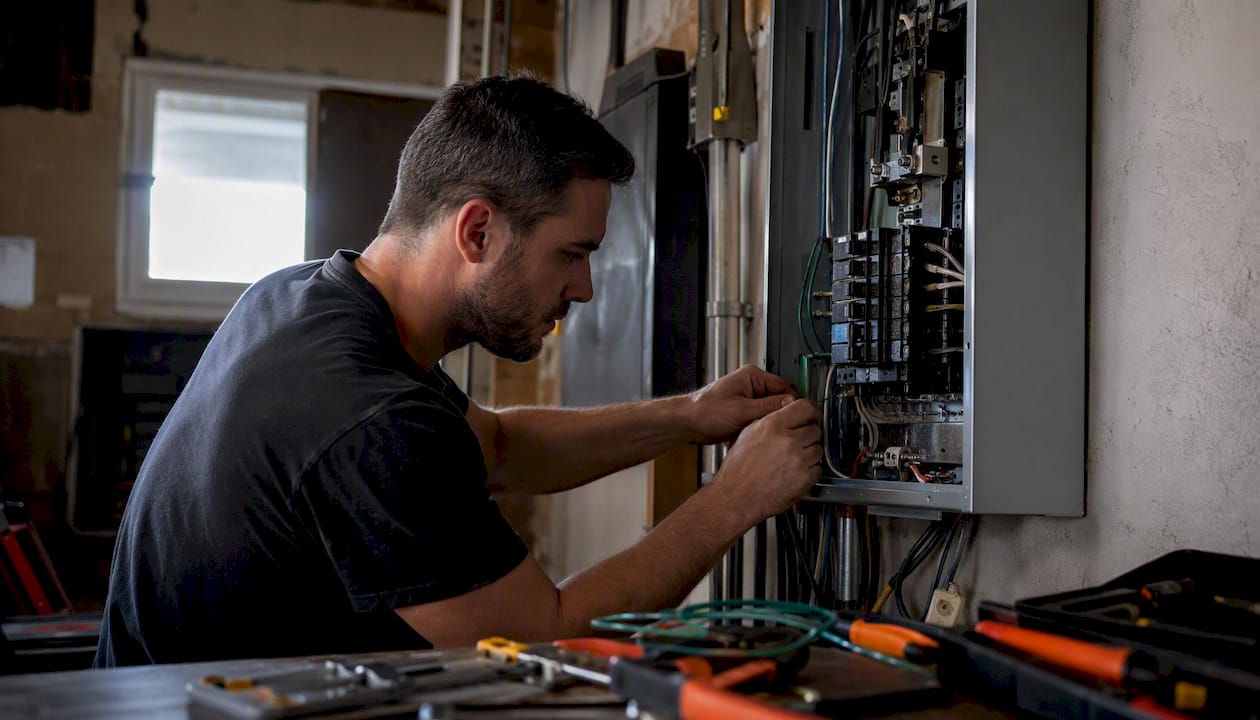
Breaker upgrades and AFCI/GFCI installs are part of every panel replacement. The NEC now requires arc-fault circuit interrupter (AFCI) breakers in bedrooms, living areas, and most habitable rooms, and ground-fault circuit interrupter (GFCI) protection in kitchens, bathrooms, garages, and outdoor circuits. Swapping in modern breakers isn’t just a code formality — it’s the layer of protection that catches wiring faults before they become fires.
Grounding and bonding work involves verifying or replacing the grounding electrode conductor, confirming the ground rod is properly driven and connected, and bonding metallic water and gas piping to the panel. Insurers and inspectors both check this. Skipping it is a common shortcut on low-bid jobs.
Whole-home surge protection is a Type 1 or Type 2 device installed directly at the panel. It’s not always included in a base quote, but it protects every appliance and circuit from voltage spikes caused by lightning or utility switching events.
Subpanel additions add breaker space and dedicated circuits to a detached garage, workshop, or addition without touching the main service. They solve the “I’m out of breaker slots” problem when total electrical demand doesn’t actually exceed the main panel’s capacity.
Meter, mast, and service-entrance coordination becomes necessary when the service amperage itself needs to increase. That work involves the utility company pulling the meter, the electrician replacing the service entrance conductors and meter base, and the utility reconnecting after inspection. The homeowner’s electrician handles everything up to the meter; the utility owns everything from the meter to the transformer.
Pro Tip: Before quoting a full service upgrade, a thorough electrician runs a formal NEC load calculation. Many homeowners are surprised to find their existing 100A or 150A service has enough headroom for a new EV charger or heat pump when circuits are rebalanced — no utility work required.
Signs your home likely needs a panel upgrade
Some warning signs are obvious. Others show up quietly until something fails.
- Breakers trip repeatedly under normal household loads, or you have a fused panel (screw-in fuses instead of breakers) that can’t safely support modern demand.
- Breakers feel warm to the touch or you notice a burning smell near the panel. Both indicate a serious hazard that needs professional attention immediately.
- No open breaker slots and the house runs on a web of extension cords and power strips — a clear sign the panel can’t support current usage.
- Federal Pacific, Zinsco, or Pushmatic panels are still in service. These brands have documented failure rates and many insurers will not renew a policy without replacement.
- New high-draw appliances are planned: an EV charger, a heat pump, an induction range, or a hot tub. Each of these can push a 100A service past its safe operating limit.
- The panel is 25–40 years old, shows visible corrosion or rust inside the enclosure, or has aluminum branch wiring (identifiable by the silver-colored conductors at breaker terminals).
- Your insurance company has flagged the panel or sent a notice requesting replacement as a condition of renewal.
What panel upgrades typically cost and how long they take
Three project types cover most residential panel jobs, and their costs vary significantly based on what the utility and local permit office require.
| Project Type | Typical Cost Range | On-Site Electrician Hours | Total Timeline |
|---|---|---|---|
| Panel replacement (same amperage) | $2,000–$4,000 | 4–6 hours | 3–7 days (permit + inspection) |
| Service upgrade (100A → 200A) | $3,200–$5,500 | 6–10 hours | 1–3 weeks (utility lead time) |
| Subpanel addition | $500–$2,000 | 2–4 hours | 3–7 days (permit + inspection) |
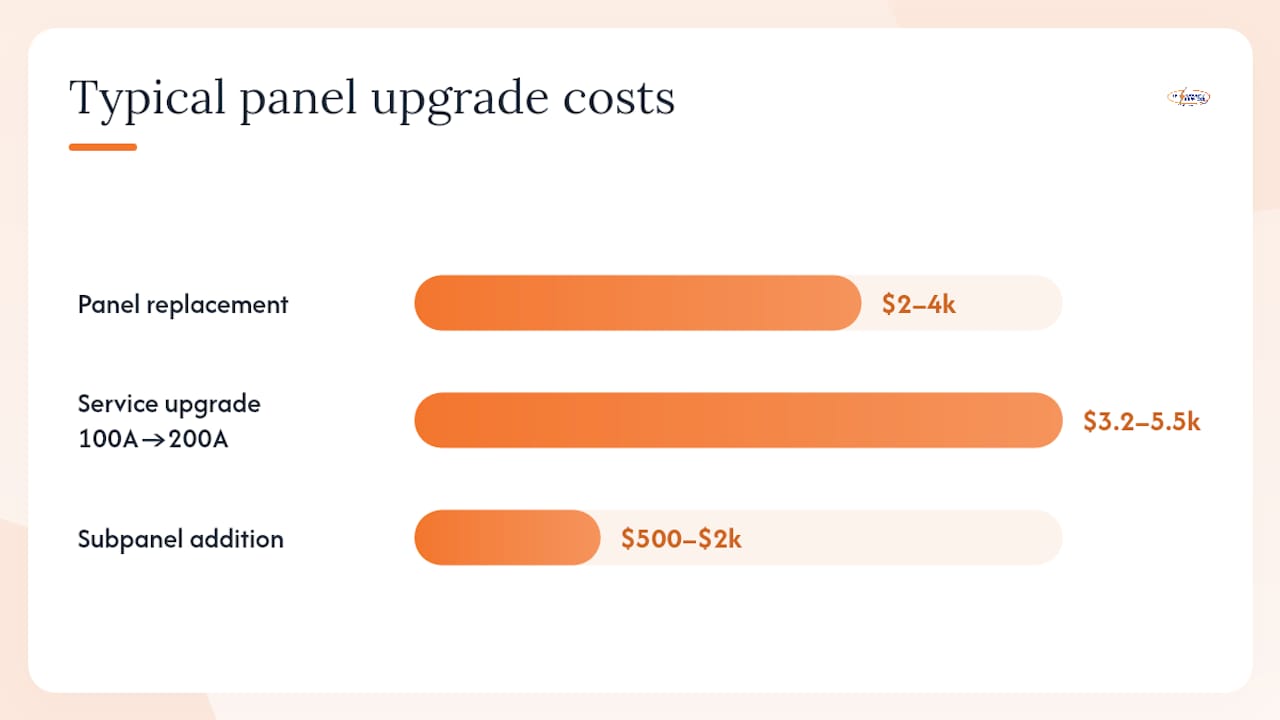
Rewiring America notes that routine panel replacements commonly run $2,000–$4,000, but total project costs can climb to $5,000–$25,000 when a service upgrade, transformer replacement, or extensive rewiring is involved. The PermitDeck NEC code guide puts a straightforward 100A→200A service upgrade in the $3,200–$5,500 range, with utility scheduling as the most common reason projects run longer than expected.
Factors that push costs higher:
- Meter base or mast relocation (adds labor and materials)
- Underground service entrance (trenching and conduit)
- Utility transformer upgrade required by the power company
- Aluminum branch wiring that needs remediation
- Permit fees that vary by municipality
- Local labor rates in Northeast Ohio vs. national averages
Ways to avoid surprise charges:
- Request a fully itemized written estimate before signing anything
- Ask specifically whether the quote includes permit fees and utility coordination
- Schedule related work (EV charger rough-in, subpanel) at the same time to share mobilization costs
- Confirm the panel brand included in the bid — some brands carry longer warranties
According to ElectrifyCost’s panel upgrade guide, subpanel additions typically run $500–$2,000, making them a practical first step when the real problem is just a shortage of breaker slots rather than insufficient total capacity.
What happens step by step during a panel upgrade
Knowing the sequence helps you plan around the outage and avoid being caught off guard by utility lead times.
- Initial assessment: The electrician inspects the existing panel, service entrance, grounding, and wiring condition. They ask about planned new loads (EV charger, appliances) and note the current amperage.
- Load calculation and scope decision: Using standard NEC sections 220.82 or 220.83 for load calculation, the electrician calculates total demand. This determines whether a panel replacement alone is sufficient or whether a service upgrade is required.
- Permit application: The electrician files the electrical permit with the local building department. In most Ohio municipalities, work cannot begin until the permit is issued.
- Utility application (service upgrades only): If amperage is increasing, the electrician or homeowner notifies the utility. The utility schedules a meter pull, which is often the longest lead-time item on the project.
- Outage day: Power is cut at the meter. The electrician removes the old panel, installs the new enclosure and breakers, updates grounding and bonding, labels all circuits, and installs any surge protection device. Most residential jobs are completed in a single day.
- Municipal inspection: The building inspector visits to verify the installation meets NEC and local code. The electrician is typically present.
- Utility reconnect: For service upgrades, the utility returns to reconnect and set the new meter. For panel replacements, the electrician restores power after inspection sign-off.
Homeowner checklist for outage day:
- Clear a 3-foot working radius around the panel
- Unplug computers, TVs, and sensitive electronics before power is cut
- Identify any medical devices (CPAP, oxygen concentrator) that need a backup power plan
- Move refrigerated and frozen food to a cooler if the outage will exceed 4 hours
- Arrange pets away from the work area
- Confirm the electrician’s arrival window the day before
How electricians decide whether a service upgrade is actually required
The answer comes from a formal load calculation, not a visual inspection or a gut feeling.
Certain NEC guidelines provide the standard method for calculating residential electrical demand. The electrician totals the square footage of the home (for general lighting and receptacle load), adds fixed appliance loads (range, dryer, water heater, HVAC), applies NEC demand factors that account for the fact that not everything runs simultaneously, and compares the result to the panel’s rated capacity. If the calculated demand exceeds the service rating, a service upgrade is required. If it doesn’t, a panel replacement or subpanel addition may be all that’s needed.
Alternatives to a full service upgrade:
Load-management systems like Span or Lumin give homeowners real-time control over circuit priorities, allowing a 100A or 150A service to support an EV charger or heat pump by shedding lower-priority loads automatically. Add-on EV load-management devices can run from a few hundred to a couple thousand dollars installed — a fraction of a full service upgrade. Rewiring America’s electrification planner recommends examining whether smart controls can support targeted electrification before committing to a full upgrade.
Pro Tip: Load-management devices make the most sense when you’re adding one or two new loads to an otherwise lightly loaded 100A or 150A service. If you’re planning to electrify everything — HVAC, water heater, range, and two EVs — a service upgrade is usually the cleaner long-term solution.
How to choose a contractor for your panel upgrade
The permit and the inspection are your protection. Any contractor who suggests skipping either one is a red flag, full stop.
Core trust signals to verify before signing:
- Proof of general liability insurance and workers’ compensation
- Local references from panel upgrade jobs in the past 12 months
- Fully itemized written estimate (labor, materials, permit fees, utility coordination listed separately)
- Confirmation that the contractor files the permit and attends the inspection
- Written warranty on both labor and the panel equipment
Questions to ask on the first call:
- Who files the electrical permit — you or me?
- Do you coordinate directly with the utility for the meter pull?
- What panel brand are you installing, and what is the warranty?
- Is surge protection included, or is it a separate line item?
- What happens if the inspector requires additional work?
Red flags that should end the conversation:
- Unusually low bid with no line-item breakdown
- Pressure to start work before the permit is issued
- Cash-only payment requirement
- Refusal to provide references or a written estimate
- No mention of inspection or final sign-off
Documents you should receive when the job is complete:
- Copy of the issued permit
- Final inspection report signed by the municipal inspector
- Warranty documentation for the panel and labor
- Itemized receipt matching the original estimate
Angi’s panel upgrade guide confirms that professional electricians handle permits, utility scheduling, and inspection sign-off — these are not tasks homeowners should be managing around a contractor who won’t.
Tri-County Services Electric & Plumbing handles permit filing, utility coordination, and inspection follow-up directly, so homeowners in Northeast Ohio don’t have to track down building departments or call the utility themselves. Their panel upgrade service page outlines the full scope of what’s included.
How to prepare your home for upgrade day
A little preparation on your end makes the electrician’s job faster and keeps your household running through the outage.
- Clear the panel area: Move storage, shelving, or furniture so the electrician has unobstructed access. A Maintaining a 3-foot clearance on all sides is the typical minimum requirement for safe electrical panel access.
- Unplug sensitive electronics: Computers, smart TVs, gaming consoles, and network equipment should be unplugged before the power is cut, not just turned off.
- Plan for medical devices: If anyone in the home uses a CPAP, nebulizer, or oxygen concentrator, arrange a battery backup or coordinate with the electrician on timing.
- Handle refrigeration: A typical panel job runs 4–8 hours. Move perishables to a cooler with ice if you’re not sure the job will finish before food safety becomes a concern.
- Secure pets: The front door will be open, and unfamiliar people will be moving through the house. Keep pets in a separate room or arrange for them to be elsewhere.
- Confirm the arrival window the day before: A quick call or text to confirm start time avoids a wasted morning.
On outage day, the electrician will communicate when power is cut and when it’s safe to restore. For service upgrades, the utility reconnect may happen the same day or the following morning depending on the utility’s schedule. Panel replacements without a service change are typically restored the same day after inspection.
One firm rule: panel work is not a DIY project. The risks — electrocution from live service conductors, fire from improper connections, failed inspections, and voided homeowner’s insurance — are not theoretical. Call a professional before touching anything inside the enclosure.
What most homeowners get wrong about panel upgrades
The conventional advice online pushes homeowners toward a full service upgrade almost by default. “Your panel is old — replace it and go to 200A while you’re at it.” That framing sells more work than it solves problems.
The more honest starting point is the load calculation. A 100A service that’s been running a 1,500-square-foot home for 30 years without issues may have plenty of headroom for a new heat pump or EV charger once you actually run the numbers. The NEC demand factors exist precisely because not every circuit runs at full load simultaneously. Skipping the calculation and defaulting to the most expensive option isn’t safety-conscious — it’s just expensive.
The second thing homeowners underestimate is the permit. It’s tempting to view it as a fee and a delay. It’s actually the only independent verification that the work was done correctly. An unpermitted panel job doesn’t just create a legal problem at resale — it means no inspector ever confirmed the grounding, the breaker sizing, or the service entrance connections. That’s a 30-year liability sitting inside your wall.
The practical takeaway: push your contractor to show you the load calculation before agreeing to a service upgrade. If they can’t produce one or won’t discuss it, that tells you something important about how they work.
Tri-County Services Electric & Plumbing handles the whole process for Northeast Ohio homeowners
Panel upgrades in Northeast Ohio involve local permit offices, utility coordination with FirstEnergy or other regional providers, and municipal inspectors who each have their own scheduling timelines. That’s a lot of moving parts for a homeowner to manage alone.

Tri-County Services Electric & Plumbing has handled panel upgrade installations for residential and commercial clients in Northeast Ohio since 1975. The process starts with an on-site assessment and formal load calculation — so you know whether a panel replacement, a service upgrade, or a load-management solution actually fits your situation before any money changes hands. From there, Tri-County files the permit, coordinates the utility meter pull, performs the installation, and attends the final inspection. If you’re also planning an EV charger or generator, those can be scoped into the same project to avoid a second mobilization cost.
Call (440) 325-0136 or visit Tricountyelectricservice to schedule your assessment. Tri-County handles the permit paperwork and utility scheduling — you just need to be home.
Sources
- Pros and cons of a panel upgrade | Rewiring America Electrification Planner
- How To Upgrade Your Electrical Panel | Angi
- Electrical Panel Upgrade Guide | ElectrifyCost
- When Should You Upgrade Your Electrical Panel? | Top Tier Electrical
FAQ
How much does a 100A to 200A panel upgrade cost?
A straightforward A typical 100A to 200A service upgrade generally costs between $3,200 and $5,500. code and cost data from PermitDeck. Costs rise when the meter base or mast needs relocation, underground service is involved, or the utility requires transformer work.
Can I upgrade my electrical panel without rewiring my house?
Yes, in most cases. A panel replacement or service upgrade does not require rewiring existing branch circuits unless the inspector identifies code violations or the wiring is aluminum branch wiring that needs remediation. The panel and circuit repair page at Tri-County covers what’s typically inspected during the process.
Who should perform an electrical panel upgrade?
A qualified electrician should handle all panel upgrade work, including the permit filing, utility coordination, installation, and inspection sign-off. Panel work involves live service conductors that remain energized even when the main breaker is off — it’s not safe for homeowners to attempt themselves.
How long does a panel upgrade take from start to finish?
On-site installation typically takes 6–10 hours for a service upgrade and 4–6 hours for a panel replacement. The total project timeline commonly runs 1–3 weeks, mainly due to permit processing and utility scheduling.