

Most small plumbing repairs cost between $125 and $350, while larger jobs and installations run from $500 to $800 or more, according to HomeAdvisor’s 2026 plumbing benchmarks. Plumbers bill hourly, flat rate, or by service call, and emergency work adds a premium. The single biggest swing factor is access: a pipe behind a finished wall or under a slab costs far more to fix than one sitting in the open. For a clear, itemized number, a professional like Tri-County Services Electric & Plumbing can walk through your specific situation.
TL;DR:
- Pipe access location, especially under slabs or behind walls, significantly increases repair costs due to demolition and restoration needs.
- High-end fixtures and materials, as well as permit requirements, can raise project prices beyond basic repairs in both parts and labor expenses.
- Emergency, after-hours, or urgent jobs cost more, especially when they involve complex access or multi-trade coordination like electrical work.
- Local market conditions and regional labor costs lead to bid variations, making regional estimates more accurate than national averages.
- Detailed, written estimates outlining costs for diagnosis, parts, labor, permits, and restoration help prevent budget overruns and clarify what the job entails.
Table of Contents
- Average plumbing costs and how to read the ranges
- What drives a plumbing quote from low to high
- Typical cost ranges by common plumbing job
- How plumbers charge: hourly, flat rate, and trip fees
- When plumbing costs escalate fast
- How to get an accurate, itemized estimate
- How Tri-County Services Electric & Plumbing builds an estimate
- What actually matters when you’re budgeting for repairs
- Request a plumbing estimate from Tri-County Services Electric & Plumbing
- Sources
- FAQ
Average plumbing costs and how to read the ranges
Published price ranges for plumbing work look wide because they’re covering very different jobs under one umbrella. A dripping faucet and a collapsed sewer line both fall under “plumbing repair,” but they sit at opposite ends of the cost spectrum.
HomeAdvisor’s 2026 cost data puts small repairs, think a running toilet or a loose faucet connection, in the $125 to $350 range. Larger jobs, like replacing a section of pipe or installing a new fixture, typically land between $500 and $800. Full installations or anything involving demolition can climb well past that, sometimes into the thousands, depending on scope.
Part of what you’re paying for is labor, but that’s not the whole bill. The Bureau of Labor Statistics reported a median annual wage of $62,970, or about $30.27 an hour, for plumbers, pipefitters, and steamfitters in May 2024. That figure covers the technician’s take-home pay. The rate you’re quoted also builds in vehicle costs, insurance, tools, training, scheduling, materials handling, warranty coverage, and a margin for the business to stay running. That’s why a customer-facing hourly rate often looks two to three times higher than the wage data alone would suggest.
A few other variables move the number:
- Time of service: Nights, weekends, and holiday calls usually carry an after-hours surcharge.
- Location: Urban markets with higher costs of living and tighter labor pools tend to price higher than rural areas.
- Job urgency: A scheduled repair costs less than an emergency dispatch for an active leak.
- Permits: Jobs that require inspection sign-off add fees and time to the total.
One of the most overlooked cost drivers in plumbing is access, not labor. BLS wage data explains the technician cost, but detection and demolition around hidden pipes can multiply the final bill well beyond what the hourly rate implies. RSMeans construction cost data organizes plumbing estimates using city cost indexes precisely because local labor rates and material costs shift so much from one region to the next. A homeowner in a high-cost metro area should expect bids on the higher end of any national range, while someone in a lower-cost rural market may see quotes closer to the floor.
What drives a plumbing quote from low to high
The gap between a $150 repair and a $3,000 one usually comes down to five factors: access, complexity, materials, permits, and location. Understanding each helps you read a quote instead of just reacting to the number at the bottom.
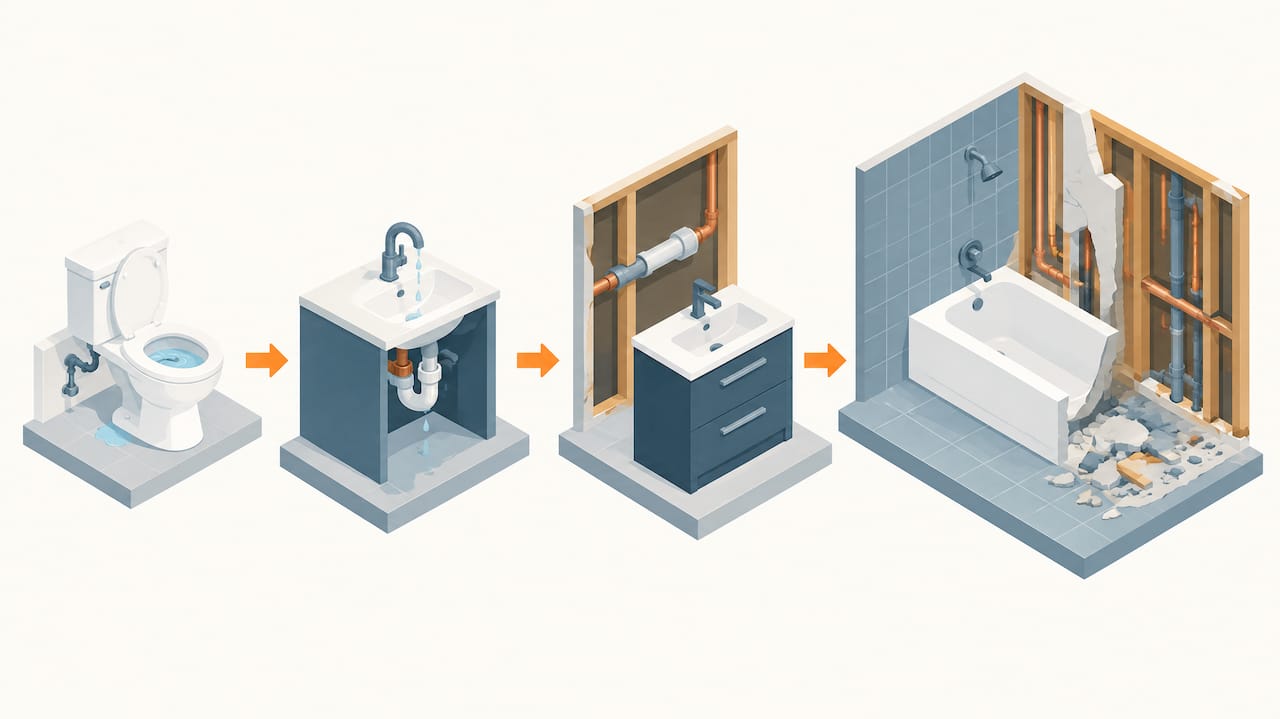
Access is the biggest lever. A pipe you can see and touch costs the least to fix. One behind a finished wall or in a crawlspace adds labor for opening and closing that space. A pipe under a concrete slab is the most expensive scenario, since it may require slab cutting, excavation, and full restoration afterward.
Fixture and material choices matter too. Upgrading to a higher-end faucet, a water-efficient toilet, or copper piping instead of PEX changes the parts cost directly. Permits and inspections add fixed fees in many municipalities, especially for water heater or sewer line work. Specialized diagnostic tools, like a sewer camera inspection or hydro-jetting equipment for stubborn clogs, carry their own line-item costs because of the equipment and expertise involved.
- Exposed pipe access: Lowest labor add-on, usually just the repair time itself.
- Wall or crawlspace access: Moderate add-on for opening and closing the space.
- Slab access: Highest add-on, often requiring concrete work and restoration.
- Material upgrades: Copper and higher-end fixtures cost more than standard PEX or builder-grade parts.
- Permit requirements: Add inspection fees and scheduling time in many jurisdictions.
Pro Tip: Ask your estimator to separate “access and demolition” from “repair labor” on the quote. It’s the fastest way to see exactly what you’re paying for the hard-to-reach part of the job.
Typical cost ranges by common plumbing job
These are national benchmark ranges, not local quotes. Your actual bid will reflect your region, the technician’s assessment, and the specific condition of your plumbing, so treat the numbers below as a starting point for comparison rather than a price you should expect to pay exactly.
| Job | Typical range | What raises the cost |
|---|---|---|
| Faucet repair | $125-$350 | Corroded valves or hard-to-reach shutoffs |
| Faucet installation | $500-$900 | Fixture upgrade, old plumbing needing adaptation |
| Toilet repair | $125-$350 | Flange damage, subfloor issues |
| Toilet installation | $500-$800 | Fixture style, flange replacement |
| Drain unclogging | $250-$600 | Depth of clog, need for camera inspection |
| Garbage disposal repair/replace | $125-$350 | Electrical connection issues |
| Water heater repair | $150-$600 | Part availability, venting problems |
| Water heater replacement (tank) | $500-$800 | Unit size, code-required upgrades |
| Tankless water heater installation | $500-$800 | Electrical or gas line modifications |
| Main water or sewer line repair | $500-$800 or more | Trenching, pipe material, depth |
| Slab leak detection and repair | $2,000-$5,000+ | Slab cutting, concrete restoration |
| Sump pump installation | $500-$800 | Pit depth, discharge line routing |
| Bathtub or shower installation | $500-$800 or more | Tile work, plumbing relocation |
The pattern across this list tracks with the access and complexity factors covered above. Anything touching a slab or requiring trenching sits at the top of the range. Fixture-level repairs sit at the bottom.
- Faucet and toilet work tends to be the most predictable, since the scope rarely changes mid-job.
- Water heater and sewer line jobs carry the widest ranges because unit size, venting, and pipe depth vary so much house to house.
- Diagnostic add-ons like a sewer camera inspection often get bundled into drain and sewer line pricing rather than billed as a separate flat fee.
How plumbers charge: hourly, flat rate, and trip fees
Billing models vary by company and by job type. Industry rate data puts hourly rates broadly between $45 and $200, with many companies charging a one-hour minimum even for a quick fix. Marketplace data from Yelp reports a similar spread, with rates commonly falling between $85 and $230 an hour depending on the market.
- Hourly billing is common for diagnostic work or repairs where the scope isn’t fully known until the technician is on site.
- Flat-rate pricing shows up for well-defined jobs like installing a faucet or toilet, where parts and labor time are predictable.
- Trip or service-call fees, often $50 to $150, cover the technician’s travel and initial diagnosis and sometimes get credited toward the repair if you move forward.
Ask upfront whether the trip fee applies toward the final bill or sits on top of it. That one question clears up a lot of invoice confusion later.
When plumbing costs escalate fast
A handful of scenarios reliably turn a modest repair into a major expense. Slab leaks top the list, since finding and fixing a pipe under concrete can mean cutting flooring, trenching, and full restoration afterward. Main water and sewer line failures follow a similar pattern, especially when tree roots or pipe collapse require excavation.
Jobs that pull in a second trade, like electrical work tied to a tankless water heater installation, also add cost because they require coordinating schedules and expertise beyond plumbing alone.
- Slab leaks: Concrete cutting and restoration can push costs into the thousands.
- Sewer line collapse: Excavation and landscaping repair add significant secondary costs.
- Multi-trade jobs: Electrical or structural work alongside plumbing increases both price and timeline.
- Delayed diagnosis: Waiting on a small leak often means more water damage and a bigger repair bill later.
Build a restoration contingency into your budget for any job involving demolition, and get a diagnosis early. A faster call often means a smaller total bill.
How to get an accurate, itemized estimate
A vague verbal quote is hard to compare and easy to misread later. A written, itemized estimate protects both sides and gives you something concrete to hold a contractor to.
- Share your address, the fixture or area involved, and a description of the symptoms you’re seeing.
- Send photos of the problem area and note whether you can access the shutoff valve.
- Mention any prior repairs or known plumbing issues in that part of the house.
- Ask the estimate to break out diagnosis, labor, parts, permits, demolition or restoration, warranty terms, and taxes as separate lines.
- Request the estimate in writing, and get a second quote if the first one feels high or vague.
- Confirm insurance coverage, ask about references, and clarify the expected timeline and how change orders are handled if the scope shifts mid-job.
Incomplete information before a quote is one of the most common reasons plumbing project costs run higher than expected, since missing details often mean a second site visit or a revised scope once work begins.
Pro Tip: Keep every written estimate, even the ones you don’t accept. Comparing line items side by side is the clearest way to spot a quote that’s missing something important.
How Tri-County Services Electric & Plumbing builds an estimate
Tri-County Services Electric & Plumbing has worked in Northeast Ohio since 1975 as a family-owned business, handling both electrical and plumbing calls for homeowners and property managers. That combination means a technician can flag related electrical issues, like a water heater’s wiring, during a plumbing visit instead of sending you to a second company.
- Estimates are itemized before work begins, separating diagnosis, labor, parts, and any restoration needs.
- Scheduling is flexible, aimed at minimizing disruption to your home or business.
- Safety inspections are part of the process, not an upsell added after the fact.
- Emergency response is available for active leaks and failures that can’t wait for a standard appointment.
Call (440) 253-0332 to talk through your situation, or review the plumbing pricing guide for service details ahead of time.
What actually matters when you’re budgeting for repairs
The advice readers skip is usually the most useful: prioritize leaks and anything that looks structural before cosmetic fixes. A slow drip waits. Water finding its way into a subfloor or ceiling does not, and the gap between those two repairs can be the difference between a $200 bill and a $5,000 one.
Build a restoration contingency into any bid involving walls, floors, or slabs. Ask your contractor if the job can be phased, diagnosis first, then a firm quote, so you’re not committing to major spending before you know the actual scope.
— Lindsay Paramore
Request a plumbing estimate from Tri-County Services Electric & Plumbing
Getting a number you can actually plan around beats guessing at a range from a blog post. Tri-County Services Electric & Plumbing handles the jobs covered here directly: drain cleaning, sewer camera inspection, hydro jetting, water heater repair and replacement, pipe leak repair, and faucet or toilet installation, with emergency repairs available when something can’t wait.

Scheduling is built around minimizing disruption to your home, and every estimate includes a safety inspection as standard practice, not an add-on. If you’re in the Cleveland-Akron area, the local plumbing services page and Lakewood plumbing services page cover nearby coverage areas, and the full plumbing pricing guide lists service details.
Call (440) 253-0332 to schedule a visit or request a written estimate before you commit to any repair.
Sources
- Plumbers, Pipefitters, and Steamfitters : Occupational Outlook Handbook: U.S. Bureau of Labor Statistics
- 2026 Plumbing Cost Estimates: Leak, Pipe Repair Prices | HomeAdvisor
- Plumbing Costs with RSMeans™ Data
FAQ
How much is plumbing for a 2,000 square foot house?
There’s no single national figure for whole-house plumbing by square footage, since cost depends on the scope of work, not the home’s size alone. A full re-pipe or major system overhaul in a home that size would combine several of the job categories above, so request a written, itemized estimate for your specific project.
What is the 135 rule in plumbing?
This isn’t a recognized industry standard, and definitions vary depending on where you encounter the term. If you’ve seen it referenced somewhere specific, ask the source what they mean, since it doesn’t correspond to a standard pricing or code rule in plumbing.
How much should you expect to pay a plumber?
Expect small repairs to run $125 to $350, with larger jobs and installations typically landing between $500 and $800 or more depending on complexity. Hourly rates generally fall between $45 and $200, and many companies also charge a separate trip or service-call fee.
How can you tell if a plumbing quote is too high?
Ask for an itemized breakdown separating diagnosis, labor, parts, permits, and any demolition or restoration work, then compare it against a second written quote. A quote that’s vague about what’s included, or one that’s dramatically above the ranges covered here without a clear reason like slab access or a sewer line issue, is worth questioning before you approve it.