

The best office lighting upgrade for most buildings is a move from fluorescent to LED, planned around your space and your controls, and installed by a professional electrician. LEDs use far less power, last far longer, and make a room more comfortable to work in. The details that decide your result are which of three retrofit paths you take, whether your wiring and controls match, and what the energy code asks for once you touch the lights. This guide walks through each, with real numbers from federal and industry sources.
TL;DR
- Lighting is a large share of an office’s power bill, and LED is the proven way to cut it. Savings range from about 25% to 70% depending on the approach.
- You have three paths: replacement LED tubes, retrofit kits that keep your existing fixture housing, or new LED fixtures. Each has a different cost, savings level and wiring impact.
- Retrofits involve ballasts, line-voltage wiring and, often, code-required controls. That is work for a professional electrician, not a weekend project.
- Old fluorescent lamps are universal waste under federal rules and should be recycled, not thrown out.
- Call Tri-County Services Electric & Plumbing at (440) 253-0332 to plan your office upgrade.
Table of Contents
- Why upgrading office lighting pays off
- Start with an honest look at what you have
- Three ways to upgrade fluorescent lighting to LED
- Why compatibility is an electrical question
- Choosing color temperature and light levels
- Controls and the energy code
- Safe handling and disposal of old fluorescent lamps
- What an office lighting upgrade costs and how fast it pays back
- Why call a professional before anything else
- Perspective: how we plan an office upgrade
- Plan your office lighting upgrade with Tri-County Services Electric & Plumbing
- FAQ
- Sources
Why upgrading office lighting pays off
Lighting is one of the biggest line items in a commercial electric bill. ENERGY STAR reports that lighting makes up 17% of the electricity used in U.S. commercial buildings, and that LEDs deliver the same brightness as traditional bulbs while using 90% less energy and lasting 15 times longer. The GSA puts the figure at more than 30% of commercial building electricity, and notes that lighting choices also touch comfort, maintenance costs, space usability, worker productivity and safety.
The Building Energy Exchange found that commercial lighting upgrades can cut energy use by as much as 75%, can pay back in under three years, and can improve occupant satisfaction and well-being. The same report observes that the more comprehensive the retrofit, the better the gains in comfort, appearance and payback.
For a business owner or property manager, that adds up to four practical benefits:
- Lower electric bills every month, starting the day the new lights go on.
- Less maintenance. Long-life LEDs mean fewer ladder trips, fewer flickering tubes and fewer burned-out ballasts.
- Better light for the people in the room. Even illumination, less flicker and the right color temperature make work easier on the eyes.
- A safer, more up-to-date electrical system, because a lighting project is a natural moment to inspect the circuits behind it.
Start with an honest look at what you have
Before choosing products, walk the space and write down what is overhead. The Building Energy Exchange’s playbook lays out five steps for a successful retrofit: identify goals and requirements, select technology, invest and finance, install and commission, and educate stakeholders. That is a good skeleton for any office, from a six-person suite to a full floor.
A useful first-pass inventory looks like this:
- Fixture type and count. Troffers in a drop ceiling, strip lights, recessed cans, wall packs, exit signs.
- Lamp type. T12, T8 or T5 fluorescent tubes, compact fluorescents, or older incandescent.
- Ballast condition. Buzzing, flickering and slow starts often point to aging ballasts.
- Current controls. Plain wall switches, dimmers, occupancy sensors, or nothing at all.
- How each area is used. Open desks, private offices, conference rooms, hallways, restrooms and storage need different light levels.
- Complaints. Glare on monitors, dark corners, headaches, and rooms that are too harsh or too dim.
Goals matter as much as the inventory. If your top goal is the lowest utility bill, you will lean toward deeper retrofits with controls. If it is the lowest upfront cost, a lamp swap may be the starting point. If tenants or staff are complaining about the quality of light, new fixtures are often the answer. A professional walkthrough turns this list into a scope of work and a clear price.
Three ways to upgrade fluorescent lighting to LED
Electrical Contractor Magazine identifies three main options for moving a fluorescent office to LED. Here they are side by side, using that source’s figures.
| Option | What changes | Typical energy savings | Notes |
|---|---|---|---|
| Replacement LED tubes (TLEDs) | Tubes swapped, existing fixture kept | 25%-40% | Average payback of 1.8-2.5 years |
| Retrofit kit | New LED light engine and driver installed in the existing fixture housing | 40%-60% | Keeps the luminaire, replaces the guts |
| New LED fixtures | Whole luminaire replaced, often as part of a redesign | Varies with design | Best for fixing light quality and adding controls |
The GSA estimated material cost for troffer retrofit kits at $75 to $200, compared with $100 to $275 for a new troffer, with about 15 minutes of installation time per kit. Utility rebates for a troffer retrofit kit were in the $20 to $40 range in that estimate.
Replacement LED tubes
This is the quickest route, and it fits offices with fixtures in good shape. The catch is that tube products are wired in different ways. Some work with the existing ballast, and others need the ballast bypassed so the tube runs on line voltage. The wiring approach has to match the tube you bought, and mixing them up creates problems.
Retrofit kits
A kit keeps the fixture housing but replaces the lighting components inside it. That generally means higher savings than a tube swap, and a cleaner look, since the fixture is effectively rebuilt around an LED driver and light engine. It suits offices with solid troffers that are simply old technology.
New LED fixtures
When housings are yellowed, damaged, or laid out in a way that gives poor light, new fixtures solve the underlying issue. They also come with the driver and controls capability designed in. The GSA’s guidance notes that new fixtures with networked controls and HVAC integration provide more total savings and a shorter cost recovery than a lighting control system alone.
Why compatibility is an electrical question
LED lighting is not just “a brighter bulb.” It is a different electrical system. According to the UL and MaxLite safety document, LED drivers are designed for line voltage input of 120 to 277 V and supply the constant current LED arrays need. Fluorescent ballasts, by contrast, produce an output matched to a specific type of fluorescent lamp, which is why retrofitting typically means bypassing the ballast.
That has consequences in the ceiling:
- Line voltage reaches the lamp holders. Tombstones, wiring and fixtures must be suitable for that use.
- Dimming depends on the driver. The GSA’s LED Lighting and Controls Guidance says the driver determines the dimming method and all equipment on the same wiring must use the same method. A mismatch means flicker, poor dimming range or equipment that will not respond.
- Labeling matters. The UL document explains that retrofitted fixtures must be clearly labeled to warn against putting fluorescent lamps back in, and that using LED lamps without regard to their markings can create safety issues.
- Other factors to specify. The GSA lists color rendering, color temperature, distribution, efficacy, controls interfaces and controls-ready fixtures among the considerations.
This is the core reason an office should have a professional electrician handle the job. Opening fixtures, rewiring lamp holders and confirming driver and control compatibility involves live building circuits and code requirements. A wrong guess can mean a failed inspection, damaged equipment or a shock or fire hazard. Calling a professional first is faster, safer and cheaper than redoing it.
Choosing color temperature and light levels
The right light is about people, not just wattage. A common rule of thumb is that cooler light in the 4000K to 6500K range suits task-heavy areas, while warmer light in the 2700K to 3500K range feels more relaxed. For many offices, a neutral white in the middle works for open work areas, with warmer tones in lounges and reception.
Things worth deciding before you order fixtures:
- Task areas versus circulation. Desks and conference tables need more light than hallways.
- Screen glare. Layout and fixture distribution matter as much as brightness.
- Consistency. Mixing color temperatures within one room looks patchy, so specify one across each space.
- Daylight. Rooms with windows can use controls that dim fixtures when the sun is doing the work.
Controls and the energy code
Lighting controls are where the biggest extra savings come from, and also where code comes in. The GSA states that the current ASHRAE/IES Standard 90.1 includes occupancy sensing for restrooms and for offices larger than 300 square feet, and that small private offices require both a local control and an automatic off.
The code can apply to your project itself. Per the Lighting Controls Association’s summary of ASHRAE/IES 90.1-2022, interior alterations over 2,000 W must meet the applicable lighting power and mandatory control requirements. At 2,000 W or less, they must meet lighting power requirements (or reduce wattage by at least 50%) and the manual local and automatic shutoff control requirements.
In practice, budget for sensors and switching, not just tubes and fixtures. Which edition of the energy code your jurisdiction enforces, and how it applies to your building, is something to confirm with your electrician and your local building department before the work starts.
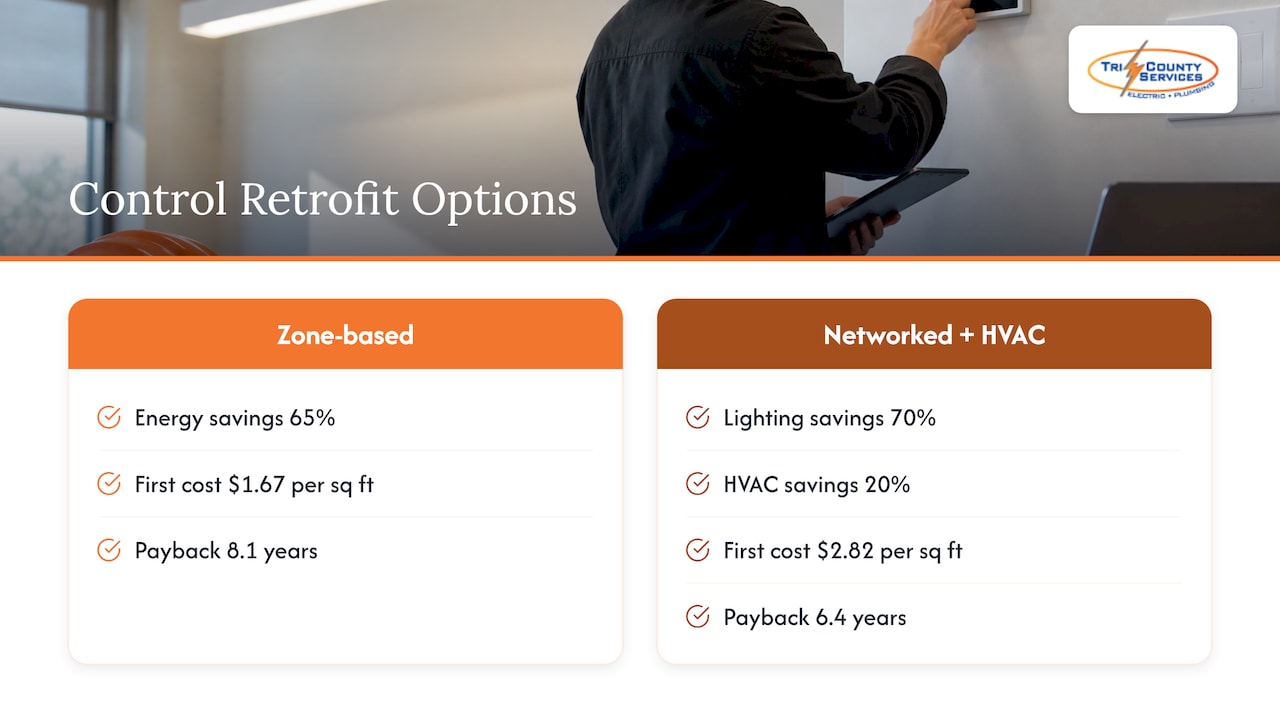
Controls are also a financial choice. The GSA’s guidance reports that retrofit kits with zone-based control reached 65% energy savings at a first cost of $1.67 per square foot with an 8.1-year payback, while kits with centrally networked controls and HVAC integration reached 70% lighting and 20% HVAC savings at $2.82 per square foot with a 6.4-year payback. Controls raise the upfront cost and deepen the savings, so it pays to match them to how each space is used.
One more connection: if you are updating lighting, ask about emergency and exit lighting at the same time. Our guide to emergency lighting rules for U.S. building owners covers the 90-minute requirement.
Safe handling and disposal of old fluorescent lamps
Fluorescent tubes contain mercury, and the removal side of the project has rules. The EPA states that fluorescent lamps are managed as universal waste under 40 CFR Part 273, that a used lamp becomes a waste on the date it is discarded, and that recycling is encouraged whether the lamps are hazardous or not.
Under the federal universal waste standards, small-quantity handlers must keep lamps in structurally sound, closed containers that prevent breakage and show no leakage. Broken lamps must be cleaned up immediately and placed in a container that prevents releases. Many states and localities add their own requirements, so ask about the rules that apply in Ohio and your city.
The GSA recommends removing every fluorescent lamp from the site when retrofitting with certain LED tube types, so nobody installs one by accident. That would erase the energy savings and, with some tube types, create a safety hazard. It also recommends recycling all discarded lamps, at a cost of about a dollar per lamp, according to Electrical Contractor Magazine.
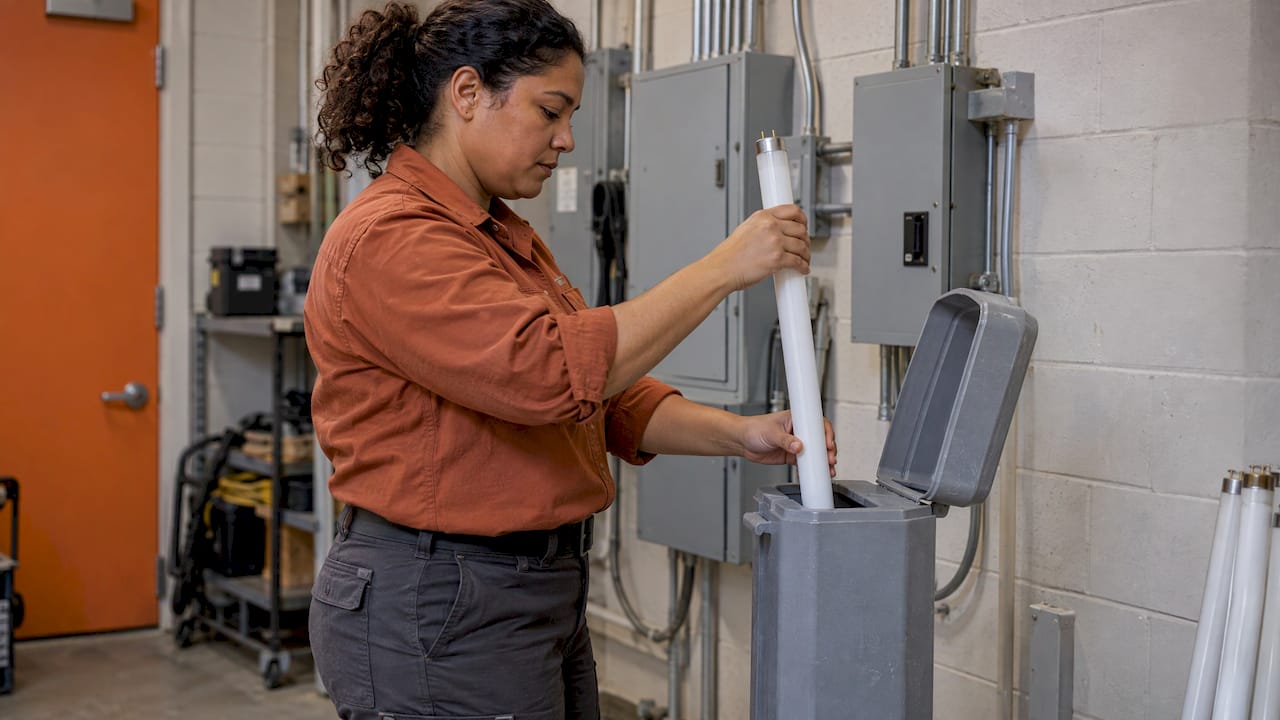
A professional crew handles removal, boxing and recycling as part of the job, so you are not left with a stack of tubes in a supply closet.
What an office lighting upgrade costs and how fast it pays back
Prices swing with fixture count, ceiling type, controls and local rebates, but published benchmarks give a sense of scale:
- The EPA’s rules of thumb list standard lighting retrofits at $0.90 to $1.20 per square foot (2016 figures, so expect higher costs today).
- A DOE FEMP analysis of an office retrofit option at 0.77 W per square foot and 51 footcandles of average illuminance reported an initial cost of $1.12 per square foot and a simple payback of 3.1 years.
- At the DOE’s Forrestal headquarters, swapping fluorescent lamps for TLEDs in 35,000 troffers cut lighting energy use by about 50%, with about $258,000 in expected annual energy cost savings on a $2,318,000 investment, per the DOE case study.
- In a GSA working-office evaluation, advanced controls cut lighting energy 69% overall, from 3.50 to 1.09 kWh per square foot. Roughly 45 points came from LED efficiency and light-level reductions, 12 from tuning and 12 from networked occupancy sensors and limited daylighting, as the GSA report details.
That same report also shows why every site needs its own math. At the site it studied, simple payback ran from 26 to 48 years because costs were high relative to savings. Savings depend on your hours of use, your electric rate, your starting fixtures and how much you spend on controls. Think of the figures above as ranges, then get a written scope for your own building. For a broader look at how to track energy savings and return, these energy efficiency tips can help you build a simple tracking routine.
For reference, our published price for electrical troubleshooting, which is how we trace flickering, tripping or dead circuits before a lighting project, is $300-$500. Lighting upgrade projects are quoted per job after we see the space.
Why call a professional before anything else
It is tempting to treat tube swaps as a maintenance chore. We would urge you not to. Here is what a professional brings that a DIY attempt cannot:
- Correct wiring for the product. Ballast bypass, driver compatibility and dimming method all have to line up.
- Code compliance. Controls and lighting-power rules can apply to the project, and an inspector will look for them.
- A look at what is behind the fixture. Overloaded circuits, aging panels and loose connections show up when lighting is opened, and they are far better caught now.
- Safe handling of mercury-containing lamps. Removal, packing and recycling are part of the job.
- Insurance and accountability. Work done right the first time protects your tenants, your staff and your building.
If an office’s circuits are already struggling, a lighting project can also expose the need for circuit and panel repairs. Finding that before the new fixtures are installed saves you a second visit.
Perspective: how we plan an office upgrade
We have worked on Northeast Ohio buildings since 1975, and the lighting jobs that go best all start the same way: with a conversation about how the space is used, not a box of tubes.
Our approach is to walk the office, check the circuits and controls behind the lights, and recommend the path that fits your goals: a lamp swap, a retrofit kit or new fixtures. We believe in clear, upfront pricing, so you know the scope before we start.
We also schedule around your workday. Our flexible service schedule is designed to minimize disruption, so your team keeps working while the new lights go in. Our technicians are certified, and they treat your office with the same respect we would want in our own.
A lighting upgrade is one of the rare projects that saves money, improves comfort and makes the electrical system safer all at once. We would rather help you do it once and do it right.
Lindsay Paramore
Plan your office lighting upgrade with Tri-County Services Electric & Plumbing
Tri-County Services Electric & Plumbing is a family-owned company serving homes and businesses across Northeast Ohio. We handle commercial lighting, circuits, panels, surge protection and inspections, so your lighting project is planned alongside the electrical system that powers it. See our commercial electrical services for what we offer businesses, or browse our electrical pricing guide for published prices.

Ready for a quote? Call our office at (440) 253-0332 and we will schedule a walkthrough of your space.
FAQ
Can I just swap fluorescent tubes for LED tubes myself?
It is better to have a professional electrician do it. Some LED tubes work with the existing ballast, while others require bypassing it and wiring line voltage to the lamp holders. Getting that wrong risks equipment damage and a shock or fire hazard, and the fixture needs to be labeled afterward. Call (440) 253-0332 and we will check your fixtures first.
How long does an office LED retrofit take?
It depends on the fixture count and the option you choose. The GSA estimated about 15 minutes to install a troffer retrofit kit, but planning, controls, removal of old lamps and testing add time. We schedule work around your business hours to keep disruption low.
Do I need to add occupancy sensors when I switch to LED?
Possibly. The energy code can treat lighting work as an alteration that triggers control requirements, including manual local control and automatic shutoff, and current standards call for occupancy sensing in restrooms and offices over 300 square feet. Confirm what applies to your building with your electrician and local building department before you budget.
What do I do with the old fluorescent tubes?
Do not throw them in the trash. The EPA manages fluorescent lamps as universal waste and encourages recycling. They should be stored in closed containers that prevent breakage until they go to a recycler. Our crew can take care of removal and recycling during the project.
Sources
- Upgrade Your Lighting, ENERGY STAR
- Lighting, GSA
- Lighting the Way: Upgrading Lighting Systems for Commercial Offices, Building Energy Exchange
- Consider All Options: Guidance for TLED retrofits, Electrical Contractor Magazine
- LED Lighting and Controls Guidance for Federal Buildings, GSA (integrated lighting campaign)
- LED Lighting and Controls Guidance for Federal Buildings, GSA (February 2024)
- Safety and Functional Considerations for Retrofitting Fluorescent Lamps, UL and MaxLite
- ASHRAE/IES 90.1-2022 Decoded, Lighting Controls Association
- Frequent Questions About Universal Waste, US EPA
- 40 CFR Part 273, Standards for Universal Waste Management, eCFR
- Rules of Thumb, EPA
- Economics of Energy Effective Lighting for Offices, DOE FEMP
- U.S. Department of Energy Headquarters Lighting Retrofit, DOE
- Evaluation of Advanced Lighting Control Systems in a Working Office, GSA