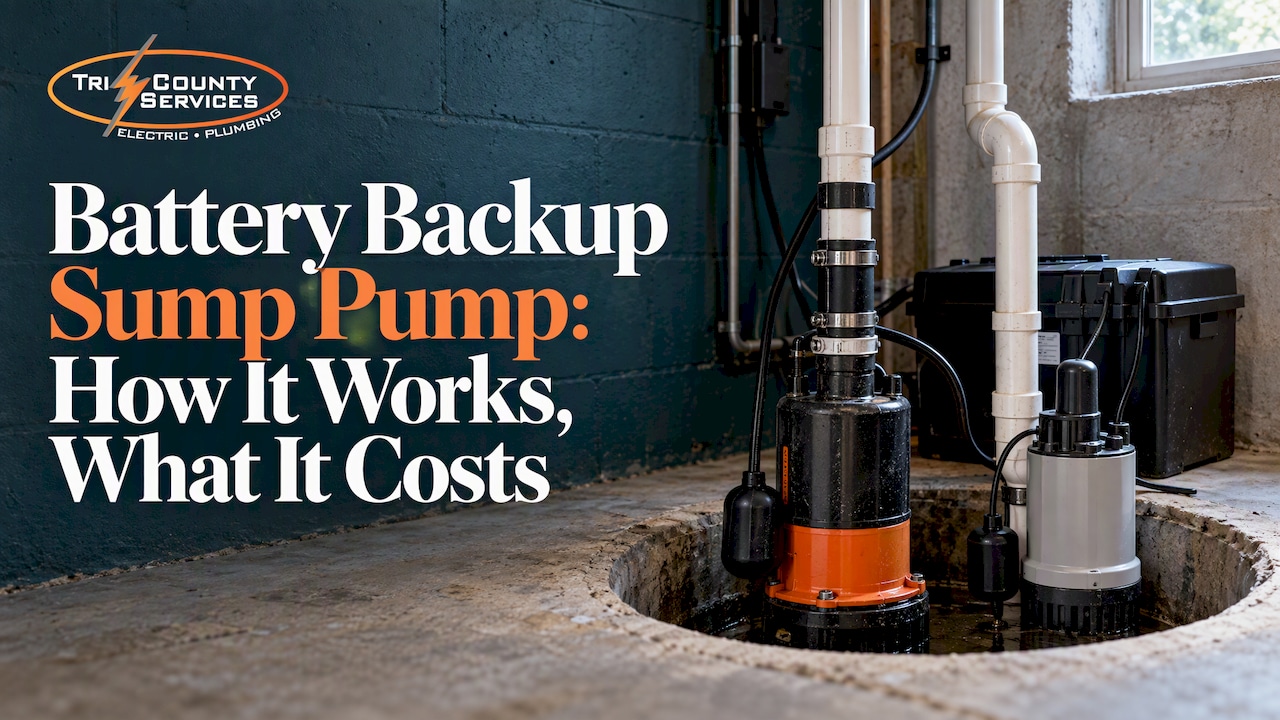


A battery backup sump pump is a second pump, powered by a battery, that takes over when your main sump pump loses power or stops working. In Northeast Ohio, where storms knock out power at the same moment the ground is saturated, it is the cheapest insurance you can put between your basement and a flood. Below, we cover how the system works, how long a battery lasts, what installation costs, and what to settle before anyone touches the wiring or the discharge line. If you want a pro to look at your pit, call Tri-County Services Electric & Plumbing at (440) 253-0332.
TL;DR
- A battery backup sump pump has its own 12-volt motor, battery and float switch, and it starts only if the water rises above where the primary pump should have turned on.
- Runtime depends on battery size and how hard the pump works. One university extension estimate puts a 120-amp-hour battery at about 96 hours of intermittent pumping.
- Professional installation of a battery backup system averages about $900, not counting the primary pump, according to Forbes Home.
- The job mixes plumbing (discharge piping, check valve) and electrical work (charger, outlet, battery), so a professional should do it for a safe, code-friendly result.
- For long outages, pair a battery backup with a whole-home generator. Call (440) 253-0332 to talk it through.
Table of Contents
- What a battery backup sump pump actually is
- Two ways to build a backup
- How long will the battery run?
- Choosing the battery
- What it costs
- Why this is a job for a professional
- Keeping the system ready
- Where a backup fits in a whole-home plan
- Our perspective
- Let us protect your basement
- FAQ
- Sources
What a battery backup sump pump actually is
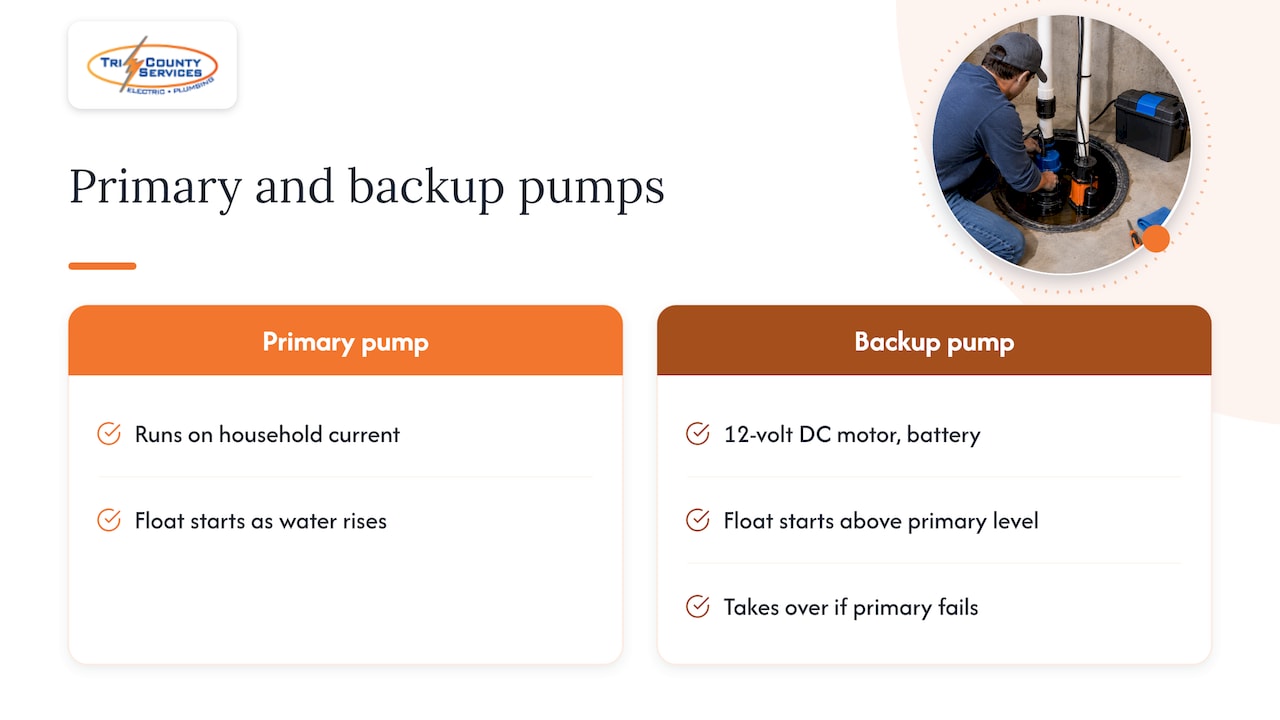
Your primary sump pump sits in a pit in the lowest part of the basement and runs on household current. When groundwater or rain raises the water in the pit, a float switch starts the pump and sends the water out through a discharge pipe.
The weakness is obvious: it needs electricity. A battery backup sump pump is a separate pump with a 12-volt DC motor, a battery and its own float switch, set to turn on above the level where the primary pump starts. If the main pump loses power or fails, the water climbs to the backup’s float and the backup begins pumping.
Consumer Reports describes the backup as a system that takes over when the primary pump loses power, stops working, or cannot keep up with the flow, and notes that both pumps share the same pit. That last point matters: the pit has to be big enough for two pumps and two float switches that do not tangle.
The Sump Pump Manufacturers Association argues that volatile weather makes backups a necessity, since a storm-related power loss can put a home at risk of flooding and damage to basement infrastructure.
Why the primary pump is not enough
Power loss is the famous failure, but it is not the only one. A primary pump can also fail because of a stuck float, a clogged intake, a failed motor or a worn check valve. It can also be undersized for a heavy storm. A backup protects against all of those, because it has its own power and its own switch.
Two ways to build a backup
Homeowners generally pick from two designs, according to the SSPMA: a separate battery-backup sump pump, or a battery-backup power inverter system.
| Design | How it works | Strengths | Trade-offs |
|---|---|---|---|
| Separate DC backup pump | A second pump with its own 12V motor and float sits in the pit beside the primary | Independent of the primary pump, so it covers motor failure too | Pit must fit two pumps; backup pumps are often smaller than the primary |
| Inverter system | An inverter and battery run your existing AC pump when the power drops | Uses the pump you already have, so full pumping capacity | Does nothing if the primary pump itself dies |
Which is right for you depends on your pit, the size of your current pump and how often water reaches the pit. That is a site-specific call, and it is one reason a pro should look at the pit before you buy anything. Our team can walk you through both options on our sump pump installation and battery backup page.
Can you add a backup to the pump you already have?
Usually yes. An inverter-based system is built to run your existing pump. A separate DC pump can also be added next to it if the pit has room, with its own discharge line or a tie-in to the existing one. The tie-in is where mistakes happen: a missing or backward check valve lets the backup’s water flow back into the pit, and the pump cycles uselessly. Getting the piping right the first time is the strongest argument for calling a professional.
How long will the battery run?
This is the question most people search, and the honest answer is: it depends on battery size, how high the pump lifts the water, and how fast water enters the pit.
The NDSU Extension guidance is the best published benchmark. It advises choosing a battery near the pump maker’s maximum recommended amp-hour rating, and it estimates that a 120-AH battery provides about 96 hours of intermittent protection, with the pump running about 30 seconds every four minutes. The same publication reports that at a 10-foot lift, a 75-AH battery gave at least 60 hours of protection under the same cycling pattern.
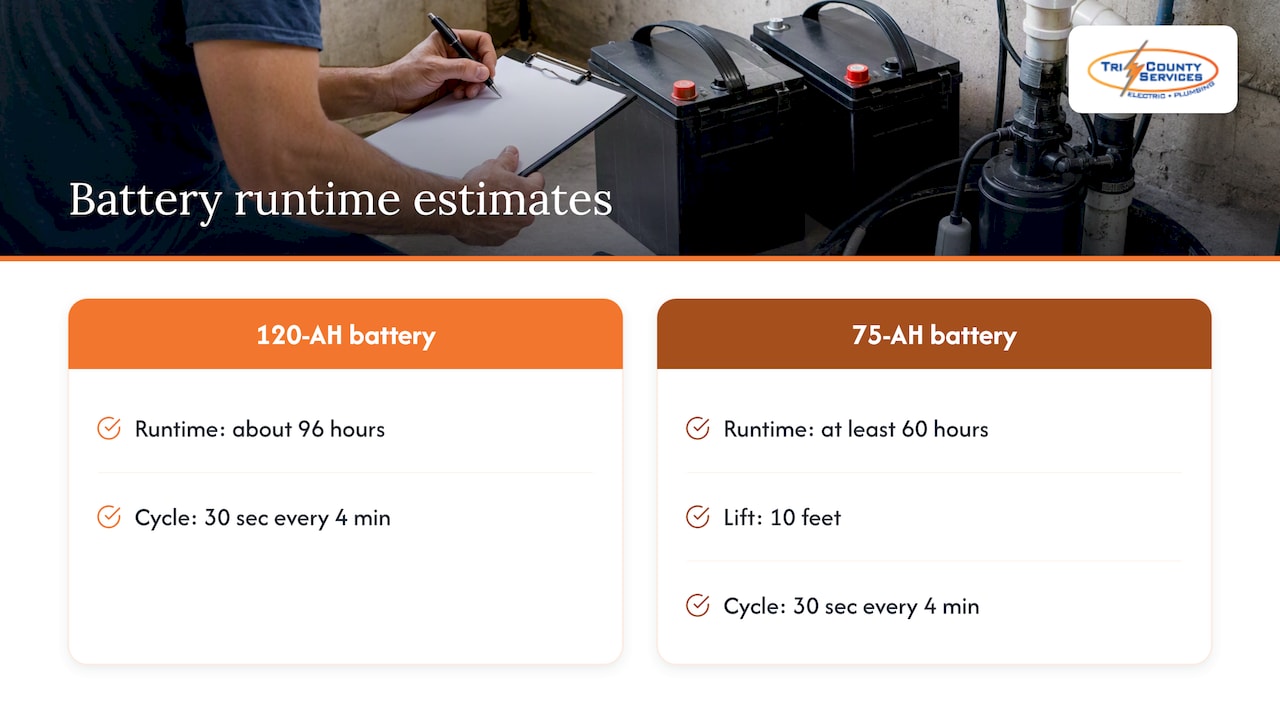
Those figures assume intermittent pumping. Continuous pumping, which is what happens in a downpour with a high water table, drains a battery much faster. NDSU states plainly that continuous pumping uses the battery faster than intermittent pumping.
What about a 200Ah battery?
We have not found a university or manufacturer test of a 200Ah battery on a household sump pump, so treat this as arithmetic, not a guarantee. Runtime scales roughly with capacity. If 120 Ah gives about 96 hours under NDSU’s test pattern, 200 Ah under the same pattern would land in the neighborhood of 150 hours. Real homes differ in several ways:
- Lift height. The higher the pump must push the water, the more current it draws.
- Inflow rate. Heavy inflow means the pump runs longer each cycle.
- Battery type and age. A worn battery delivers a fraction of its rated capacity.
- Usable capacity. Lead-acid batteries should not be drained to zero, so the usable share is smaller than the label.
- Inverter losses. If an inverter converts the power, some energy is lost as heat.
In a long, wet outage the pump may run almost constantly, and then a big battery lasts hours, not days. If your area sees multi-day outages, a battery alone is not a plan. A generator is.
Choosing the battery
NDSU recommends a deep-cycle lead-acid battery for backup sump pumps, with AGM and gel-cell types preferred, and says a vehicle battery should be used only in an emergency. Car batteries are built for short, high bursts, not long, steady discharge, and they wear out quickly when used this way.
Batteries are also usually not included. Consumer Reports notes that battery-powered backup systems cost $100 to $300 or more, and the batteries are typically sold separately. When you budget, add the battery, and plan to replace it on a schedule.
What it costs
There are two numbers to keep apart: the equipment and the installed job.
- Equipment. Consumer Reports puts battery-powered backup systems at $100 to $300 or more, battery extra.
- Professional installation. Forbes Home reports that professional installation of a battery backup system averages $900, excluding the primary pump, and that cost depends on the home and the features you want.
What moves your price: whether you need a new pit or just a new pump, how much discharge piping must be run or rerouted, whether an outlet and dedicated circuit are needed near the pit, battery size, and extras such as alarms or remote monitoring. We do not publish a flat sump-pump price, because the pit, the piping and the power supply differ in every basement. We give you a clear, upfront quote after seeing yours. Call (440) 253-0332 to schedule a visit.

Why this is a job for a professional
You will find guides saying a handy person can finish a backup install in a few hours. This Old House, for example, lists the steps as placing the backup pump in the sump, connecting the discharge piping, setting up the battery and charger, making electrical connections and testing. That is a fair summary of the scope. It is also a list of five places where a mistake floods a basement or starts a fire.
Here is why we would call a professional first:
- The piping decides whether it works. A backup that shares a discharge line needs a check valve in the right spot and direction. Get it wrong and the pump recirculates water instead of removing it.
- The pit is crowded. Two pumps and two floats must sit at different heights without touching each other, the pit wall or the discharge pipe. A float that snags is a pump that never starts.
- The battery is a hazard. NDSU warns that gel-cell and AGM batteries carry a small chance of hydrogen-gas explosion, and that the battery is often kept in a plastic box with the charger and battery in a dry spot.
- The charger needs a safe place and safe power. The Myers manual for its backup system says to keep the charger and battery box off the floor in a dry, cool, well-ventilated area and to pump only clear water, never flammable liquids or chemicals. A basement that floods is the opposite of a dry location, so placement takes judgment.
- Electricity and water share one room. The outlet, the circuit and the charger wiring all sit near a pit that can fill with water. That is electrical work that should be done right, with a dedicated circuit where needed.
Because the job is part plumbing and part electrical, you would normally need two trades. We are one team that does both, so one visit covers the pit, the pipe, the outlet and the test. If you have been thinking about doing it yourself, call us first. We will tell you what your pit needs, and you may find the cost of a professional job is close to what a trial-and-error weekend would cost anyway.
Keeping the system ready
A backup that has sat dead for two years is not a backup. NDSU recommends you check battery voltage every six months and look for corrosion. A few habits keep the system honest:
- Test the primary and backup floats a couple of times a year by slowly adding water to the pit and watching each pump start.
- Confirm the charger light or indicator shows a charging battery.
- Look at terminals for white or green crust, and keep the battery box clean and dry.
- Clear the pit of silt and debris that can jam a float.
- Replace the battery on the maker’s schedule, not when it dies.
Some advanced systems add help here. The SSPMA notes that certain units give visual and audio alarms for low battery fluid, corroded terminals, power loss or a defective pump. An alarm you can hear from upstairs is worth paying for if you travel or if the basement is finished.
Warning signs the primary pump is on its way out
Backups are not an excuse to ignore the main pump. Unusual noise, short cycling, a pump that runs without moving water, or a pump that never seems to turn off are all signals to have it checked. The same logic applies to other pumps in the house, and this guide to the signs of pump trouble shows the habit of catching problems before they become failures.
Where a backup fits in a whole-home plan
A battery backup buys hours or days, not weeks. If your neighborhood loses power for long stretches, or you also want your furnace, refrigerator and lights running, a standby generator covers the sump circuit along with everything else. Our guides on whole-home generators and on what a generator installation involves explain the options. Many homeowners start with the battery backup and add a generator later.
Power surges are another threat to pumps. A whole-home surge protection setup protects the pump motor, charger and controls, and it is on our electrical menu.
Our perspective
We have served Northeast Ohio homes since 1975, and the pattern is familiar. The basement stays dry for years, then one storm takes the power and the pump with it. The homeowners we hear from afterward rarely say the backup was too expensive. They say they wish they had added it before the storm.
What we have learned is that the equipment is the easy part. The real work is in the details around it: the right pump for the pit, a check valve that faces the right way, a battery sized for the pump, a charger on a safe circuit, and a test that proves it all works. Because we do both plumbing and electrical work, we can handle each piece in one visit and schedule around your day so the disruption stays small.
Our advice is simple. Do not wait for the forecast. Ask a professional to look at your pit, tell you honestly whether you need a separate pump or an inverter system, and give you a price before any work starts.
— Lindsay Paramore
Let us protect your basement
Tri-County Services Electric & Plumbing installs and services sump pump battery backup systems for homes across Northeast Ohio. Our certified technicians handle the pit, the piping, the power and the testing, and we explain your options in plain terms before we start. See our sump pump battery backup service or call our office at (440) 253-0332.

If your drains, water heater or pipes also need attention, browse our plumbing services and pricing guide for what we handle.
FAQ
Do they make sump pumps with battery backup?
Yes. Some are sold as packages that pair a primary pump with a battery-powered backup pump, and others are standalone backup units added to an existing pit. Which one suits you depends on the size and layout of your sump pit. A professional can check that before you buy.
How long will a 200Ah battery run a sump pump?
There is no single answer. Scaling NDSU’s estimate of about 96 hours for a 120-AH battery under intermittent pumping, a 200-AH battery might last roughly 150 hours in the same conditions. In a heavy storm with near-constant pumping, it could be only hours. Lift height, battery age and inflow all change the result.
Can I use a car battery for a backup sump pump?
Only in an emergency. NDSU recommends a deep-cycle lead-acid battery, with AGM or gel-cell types preferred, because car batteries are not built for long, steady discharge. A professional can size and install the right battery along with a safe charger setup.
How often should the battery be checked?
Check the voltage and look for terminal corrosion about every six months, per NDSU guidance. Also test the float switches and confirm the charger is working. Replace the battery on the manufacturer’s schedule.
What does it cost to have a battery backup installed?
Forbes Home reports that professional installation averages about $900, excluding the primary pump, with the final figure depending on your home and features. Equipment alone often runs $100 to $300 or more, battery extra, per Consumer Reports. Call (440) 253-0332 for a quote on your basement.
Sources
- Electric Backup Sump Pumps for Houses, NDSU Extension
- Sump Pump Backup System Buying Guide, Consumer Reports
- Why Homeowners Need a Backup, SSPMA
- How To Install a Battery-Operated Backup Sump Pump, This Old House
- Myers MBSP-2-01 Battery Backup System Manual
- 5 Best Battery Backup Sump Pumps, Forbes Home