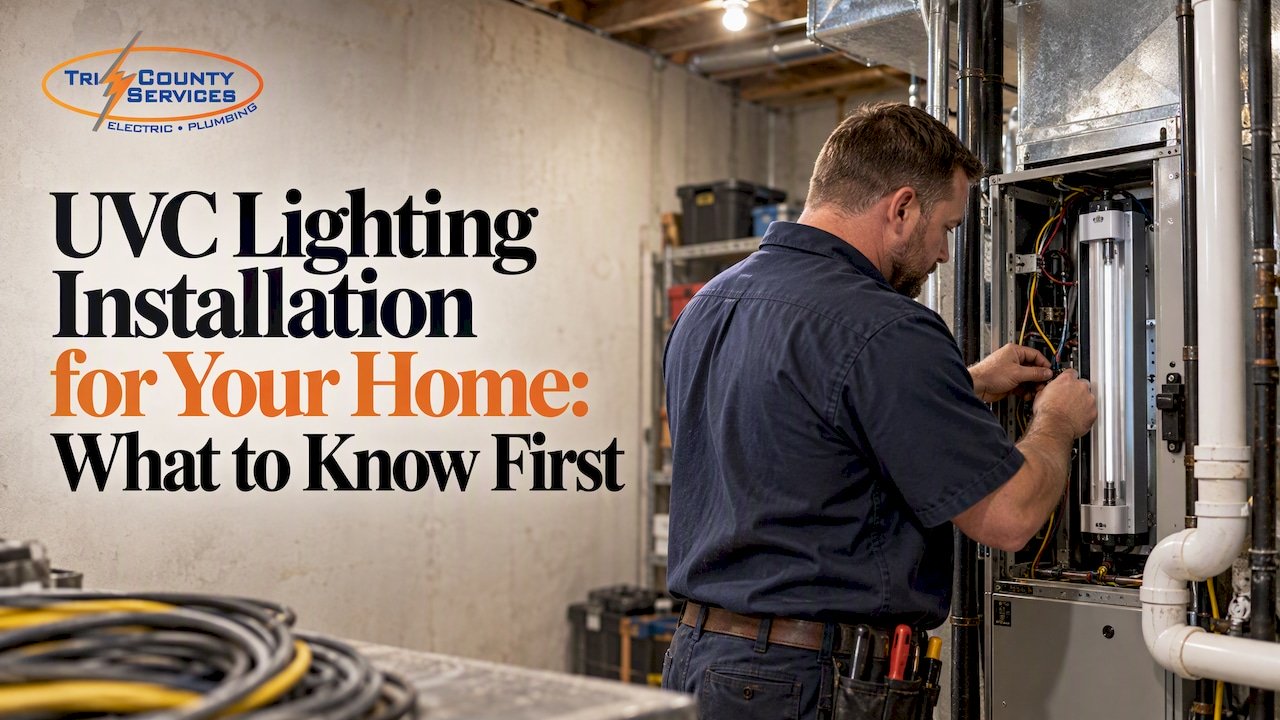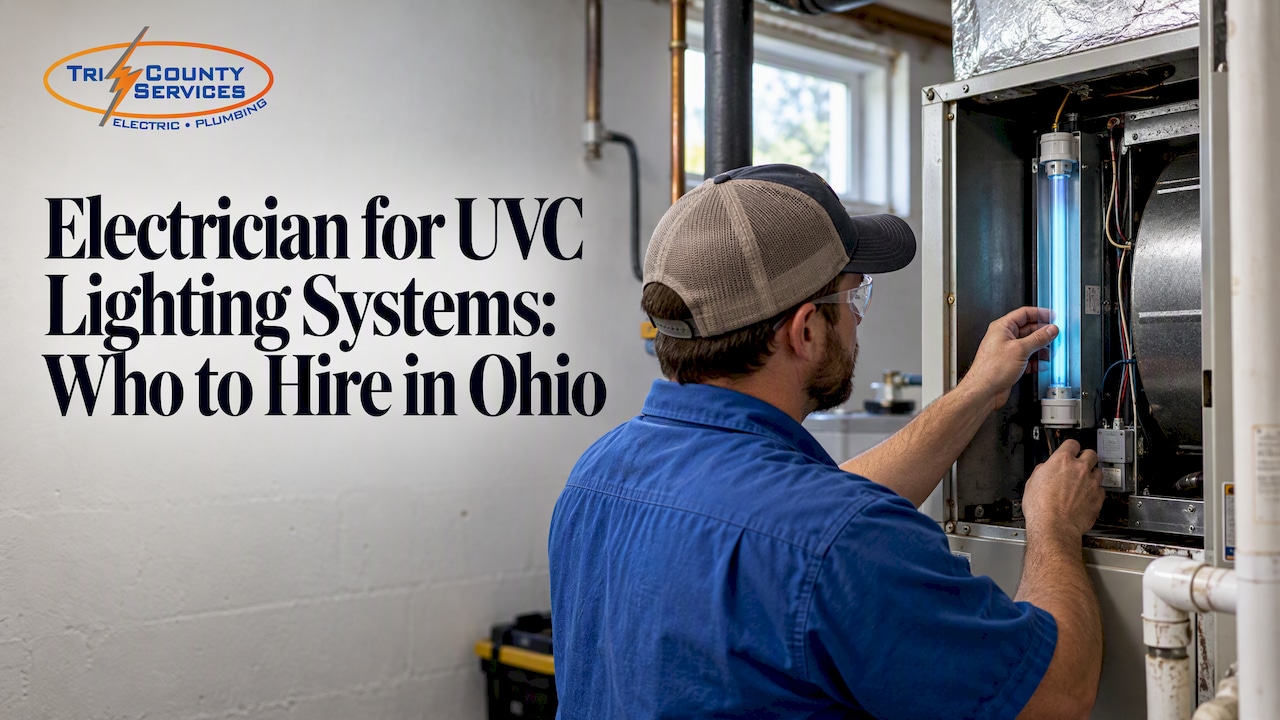

UVC lighting installation means mounting a germicidal lamp, most often inside your HVAC system, and wiring it with the safety controls that keep UV-C light away from people. Done well, it keeps cooling coils and drain pans cleaner and adds a modest layer of air cleaning. Done badly, it can expose your eyes and skin to radiation or add ozone to your indoor air. At Tri-County Services Electric & Plumbing, we think the safest first step is a call to a professional: (440) 253-0332.
TL;DR
- UV-C lamps in an HVAC system work best at keeping coils and drain pans free of mold and slime. They are a supplement to filtration, not a replacement.
- UV-C light is hazardous to skin and eyes, and some UV devices can emit ozone. Ask for equipment certified to the relevant UL standards.
- A proper installation includes power, a safety interlock that cuts the lamp when a panel opens, and warning labels, not just a lamp.
- Lamps need cleaning and replacement over time, and the system must be off before anyone services the HVAC unit.
- Call (440) 253-0332 and we will talk through your system and the electrical work involved.
Table of Contents
- What UVC lighting actually does in a home
- Set realistic expectations before you buy
- Why airflow and dose decide whether it works
- The safety issues homeowners underestimate
- Why the pro route beats the YouTube route
- What a professional installation involves
- What to expect on cost
- Our perspective: treat UV-C as electrical safety work first
- Other places UVC shows up: commercial and water
- Work with Tri-County Services Electric & Plumbing
- FAQ
- Sources
What UVC lighting actually does in a home
UV-C is the short-wavelength band of ultraviolet light. According to ASHRAE, wavelengths up to about 280 nm have the strongest germicidal effect, because they damage the DNA and RNA of microorganisms. Germicidal systems are often built around lamps that emit near 254 nm.
In a house, that technology shows up in three main ways:
- Coil-mounted lamps. A lamp sits near the evaporator coil in your air handler or furnace plenum and shines on the coil and drain pan.
- In-duct (airstream) lamps. One or more lamps irradiate the air as it moves through the ductwork.
- Upper-room fixtures. Wall- or ceiling-mounted units direct UV-C above head height in a room. These are more common in commercial and institutional spaces.
The EPA explains that a professionally designed UVGI system that is well installed and maintained can kill airborne viruses, including the one that causes COVID-19. The key words there are professionally designed, well installed and maintained. Those three conditions are where most home projects go wrong.
Set realistic expectations before you buy
Marketing for UV lights often promises a lot. The agencies that study this are more measured.
- The CDC describes UVGI as a supplemental air-cleaning measure. It is not a standalone fix.
- The CDC and NIOSH list filtration and germicidal UV as two primary ways to improve air cleanliness, and the two work together.
- UV light does nothing about dust, pollen or other particles. A good filter does. The EPA’s Clean Air in Buildings guidance points to better ventilation and filtration first.
In practice, the most reliable payoff for a typical Northeast Ohio home is on the cooling side. A lamp that keeps the coil and drain pan from growing biological film can help keep an air conditioner cleaner through our humid summers. Airstream disinfection is harder, because air moves past the lamp quickly and exposure time is short.
If you are mostly after cleaner air, check your filter first. Make sure your HVAC system can handle a higher-efficiency filter, such as MERV-13, and that the filter fits tightly. A professional can tell you whether UV-C adds anything on top of that.
Why airflow and dose decide whether it works
UV-C kills by exposure: intensity multiplied by time. That is why in-duct systems are designed around airflow speed and lamp placement rather than simply bolting a bulb inside a duct.
For airstream systems, design guidance generally calls for air moving at about 500 feet per minute or slower, and a target dose of roughly 1,500 µW·s/cm² across an irradiated zone that extends at least two feet. Those figures come from the ASHRAE filtration and disinfection resources summarized in our research. If your ducts are small, your blower is strong, or your coil is hard to reach, a single off-the-shelf lamp may not deliver what the box implies.
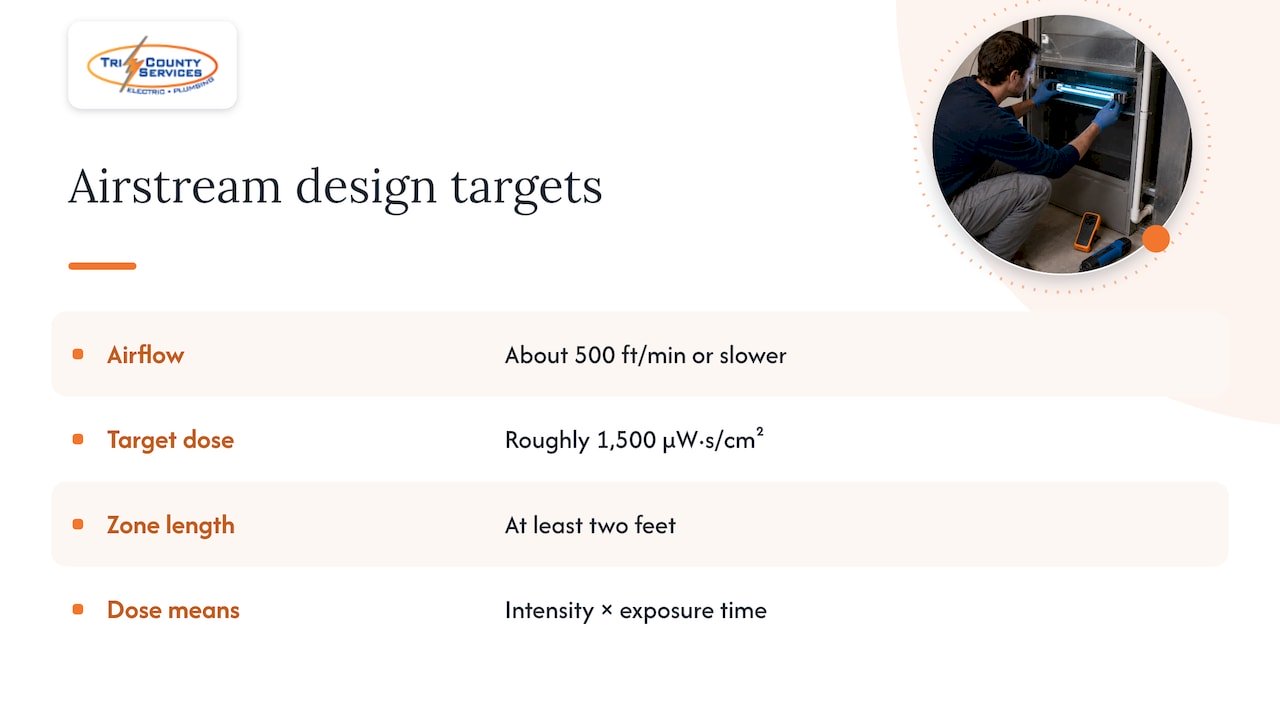
That is the practical argument for sizing the system to the equipment. A lamp that is too weak, too far from the coil, or aimed poorly will glow without doing much.
The safety issues homeowners underestimate
Radiation exposure
UV-C is hazardous to human skin and eyes. UL Solutions says UVC is proven to have germicidal effects, but it also warns that, like many high-energy devices, it carries risks. The light you cannot see can still burn.
That is why contained systems, meaning lamps inside a sealed duct or air handler, are safer for occupants than portable or open fixtures. Nobody should be able to look at the lamp while it is on.
A correct installation therefore includes:
- An interlock switch that cuts power to the lamp immediately when an access panel or cabinet is opened.
- Warning labels at every access point.
- Shielding or placement that keeps the lamp out of sight lines.
- Clear shut-off instructions for anyone who changes a filter or services the unit.
The interlock is an electrical component. It has to be wired correctly, tested and kept working. A lamp without one is a hazard waiting for the next filter change.
Ozone
Some UV lamps produce ozone, a lung irritant. The EPA’s guide to air cleaners notes that UV lights without adequate lamp coatings may have the potential to emit ozone, and advises avoiding devices that intentionally produce it.
Look for equipment tested to a zero-ozone standard. UL 2998 validates air cleaners that emit ozone below 0.005 ppm, which is stricter than the 0.050 ppm regulatory limit. UL also developed UL 8802 requirements to address UV overexposure hazards, as described on its code authority page. Ask your installer which listings your equipment carries, and check the paperwork yourself.
Maintenance exposure
UV-C is not a set-and-forget upgrade. Dust on a lamp blocks output, and lamps lose germicidal strength as they age even if they still glow. ASHRAE stresses that UV systems must be powered off before any HVAC maintenance to prevent eye and skin exposure. Plan on scheduled cleaning and lamp replacement, and keep a record of the install date.
Why the pro route beats the YouTube route
Search for this topic and you will find video walk-throughs of homeowners dropping a lamp kit into an air handler. We understand the appeal. We would still urge you to call a professional first, for four reasons.
- You are working inside live equipment. Air handlers and furnaces contain line-voltage and low-voltage wiring, blower motors and control boards. A UV kit needs a power source, and tapping the wrong one can damage the equipment or create a shock hazard.
- The failure mode is invisible. If a lamp is mis-aimed, too weak or not interlocked, you cannot see the problem. You find out later, through exposure, ozone or a coil that is still dirty.
- Warranty and code questions. Modifying HVAC equipment can affect manufacturer warranties, and electrical work has to meet code. A professional can tell you what applies before the cabinet is opened.
- Certification matters and is easy to get wrong. Many consumer devices lack proper containment or interlocks. A professional specifies equipment with the right listings and installs the whole safety package.
A wrongly installed UV lamp rarely announces itself. That is the strongest argument for putting a professional in charge from the start.
What a professional installation involves
Every home is different, but a well-run UV-C project follows a recognizable sequence.
- Assess the goal. Is the problem a musty smell at the coil, recurring drain-pan slime, allergy concerns or a general wish for cleaner air? The answer shapes the design.
- Check the basics first. Filter rating and fit, airflow, duct condition and drain pan state. UV-C will not make up for a neglected system.
- Choose equipment. Coil-mounted or airstream, lamp length and output, ozone-free and UL-referenced products.
- Plan the power. The lamp needs a reliable supply with a safe disconnect. Depending on the unit, that may mean a power tap in the air handler or a separate dedicated circuit. Our installation team handles this kind of electrical work, and our residential installation guide explains how we approach new circuits and wiring.
- Mount and wire the lamp with the interlock, labels and shielding in place.
- Test. Confirm the lamp shuts off when the access panel opens and comes back on when it closes.
- Set a maintenance schedule for lamp cleaning and replacement, and show you how to shut the system off.
The electrical side
Our specialty is the power and safety wiring that makes the project safe. Before any new load goes onto your system, we check that the circuit it will share is not already overloaded and that your panel has room. If your panel is crowded or aging, an electrical panel upgrade may come up in the conversation. A UV lamp draws little power by itself, but it often shows up alongside other projects such as new air conditioning, a heat pump or an EV charger.
You may also want to add whole-home surge protection in the same visit. Lamp ballasts and HVAC control boards are electronic, and storm-related surges are hard on them.
What to expect on cost
We do not publish a fixed price for UV-C installation, because the work depends on the equipment, how accessible the coil is and what wiring is needed. We can say what we publish for related electrical work: electrical troubleshooting is listed on our electrical pricing guide at $300 to $500, a one-off fee. Dedicated circuit installation is also on that guide, without a published price, so we quote it after we see the job.
When you collect quotes from anyone, compare like with like:
| Question | Why it matters |
|---|---|
| Is the lamp tested for zero ozone (UL 2998)? | Protects your indoor air quality |
| Is there an interlock switch? | Prevents exposure during filter changes and service |
| Is the unit sized to your airflow and coil? | A lamp that is too weak just glows |
| What does annual lamp replacement cost? | The ongoing expense is often left out |
| Who services it? | Lamps need cleaning and replacing on a schedule |
Be wary of any quote that skips the safety hardware to look cheaper.
Our perspective: treat UV-C as electrical safety work first
We have been serving Northeast Ohio families and businesses since 1975, and the pattern we see is consistent: people hear about a gadget, buy it, and only then ask what it needs from the house. UV-C lighting is a good example. The lamp is the easy part. The power source, the interlock, the labeling and the long-term upkeep are what make it safe to live with.
Our advice is plain. Fix the fundamentals first: filter, airflow, a clean coil and drain pan. Then decide whether UV-C adds real value for your home. If it does, have it specified and installed by a professional who will treat it as what it is, a radiation-emitting device wired into your home’s electrical system. We would rather talk you out of a lamp you do not need than install one that does not fit your system.
We also take scheduling seriously. A UV project should not turn your week upside down, and our flexible schedule is designed to minimize disruption. We respect your home, and we will tell you straight what the job involves before we start.
— Lindsay Paramore
Other places UVC shows up: commercial and water
If you manage a business property, the same principles apply at a larger scale: engineered design, certified equipment, interlocks, trained maintenance staff. Upper-room systems, which the EPA covers, belong to professional design, not retail purchase. Call us with your building’s details and we can talk through the electrical requirements.
You will also see UV used for water treatment on wells. That is a different system with different design rules, and it ties into plumbing as well as power. If you are thinking about it, describe your setup when you call and we will tell you what we can and cannot help with.
Work with Tri-County Services Electric & Plumbing
Whether you are weighing a UV-C lamp, adding a dedicated circuit for new HVAC equipment, or clearing a backlog of electrical concerns, Tri-County Services Electric & Plumbing is a family-owned team with skilled, certified technicians and clear, upfront pricing. We now offer plumbing too, from drain cleaning to water heaters, so one call can cover the house. Start with our electrical pricing guide, or call our office at (440) 253-0332 to schedule a visit.
FAQ
Is UVC lighting safe to have in my home?
It can be, when the lamp is fully contained inside ductwork or an air handler, has an interlock that cuts power when a panel opens, and is tested for low ozone. UV-C is hazardous to skin and eyes, so open or portable fixtures carry more risk. Have a professional specify and install it.
Will a UV light in my HVAC system clean my air?
It adds a supplemental layer, and it is usually most effective at keeping the cooling coil and drain pan free of mold and slime. It does not remove dust or particles, so it does not replace a good filter or regular HVAC cleaning. Check your filter and airflow before adding it.
Does UVC lighting produce ozone?
Some UV devices can, particularly those without adequate lamp coatings, according to the EPA. Ask for equipment validated to UL 2998 for zero ozone emissions, and keep the documentation.
How often do UV-C lamps need service?
Lamps need periodic cleaning, because dust blocks the light, and replacement as they age, since their germicidal output declines even while they still glow. Ask your installer for the manufacturer’s replacement interval and turn the system off before any HVAC service.
Who should I call for UVC lighting installation near Cleveland or Akron?
Call Tri-County Services Electric & Plumbing at (440) 253-0332. We will talk through your system, the power and safety wiring involved, and the right next step for your home.
Sources
- ASHRAE: Filtration and disinfection
- EPA: Guide to Air Cleaners in the Home
- EPA: Clean Air in Buildings Challenge
- CDC: Air, Infection Control
- CDC NIOSH: Improving Air Cleanliness
- UL Solutions: Zero Ozone Emissions Validation
- UL Solutions: UVC germicidal devices, what consumers need to know
- UL Solutions Code Authorities: UVC germicidal lighting