

Most homeowners land in one of three kW bands: 6 to 12 kW covers essentials only (fridge, sump pump, a few lights), 12 to 18 kW handles comfort with partial-home coverage, and 18 to 22 kW or more powers a whole house with central air and an electric range. If your list includes an EV charger, well pump, or heat pump, plan toward the higher end. Run the quick checklist below first, then call Tri-County Services Electric & Plumbing at (440) 253-0332 for a professional site survey before you buy anything.
TL;DR:
- Most homes requiring whole-house coverage with central air or high-demand appliances need a generator in the 18 to 22 kW range, depending on the appliance mix.
- Critical factors like HVAC type, well pumps, EV chargers, and panel capacity significantly influence the required generator size, sometimes adding several kilowatts.
- Precise load calculation, including startup surges of motor-driven appliances, is essential, and a professional load analysis is recommended for accurate sizing.
- Generator placement must be at least 20 to 25 feet away from doors, windows, or vents to prevent carbon monoxide poisoning risk.
- Proper sizing through a site survey helps prevent frequent trips, overpayment, and safety hazards, emphasizing the importance of professional evaluation before purchase.
Table of Contents
- What to List Before You Calculate Generator Sizing for Your Home
- How Do You Calculate the Right Generator Size?
- What Size Generator Do Most Homes Actually Need?
- What Factors Change Your Generator Size Up or Down?
- How Far Should a Generator Be From Your House?
- When Should You Call a Professional for Generator Sizing?
- Why Accurate Generator Sizing Matters More Than the Price Tag
- Schedule Your Generator Site Survey With Tri-County Services
- Sources
- FAQ
What to List Before You Calculate Generator Sizing for Your Home
Grab a notepad and walk your house for 15 to 20 minutes. You need two numbers for every device you want powered during an outage: running watts and starting watts. Skip this step and any generator size calculator you use later is just guessing with extra steps.
Start with these categories:
- Refrigerator and freezer — check the nameplate on the back or inside the door frame.
- Sump pump — critical if you live anywhere with a basement and a water table that rises after storms.
- Central air conditioner or heat pump — usually the single biggest power draw in the house.
- Water heater — electric tank units pull real power; gas units mostly just need a small igniter circuit.
- Electric range or oven — often a 240-volt, high-draw circuit.
- EV charger — Level 2 chargers can draw as much as a small HVAC unit.
- Well pump — has a hard starting surge that catches a lot of people off guard.
- Medical equipment — oxygen concentrators, CPAP machines, or dialysis equipment need dedicated, uninterrupted power.
Write down the amperage and voltage stamped on each nameplate, then find your electrical panel’s main breaker rating (usually 100, 150, or 200 amps) and note whether you have a subpanel. That panel data matters as much as the appliance list.
How Do You Calculate the Right Generator Size?
Every appliance with a motor pulls more power the instant it starts than it does while running. That gap is the whole game in whole house generator sizing. A central air conditioner might run at 3,500 watts but spike to 9,000 watts or more for a second or two on startup. Refrigerators, sump pumps, and well pumps all do the same thing, just at smaller scale.
Here’s the math a generator size calculator actually runs behind the scenes:
- Add up the running watts for everything you want powered at once.
- Identify the single largest starting watt surge among all your motor-driven appliances (not the total of all surges, just the biggest one).
- Add that one surge figure to your running-watts total. That’s your minimum starting wattage.
- Add a 10 to 20 percent buffer for safety margin and future appliances.
- Divide by 1,000 to convert to kW.
Worked example, essentials only: Refrigerator (700W running, 2,200W starting) + sump pump (800W running, 1,300W starting) + a few circuits for lights and a modem (400W) = 1,900 running watts. Add the sump pump’s 1,300W surge (the largest single spike): 3,200W minimum. That’s a small portable or inverter generator’s territory.
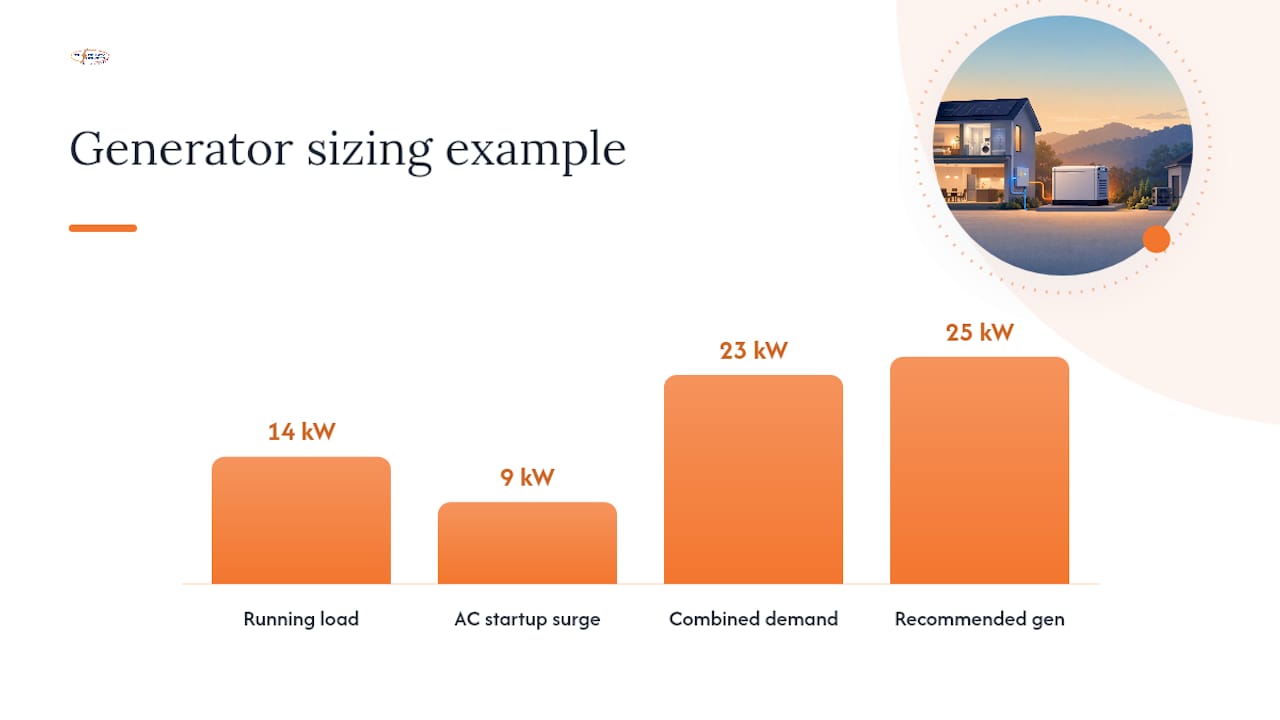
Worked example, whole-home with central air: Running loads (AC, water heater, range, refrigerator, general circuits) might total 14,000 watts. Central air alone can surge to 9,000 watts on startup. Add those together and you’re at 23,000 watts before any buffer, pushing you toward 25 kW once you add margin.
Pro Tip: If you can’t find a nameplate rating or your HVAC system has multiple stages, stop guessing. That’s exactly when a professional load analysis using ACCA’s Manual J and Manual S procedures earns its cost. Manual J calculates the actual heating and cooling load; Manual S matches equipment to that load instead of picking a number off a chart.
What Size Generator Do Most Homes Actually Need?
Square footage gives you a rough starting point, not an answer. Two houses of identical size can need wildly different generator capacity depending on whether one has a well pump and the other doesn’t, or whether one runs a heat pump and the other has gas heat.
| Home profile | Typical running kW range | Notes |
|---|---|---|
| Small home, essentials only | 6–10 kW | Refrigerator, sump pump, some lighting and outlets |
| Around 1,550 sq. ft. | 10–18 kW | Range depends heavily on AC size and appliance mix |
| Around 2,000 sq. ft. | 18–22 kW | Whole-home coverage with central air commonly needs this band |
| Large home, 3,000+ sq. ft. | 22 kW and up | Multiple HVAC zones, well pump, or EV charger push toward the top |
A Generac sizing analysis confirms this spread: a 2,000 square foot home typically needs 20 to 22 kW for full-home coverage, while a 1,550 square foot home can run anywhere from 10 to 18 kW depending on what’s actually installed. The appliance mix decides the number far more than the floor plan does.
What Factors Change Your Generator Size Up or Down?
A few details move the needle more than most homeowners expect, and catching them early can save you from buying a bigger (and pricier) unit than you actually need.
- Panel capacity. If your main breaker is rated at 100 amps and you’re adding an EV charger and a heat pump, you may need a panel upgrade before generator size even matters.
- HVAC type. Heat pumps and central AC units have the highest starting surge in most homes, and multi-stage systems complicate the math further.
- Well pumps and EV chargers. Both draw enough to justify a full kW size class jump on their own.
- Fuel choice. Natural gas and propane units are rated differently than diesel, and a generator’s continuous rating is usually lower than its brief standby rating.
- Load management. Soft-start kits on your AC compressor can cut starting surge dramatically, sometimes letting you drop down a size class instead of overbuying capacity you’ll rarely use.
Pro Tip: Staged load management, running your dryer and AC on a schedule rather than simultaneously, is often cheaper than jumping to the next generator size up.
How Far Should a Generator Be From Your House?
Carbon monoxide is the real danger, not fire. CPSC data tied 553 non-fire CO deaths between 2010 and 2020 to generators, and most involved gasoline-fueled units placed too close to doors, windows, or vents. Stationary units are not immune either. Some incidents in CPSC’s reporting involved 22 kW standby generators positioned near openings.
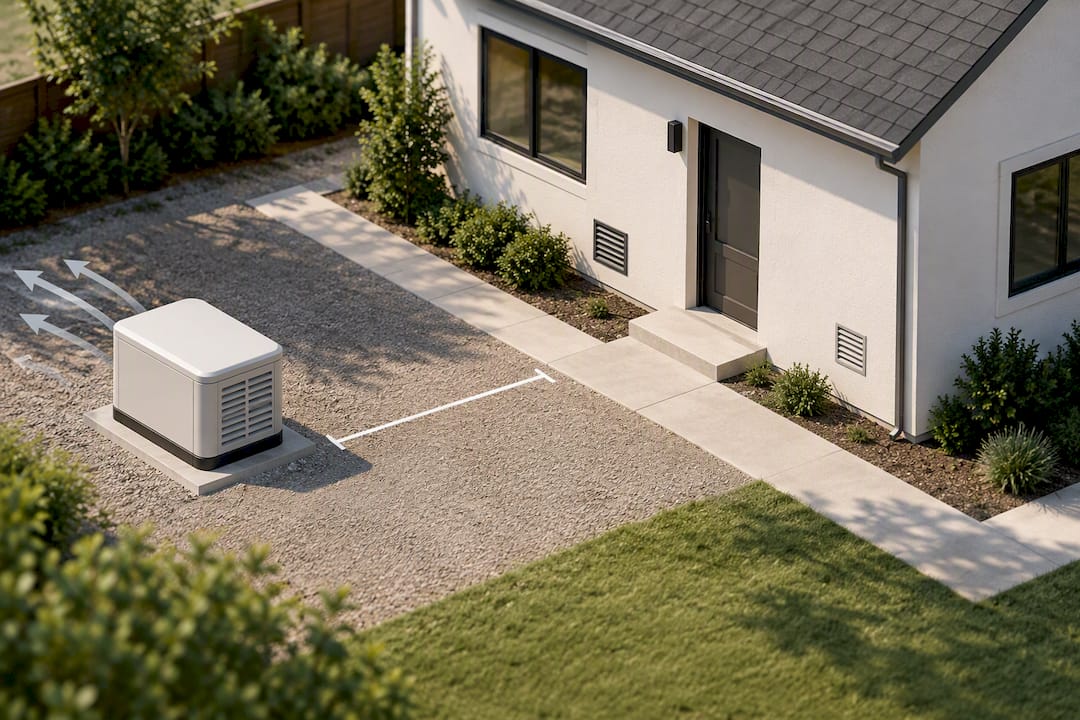
Keep any generator, portable or stationary, at least 20 to 25 feet from doors, windows, and vents. A garage with the door open still lets exhaust drift into living spaces; CPSC’s own findings show this is a common failure point even when people think they’ve taken precautions. Installers check adopted local codes and NFPA guidance during a site survey and pull the necessary permits before placement, which is one more reason placement isn’t a DIY decision.
When Should You Call a Professional for Generator Sizing?
Once your appliance list gets past “refrigerator and a few lights,” the math has enough moving parts that a mistake is easy and expensive. A site survey typically covers actual measured loads (not nameplate estimates), a full inspection of your electrical panel, an assessment of fuel supply and exhaust routing, and a recommendation on transfer switch size and pad placement.
Before hiring anyone, ask these questions:
- Will you perform a load analysis, or are you sizing off square footage alone?
- Do you size to both starting and running watts, or just running watts?
- Who pulls the permits, and are they included in the quote?
- Do you handle panel upgrades and transfer switch wiring, or will I need a second contractor?
If a contractor can’t answer all four clearly, keep calling. Tri-County Services Electric & Plumbing walks through every one of these during a generator installation site survey. Call (440) 253-0332 to schedule one.
Why Accurate Generator Sizing Matters More Than the Price Tag
Accurate sizing conversations help avoid most callbacks related to generator installations. An undersized unit trips constantly and shortens its own lifespan. An oversized one burns more fuel than it needs to and costs more upfront for capacity nobody uses. A proper site survey costs nothing extra in the long run. It protects your equipment and your family from CO risk. Call (440) 253-0332 or visit our generator installation page to schedule yours.
— Lindsay Paramore
Schedule Your Generator Site Survey With Tri-County Services
Tri-County Services Electric & Plumbing sizes generators the way this article recommends: measured loads, not guesswork off a spec sheet. That’s the gap between a unit that trips under real winter load and one that just works when the power drops.

Our site surveys cover panel capacity, transfer switch sizing, fuel supply, and placement that meets CPSC and NFPA clearance guidance, the same checklist covered above. We also handle the panel upgrades that oversized loads often require, along with EV charger circuits if that’s part of your plan. If electrical troubleshooting turns up other issues during the visit, our electrical pricing guide lays out typical costs so there are no surprises. Call (440) 253-0332 to request a free estimate and get a site survey on the calendar before the next storm season.
Sources
- What Size Generator Do I Need? Sizing Guide | Standby Generator | Generac
- Generators and OEDT CO-Poisoning Fatalities Report (CPSC)
- Right-Size Heating and Cooling Equipment. Office of Building Technology, State and Community Programs (BTS) Technology Fact Sheet
- Electrical inspectors and generators for existing dwellings | NFPA
FAQ
How Big of a Generator Do You Need for a 2,000 Sq. Ft. House?
A 2,000 square foot home typically needs 20 to 22 kW for whole-home coverage, though the exact number depends on your HVAC size and whether you have a well pump or EV charger. A professional load analysis gives you an exact figure rather than a range.
What Is the 20/20/20 Rule for Generators?
There’s no single standardized “20/20/20 rule” in generator sizing literature; the number that does show up consistently is the 20 to 25 foot placement clearance CPSC recommends to keep carbon monoxide away from doors, windows, and vents. If you’ve seen a “20/20/20” reference elsewhere, verify what it’s actually describing before relying on it.
How Many kW Generator Do You Need for a 3,000 Sq. Ft. House?
Large homes around 3,000 square feet or more typically need 22 kW or higher, especially with multiple HVAC zones, a well pump, or an EV charger in the mix. This falls above the 18 to 22 kW band that covers most 2,000 square foot whole-home setups, so a site survey is worth scheduling before you buy.
What Size Generator Do You Need for a 1,200 Sq. Ft. House?
A small home with essentials only (refrigerator, sump pump, some lighting) often falls in the 6 to 10 kW range. If you want central air or an electric range included, you’ll likely need a higher capacity, which is why running the appliance checklist matters more than the square footage number alone.