
TL;DR:
- Proper excavation corrects yard flooding caused by poor grading, dense clay soil, or inadequate drainage systems. Professional evaluation ensures the correct slope, outlet, and materials, avoiding costly failures and legal liabilities. Combining grading, French drains, and proper outlet design provides the most durable solution for long-term drainage improvements.
Excavation is the reliable long-term fix when poor grading, clay subsoil, or inadequate drainage lets water pool and damage your property. Most Northeast Ohio yards flood for one of three reasons: the ground slopes toward the house instead of away from it, the soil is too dense to absorb rain fast enough, or there is simply nowhere for the water to go. Clay soil absorbs water at roughly 0.2 in/hr, while sandy soil handles 8–12 in/hr. That gap explains why a single storm leaves one yard dry and another one soggy for days.
The short version:
-
Most common causes: improper grading, compacted or clay-heavy soil, increased runoff from roofs and driveways, and clogged or missing drainage
-
When excavation solves it: standing water returns after every storm, pools in the same spot, or sits for 48+ hours — excavation addresses the root hydrology, not just the surface symptom
-
Immediate next step: call Tri-County Services Electric & Plumbing for a professional site evaluation before spending a dollar on materials
Skipping the professional evaluation is where most homeowners lose money. A drainage correction that misses the outlet or gets the slope wrong fails just as badly as doing nothing.
Table of Contents
- Why your yard keeps flooding: the real root causes
- How excavation solves wet yards: systems and what each one does
- The four non-negotiables for a durable drainage install
- Quick checks before you commit to excavation
- What a professional drainage project actually looks like
- Why DIY drainage fails and why professionals get it right
- Key takeaways
- A Northeast Ohio perspective on drainage pitfalls
- Tri-County Services Electric & Plumbing handles drainage from evaluation to restoration
- Useful sources and references
- FAQ
Why your yard keeps flooding: the real root causes
Persistent yard flooding almost always traces back to a combination of factors, not a single problem. Knowing which ones apply to your property is the first step toward fixing it correctly.
Improper grading is the most common culprit. When soil near the foundation pitches toward the house instead of away from it, every rainstorm funnels water directly against your walls. ICC slope guidance calls for at least a 2% positive grade for the first 10 feet from any structure.
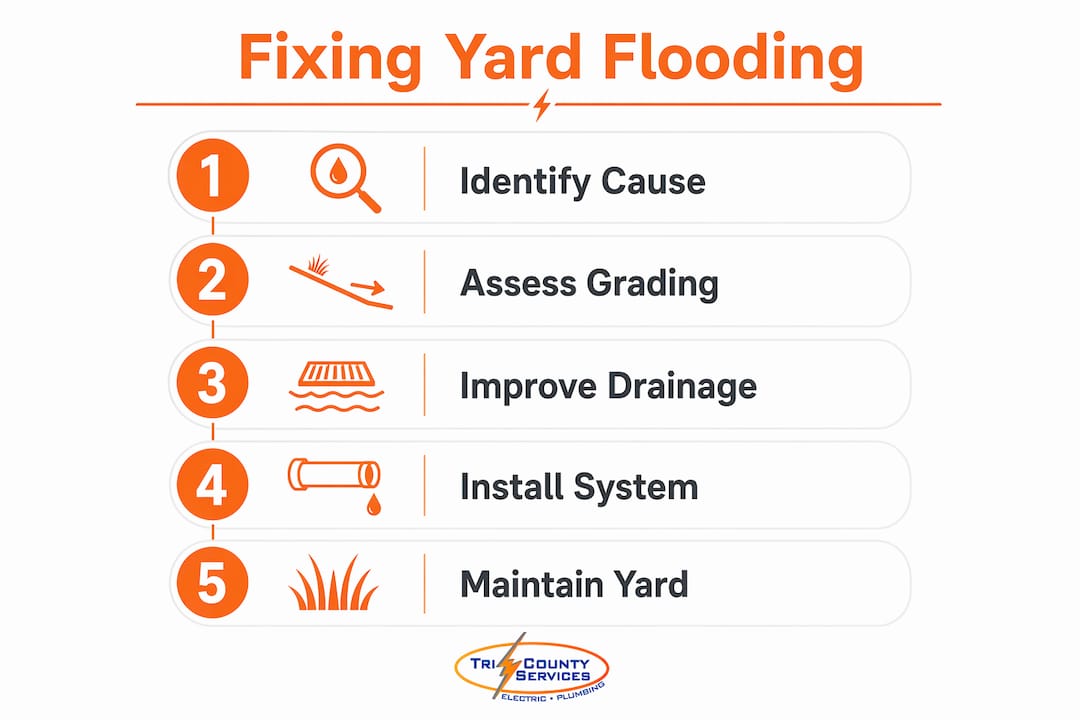
Heavy clay subsoil is the Northeast Ohio reality. Much of the region sits on dense glacial clay that simply cannot process rainfall at the rate it arrives. When a storm drops an inch of rain, a 2,000 sq ft roof sheds about 1,250 gallons during that event. Clay soil absorbs almost none of that quickly, so it spreads across the surface and finds every low spot.
Compacted soil behaves like clay even when it isn’t. Equipment traffic, foot traffic, and years of settling seal the surface so water can’t infiltrate at all.
Increased impermeable runoff from new driveways, patios, or additions redirects water that used to soak in across a wide area into a concentrated stream aimed at your yard.
Signs to watch for:
- Standing water in the same low spot after every storm
- Soggy turf that stays soft 48+ hours after rain stops
- Water pooling at or near the foundation
- New flooding that appeared after nearby construction
- Downspouts discharging within a few feet of the house
A quick visual check: walk the yard during or right after a heavy rain. Note where water starts, how long it stays, and whether it tracks back from a gutter or downspout. That information is exactly what a professional needs to design the right system.
How excavation solves wet yards: systems and what each one does
Different flooding causes call for different solutions. Here is what professionals typically propose and when each system makes sense.
| System | Best for | Key requirement |
|---|---|---|
| Regrading | Back-pitched soil, foundation pooling | Positive slope ≥2% for first 10 ft |
| French drain | Subsurface saturation, wet base of slopes | Perforated pipe, gravel, fabric, daylight outlet |
| Catch basin | Surface runoff concentration points | Pipe network to legal outlet |
| Swale | Sheet runoff across open yard | Correct fall, stable lining |
| Curtain drain | Groundwater migrating from uphill | Installed uphill of problem area |
| Dry well | Localized pooling, adequate native soil | Soil infiltration rate must support it |
Regrading reshapes the land itself through cut-and-fill work. It is often the first recommendation because no drain system performs well on a back-pitched site. French drains intercept subsurface water and carry it to an outlet through perforated pipe surrounded by washed stone and wrapped in geotextile fabric. Catch basins collect surface water at low points and pipe it away. Swales are shallow, grassed channels that guide sheet runoff to a safe discharge point. Curtain drains are installed uphill of a wet area to intercept groundwater before it ever reaches the problem zone. Dry wells work only where native soil can accept the water — not a reliable option in heavy clay without significant oversizing.
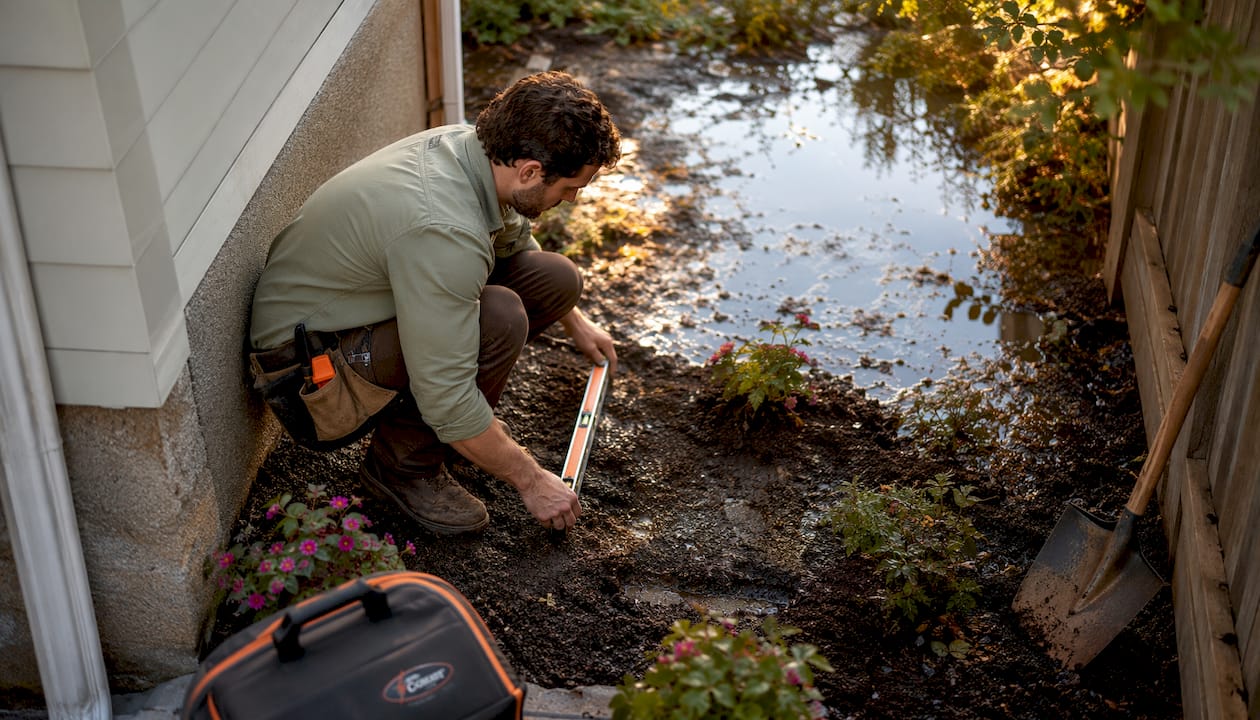
For most Northeast Ohio properties, a combined approach works better than any single system. Regrading plus a French drain plus a controlled outlet addresses surface geometry, subsurface saturation, and discharge in one project.
The four non-negotiables for a durable drainage install
Any professional drainage installation must meet four technical minimums. If a bid skips any of these, the system will fail.
- Correct slope. The drain pipe must maintain a consistent fall of at least 1% (ideally 2%) toward the outlet. Even a small back pitch turns a French drain into a buried bathtub.
- High-quality washed gravel. Clean, angular stone (typically ¾" washed gravel or ODOT #57 stone) allows water to move freely. Dirty or mixed fill clogs fast.
- Geotextile filter fabric, correctly placed. Fabric wraps the gravel envelope to keep soil fines out. Skipping it is the single most common reason French drains fail within a few years.
- A validated, legal outlet. Water has to go somewhere. That somewhere must be a legal daylight point, a properly sized dry well, or a connection to the municipal storm system with any required permits.
Pro Tip: Design the outlet first, then work backward to the collection system. A perfectly installed French drain that discharges into a neighbor’s yard or a low spot creates a new problem and potential legal liability.
In clay conditions, professionals typically upsize the trench width and gravel volume and may specify larger-diameter pipe because clay’s slow infiltration rate means the system must carry more water, not rely on the soil to absorb it.
Quick checks before you commit to excavation
Before scheduling a full project, run through these checks. They also make your professional site evaluation faster and more productive.
- Time how long water sits. If it’s still standing 48+ hours after rain stops, surface fixes won’t solve it.
- Check downspout discharge distance. Downspouts should extend at least 10 feet from the foundation. If they don’t, that’s the first thing to address.
- Look at the grade near the house. A simple 4-foot level and a tape measure can confirm whether soil pitches toward or away from the foundation.
- Probe for clay. Push a screwdriver or rod into the soil 12–18 inches. Resistance at a shallow depth often signals a clay layer that blocks downward drainage.
- Trace roof runoff during a storm. Watch where water from each downspout actually travels. It often reveals the source of a pooling problem that looks unrelated.
- Inspect culverts and driveway edges. A crushed or undersized culvert under a driveway can back up stormwater into the yard.
Questions to bring to the professional evaluation: Where will the outlet discharge, and is it permitted? Will the project require a municipal stormwater permit? How will the lawn be restored after excavation? What warranty covers the installation?
What a professional drainage project actually looks like
Understanding the project phases helps you budget time and money realistically.
- Site assessment and plan. A professional measures slope, probes soil, identifies a legal outlet, and reviews any local stormwater rules. This step determines everything else.
- Permits and approvals. Ohio townships and municipalities vary on what requires a permit. Connecting to a storm sewer or discharging to a roadside ditch typically does. Your contractor should handle this.
- Excavation and installation. Trenching, pipe placement, gravel, and fabric installation. Clay soils require wider trenches and more gravel volume than sandy conditions.
- Outlet connection. The system is tied to its discharge point and tested for flow.
- Backfill, compaction, and final grading. Disturbed soil is compacted in lifts to prevent settlement.
- Restoration. Topsoil, seed or sod, and any hardscape repairs bring the site back to usable condition.
Timeline: A straightforward surface regrading job can wrap in one to two days. A full French drain system with outlet work typically runs three to five days. Deep footer drains or combined systems on larger properties can take a week or more.
Timing matters in Northeast Ohio. Late summer through early fall is the preferred window. Soil is drier and easier to work, seed establishes before winter, and the system is in place before the heavy rain and snowmelt season arrives. Scheduling work in November means excavating wet clay, which costs more and takes longer.
Rough cost ranges vary by system complexity, soil conditions, and outlet distance. Surface regrading tends to run on the lower end; combined French drain and curtain drain systems with long outlet runs sit at the higher end. A professional site evaluation gives you a real number for your specific conditions. For a sense of how excavation compares to trenchless alternatives, this cost breakdown is a useful reference.
Why DIY drainage fails and why professionals get it right
DIY surface fixes fail because they address what you can see, not what’s happening below grade. Incorrect slope, missing filter fabric, and poor outlet selection are the leading causes of system failure. A drain that discharges into a low spot or a neighbor’s property doesn’t just fail — it can create legal liability and municipal enforcement issues.
Excavation also intersects with systems most homeowners don’t expect. Sump pump wiring, outdoor electrical outlets, and underground utility lines all come into play on a drainage project. Hitting a line during DIY trenching is a real risk; so is installing a sump without a proper circuit.
Tri-County Services Electric & Plumbing has served Northeast Ohio since 1975. The team coordinates drainage projects with the plumbing and electrical work that often comes with them: sewer and drain services, sump pump tie-ins, and exterior electrical coordination. Before any excavation begins, a professional evaluation confirms slope, soil conditions, outlet legality, and permit requirements. Before-and-after documentation and clear warranty terms are part of every project.
For homeowners whose flooding may also involve a blocked line, a camera inspection can rule out a clogged drain before committing to full excavation.
Key takeaways
Excavation fixes persistent yard flooding by correcting the root hydrology — grading, soil infiltration, and a legal outlet — rather than managing surface symptoms.
| Point | Details |
|---|---|
| Identify the root cause | Match symptoms (location, duration, relation to gutters) to causes before choosing a system. |
| Require the four non-negotiables | Correct slope, washed gravel, filter fabric, and a validated outlet are non-optional on any installation. |
| Design the outlet first | A drain without a legal discharge point creates liability; plan the outlet before the collection system. |
| Time the project right | Late summer through early fall is the best window for Northeast Ohio excavation and turf recovery. |
| Call Tri-County Services Electric & Plumbing | Professional site evaluation confirms slope, soil, and outlet before a dollar is spent on materials. |
A Northeast Ohio perspective on drainage pitfalls
The most consistent mistake homeowners make here isn’t choosing the wrong drain type — it’s underestimating what Northeast Ohio clay actually does to a drainage system over time.
Clay doesn’t just slow infiltration. It shifts. Freeze-thaw cycles in a typical Ohio winter move soil in ways that gradually alter the slope of a pipe run. A French drain installed at 1% fall in October can develop a back pitch by spring if the trench wasn’t compacted properly in lifts. That’s not a materials failure. It’s a workmanship and process issue that only shows up after the first hard winter.
Spring snowmelt compounds the problem. When several inches of snow melt over a week or two on already-saturated clay, the ground has no capacity left. Any drainage system that was sized for rainfall alone gets overwhelmed. Professionals who work regularly in this region account for snowmelt volume in their designs; contractors from outside the area often don’t.
On the permit side: Ohio townships vary more than most homeowners expect. Some require nothing for a private French drain that daylights on your own property. Others require a stormwater permit the moment you connect to a roadside ditch or storm sewer. Getting that wrong doesn’t just create a fine — it can mean tearing out a completed installation. Ask the permit question before the first shovel goes in the ground.
Tri-County Services Electric & Plumbing handles drainage from evaluation to restoration
Yard flooding in Northeast Ohio rarely has a single fix, and it almost never has a safe DIY fix. The soil conditions, permit requirements, and the electrical and plumbing systems that intersect with excavation work make professional coordination the practical choice, not just the cautious one.

Tri-County Services Electric & Plumbing offers professional site evaluations for homeowners and businesses across Northeast Ohio, coordinating drainage installation with the sump pump wiring, exterior circuits, and plumbing connections that drainage projects frequently require. The team has been doing this work in the region since 1975, and they bring the local soil and permit knowledge that out-of-area contractors miss.
If your yard stays soggy after every storm, the right next step is a site evaluation, not a trip to the hardware store. Request a professional evaluation or explore residential services to get a real diagnosis and a plan with real numbers attached.
Useful sources and references
| Resource | What it covers |
|---|---|
| Fairfax County Soil & Water Conservation — Wet Yard Drainage | Soil infiltration rates, clay vs. sand absorption, and residential drainage guidance |
| ICC Codes & Standards — Site Drainage | Slope specifications and site drainage requirements for residential construction |
| US EPA — Mitigate Flooding | Green infrastructure approaches, infiltration trench and rain garden performance data |
Have these references on hand when meeting with a contractor. The ICC slope standard (≥2% for the first 10 feet) and the Fairfax County infiltration data are the two most useful benchmarks for evaluating a drainage proposal.
FAQ
Why does my yard stay soggy for days after rain?
Standing water that lingers 48+ hours typically signals poor grading, compacted soil, or a clay subsoil layer that can’t absorb water fast enough. Clay soil absorbs only about 0.2 in/hr, so even moderate rainfall overwhelms it quickly.
Will a French drain fix my backyard flooding?
A French drain solves subsurface saturation and wet areas at the base of slopes, but only when it has a valid outlet and correct slope. Without those two elements, the drain collects water with nowhere to send it.
Do I need a permit for yard drainage work in Ohio?
It depends on your township and where the water discharges. Connecting to a roadside ditch or municipal storm sewer typically requires a permit; a private daylight outlet on your own property often does not. Ask your contractor before work begins.
When is the best time to install drainage in Northeast Ohio?
Late summer through early fall is the preferred window. Soil is drier, excavation is cleaner, seed establishes before winter, and the system is working before snowmelt season arrives.
Can Tri-County Services Electric & Plumbing handle both the drainage and the electrical work?
Yes. Tri-County Services Electric & Plumbing coordinates drainage projects with sump pump wiring, exterior circuits, and plumbing connections, covering the full scope of what excavation projects in Northeast Ohio typically require.