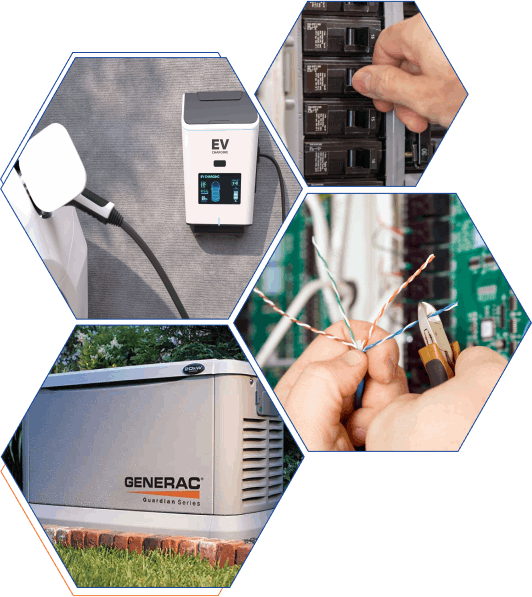


Whole home generator installation is the process of integrating a standby generator into your home’s electrical and fuel systems to deliver automatic backup power the moment the grid fails. Unlike portable units, a properly installed standby generator activates within seconds, covers every circuit in your house, and requires no manual setup during a storm. Northeast Ohio homeowners know this reality well. The Cleveland-Akron area sees its share of ice storms, high winds, and summer outages that can last days. Under NEC Article 702, all standby generator work must meet strict safety and permitting standards. Professional installation is not optional. It protects your warranty, your home, and your family. Ready to protect your home from unexpected power outages? Call (440) 253-0332 today to schedule a whole-home generator consultation and get reliable backup power when you need it most.
What does whole home generator installation actually require before you start?
Preparation determines whether your project runs smoothly or drags on for months. The single most important first step is an electrical load assessment. This calculation identifies your home’s total power demand, including startup watts for your HVAC system, refrigerator, sump pump, and other major appliances. Generator sizing must match your actual electrical load. Oversized units waste money. Undersized units leave critical systems without power during an outage.
Fuel choice comes next. Natural gas connects directly to your municipal supply line and eliminates the need for on-site storage. Propane works well in areas without natural gas access but requires a tank, which adds to upfront cost and ongoing logistics. Your professional electrician will evaluate which option fits your property and local utility infrastructure.
Site selection is where many homeowners focus only on aesthetics and miss the bigger picture. Strategic placement near gas lines and your electrical panel reduces trenching and conduit runs, which directly lowers your total cost. The generator also needs clear access for annual maintenance. Tight corners or landscaping that blocks the unit creates problems later.
-
Conduct a full electrical load assessment before selecting a generator size
-
Choose between natural gas and propane based on local utility access and budget
-
Evaluate site placement for safety clearance, maintenance access, and proximity to panel and fuel supply
-
Check HOA rules and local zoning codes before finalizing placement
-
Apply for electrical, fuel, and zoning permits early, since approvals can take one to two weeks
Pro Tip: Start the permitting process before you finalize your contractor. Permit backlogs are common, and starting before storm season gives you a real scheduling advantage.
How does a professional install a standby generator step by step?
The physical installation is only one to two days of work, but the full project runs three to six weeks when you include permitting, site prep, and inspections. Understanding the full sequence helps you set realistic expectations and avoid frustration.
-
Site preparation. The crew pours a concrete pad or installs a pre-cast composite pad as the generator’s foundation. Concrete needs 24–48 hours to cure before the unit is set.
-
Generator placement. The unit is positioned on the pad with correct clearance from doors, windows, and vents. Propane systems require a minimum of 10 feet of clearance. All systems require at least 5 feet from openings.
-
Automatic transfer switch installation. The automatic transfer switch, or ATS, is wired between your utility meter and your main electrical panel. ATS prevents backfeed and protects both utility workers and your home’s wiring. This is the component that makes true whole-home backup possible.
-
Electrical panel connection. An electrician connects the generator’s output to your home’s main panel.
-
System testing. The installer simulates a power outage to confirm the ATS activates correctly, the generator reaches full load, and all circuits restore as expected.
-
Final inspection. Local authorities inspect the completed installation before the permit closes. No shortcuts here. An uninspected system can void your homeowner’s insurance.
Pro Tip: Ask your contractor for a written test report after the simulated outage test. It documents that the system performed correctly and gives you a baseline for future service calls.
The table below shows how each phase maps to the overall project timeline.
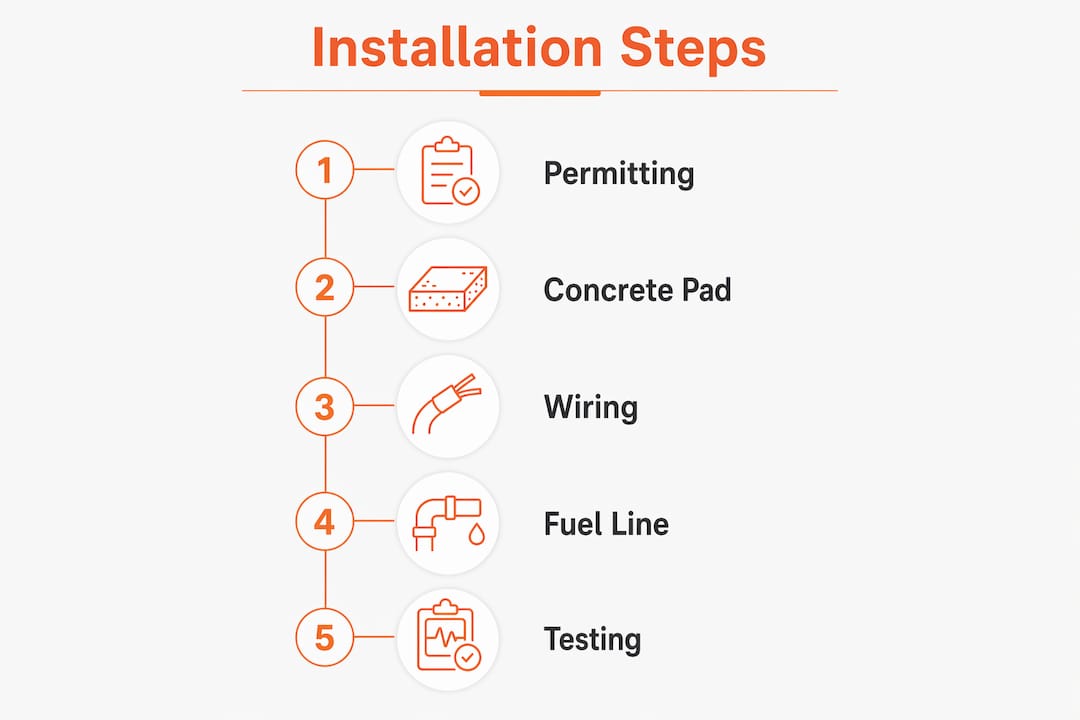
| Phase | Typical Duration |
|---|---|
| Permitting and approvals | 1–2 weeks |
| Concrete pad pour and cure | 2–3 days |
| Physical installation | 1–2 days |
| Fuel line connection | 1 day |
| Inspection and sign-off | 1–5 days |
Multi-trade coordination by a professional contractor managing electrical, gas, slab work, and permitting together is the single most effective way to avoid delays and safety hazards.
How much does a whole home generator installation cost?
Total installed costs for a residential standby generator range from $7,000 to $18,000, including equipment, labor, and permits. That range is wide because several variables push costs up or down significantly. Complex installs can exceed $20,000 when major electrical work is involved.
Natural gas systems run 10–15% cheaper than propane setups. The difference comes from propane tank infrastructure, which adds both material and labor costs. Permit fees typically fall between $50 and $200, though local jurisdictions vary.
-
Generator size and brand. Larger units covering more kilowatts cost more. Whole-home coverage for a larger house requires a bigger unit.
-
Electrical panel condition. Older panels often need an upgrade before a generator can connect safely. Panel upgrades add to the total project cost.
-
Gas line distance. The farther the generator sits from the existing gas supply, the more pipe and labor the job requires.
-
Concrete pad work. Pre-cast pads cost less than poured concrete. Site conditions like slopes or tight access affect labor time.
-
HOA requirements. Some associations require specific screening or enclosures, which add material and installation costs.
Get at least two detailed written estimates. A legitimate estimate breaks out equipment, labor, permits, and any site prep separately. Vague lump-sum quotes are a warning sign.
What safety codes and best practices govern the installation?
Safety compliance is not a formality. It is what separates a reliable home backup power system from a serious hazard. NEC Article 702 governs optional standby systems, which includes residential whole-home generators. Every installation must meet its requirements to pass inspection and preserve the manufacturer’s warranty.
Backfeed is one of the most dangerous risks in generator installation. Without a properly installed automatic transfer switch, power from your generator can flow back into the utility grid, creating a lethal hazard for line workers restoring power in your neighborhood. The ATS physically isolates your home from the grid before the generator activates, eliminating that risk entirely.
Carbon monoxide is the other major hazard. Standby generators must be placed outdoors with adequate ventilation. No generator should ever operate in an enclosed space, garage, or near any air intake. Minimum clearance distances of 5 feet from doors, windows, and vents are required by code. Propane systems carry a 10-foot minimum clearance requirement.
Electrical professionals handle both the electrical and gas connections for a reason. These are not tasks for a general contractor or a capable DIYer. Improper connections create fire, explosion, and electrocution risks. Local inspection closes the loop by confirming that every connection meets code before the system goes live.
How do you maintain your standby generator after installation?
A generator that sits unused for months without maintenance will fail when you need it most. Post-installation maintenance includes regular oil and filter changes, battery tests, and scheduled system test runs. Neglecting these tasks voids most manufacturer warranties and leads to failures during actual outages.
-
Run a test cycle monthly. Most modern standby generators do this automatically, but confirm the feature is enabled.
-
Change the oil and filter annually or per the manufacturer’s interval, whichever comes first.
-
Inspect the battery every six months. Cold Ohio winters are hard on batteries, and a dead battery means the generator will not start.
-
Check for debris, nesting animals, or vegetation growing near the unit each season.
-
Schedule a professional service visit once a year to inspect fuel connections, electrical contacts, and control board function.
Pro Tip: Keep a maintenance log near the unit or in a digital file. When you call for generator service, a complete history helps the technician diagnose problems faster and confirms your warranty compliance.
Warning signs that need immediate professional attention include unusual exhaust smoke, failure to start during a test cycle, error codes on the control panel, or any fuel smell near the unit.
Key Takeaways
A properly installed standby generator, sized correctly and connected through an automatic transfer switch, is the most reliable whole-house power solution available to Northeast Ohio homeowners.
| Point | Details |
|---|---|
| Size before you buy | Match generator output to your home’s actual electrical load, including HVAC startup watts. |
| Permit early | Permitting takes one to two weeks; HOA approvals can push timelines further. |
| ATS is non-negotiable | An automatic transfer switch prevents backfeed and enables hands-free whole-home backup. |
| Budget $7,000–$18,000 | Total installed cost varies by generator size, fuel type, panel condition, and site complexity. |
| Maintain annually | Oil changes, battery checks, and professional service preserve reliability and warranty coverage. |
What I’ve learned after years of watching these projects go sideways
The most common mistake I see homeowners make is treating generator installation like a simple appliance purchase. They pick a unit based on price, then discover the site they chose requires $3,000 in extra trenching, or that their panel needs a full upgrade before the generator can connect. These surprises are almost always avoidable with a proper site survey upfront.
HOA restrictions catch people off guard more than anything else. I’ve seen projects delayed by six weeks because a homeowner assumed placement approval was automatic. Get that approval in writing before you sign a contract with any installer.
The size-versus-budget tension is real. Whole-home coverage for a larger house costs more, and some homeowners try to save money by undersizing. That works until a winter storm knocks out power for four days and the generator can’t run the furnace and the refrigerator simultaneously. Size for what you actually need, not for what fits the budget today.
One thing that genuinely pays off is choosing a contractor who handles electrical, gas, and permitting as a single coordinated project. When those trades work separately without coordination, scheduling gaps add weeks to the timeline and create accountability gaps when something needs to be corrected.
Service contracts are worth the annual cost. A generator that gets professional attention every year is a generator that starts when the lights go out.
— Carla
Tri-County Services handles your generator installation from start to finish
Tri-County Services has served Northeast Ohio homeowners since 1975, and whole-home generator installation is one of the most requested services the team handles. The process involves electrical, gas, permitting, and site coordination all at once.
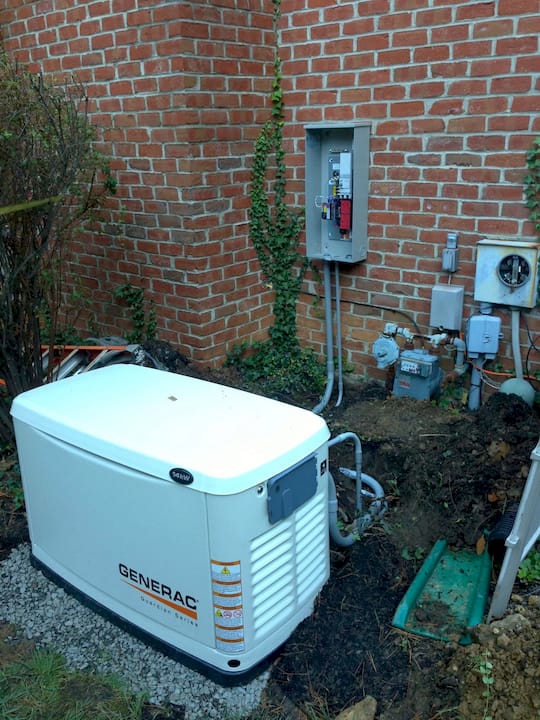
Tri-County Services manages every phase of the project, from the initial load assessment and site survey through permit filing, installation, and final inspection. The team’s professional electricians and plumbers work as a coordinated crew, which eliminates the scheduling gaps that cause delays when trades work independently. For homeowners in Cleveland, Akron, and the surrounding communities, that local experience with Northeast Ohio permit offices and utility providers makes a real difference. Call (440) 325-0136 or visit the website to schedule a consultation and get a detailed estimate for your home.
FAQ
How long does whole home generator installation take?
The full project takes three to six weeks, including permitting and site prep. The physical installation itself takes one to two days.
Do I need a permit to install a standby generator?
Yes. All whole-home standby generator installations require electrical and fuel permits, and most jurisdictions require a final inspection before the system can operate legally.
What size generator do I need for a whole house?
Generator size depends on your home’s total electrical load, including HVAC startup demand. An electrician performs a load assessment to determine the correct output rating for your specific home.
Is natural gas or propane better for a whole home generator?
Natural gas is generally 10–15% cheaper to install and operate because it connects directly to the municipal supply line. Propane is the better option in areas without natural gas access.
Can I install a whole home generator myself?
No. NEC Article 702 requires professionals for both the electrical and fuel connections. DIY installation voids warranties and will not pass the required inspection.