
A qualified electrical professional, like the technicians at Tri-County Services Electric & Plumbing, is who fixes frequent circuit breaker trips. Repeated tripping usually points to an overload, a short circuit, a ground fault, or aging wiring, and figuring out which one is happening requires testing equipment and training most homeowners don’t have on hand.
If your breaker has tripped more than once today, stop resetting it. Repeated trips are your electrical panel’s way of telling you something abnormal is pulling or leaking current, and forcing it back on over and over raises the risk of overheated wiring. Push the breaker fully to OFF, then firmly to ON one time. Unplug everything on that circuit first. If it trips again with nothing connected, leave it off and call a professional. That single step is the difference between a minor inconvenience and a wiring fire.
Key Takeaways
Frequent circuit breaker trips almost always trace back to overload, a short circuit, a ground fault, or aging wiring, and diagnosing which one it is requires a professional’s testing tools, not guesswork.
| Point | Details |
|---|---|
| Reset once, then stop | Turn the breaker fully OFF then ON one time; if it trips again immediately, leave it off. |
| Log the pattern | Note the time, devices running, and conditions for each trip to help a technician diagnose faster. |
| Know the red flags | Burning smells, sparks, a hot panel, or multiple breakers tripping together mean call immediately. |
| Don’t just swap the breaker | Replacing a breaker without finding the root wiring issue often means the new one trips too. |
| Call a professional for lasting fixes | Tri-County Services Electric & Plumbing diagnoses and repairs recurring trips across Northeast Ohio, from circuit repairs to full panel upgrades. |
Table of Contents
- Why does my breaker keep tripping, and what does it actually mean?
- What are the most common reasons a breaker keeps tripping?
- What can homeowners safely do before calling for help?
- When should you stop troubleshooting and call a professional?
- What does a professional actually do to diagnose and fix the problem?
- How much does it cost to fix a breaker that keeps tripping, and how long do breakers last?
- How do you stop a breaker from tripping again in the future?
- How Tri-County Services Electric & Plumbing handles repeated breaker trips
- Get your breaker checked before a small trip becomes a big problem
- Sources
- FAQ
Why does my breaker keep tripping, and what does it actually mean?
A circuit breaker is a safety switch, not a nuisance. Its entire job is to cut power the instant current exceeds what the wiring behind your wall can safely carry. When it trips once in a while during a legitimately heavy load, like running a space heater and a hair dryer on the same circuit, it’s doing exactly what it was built to do. When it trips repeatedly over days or weeks, that’s a different story entirely.
The Electrical Safety Foundation International (ESFI) explains that breakers exist specifically to stop current flow before it can overheat wiring or damage connected devices, and that a breaker tripping again and again is a signal the circuit itself needs inspection, not just a reset. Left unaddressed, that constant strain can degrade insulation on the wires inside your walls, and degraded insulation is one of the more common paths to an electrical fire.
Modern homes add another layer of protection with arc-fault circuit interrupter (AFCI) and ground-fault circuit interrupter (GFCI) devices, both designed to catch problems standard breakers can miss. A standard breaker mainly watches for overcurrent. AFCI and GFCI protection watches for arcing and current leakage, respectively, which is why a home with AFCI/GFCI coverage may trip more often than an older one, not because anything got worse, but because the system is finally catching problems that used to go unnoticed.
A quick reality check: most homes built before the late 1990s were never wired with AFCI protection. If yours trips constantly after an upgrade added that protection, it’s often the AFCI doing its job on a circuit that had a latent issue all along.
What are the most common reasons a breaker keeps tripping?
Electricians generally trace repeat trips back to a handful of root causes, and each one behaves a little differently. Homeowner-facing guidance from Angi narrows it down to three primary categories: overload, short circuit, and ground fault. Add arc-faults, aging components, and appliance failures, and you’ve got the full list worth knowing.
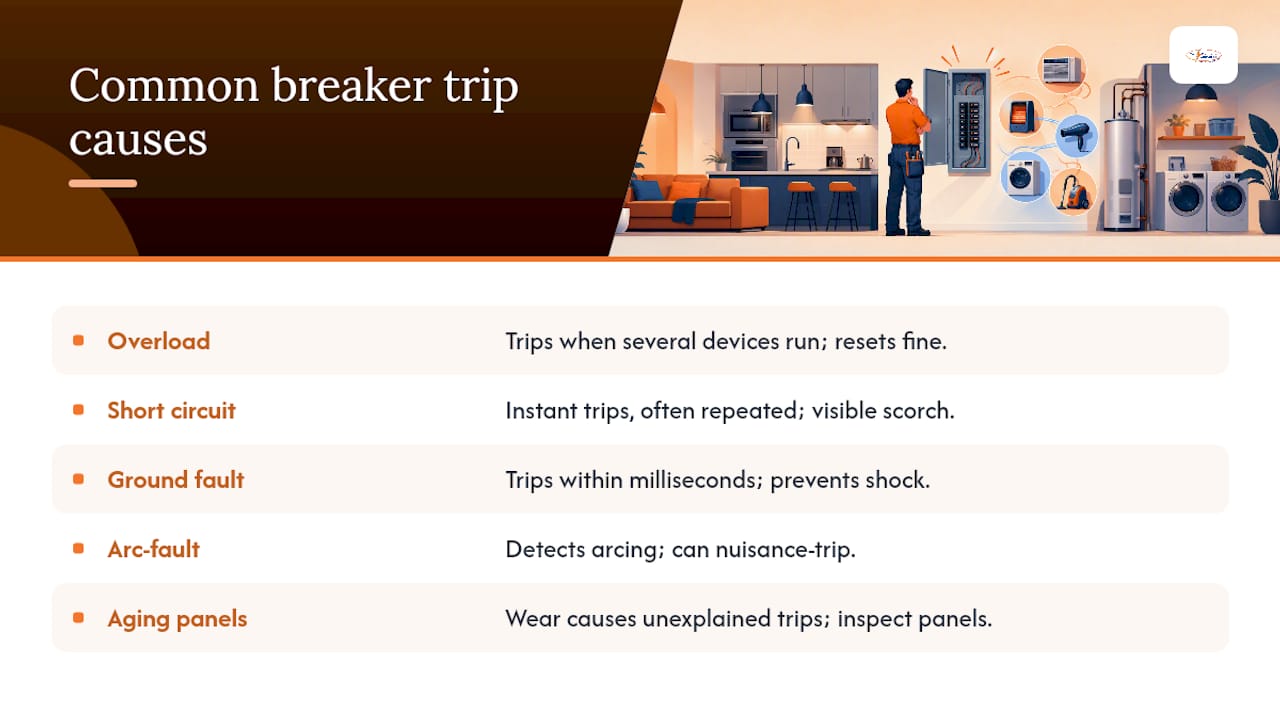
Overloaded circuits happen when too many devices draw power from one circuit at once. Kitchens, laundry rooms, and home offices are the usual suspects because they cluster high-draw appliances (microwaves, space heaters, window AC units) on circuits that were never sized for that load. The tell: the breaker trips only when several things run together, and it resets fine afterward.
Short circuits happen when a hot wire touches a neutral or ground wire, creating a sudden surge. These trips happen instantly and often repeatedly, sometimes accompanied by a burning smell, a scorch mark on an outlet, or a visible frayed cord. Treat this as urgent.
Ground faults occur when current escapes its intended path and finds a route through something it shouldn’t, often water or a person. These commonly show up in kitchens, bathrooms, garages, and outdoor outlets, which is exactly why those spaces get GFCI protection. A GFCI outlet or breaker trips fast, usually within milliseconds, specifically to prevent shock.
Arc-faults are trickier. According to AFCI Safety, AFCI devices are built to detect the hazardous arcing that happens when wiring is damaged, pinched, or deteriorating. They can also nuisance-trip when certain electronics create electrical “noise” the device misreads as an arc. Distinguishing a nuisance trip from a real arcing fault is exactly the kind of judgment call that needs a trained eye.
Aging panels and worn breaker components are a quieter cause. Breakers wear out mechanically over time, and older panels, especially those with aluminum wiring or outdated bus bar connections, become more prone to loose or overheating connections. A breaker that trips for no obvious reason on an older panel deserves a full inspection, not just a swap.
Pro Tip: Keep a simple log for a few days: the time each trip happened, what was running, whether it was raining or humid, and whether the breaker tripped the instant you reset it or only after a delay. That pattern tells a professional more in thirty seconds than a vague “it keeps tripping” ever could.
What can homeowners safely do before calling for help?
There’s a narrow, safe lane of troubleshooting you can do yourself, and it stops well short of touching wiring or opening the panel cover. The goal isn’t to fix the problem yourself. It’s to gather information a professional can use, and to rule out the simplest cause: overload.
- Unplug or switch off everything on the affected circuit before you touch the breaker. You want the circuit unloaded before you try resetting it.
- Reset it fully. Push the breaker handle all the way to OFF, then firmly back to ON. A lot of people just nudge it, which doesn’t reliably reset the internal mechanism.
- If it holds, reconnect devices one at a time, waiting a minute or two between each. Whatever’s running when it trips again is your overloaded culprit.
- If it trips instantly with nothing plugged in, stop. That’s not an overload. Leave the breaker off and don’t try again.
- Never tape, wedge, or force a breaker to stay on, and never replace one with a higher-amperage breaker to make the tripping stop. That defeats the entire safety purpose of the device and can leave undersized wiring exposed to more current than it can handle, as Schneider Electric’s engineers point out.
- Write down what you find, including the room, the devices involved, and the time of each trip. Bring that list when you call for service.
Guidance like this, echoed by electricians at outlets such as Zimmerman Electric, draws a firm line: resetting and unplugging is fine. Anything involving the panel’s interior, wire connections, or breaker replacement is not a homeowner task, and for good reason. Panels carry live current even when a breaker is off, and misdiagnosing a short circuit as a simple overload can mean sending someone back into a hazard you didn’t realize was there.
When should you stop troubleshooting and call a professional?
Some signs mean pick up the phone right now, not tomorrow. Others mean you have a day or two of breathing room. Knowing the difference matters.
Call immediately, this is a safety emergency, if you notice:
- A burning odor near an outlet, switch, or the panel itself
- Visible sparks when plugging something in or resetting the breaker
- Scorch marks, melted plastic, or discoloration around an outlet or the panel
- A panel or breaker that feels warm or hot to the touch
- A buzzing or crackling sound coming from the panel
- Multiple breakers tripping at the same time
Call the same day if:
- One breaker trips instantly every time you reset it, with nothing plugged in
- A single circuit has tripped more than two or three times in a week
- The panel is more than 25 to 30 years old and trips have become more frequent recently
Schedule a visit (non-urgent) if:
- Trips only happen when you run several specific high-draw appliances together
- You’re planning an addition, like a workshop or an EV charger, and want the circuit checked before installation
Before you call, jot down the trip log mentioned earlier: which circuit, what was running, how old the panel is, and whether you’ve noticed any recent changes like a new appliance or renovation work. A safety-focused explainer from American Home Shield makes the same point: immediate trips, a hot panel, or burning smells all mean it’s time for a professional, because the internal components of a breaker aren’t something a homeowner can safely service.
What does a professional actually do to diagnose and fix the problem?
A trained technician doesn’t start by swapping the breaker and hoping for the best. Diagnosis begins with a load check across the affected circuit, followed by a visual inspection of outlets, junction boxes, and the panel itself for scorch marks, loose connections, or corrosion. From there, testing typically includes checking AFCI and GFCI function, running insulation and continuity tests on suspect wiring, and using a thermal reading to spot connections running hotter than they should.
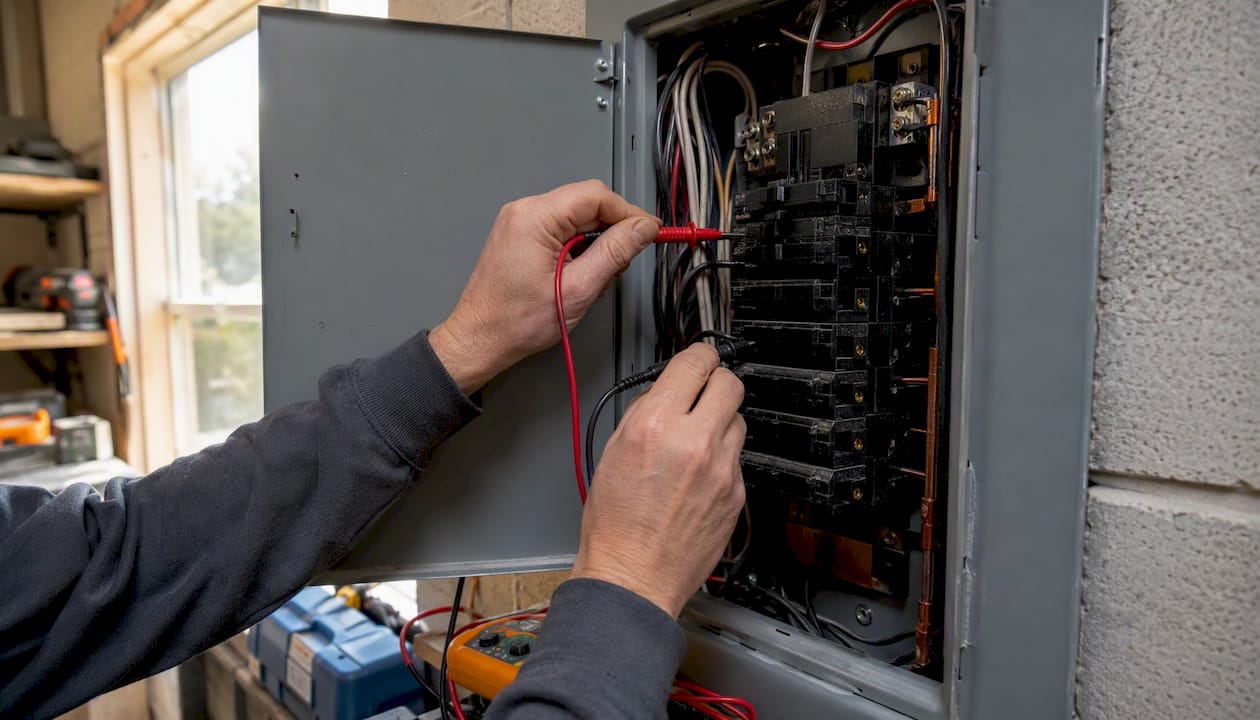
Siemens’ technical diagnostic guidance recommends exactly this kind of methodical, step-by-step flow for AFCI and GFCI trips rather than guessing at a cause, since arc-fault and ground-fault trips can look identical to an overload on the surface but require completely different fixes.
Once the cause is identified, the repair depends on what’s found. Overloaded circuits often get resolved by redistributing devices across circuits or adding a dedicated circuit for a specific appliance. Damaged or deteriorating wiring gets repaired or replaced outright. A worn breaker gets swapped for a new one, but only after confirming the underlying wiring isn’t also compromised, because as Schneider Electric notes, a new breaker on a bad circuit will simply trip again. Loose bus bar or neutral connections get tightened or rebuilt, and in cases where the panel simply can’t support the home’s current demand, a full panel upgrade gets recommended.
On a typical visit, expect the technician to walk you through findings before starting repairs, give you a written estimate, and take basic precautions like shutting off power at the main before opening the panel. Many visits wrap up with a short safety checklist or repair summary you can keep for your records.
Pro Tip: If a technician recommends a panel upgrade, ask specifically what capacity issue drove that recommendation. A good explanation ties back to your home’s actual electrical demand, not just the panel’s age.
How much does it cost to fix a breaker that keeps tripping, and how long do breakers last?
Costs vary widely depending on what’s actually wrong, how accessible the wiring is, and whether permit work is involved. Here’s a general range homeowners can expect for the most common fixes.
| Repair Type | Typical Range | What Drives the Cost |
|---|---|---|
| Outlet or wiring repair | Lower end for a single accessible outlet | Wall access, wire length, damage extent |
| Single breaker replacement | Moderate, includes labor and parts | Breaker type (standard vs. AFCI/GFCI), panel brand |
| Dedicated circuit installation | Mid to upper range | Distance from panel, wall/attic access, permit requirements |
| Full panel upgrade | Highest range | Panel capacity needed, service size, permit and inspection costs |
Costs like these are consistent with the ranges homeowner guides such as Angi describe, though every home’s wiring layout and panel condition shifts the final number. Get a written scope of work before agreeing to anything, and be cautious of a bid that’s dramatically lower than others. It often means safety testing, like AFCI/GFCI verification or thermal checks, got skipped to save time.
As for lifespan, a standard residential breaker can last for decades under normal conditions, but the internal components are factory-sealed and not meant to be opened or serviced by anyone outside a trained technician, a point Eaton’s own reconditioning documentation makes clear even for commercial-grade equipment. Panels themselves generally last 25 to 40 years, but a panel that’s frequently tripping, feels warm, or can’t support your home’s modern electrical load (think EV chargers, multiple AC units, and a kitchen full of appliances that didn’t exist when the panel was installed) is often due for replacement well before that window closes.
How do you stop a breaker from tripping again in the future?
Prevention comes in two flavors: changes you make around the house, and upgrades a professional installs. Both matter.
- Spread high-draw appliances (space heaters, window units, countertop cookers) across different circuits instead of clustering them on one.
- Stop using extension cords as a permanent wiring solution. They’re not rated for continuous heavy loads and hide a lot of overload problems.
- Use surge-protected power strips for sensitive electronics rather than plugging everything directly into an aging outlet.
- Ask about dedicated circuits for major appliances like refrigerators, microwaves, and washer/dryer units.
- Consider whole-home surge protection to shield your panel and connected devices from voltage spikes.
- Confirm AFCI and GFCI coverage matches current safety expectations for kitchens, bathrooms, garages, and outdoor circuits.
- If your panel is nearing capacity, a professional capacity upgrade solves the root problem instead of masking it.
Pro Tip: Planning a big addition, like an EV charger, a home workshop, or a new HVAC system? Get your panel’s capacity checked before installation, not after the new equipment starts tripping breakers. A dedicated circuit planned in advance is far cheaper than a patch fix added later.
How Tri-County Services Electric & Plumbing handles repeated breaker trips
When a Northeast Ohio homeowner calls about a breaker that won’t stop tripping, the process starts with a triage conversation: what’s tripping, how often, and whether any of the red-flag warning signs (burning smell, sparks, a hot panel) are present. That call determines whether the visit gets scheduled as an emergency or a standard appointment.
On-site, technicians work through a diagnostic checklist that includes load measurement on the affected circuit, a visual inspection of the panel and outlets, and AFCI/GFCI testing where applicable. Once the cause is confirmed, repairs are targeted, not guesswork, whether that means rebalancing loads, repairing damaged wiring, replacing a worn breaker, or recommending a panel upgrade when capacity is the real issue. Visits typically close with a follow-up safety check to confirm the fix holds.
Services relevant to recurring trip issues include circuit and panel repairs, breaker replacement, service panel upgrades, dedicated circuit installation, AFCI/GFCI testing, whole-home surge protection, and EV charger wiring for homeowners planning ahead. Homeowners across Northeast Ohio can request service by phone or online scheduling, and it helps to have the circuit location, a short symptom log, and the panel’s approximate age ready when you call.
A safety-first perspective on why this isn’t a DIY job
Decades of doing this work in Northeast Ohio homes has shaped one consistent view: the panel is the one part of a house where guessing carries real consequences. A breaker tripping repeatedly isn’t a puzzle to solve with YouTube videos and a multimeter from the hardware store. It’s a live electrical system telling you something is wrong, and the only way to know what, definitively, is testing equipment and training most people never have reason to own.
What gets underestimated is how often a “simple” breaker swap masks a real wiring problem underneath. Homeowners replace the breaker, the trips stop for a few weeks, and then they start again because the actual fault, a pinched wire, a failing connection, was never addressed. A proper diagnostic process, done once and done right, costs less in the long run than repeated service calls chasing the same symptom. That’s the whole philosophy behind clear estimates and minimally disruptive repairs: find the actual cause the first time, explain it plainly, and fix it without turning your house upside down for a week.
Disassembling a panel or attempting to repair a breaker’s internal components is not a weekend project, no matter how confident the instructions online sound. A professional’s job is to prioritize your safety and code compliance over speed, and that’s worth more than saving a service call fee.
Get your breaker checked before a small trip becomes a big problem
Tri-County Services Electric & Plumbing gives Northeast Ohio homeowners a direct path to a real diagnosis instead of a guessing game, with technicians who handle breaker and panel repairs, dedicated circuit installation, AFCI/GFCI testing, and emergency electrical calls throughout the region.

If your breaker has tripped more than once this week, or you’ve noticed any warning sign like a warm panel or a burning smell, it’s worth getting it looked at before the underlying issue gets worse or more expensive to fix. Tri-County Services covers homes and businesses throughout Northeast Ohio, and scheduling starts with a phone call or a quick online request. Visit the electrical repair service page to see what’s involved, or call (440) 325-0136 to get a technician out to diagnose the problem and give you a clear, written plan for fixing it.
Sources
- Understanding your home electrical system — ESFI
- What is AFCI? — AFCI Safety
- Electricians explain why circuit breakers trip — Angi
- Obsolete breakers: debunking common misconceptions — Schneider Electric blog
FAQ
Why is my circuit breaker tripping so frequently?
It’s usually one of three causes: an overloaded circuit, a short circuit, or a ground fault, though arc-faults and aging wiring or panel components can also be behind it. Recording when trips happen and what’s running helps a professional narrow it down quickly.
How do I stop a breaker from continuously tripping?
Unplug everything on the circuit, reset the breaker fully to OFF then ON, and reconnect devices one at a time to check for overload. If it trips instantly with nothing plugged in, stop and call a professional rather than continuing to reset it.
How much does it cost to fix a breaker that keeps tripping?
Costs range from a modest fee for a simple outlet or breaker repair up to a much larger investment for a full panel upgrade, depending on what’s causing the trips and how accessible the wiring is. Getting a written estimate from a qualified professional, like Tri-County Services Electric & Plumbing, before work begins helps you budget accurately.
How many times can a breaker trip before it needs to be replaced?
There’s no fixed trip count that triggers replacement. What matters more is the pattern: a breaker that trips repeatedly even after the load is reduced, or one on an older panel, usually needs a professional inspection to determine whether the breaker, the wiring, or the panel itself needs attention.
Can I replace a breaker myself to stop the tripping?
Internal breaker components are factory-sealed and not meant to be serviced by homeowners, and swapping a breaker without finding the underlying wiring fault often just means the new one trips again. This is work for a qualified professional who can test the circuit properly before replacing anything.