
When the power goes out, the first 10 minutes matter most. Stay calm, switch on a battery-powered flashlight, keep the refrigerator and freezer closed, unplug sensitive electronics, and call your utility to report the outage. If anyone in your home depends on powered medical equipment, contact your provider immediately.
Your immediate checklist:
- Grab a flashlight or battery lantern. Avoid candles near curtains, paper, or anything flammable.
- Check your circuit breaker panel to see if the outage is isolated to your home.
- Report the outage to your utility company or check their online outage map.
- Keep the refrigerator and freezer doors closed.
- Unplug computers, TVs, and other sensitive electronics to protect them from surge damage when power returns.
- Leave one lamp switched on so you know the moment electricity is restored.
Pro Tip: Never run a generator indoors, in a garage, or near any window or vent. Carbon monoxide is colorless and odorless, and it kills fast. Per Ready, generators must be placed at a safe distance from windows, doors, and attached garages.
Key Takeaways
Staying safe during a power outage comes down to a few non-negotiable actions: protect people first, then food and medications, and call a professional for anything electrical that looks or smells wrong.
| Point | Details |
|---|---|
| Refrigerator safe window | Keep the fridge closed; food stays safe for about 4 hours, a full freezer for about 48 hours. |
| Generator placement | Run generators at least 20 feet from windows, doors, and garages; install battery-backup CO detectors on every level. |
| Medical device prep | Arrange at least 48 hours of backup power and a clinician-approved contingency plan before an outage occurs. |
| Discard rule | Throw out refrigerated food that has been above 40°F for two or more hours — when in doubt, throw it out. |
| Call Tri-County Services | Contact Tri-County Services Electric & Plumbing for burning smells, repeated breaker trips, water in panels, or generator transfer-switch work. |
Table of Contents
- What should you do in the first 30 minutes after power loss?
- How long will your food stay safe?
- How do you protect medical devices and medications?
- Generator safety: what you must know before you start one
- Safe heating and cooking when the power is out
- Which appliances should you unplug, and what are the red flags?
- What to do once the power comes back on
- How to prepare for a 72-hour outage
- When should you call a professional electrician or plumber?
- Sources
- FAQ
What should you do in the first 30 minutes after power loss?
The first half-hour sets the tone for everything that follows. Work through these steps in order.
Check whether it’s just your home
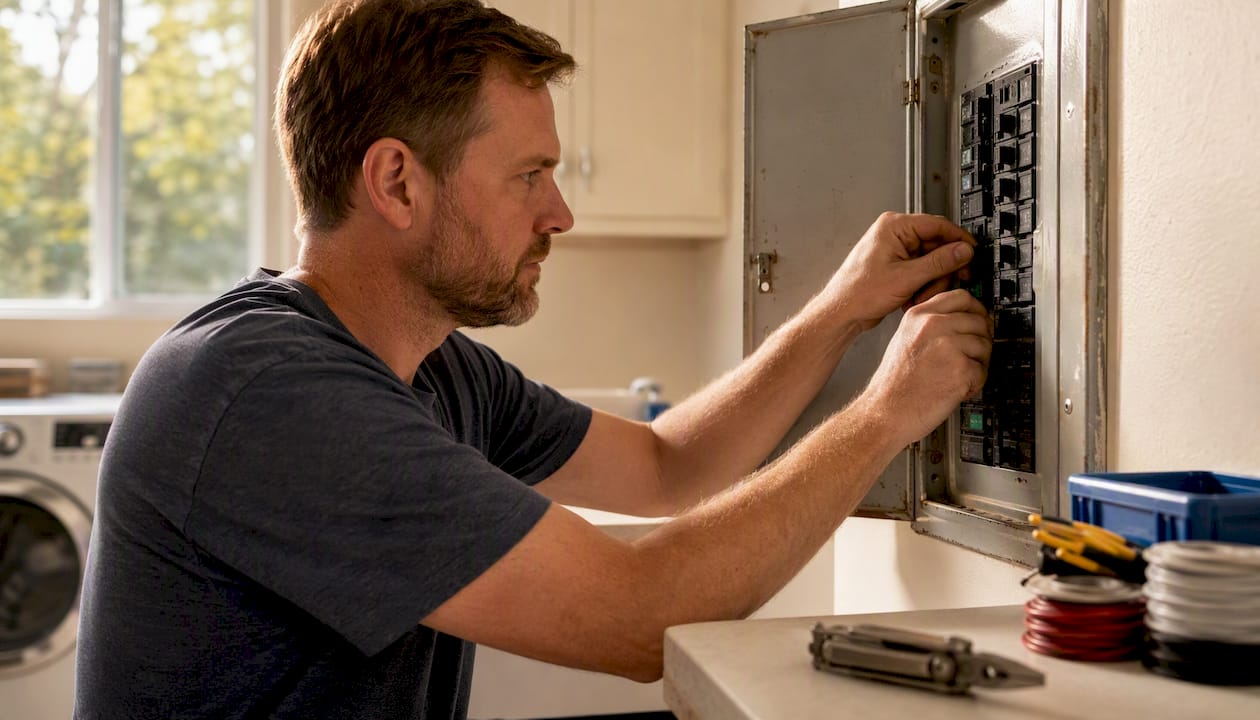
Before calling the utility, open your breaker panel and look for any tripped breakers (they’ll sit between ON and OFF). Reset a tripped breaker by pushing it fully to OFF first, then back to ON. If the breaker trips again immediately, stop. That’s a sign of a wiring or appliance problem, not a simple fix. Check your utility’s outage map online or call their outage line to confirm whether the whole neighborhood is affected.
For a more detailed walkthrough of what to check before calling a pro, the no electricity troubleshooting guide from Tri-County Services Electric & Plumbing covers breaker checks and GFCI basics clearly.
Downed power lines and outdoor hazards
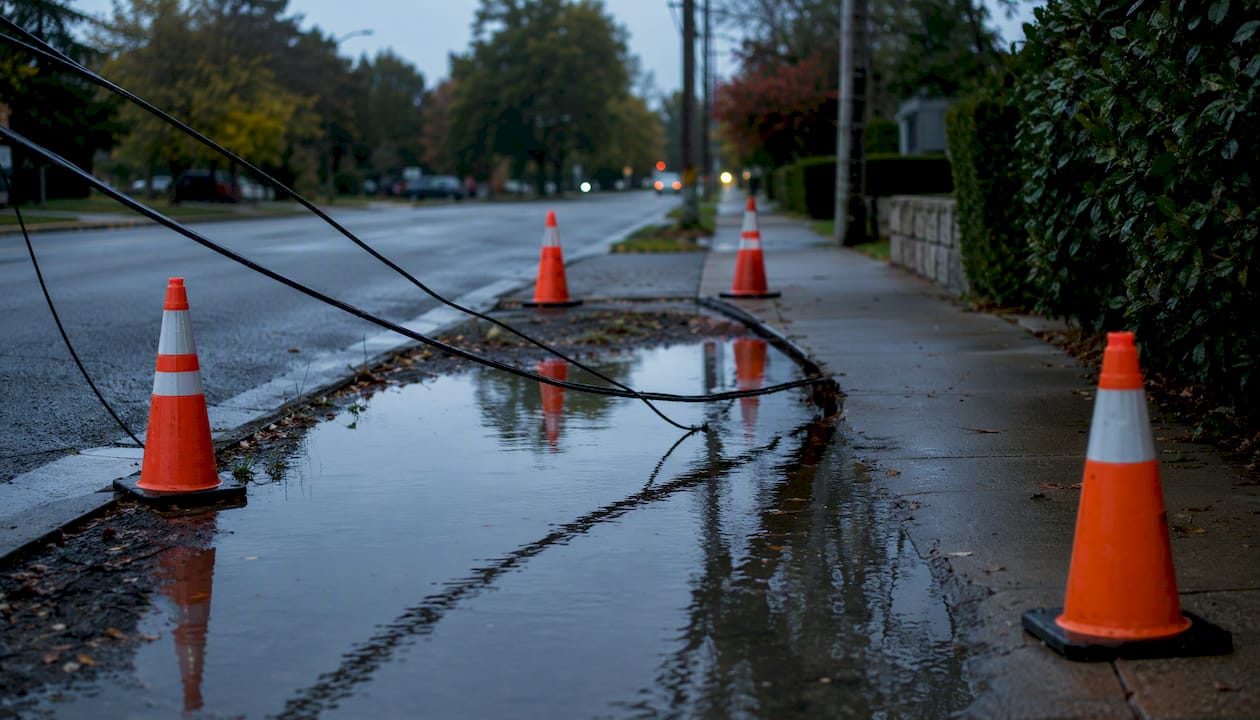
If you see a downed line outside, treat it as live. Don’t approach it, don’t drive over it, and don’t let children near it. Call 911 and your utility immediately. If water is pooling near any downed line, stay well back and keep others away.
Lighting and fall risk
CDC guidance specifically flags fall risk in the dark as a serious hazard, particularly for older adults. Battery-powered lights placed at stairways, hallways, and bathrooms reduce that risk far better than candles, which introduce fire danger. Keep paths clear of anything you’d trip over in the dark.
Electrical triage
Unplug or power off TVs, computers, gaming consoles, and microwaves. Leave the refrigerator and freezer plugged in. Leave one lamp on as your power-return indicator. If you smell burning or see sparks near your panel or any outlet, don’t touch anything. Call a professional right away.
How long will your food stay safe?
Food safety is one of the most underestimated risks during an outage. The rules are simple, but people routinely guess wrong.
According to the American Red Cross, an unopened refrigerator keeps food cold for about 4 hours. A full freezer holds temperature for roughly 48 hours; a half-full freezer, about 24 hours. The key word is “unopened.” Every time you open the door, you lose cold air and shorten that window.
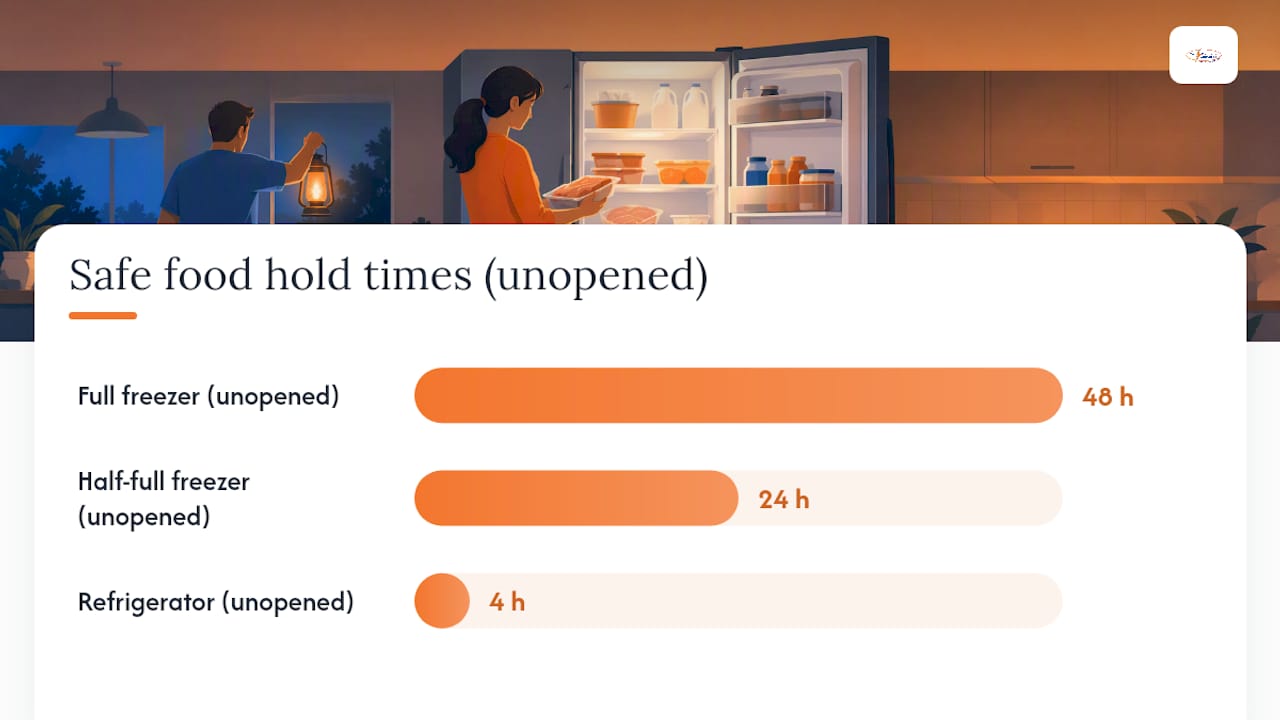
| Storage | Safe hold time (unopened) | Discard threshold | Action |
|---|---|---|---|
| Refrigerator | ~4 hours | Above 40°F for 2+ hours | Discard perishables |
| Full freezer | ~48 hours | Thawed with no ice crystals | Discard or cook immediately |
| Half-full freezer | ~24 hours | Thawed with no ice crystals | Discard or cook immediately |
Immediate fridge and freezer steps:
- Keep both doors closed as much as possible.
- Place bags of ice or frozen water bottles inside to extend cold time.
- Move critical refrigerated medications (insulin, biologics) to a cooler with ice if the fridge warms above the safe range.
- Use a refrigerator thermometer to get an actual temperature reading, not a guess based on how long the power has been out. Visual checks alone are unreliable.
The rule for discarding is blunt: if refrigerated food has been above 40°F for two hours or more, throw it out. Smell and appearance are not reliable indicators of safety. “When in doubt, throw it out” is not just a slogan.
Pro Tip: Keep a standalone fridge/freezer thermometer in both your refrigerator and freezer year-round. When power returns, you’ll have an actual temperature reading rather than guessing based on elapsed time alone.
How do you protect medical devices and medications?
If anyone in your household depends on a powered medical device — a CPAP machine, home oxygen concentrator, infusion pump, or dialysis equipment — a power outage is a medical situation, not just an inconvenience.
Harvard Health recommends that people relying on powered medical equipment have backup power available for a suitable duration and a contingency plan worked out with their clinician well before an outage occurs. That plan should include knowing where the nearest powered facility is if home backup fails.
Checklist for medically dependent households:
- Invest in a portable battery backup sized for your specific device’s power draw.
- Keep at least 48 hours of battery capacity charged and ready.
- Store a written list of all devices, their power requirements, and emergency contacts in your kit.
- Register with your utility company as a medical-baseline or life-support customer. Many Ohio utilities maintain priority lists for restoration and can flag your address for emergency crews.
- Contact your local fire department or EMS to let them know a power-dependent resident lives at your address.
For refrigerated medications, the stakes are high. Insulin, for example, should be stored within recommended temperature ranges and discarded if frozen. If it warms above 46°F for an extended period, contact your pharmacist before using it. Don’t assume it’s still effective based on appearance alone. Your pharmacist can advise on specific storage exceptions and whether a particular lot is still viable.
Generator safety: what you must know before you start one
Generators save lives during extended outages. They also kill people every year through carbon monoxide poisoning, electrical backfeed, and fires. The rules are not suggestions.
Per Ready.gov and CDC guidance, generators must be operated outdoors, at least 20 feet from any window, door, or attached garage. Carbon monoxide is colorless and odorless. By the time you feel symptoms, you may not be able to move. Install battery-backup CO detectors on every level of your home and test them monthly.
Portable generator safety checklist:
- Position the unit at least 20 feet from the house, with the exhaust pointing away from any opening.
- Use only heavy-duty, outdoor-rated extension cords rated for the load you’re running.
- Never refuel while the generator is running or still hot. Let it cool completely first.
- Keep the unit dry. Operate it under a canopy or open shelter, never in a garage or shed.
- Never plug a generator directly into a wall outlet. This creates backfeed, which can electrocute utility workers on the line. A transfer switch is the only safe connection method.
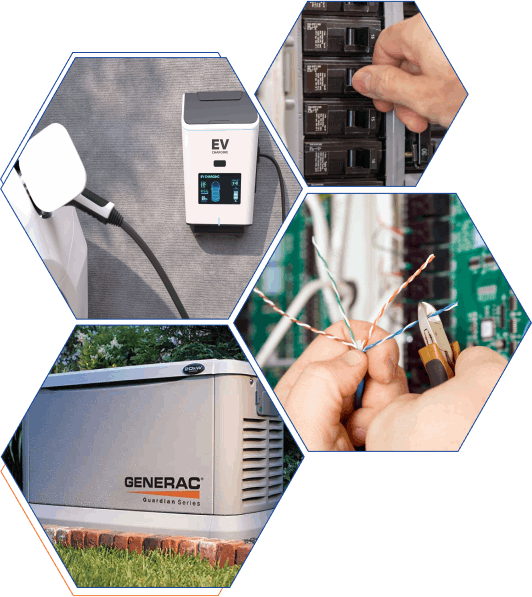
When to call a professional for generator work: any permanent hookup to your home’s electrical system requires a transfer switch installed by a qualified professional. This is not a gray area. Improper connections violate electrical code, void homeowner’s insurance, and put utility workers at risk. If you’re considering a whole-home standby generator, read through the whole-home generator installation guide before making decisions on sizing and placement.
Pro Tip: A standby generator with an automatic transfer switch eliminates the manual setup entirely. It detects the outage and switches on within seconds, without you touching anything. For households with medical devices or sump pumps, that automatic response time matters.
Safe heating and cooking when the power is out
This is where people make dangerous mistakes, usually because they’re cold or hungry and improvising.
Never use a gas oven, charcoal grill, camp stove, or propane heater indoors to warm your home. These produce carbon monoxide and, in the case of charcoal, significant amounts of it even when you think the space is “ventilated.” The same applies to running a generator in a garage with the door open. Ready PA guidance is clear: ovens and stovetops used for heating increase both fire and CO risk significantly.
Safe alternatives:
- A properly installed, vented wood stove or fireplace insert is one of the safest heat sources during an outage.
- EPA-approved electric space heaters work well if you have generator power, but keep them at least three feet from anything flammable and never leave them unattended.
- Dress in layers and close off unused rooms to concentrate heat in the spaces where people are.
- In Northeast Ohio winters, know where your nearest public warming shelter is before you need it. Local emergency management agencies and the Red Cross maintain shelter lists during declared emergencies.
For cooking, outdoor grills and camp stoves are fine when used outside. Bring the food in; leave the heat source out. Never bring a lit grill onto a porch or into a garage, even partially.
For Ohio-specific seasonal prep, the Ohio homeowner winter storm guide from Tri-County Services Electric & Plumbing covers cold-weather specifics in detail.
Which appliances should you unplug, and what are the red flags?
The surge that hits when power returns can damage electronics that survived the outage itself. Unplug or switch off everything except the refrigerator and freezer before power comes back.
Unplug during an outage:
- Computers, monitors, and external hard drives
- Televisions and streaming devices
- Microwaves and countertop appliances
- Window air conditioning units
- Washing machines and dryers
Leave the refrigerator and freezer running if you have generator power. Leave one lamp on as your restoration signal.
Red flags that mean stop and call a professional:
- A burning smell from any outlet, switch, or appliance
- Visible sparks or scorch marks near your panel or outlets
- Breakers that trip immediately after you reset them
- Any outlet or switch that feels warm or hot to the touch
- Water intrusion into electrical panels, outlets, or junction boxes
These are not situations to troubleshoot yourself. Forced breaker resets after wiring damage can cause fires. A home safety inspection checklist can help you identify which areas of your home need a professional eye after an outage involving water or structural damage.
What to do once the power comes back on
Don’t just flip everything back on. A few minutes of caution here prevents appliance damage and foodborne illness.
First, check your refrigerator thermometer. If the temperature is above 40°F and has been for two hours or more, discard the perishables. For the freezer, look for ice crystals. Food that still has ice crystals throughout is generally safe to refreeze or cook. Food that has fully thawed with no crystals should be cooked immediately or discarded.
For medications, if your refrigerator warmed above the safe range for your specific medication, call your pharmacist before using anything. Don’t assume the medication is fine because it looks normal.
On the electrical side, reset surge protectors before plugging devices back in. Then reconnect appliances gradually, starting with the refrigerator, then major appliances, then smaller electronics. This staged reconnection avoids overloading the circuit the moment power returns.
If breakers trip immediately when you restore power, don’t force them. That pattern points to wiring or appliance damage. Call Tri-County Services Electric & Plumbing for a post-outage electrical inspection before using those circuits again.
How to prepare for a 72-hour outage
Most outages resolve within hours. But winter storms, ice events, and major grid failures in Northeast Ohio can stretch to days. Preparing for 72 hours costs very little and changes everything.
Core emergency kit (per Mass):
- Water: one gallon per person per day, minimum three-day supply
- Nonperishable food: canned goods, protein bars, peanut butter
- Battery-powered or hand-crank radio for emergency alerts
- Flashlights and extra batteries
- First-aid kit
- Portable phone charger or power bank, kept charged
- Copies of critical documents and a list of emergency contacts
Home preparation steps:
- Charge all devices and power banks before a storm hits.
- Fill your bathtub with water if your home is on a well pump. Electric pumps stop working during outages, and that water covers toilet flushing and basic sanitation.
- Freeze water bottles ahead of time to extend freezer cold time.
- Move a three-day supply of critical medications into your kit with a cold pack if needed.
Family plan basics:
- Designate a meeting point outside your home and one outside your neighborhood.
- Assign someone to check on elderly or disabled neighbors.
- Identify a family contact outside the area who everyone can reach to relay status updates.
- Sign up for your county’s emergency alert system and your utility’s outage notifications.
For portable solar panels and battery stations, options like Goal Zero or Jackery work well for phone charging and small device power. They won’t run a refrigerator, but they keep communication going. If you’re on a well pump or have a sump pump, a whole-home generator is the only real solution for extended outages.
When should you call a professional electrician or plumber?
The short answer: sooner than most people do.
Call a professional immediately if you notice any of the following:
- Burning smell from your panel, outlets, or wiring
- Visible arcing, sparks, or scorch marks anywhere in your electrical system
- Breakers that trip repeatedly after being reset
- Water intrusion into your electrical panel, outlets, or any wiring
- Any need to connect a generator to your home’s electrical system
Tri-County Services Electric & Plumbing handles all of these situations for residential and commercial clients across Northeast Ohio. Services relevant to outage recovery include emergency electrical repairs, circuit and panel repairs, transfer switch installation, whole-home generator installation and service, and post-outage electrical inspections.
The reason professionals matter here goes beyond convenience. Backfeed from an improperly connected generator can energize utility lines and kill lineworkers. A forced breaker reset on damaged wiring can start a fire inside a wall where you won’t see it for hours. Code-compliant work protects your home, your insurance coverage, and the people working to restore your power.
Tri-County Services Electric & Plumbing has served Northeast Ohio since 1975. For plumbing emergencies during outages — sump pump failures, water heater issues, or drain problems that surface when systems restart — their team handles those calls as well.
A note from the Tri-County Services team
Power outages in Northeast Ohio are a reality, especially during winter storms and summer thunderstorm season. The calls we get most often after a major outage involve two things: generators that were connected unsafely, and electrical panels that took damage nobody noticed until something stopped working weeks later. Both are preventable. Keep generators outside, keep CO detectors fresh, and if anything about your electrical system looks or smells wrong after power returns, don’t wait to see if it resolves itself. A quick inspection now is far less expensive than a repair after a fire or a failed panel. We’re here when you need us.
Tri-County Services Electric & Plumbing is ready when you need help
When an outage leaves you with a tripped panel, a generator that needs a proper transfer switch, or wiring that doesn’t look right after the lights come back on, Tri-County Services Electric & Plumbing is the call to make in Northeast Ohio. The team has handled emergency electrical response, whole-home generator installation, panel and circuit repairs, and post-outage inspections for residential and commercial clients since 1975, with a safety-first approach that means no shortcuts and no DIY guesswork on your end.

Whether you need an emergency repair today or want to schedule a pre-storm inspection before the next weather event hits, contact Tri-County Services Electric & Plumbing to get on the schedule. For circuit and panel concerns specifically, the panel and circuit repair page has details on what the inspection covers and how to request service.
Sources
- Ready
- What to Do to Protect Yourself During a Power Outage | CDC
- Power Outage Safety | American Red Cross
- How to protect your health in a power outage | Harvard Health
- Mass
Sign up for your local utility’s outage notification system and your county’s emergency alert program. If anyone in your household depends on powered medical equipment, register with your utility as a life-support customer now, before the next storm.
This article is general information, not a substitute for advice from a qualified doctor. Consult a qualified healthcare professional about your own circumstances before acting on anything here.
FAQ
What is the first thing to do when the power goes out?
Grab a battery-powered flashlight, then check your circuit breaker panel to determine whether the outage is isolated to your home or affects the neighborhood. Report the outage to your utility company and keep the refrigerator and freezer doors closed.
Can you flush the toilet if the power is out?
Yes, if your home is connected to a municipal water system. If your home relies on a well pump, the pump won’t run without electricity, so fill your bathtub and containers with water before a storm to cover flushing and basic sanitation needs.
How do you prepare for three days without power?
Stock at least one gallon of water per person per day, three days of nonperishable food, a battery-powered radio, flashlights, extra batteries, a first-aid kit, and a charged power bank. Freeze water bottles ahead of time to extend freezer cold time, and charge all devices before the storm arrives.
What are the top five items to have if you lose power?
A battery-powered flashlight, a portable phone charger, a battery-powered or hand-crank radio, a three-day supply of water, and a first-aid kit. If anyone in your home depends on powered medical equipment, a portable battery backup sized for that device belongs at the top of the list.
When should you call Tri-County Services Electric & Plumbing after an outage?
Call immediately if you smell burning near your panel or outlets, see sparks or scorch marks, have breakers that trip repeatedly after being reset, or need a generator connected safely to your home’s electrical system. Tri-County Services Electric & Plumbing provides emergency electrical repairs, panel and circuit repairs, and transfer-switch installation across Northeast Ohio.