
If you suspect tree roots in your sewer line, call a professional for a camera inspection before you try anything else. Skip the store-bought root killer. Skip the rental snake. A scope camera is the only way to see what’s actually happening inside your pipe, and guessing wrong here costs more than the inspection ever will.
Some situations can’t wait for a scheduled appointment. Call for emergency service right away if you notice:
- Raw sewage backing up into a tub, shower, or floor drain
- A sinkhole or sudden depression forming in your yard near the sewer line
- Water pooling around your foundation with a sewage smell
The urgency makes sense once you know the scale of the problem. A U.S. Forest Service review found that roots cause more than half of all sewer blockages nationwide. That’s not a rare landscaping nuisance. It’s the single most common reason sewer lines fail, and the longer roots sit undiagnosed, the more they compound into cracked pipe and repeat backups.
Key Takeaways
Tree root intrusion causes over half of all sewer blockages, and a camera inspection is the only reliable way to tell whether cleaning will hold or permanent repair is overdue.
| Point | Details |
|---|---|
| Get a camera inspection first | Skip DIY snaking and chemical guessing; a scope confirms root depth, pipe shape, and joint condition. |
| Watch for multi-fixture symptoms | Slow drains in several fixtures, gurgling, and yard sinkholes point to main line trouble, not a local clog. |
| Roots exploit existing damage | Roots enter through cracks and loose joints; they don’t puncture intact pipe, so joint condition matters most. |
| Recurrence within 12 months means repair | If cleaning doesn’t hold for about a year, push for relining or trenchless replacement instead of repeating cuts. |
| Tri-County Services Electric & Plumbing diagnoses before recommending | Camera scoping, hydrojetting, and repair guidance from a team that has restored cast-iron lines without unnecessary excavation. |
Table of Contents
- Recognizing Tree Root Intrusion in Your Sewer Line
- How Do Tree Roots Get Into Sewer Pipes?
- What Does a Sewer Camera Inspection Actually Show?
- Snaking, Hydrojetting, or Chemical Treatment: Which Removes Roots?
- When Should You Repair vs. Replace a Root-Damaged Sewer Line?
- Preventing Tree Roots From Coming Back
- How Tri-County Services Electric & Plumbing Handles Root Intrusion
- What Tri-County Services Electric & Plumbing Offers Homeowners
- The Camera Inspection Habit Homeowners Should Have
- Sources
- FAQ
Recognizing Tree Root Intrusion in Your Sewer Line
Sewer line root intrusion rarely announces itself with a single dramatic event. It builds slowly, and most homeowners write off the early warnings as one-off plumbing quirks.
Watch for these patterns, roughly in the order they tend to show up:
- Slow drains in more than one fixture. A single slow sink is probably local. Slow drainage in your tub, toilet, and kitchen sink at the same time points to a blockage further down the line, closer to where roots typically intrude.
- Gurgling sounds from toilets or drains. That gurgle is trapped air pushing back through the system because something downstream is restricting flow.
- Backups that keep coming back. If you’ve plunged or snaked the same drain more than twice in a few months, the problem isn’t the drain. It’s what’s blocking the main line.
- Green, unusually lush, or soggy patches in the yard. Sewage leaking from a compromised pipe acts like fertilizer, and it also saturates soil in a way that shows up as standing water or a sunken strip of lawn.
- Sinkholes near the sewer line’s path. This usually means the pipe has already partially collapsed or roots have opened enough of a gap that soil is draining into the pipe itself.
The common signs of tree root intrusion match what municipal and plumbing authorities report seeing most often, and the pattern usually tells you where to look. Multiple slow fixtures on one floor usually means the trouble is in the main line, not a branch line.
Pro Tip: Keep a simple log of which drains act up and when. If your basement floor drain backs up before your upstairs bathroom does, that sequence alone helps a technician narrow down where to run the camera first.
How Do Tree Roots Get Into Sewer Pipes?
Roots don’t drill through solid pipe. They can’t. What actually happens is more like opportunistic hitchhiking: roots grow toward the moisture and warmth radiating from a sewer line, and if they encounter a crack, a loose joint, or a deteriorated seal, they push through and expand once they’re inside.
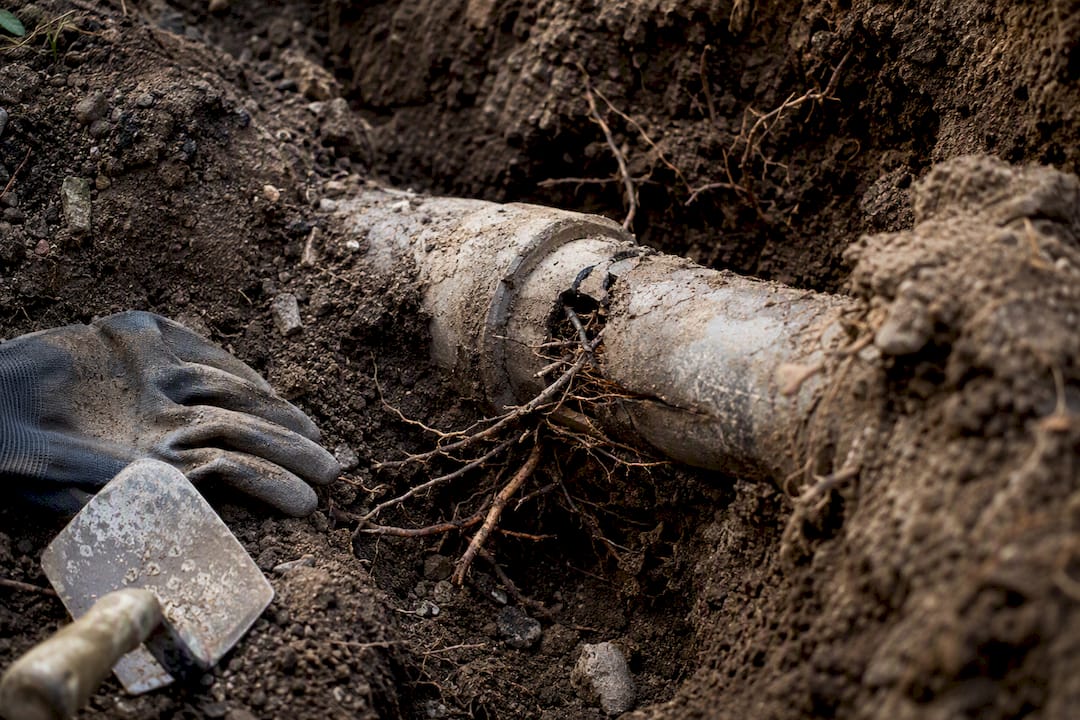
Extension research confirms that roots exploit existing leaks and gaps rather than creating new damage in intact pipe. That distinction matters when you’re deciding whether the pipe itself needs attention, or just the roots inside it.
Pipe material and age largely determine your risk level:
- Clay and cast iron pipes, common in homes built before the 1970s, have jointed sections every few feet. Each joint is a potential entry point.
- Orangeburg pipe, a tar paper composite used mid-century, deteriorates from the inside out and is especially prone to root intrusion and collapse.
- PVC pipe, standard in newer construction, uses solvent-welded or gasketed joints that resist root penetration far better, though it isn’t immune if joints are installed poorly.
Roots can travel much farther than most homeowners assume, sometimes extending well beyond the tree’s canopy in search of moisture. Under ideal soil and moisture conditions, some sources describe root growth reaching up to a foot per day, though how fast that happens depends heavily on species, soil, and season. Either way, a mature tree three lots down can still be the source of your blockage.
What Does a Sewer Camera Inspection Actually Show?
A camera inspection, sometimes called scoping, sends a waterproof lens through your sewer line to give a technician a live interior view. It’s the only reliable way to confirm root intrusion versus grease buildup, a collapsed section, or a simple clog, and it’s why we don’t recommend guessing with a snake first.
Here’s what the footage typically reveals:
- Whether roots are present, and roughly how much of the pipe diameter they’re blocking
- The condition of pipe joints and whether they’re separated or intact
- Cracks, offsets, or sections where the pipe has gone oval instead of round
- The general pipe material and its overall age-related wear
The camera has real limits, though. It shows the inside of the pipe, not what’s happening in the soil around it. A camera can’t tell a technician how far root mass extends outside the pipe wall, and that’s information that sometimes only shows up once a section gets excavated.
When you talk to your technician, ask three questions that cut straight to the decision you’ll need to make:
- How deep is the root intrusion? A light root hair intrusion is a different problem than roots filling half the pipe.
- Is the pipe still round, or has it gone oval? Ovalling signals structural stress, not just a clog.
- Are the joints holding, or are they separated? Separated joints usually mean the problem will recur even after cleaning.
Pro Tip: Ask to see the footage yourself, not just hear a summary. Most technicians are glad to walk you through it, and seeing the actual crack or root mass makes the repair recommendation much easier to trust.
A camera inspection is usually sufficient for a cleaning decision. Excavation or additional testing becomes necessary when the footage shows heavy ovalling, multiple failed joints, or when cleaning has already failed more than once at the same spot.
Snaking, Hydrojetting, or Chemical Treatment: Which Removes Roots?
Three methods dominate root removal, and each solves a different piece of the problem. None of them repair a damaged pipe. That’s the part homeowners most often miss.
Mechanical rodding and augering uses a rotating cutting head on a cable to physically chew through root masses blocking the pipe. It’s the fastest and cheapest option, and it’s often the right first move for a straightforward clog. The catch is that cutting roots doesn’t remove them from the crack they’re growing through, and snaking can actually stimulate faster, thicker regrowth at the same spot, since the plant responds to being cut the way pruning triggers new growth on a hedge.
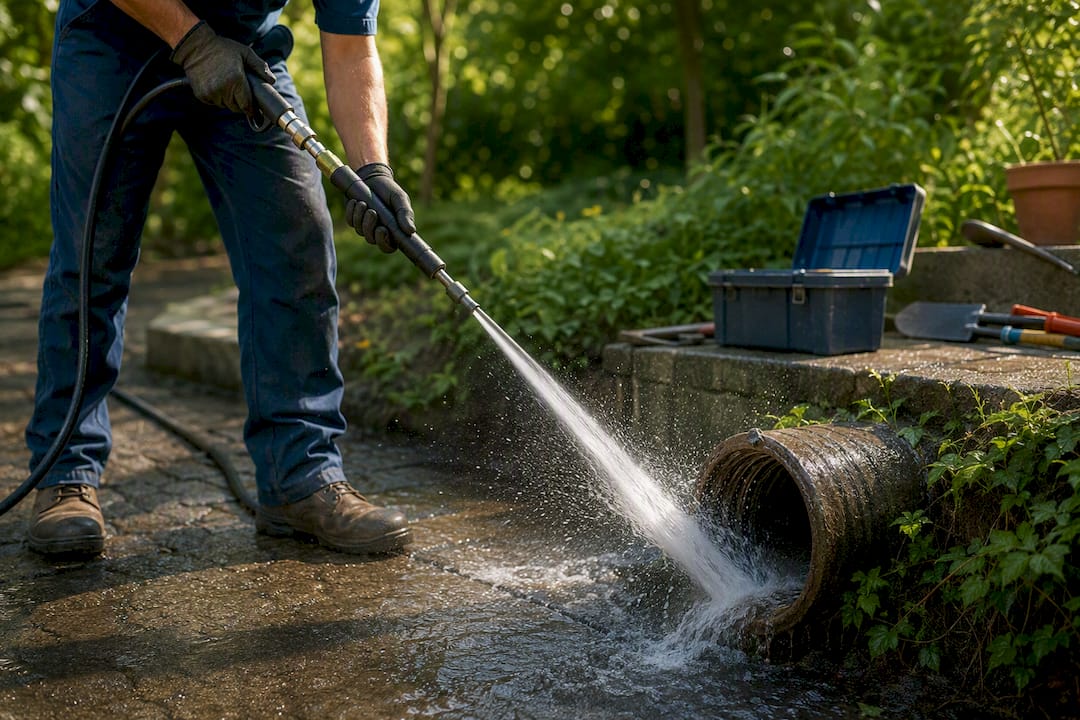
Hydrojetting blasts pressurized water through the line, scouring the pipe wall clean of grease, scale, and root hairs that a blade cutter leaves behind. Hydrojetting gives a more thorough clean than mechanical cutting and removes the sludge that roots use to anchor and trap debris. It’s a strong option when the pipe structure is sound, but that’s the key qualifier. High-pressure water can worsen an existing crack in a fragile or already-compromised pipe, which is exactly why a camera inspection should always come before jetting, not after.
Chemical and foaming root treatments use herbicidal foam that expands to coat the entire pipe circumference and kill root growth without harming the tree itself. Industry guidance treats this as a maintenance step that follows mechanical clearing, not a standalone fix. There are real cautions here too. Some municipalities restrict or ban copper sulfate and certain foaming herbicides because they can affect groundwater and septic systems, and any product used near pets or edible gardens needs label-level attention to runoff and reentry timing.
Here’s the honest math on longevity: mechanical cutting alone often needs to be repeated every 6 to 18 months if the underlying crack or joint separation isn’t addressed. Hydrojetting typically extends that window because it clears more debris. Chemical foam, used consistently, can stretch clean intervals out further, but it still isn’t fixing the pipe.
That repetition adds up. Roughly six repeat cleanings on the same problem spot can approach the cost of simply replacing that section of pipe, and access difficulty (a line running under a driveway or slab) is usually what drives that cost up rather than the pipe material itself. If you’ve cleaned the same blockage more than twice in a year, you’re not maintaining the line anymore. You’re renting time on a pipe that needs real repair.
When Should You Repair vs. Replace a Root-Damaged Sewer Line?
Four signals tell you it’s time to stop cleaning and start talking about permanent repair:
- Roots return within about 12 months of clearing. That recurrence window is a practical trigger point for pushing toward relining rather than another round of cutting.
- The pipe has gone oval instead of staying round, visible on camera footage as structural deformation rather than simple blockage.
- The pipe material is old and brittle (clay, Orangeburg, or aging cast iron), where root intrusion is a symptom of a pipe already near the end of its service life.
- Excavation reveals roots encapsulating the pipe from outside, which cleaning from the inside can never resolve.
Two repair paths dominate once replacement is on the table. Trenchless CIPP relining inserts a resin-saturated liner into the existing pipe and cures it in place, creating a new pipe-within-a-pipe without digging up your yard. It works well when the original pipe still has structural integrity to support the liner, and a properly installed liner typically lasts 30 to 50 years. Trenchless pipe bursting replaces the pipe entirely by pulling a new one through while fracturing the old, and it’s the better choice when the existing pipe has collapsed sections or ovalling too severe for relining to bridge.
| Repair Path | Best Fit |
|---|---|
| CIPP relining | Sound pipe shape with cracks or root entry points, minimal yard disruption |
| Trenchless replacement | Collapsed or badly deformed sections that relining can’t bridge |
| Full excavation | Severe structural failure or lines requiring grade changes |
Traditional excavation and replacement is still sometimes the only option, particularly when the line needs a grade change or has failed across most of its length. It’s the most disruptive path but also the most complete reset.
Preventing Tree Roots From Coming Back
Once a line is cleaned or repaired, protecting that work is mostly about what you plant and where.
- Avoid planting aggressive-rooted species near sewer lines. Poplar, willow, elm, ash, and birch consistently show up on municipal lists of trees most associated with sewer root problems, thanks to fast growth and a strong drive toward moisture.
- Choose slower-growing, deeper-rooted species for new plantings near utility lines, and check your local extension office’s recommended list before you dig.
- Install a root barrier between an existing tree and the sewer line if the tree is already established and removal isn’t practical. Barriers work best installed before intrusion starts, not after.
- Don’t assume planting distance alone protects you. Roots travel toward moisture regardless of distance, so sealing joints and fixing small leaks matters more than how far the tree sits from the pipe.
- Schedule a camera inspection every 2 to 3 years for lines with a known history of root intrusion or pipe materials older than PVC, catching new growth before it becomes a backup.
- Use chemical foam treatments on a maintenance schedule, not as a one-time fix, and only where local regulations permit their use.
For a broader rundown of what to watch for between inspections, this outside guide to sewer line warning signs covers similar ground worth bookmarking.
How Tri-County Services Electric & Plumbing Handles Root Intrusion
We’ve walked this exact path with a Cleveland-area cast-iron line clogged by root intrusion and years of grease buildup. Rather than jumping straight to replacement, our team ran hydrojetting and descaling to strip the pipe wall clean and restore full flow, avoiding an unnecessary excavation because the camera footage confirmed the pipe structure itself was still sound.
That’s the workflow behind every root call we take:
- Scope the line first to see exactly what’s happening inside
- Diagnose root depth, joint condition, and pipe shape from that footage
- Recommend the least invasive fix that actually solves the problem, whether that’s cleaning, relining, or replacement
- Walk you through scheduling and what to expect before any work starts
Pro Tip: Bring up your yard’s tree history when you call. Knowing what’s planted nearby, and how old it is, helps our technicians know what to look for before the camera even goes in.
Don’t let a slow drain turn into a yard sinkhole. Call (440) 253-0332 to schedule a camera inspection, and skip the DIY guesswork that tends to make root problems worse before they get better.
What Tri-County Services Electric & Plumbing Offers Homeowners
You’ve just read what separates a quick fix from a real one, and that’s exactly the judgment call Tri-County Services Electric & Plumbing makes on every root intrusion call across Northeast Ohio.

We handle the full range, from camera diagnostics through hydrojetting, descaling, and permanent repair recommendations, so you’re never stuck guessing whether last year’s snaking actually fixed anything. Our technicians walk you through the footage, explain what your pipe material means for your options, and give you a straight answer on whether cleaning will hold or whether it’s time to talk relining. If your home also has an aging electrical panel or you’ve been putting off a generator install, we cover that too under one roof, which means one call handles more than just your sewer line. Visit our sewer drain and plumbing services page to see the full scope of what we handle, or call (440) 253-0332 to get a camera inspection scheduled this week.
The Camera Inspection Habit Homeowners Should Have
The conventional advice on tree roots in sewer lines has a blind spot: it treats cleaning and repair as interchangeable, when they solve entirely different problems. Cutting roots clears the channel. It does nothing for the crack the roots grew through in the first place. That gap is where homeowners lose money, paying for the same service every year instead of fixing the actual fault once.
What the research actually supports is a decision framework, not a default fix. If your pipe is structurally sound, cleaning is the right call, and repeating it every couple of years is reasonable maintenance, not a failure. If roots keep coming back within a year, or the camera shows ovalling and separated joints, that’s your pipe telling you cleaning was never going to be a permanent answer.
Prioritize the inspection over the fix. Homeowners who skip straight to snaking or foam are optimizing for the cheapest next step instead of the cheapest total outcome, and those are rarely the same number once you count five years of repeat visits.
Sources
- Tree root research overview — USDA Forest Service
- Tree roots and sewer lines — N.C. Cooperative Extension
- Five ways to remove and prevent tree roots in sewer lines — Oatey
- Tree roots in sewer line: Symptoms, removal, and prevention — Perry Plumbing & Pipelining
FAQ
How serious are tree roots in a sewer line?
Tree root intrusion is one of the most common causes of sewer failure, responsible for more than half of all sewer blockages, and left unaddressed it can progress to full pipe collapse and yard sinkholes.
What dissolves tree roots in sewer lines?
Foaming herbicidal treatments can kill root growth inside the pipe, but they’re most effective when used as maintenance after mechanical cutting or hydrojetting has already cleared the blockage, not as a standalone fix.
Does homeowners insurance cover tree roots in a sewer pipe?
Standard homeowners policies typically exclude gradual damage like root intrusion, since it develops over time rather than from a sudden event; coverage usually depends on whether you carry a separate service line or sewer backup endorsement.
How fast do tree roots grow in sewer pipes?
Growth rates vary widely by species and conditions, and roots can grow rapidly under ideal moisture and soil conditions, which is why even a tree several yards away can reach your line.
Should I try to clear tree roots myself before calling a professional?
Store-bought root killers and rented snakes can’t diagnose what’s actually wrong with the pipe, and using them first often delays the camera inspection that would catch a structural problem early; call Tri-County Services Electric & Plumbing at (440) 253-0332 before attempting a DIY fix.