
A transfer switch is the piece of equipment that safely moves your home’s electrical load between utility power and a backup generator, and it exists for one non-negotiable reason: to stop both power sources from ever touching the same wires at once. That isolation prevents backfeeding, a condition that can electrocute utility workers repairing lines they think are dead. Transfer switches come in two main flavors, manual and automatic, and picking the right one shapes everything from your generator’s usefulness to whether your setup passes inspection.
TL;DR:
- Transfer switches must be properly rated for fault current with UL 1008 and WCR ratings to prevent catastrophic failure during faults or faults with generator use.
- Automatic transfer switches are ideal for whole-home backup, as they detect outages and switch power sources seamlessly without homeowner intervention.
- Interlock kits enable whole-panel transfer and are suitable for budget-conscious homeowners using portable generators, but local codes may restrict their acceptance.
- Load analysis and local AHJ approval are essential before purchasing or installing any transfer switch to ensure electrical and legal compliance.
- Proper installation, regular testing, and monthly exercises are crucial to ensure the transfer switch functions correctly when needed most.
Table of Contents
- How Does a Transfer Switch Work?
- What Types of Transfer Switches Exist?
- Why Do Codes Require Transfer Switches?
- Interlock Kit, Manual Subpanel, or ATS: Which Fits Your Home?
- What Should You Ask Before Choosing a Transfer Switch?
- What Does a Transfer Switch Cost to Install?
- Why Tri-County Services Electric & Plumbing Handles Transfer Switches Differently
- Where Homeowners Get This Wrong
- Ready to Install a Transfer Switch the Right Way?
- Sources
- FAQ
How Does a Transfer Switch Work?
An automatic transfer switch, or ATS, runs on a simple loop of sensing and decision-making. Here’s the sequence most residential units follow when the grid goes down:
- Detect the outage. The ATS continuously monitors incoming utility voltage and frequency, watching for a drop outside acceptable tolerances, typically a few percent off nominal voltage or frequency.
- Start the generator. Once the outage is confirmed, usually after a short delay to ignore brief blips, the ATS sends a start signal to the standby generator.
- Verify generator output. The switch waits until the generator’s voltage, frequency, and phase settle within acceptable range before doing anything else.
- Transfer the load. The mechanism physically (or electronically) shifts your home’s circuits from the utility feed to the generator feed.
- Monitor utility power. While running on generator, the ATS keeps checking the grid in the background.
- Retransfer and cool down. Once utility power returns and stays stable for a set period, the switch shifts the load back and lets the generator cool before shutting off.
This entire process, as Eaton’s technical documentation on ATS fundamentals describes, happens without you touching anything. A whole-home ATS manages every circuit in your panel; a smaller unit tied to a subpanel only covers circuits you’ve pre-selected, like the furnace, sump pump, and refrigerator.
What Types of Transfer Switches Exist?
Not every home needs the same switching hardware, and the differences matter more than most product listings let on.
- Manual transfer switches require you to flip a lever or set of switches by hand. They’re cheaper and simpler, but someone has to be home and awake to operate them during an outage.
- Non-automatic transfer switches sit between manual and automatic. They’re electrically operated but still need a person to initiate the transfer, common in commercial settings with staff on-site.
- Automatic transfer switches handle detection, starting, and switching without human input, the standard pairing for whole-home standby generators.
- Static transfer switches use solid-state components with no moving parts, switching in milliseconds. These show up in data centers and critical commercial loads, rarely in homes.
Transition mode is the other variable. Open transition (break-before-make) disconnects one source fully before connecting the next, causing a brief power interruption but keeping the two sources completely isolated. Closed transition (make-before-break) briefly parallels both sources for a seamless handoff, which requires tighter synchronization and more sophisticated controls. Delayed transition adds a pause between disconnect and reconnect, often used to let motors and heavy loads spin down safely. Most residential standby systems use open transition with a short delay. Portable generators typically pair with manual or non-automatic switches, while standby systems almost always require an ATS.
Why Do Codes Require Transfer Switches?
Backfeeding happens when a generator pushes power backward through your home’s wiring and out onto the utility grid, energizing lines that linemen assume are dead. A transfer switch physically or electronically isolates the two sources so that can’t happen, which is exactly why the National Electrical Code addresses transfer equipment in Article 702.6. Your local Authority Having Jurisdiction, or AHJ, decides how strictly that requirement gets enforced and whether alternatives like interlock kits are acceptable in your area. That’s a call worth making before you buy anything.
UL 1008 and Withstand/Close-on-Fault Ratings: Equipment rated to UL 1008 has been tested to complete a transfer even while fault current is flowing through it, a scenario a mislabeled or undersized switch could fail catastrophically. The Withstand and Closing Rating, or WCR, tells you the maximum fault current the switch can handle without welding shut or exploding.
A few distinctions worth keeping straight:
- A transfer switch routes power between sources; a circuit breaker protects a circuit from overload or short circuit. They do different jobs and neither substitutes for the other.
- UL 1008 listing applies to the switch itself, not to the panel or the generator.
- WCR ratings vary by model, so a switch sized correctly for amperage can still be undersized for available fault current at your service.
Interlock Kit, Manual Subpanel, or ATS: Which Fits Your Home?
Three installation paths dominate residential projects, and each comes with real trade-offs in cost, convenience, and code acceptance.
Interlock kits are mechanical devices installed in your main panel that physically prevent the main breaker and a generator breaker from being on simultaneously. They’re inexpensive and give you access to your whole panel, but not every AHJ accepts them, and operating one means going out to the panel, flipping breakers in the right order, and starting the generator manually.
Manual transfer subpanels dedicate a small breaker panel to pre-selected circuits, typically 6 to 10 essential loads. Switching is simpler than an interlock because the subpanel is purpose-built, but you’re limited to whatever circuits you wired into it.
Automatic transfer switches integrate with a permanently installed standby generator, sensing outages and switching without anyone flipping anything.
| Option | Circuit coverage | Operation | Best fit |
|---|---|---|---|
| Interlock kit | Whole panel (shared capacity) | Manual, at the panel | Portable generators, budget-conscious homeowners |
| Manual transfer subpanel | Selected circuits only | Manual, at subpanel | Homeowners who want simpler switching for essentials |
| Automatic transfer switch | Whole home or large subpanel | Fully automatic | Standby generators, homes wanting zero manual steps |
Before committing to any of these, call your AHJ to confirm what’s permitted, and bring in a professional for installation and permitting. This isn’t a project where a wiring mistake just trips a breaker. A mistake here can backfeed a live line.
What Should You Ask Before Choosing a Transfer Switch?
Sizing a transfer switch means matching it to your panel, your generator, and your actual load, not just picking the biggest one on the shelf.
- Confirm ampacity. The switch’s rated amperage should match or exceed your service size and generator output.
- Check pole count. Most residential switches are two-pole for 240-volt service; commercial applications sometimes need three or four poles.
- Ask about switched neutral. Some jurisdictions require the neutral conductor to switch along with the hot legs, especially with separately derived generator systems.
- Verify enclosure rating. Outdoor installations need a NEMA 3R or better rated enclosure.
- Confirm UL listing and WCR. Ask your electrician to state the WCR in writing, not just “it’s rated for your panel.”
- Match transition mode to your needs. Open transition is standard for most homes; closed transition matters more for continuous-run equipment like medical devices.
When interviewing an electrician, ask directly who pulls the permit, whether they’ve gotten interlocks approved by your local AHJ before, what commissioning and testing looks like after installation, and what the warranty covers.
Pro Tip: Before you even talk switch sizing, ask for a load analysis. Skipping this step is the single most common reason homeowners end up with a switch that can’t handle their actual generator output or their real household demand during a storm.
Watch for contractors who quote a price without walking your panel first, or who shrug off the AHJ question entirely. That’s a red flag, not a shortcut.
What Does a Transfer Switch Cost to Install?
Installed pricing varies a lot depending on which path you choose and what your existing panel can support.
- Interlock kits often come in under $500 installed, the cheapest entry point but limited by your panel’s shared capacity.
- Manual transfer subpanels typically run $700 to $1,400 installed, depending on circuit count and wiring runs.
- Automatic transfer switches frequently range from $1,000 to $3,500 or more, driven up by generator size, site conditions, and any panel upgrades needed.
Cost drivers to watch for: a panel that needs upgrading before it can accept new equipment, a long feeder run between the generator and the panel, and add-ons like a dedicated inlet box or load-shedding devices that manage which circuits stay powered during peak generator load.
Most straightforward jobs take a day or two once permits are pulled, though permit turnaround with your local AHJ can add a week or more before work even starts.
Why Tri-County Services Electric & Plumbing Handles Transfer Switches Differently
Tri-County Services Electric & Plumbing has served Northeast Ohio since 1975, and that kind of history means we’ve seen what happens when generator hookups get rushed or done wrong. Our process doesn’t skip steps:
- A real load analysis before we recommend equipment, not a guess based on panel size alone.
- Permit pulling and AHJ coordination handled for you, so there’s no surprise at inspection.
- Listed, properly rated equipment selection, including UL 1008 and WCR verification.
- Full testing and a homeowner walkthrough so you know exactly how your system operates before we leave.
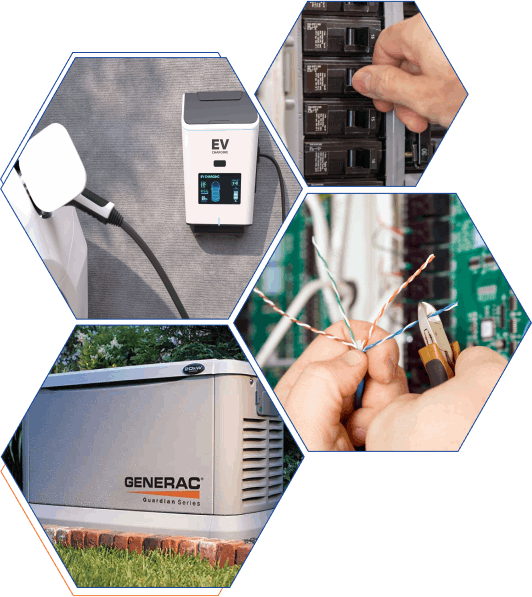
We also handle EV charger installations and full generator setups, plus we now offer plumbing services alongside our electrical work. If you’re weighing your options for a whole-home generator installation, call our office at (440) 253-0332 and we’ll walk through what your home actually needs.
Where Homeowners Get This Wrong
Most guidance on transfer switches treats the decision like a shopping problem: pick a brand, pick an amperage, done. That’s backwards. The equipment specs matter far less than two things most articles gloss over, the WCR rating and your local AHJ’s actual stance on interlocks versus listed transfer equipment. I’ve seen more failed inspections traced to skipping the AHJ phone call than to any hardware defect.
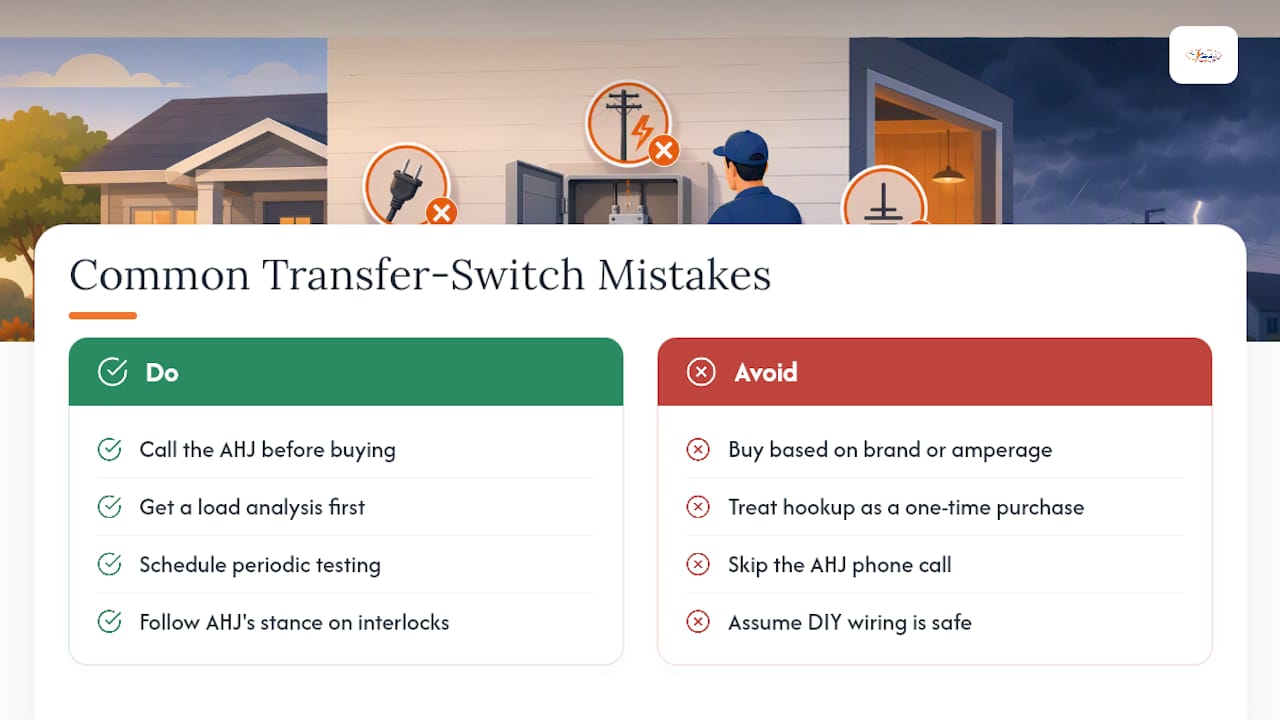
The other place conventional advice falls short is treating a generator hookup as a one-time purchase decision rather than a system that needs periodic testing. A transfer switch that sat untouched for two years and never got exercised is a coin flip on whether it’ll work the night you actually need it.
If you take one thing from this article, let it be this: get the load analysis and the AHJ answer before you spend a dollar on equipment. Everything else, brand, price, even transition mode, is secondary to getting those two things right. A DIYer with a wiring diagram and good intentions can still backfeed a line without realizing it, which is exactly the scenario this equipment was designed to prevent.
— Lindsay Paramore
Ready to Install a Transfer Switch the Right Way?
If you’ve read this far, you already know a transfer switch isn’t a weekend project you want to gamble on, it’s the one piece of equipment standing between your generator and a genuinely dangerous backfeed situation. Tri-County Services Electric & Plumbing has installed and serviced this equipment across Northeast Ohio since 1975, and we handle the permit calls, the AHJ questions, and the equipment selection so you don’t have to guess your way through it.

Whether you’re weighing an interlock kit against a full ATS, or you already have a generator and need the switching equipment to match, our team can walk your panel, run the load numbers, and give you a straight answer on what fits your home and your budget. We also handle the panel upgrades that sometimes come along with these projects, and if you’re coordinating an EV charger install at the same time, our partners at Rare Plumbing’s EV charger services cover that side of the work too. Call (440) 253-0332 to schedule a load analysis and get a real quote for your electrical repair service needs.
Sources
- Reliance Controls blog — transfer switch safety and purpose
- ATS 101 (IEEE technical brief)
- ShelterVolt — interlock kit vs transfer switch comparison
FAQ
Do You Have to Turn Off the Main Breaker When Using a Transfer Switch?
With a properly installed transfer switch, no, the switch itself handles isolating the main breaker from the generator feed automatically or through a mechanical interlock, so you don’t manually shut it off during normal operation. If you’re using a basic interlock kit, you do manually flip the main breaker off as part of the switching sequence, which is one reason correct installation and homeowner training matter.
What Are the Common Problems With Transfer Switches?
The most frequent issues are failure to transfer due to a dead control board or worn contacts, incorrect sensing settings that cause nuisance transfers, and switches that were never sized correctly for the generator’s actual output. Regular testing, ideally monthly exercise cycles, catches most of these before they become an outage-night surprise.
What Happens to the Transfer Switch When Power Comes Back On?
The ATS detects that utility voltage and frequency have stabilized, waits out a short confirmation delay, then automatically retransfers your load back to utility power and signals the generator to cool down before shutting off, per the standard sequence Eaton documents for ATS operation.
How Far Away Can a Generator Be From the Transfer Switch?
There’s no single fixed maximum distance; it depends on wire gauge, voltage drop tolerance, and local code requirements for the feeder run. Longer runs typically require larger conductors to avoid voltage drop, which is a sizing calculation best left to a professional during installation planning.
Do I Need a Transfer Switch If I Only Use a Portable Generator?
Yes, some form of transfer equipment, whether an interlock kit or a manual transfer subpanel, is what keeps a portable generator from backfeeding into the grid. Plugging a generator directly into an outlet without transfer equipment creates a real backfeed hazard, which is why makeshift generator hookups are worth avoiding entirely.