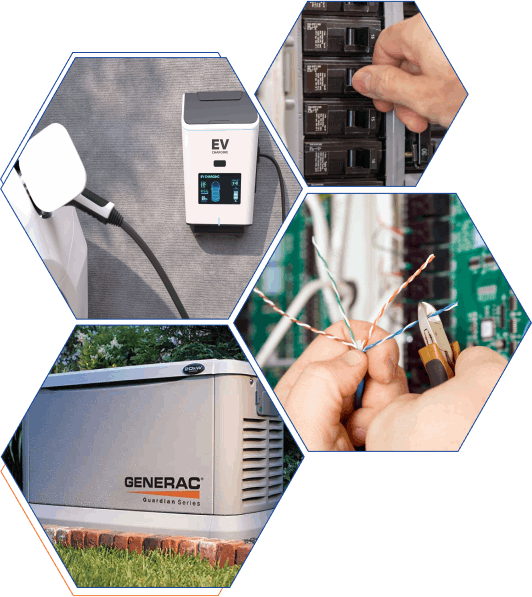

Hire a professional who manages the entire EV charger installation, not just someone willing to mount a box on your garage wall. That means one company handling the site assessment, the permit, any panel work your home needs, and the final inspection. Tri-County Services Electric & Plumbing has served Northeast Ohio since 1975 and brings that full scope to every EV charger project.
Before you sign anything, make sure your quote includes:
- A site visit with a load calculation, not a phone estimate
- Permit filing and inspection scheduling with your local jurisdiction
- A clear answer on whether your panel needs an upgrade
- An itemized written quote, not a verbal number
Call (440) 253-0332 to get a written estimate from a team that has handled Northeast Ohio’s electrical work for five decades.
Key Takeaways
A code-compliant EV charger installation requires a load calculation, permit filing, and an itemized written quote, and any installer who skips these steps is cutting corners that put your home’s electrical system at risk.
| Point | Details |
|---|---|
| Full scope matters | A proper install covers site survey, load calculation, circuit work, and inspection, not just mounting the charger. |
| Credentials to verify | Confirm state license, insurance, and EVITP or manufacturer-specific training before hiring. |
| Budget for panel work | Homes with older 100-amp panels often need an upgrade, which changes both cost and timeline. |
| Rebates require paperwork | Utility rebates up to $500 and federal tax incentives often require filing; ask who handles that paperwork. |
| Tri-County meets the checklist | Tri-County Services Electric & Plumbing manages surveys, permits, panel upgrades, and inspections as one service. |
Table of Contents
- What Does a Full EV Charger Installation Actually Include?
- How Do You Choose the Right EV Charger Electrician?
- How Much Does EV Charger Installation Cost, and How Long Does It Take?
- Why Does EVITP Certification Matter for EV Charger Installers?
- Who Handles Permits and Rebates for Your EV Charger?
- Why Tri-County Services Electric & Plumbing Fits the Checklist
- Request a Written Estimate From Tri-County Services Electric & Plumbing
- Sources
- FAQ
What Does a Full EV Charger Installation Actually Include?
A real EV charger installation is closer to a small electrical project than a plug-and-play task. Skipping steps here is how homeowners end up with tripped breakers, failed inspections, or a charger that can’t deliver full power.
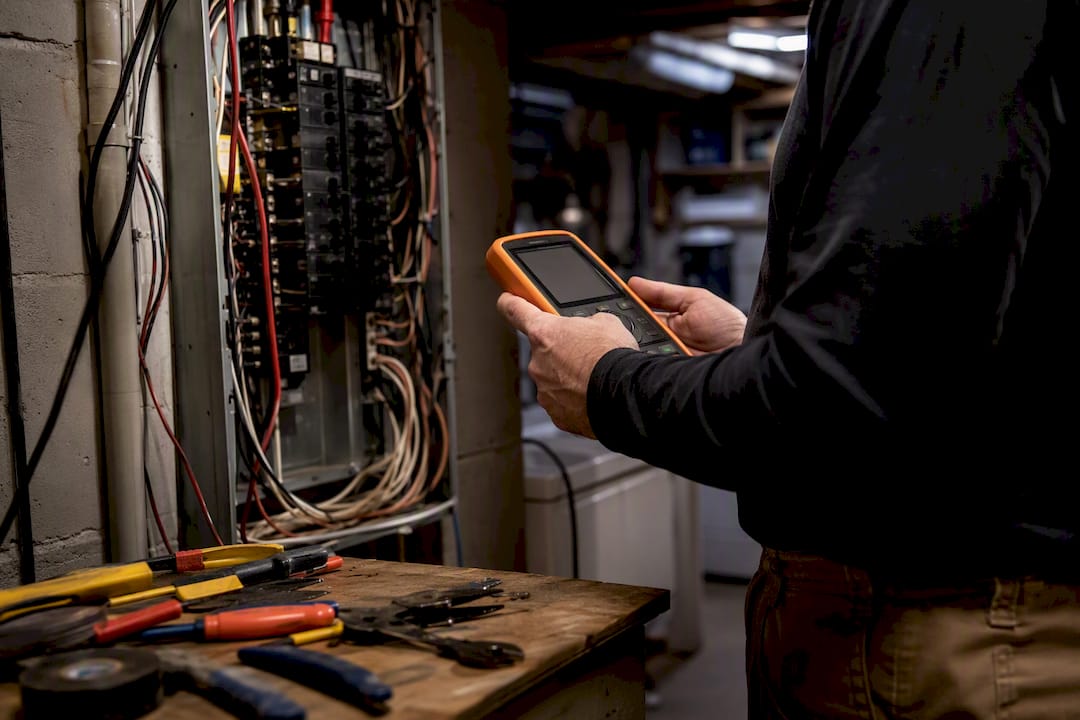
- Site survey and load calculation. The electrician measures your home’s existing electrical load against the new demand a Level 2 charger adds. This step, recommended by the EPA’s home EV charging guidance, determines whether your existing panel can handle the charger or needs an upgrade first.
- Dedicated circuit and breaker. Most Level 2 chargers need a dedicated 240-volt circuit, sized breaker, and properly run conduit from the panel to the charger location.
- Mounting and commissioning. The unit gets mounted, wired, and tested to confirm it charges at its rated speed.
- Panel upgrade, if needed. Older homes with 100-amp service sometimes can’t absorb a new 40 or 50-amp circuit without a panel swap. This changes both scope and price, and a good panel upgrade plan should be part of the original quote, not a surprise add-on.
- Final inspection. Local code officials sign off before the charger goes into regular use.
Your written estimate should spell out every one of these steps, plus a workmanship warranty covering the labor.
How Do You Choose the Right EV Charger Electrician?
Not every electrician who says “sure, I can do that” has actually done it right. Here’s what separates a competent installer from someone winging it.
Credentials worth requiring:
- A current state contractor license and active liability insurance
- EVITP or comparable EV-specific training (more on that below)
- A track record of panel upgrades and load calculations, not just outlet swaps
Questions to ask during the estimate:
- “Will you pull the permit and schedule the inspection?”
- “Have you done a load calculation on my panel yet, or is that included in the quote?”
- “What’s the timeline from today to a working, inspected charger?”
- “Is the workmanship covered under warranty, and for how long?”
Watch for red flags: a quote given only over the phone with no site visit, an electrician who tells you permits are “not really necessary,” or a bid that’s dramatically lower than everyone else’s. Underpriced jobs usually mean skipped steps, not a better deal. Reputable installers typically provide itemized written estimates and coordinate inspections as standard practice, according to installation guidance from MNEV Charger.
Pro Tip: Ask the electrician to show you the load calculation number, not just tell you the panel “should be fine.” If they can’t produce a number, they haven’t actually run the calculation.
How Much Does EV Charger Installation Cost, and How Long Does It Take?
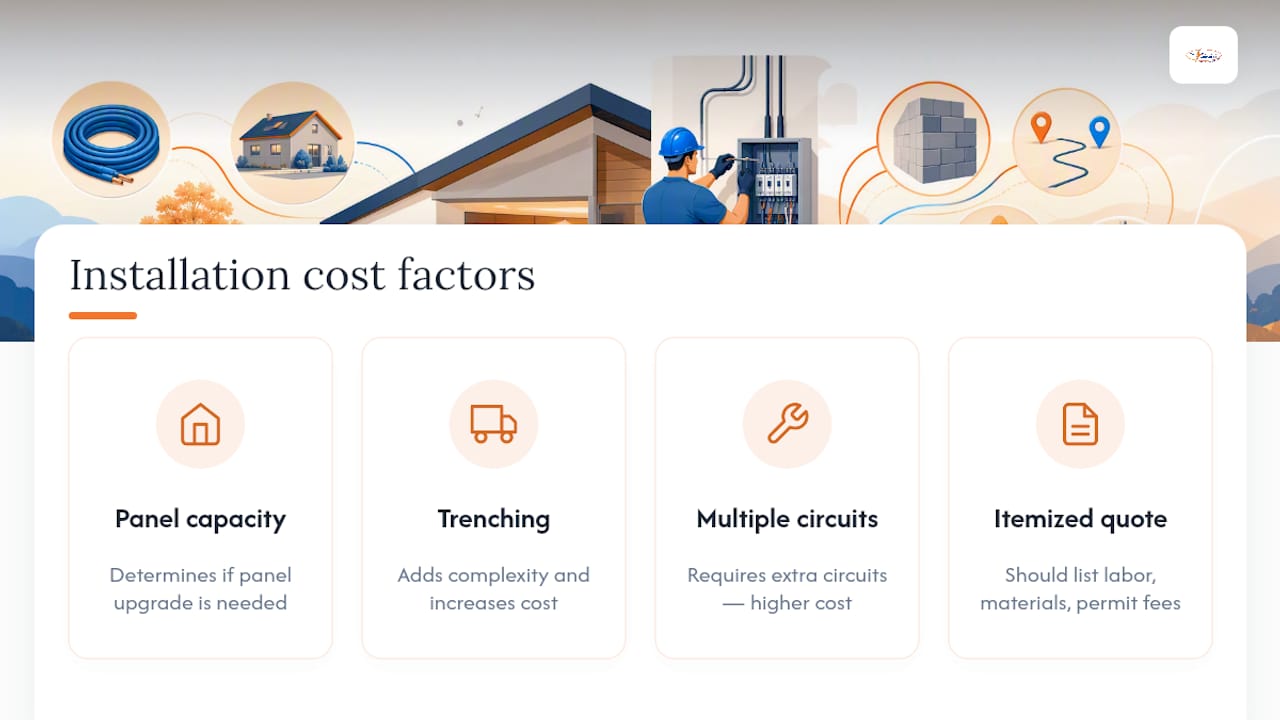
A straightforward Level 2 installation, where your panel already has capacity, is the cheapest and fastest path. Add a panel upgrade, trenching for a detached garage, or a second charger, and both cost and time stretch out.
Cost drivers you should expect on any itemized quote:
- Labor for running the circuit and mounting the unit
- Materials: breaker, wire, conduit, and the charger hardware itself
- Permit fees, which vary by municipality
- Panel upgrade costs, if your load calculation shows you need one
On timeline, expect a sequence: site visit and load calculation, then permit filing, then the install itself, then inspection. Straightforward garage installs commonly wrap up in a single day of onsite work, while combined panel-and-charger jobs can extend to a full day of labor with inspection adding a few more days depending on your local jurisdiction’s schedule.
Bundling panel work with the charger install in one visit typically shortens the overall project compared to scheduling two separate jobs weeks apart. Some installer networks report complex jobs running a 3 to 6 week window end to end once permitting and scheduling are factored in, so ask upfront how your specific job compares.
Why Does EVITP Certification Matter for EV Charger Installers?
The Electric Vehicle Infrastructure Training Program, known as EVITP, trains electricians specifically on EVSE installation, covering code requirements, load management, and commissioning procedures that a general electrical background doesn’t automatically teach. Thousands of electricians nationwide hold this certification, and it’s widely recognized in the industry as a real signal of EV-specific competency rather than a marketing badge.
A few things worth knowing when you vet installers:
- EVITP certification focuses on installation best practices, not just product familiarity
- Manufacturer-specific training (from brands like Tesla or ChargePoint) is a useful supplement, especially if you already know which charger you’re buying
- None of this replaces the baseline: an active state license and current insurance are still non-negotiable, regardless of what specialty training an electrician holds
Who Handles Permits and Rebates for Your EV Charger?
Your installer, not you, should be filing the permit and coordinating with your local authority having jurisdiction. This is standard for professional installs, and it’s one of the clearest signs you’ve hired the right company, according to permitting guidance from the Alternative Fuels Data Center.
On the savings side, don’t leave money on the table:
- Some local utility programs offer rebates of up to $500 toward EV charger installation costs
- Federal tax incentives may also apply to qualifying installations, depending on your situation
- A reputable installer will either file rebate and tax paperwork on your behalf or hand you clear instructions before work starts
Ask this directly during your estimate: “Who’s filing the permit, and who’s handling the rebate paperwork?” If the answer is vague, that’s worth noting before you sign.
Why Tri-County Services Electric & Plumbing Fits the Checklist
Every criterion above, licensing, load calculations, permit handling, written quotes, describes exactly how Tri-County Services Electric & Plumbing has operated since 1975 as a family-owned business serving Northeast Ohio.
- Decades of regional experience across residential and commercial electrical work, not just EV chargers
- Full-service capability: site surveys, panel upgrades, permitting, and inspection coordination under one roof
- Flexible scheduling designed to minimize disruption to your home or business
- A dedicated EV charger installation service built around the same checklist homeowners should be using to vet anyone else
Call the office or request a written estimate before your next quote comparison.
A note on why this matters
Skipping a load calculation or letting someone install a charger without a permit doesn’t save you money, it just moves the risk to your breaker panel and your home’s wiring. Professional installation and proper permitting protect the investment you’re making. Tri-County’s crews have built their reputation on doing that work right the first time.
Request a Written Estimate From Tri-County Services Electric & Plumbing
If you’ve been comparing quotes and running into vague answers about permits or panel capacity, that’s the exact gap Tri-County Services Electric & Plumbing was built to close. On an EV charger project, the team handles the site survey and load calculation, files the permit with your local jurisdiction, completes the install, and coordinates the final inspection, all as one continuous process instead of a chain of separate vendors.

Scheduling works around your household or business, not the other way around, and every job comes with a workmanship guarantee behind the labor. If you’re ready to see real numbers instead of ballpark guesses, visit the EV charger installation page or call (440) 253-0332 to schedule a site visit and get a written, itemized estimate.
Sources
- EVITP — Electric Vehicle Infrastructure Training Program
- EPA — Getting started with home EV charging
FAQ
How much does it cost to have an electrician install an EV charger?
Cost depends on whether your panel already has capacity; a straightforward Level 2 install costs less than a job requiring a panel upgrade, trenching, or multiple charger circuits. Always get an itemized quote covering labor, materials, and permit fees before comparing prices.
Can a general electrician install an EV charger, or do I need a specialist?
A general electrician can perform the wiring, but EV-specific training like EVITP certification ensures they understand load management and commissioning procedures unique to EVSE installations. Ask about EV-specific experience and certification before hiring, not just general electrical licensing.
Is EV charger installation expensive compared to other home electrical upgrades?
It varies significantly based on your panel’s existing capacity, since panel upgrades add meaningful cost while straightforward installs on adequate panels cost less. A proper load calculation during your site visit will tell you which scenario applies to your home.
Which provider is best for EV charger installation in Northeast Ohio?
Look for a provider that manages the full process: load calculation, permitting, installation, and inspection coordination, rather than one that skips steps to quote a lower price. Tri-County Services Electric & Plumbing has served Northeast Ohio homeowners and businesses since 1975 with that full-service approach.