
TL;DR:
- The Tesla Wall Connector offers a powerful, dedicated charging solution mainly for Tesla households. The ChargePoint Home Flex provides adjustable amperage and broad compatibility for mixed EV brands. Professional installation ensures safe, efficient charging and protects your device warranty.
Pick the Tesla Wall Connector if every vehicle in your household is a Tesla. Pick the ChargePoint Home Flex if you own a mix of brands, want adjustable amperage, or want flexibility for a future vehicle swap.
-
Tesla Wall Connector (Gen 3): 48A / 11.5 kW, NACS connector, hardwired only, cable approximately 24 feet long, retail price typically $450–$650 depending on the seller
-
ChargePoint Home Flex: adjustable amperage from 16A to 50A, up to 12 kW, available in J1772 or NACS cable variants, can be hardwired or use a NEMA plug, cable length about 23 feet, retail price typically $550–$800 depending on the seller
-
Both units can add a substantial amount of range per hour at full output, though actual charging speed depends on your car’s onboard charger
-
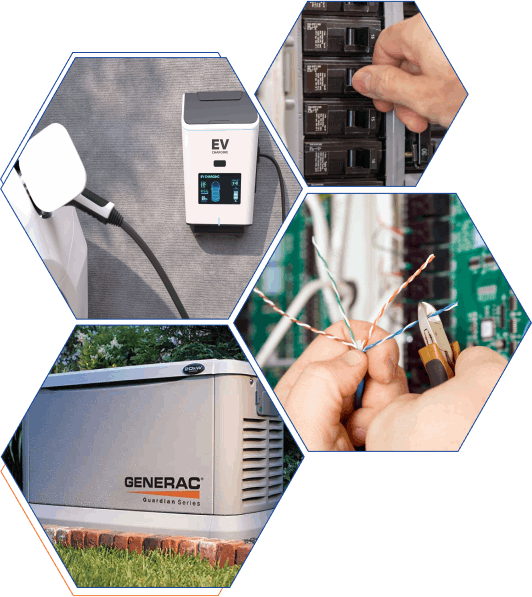
Tri-County Services Electric & Plumbing handles EV charger installations across Northeast Ohio, including site surveys, permitting, and panel upgrades
Table of Contents
How we compared the Tesla Wall Connector vs ChargePoint
Specs come from manufacturer documentation and independent technical reviews. Installation cost ranges reflect real-world electrician quotes and permit fees across U.S. markets. One important caveat: the head-unit’s maximum amperage rarely determines actual charging speed. Your car’s onboard charger and your home’s available circuit capacity are the binding constraints.
| Dimension | Tesla Wall Connector (Gen 3) | Tesla Universal Wall Connector | ChargePoint Home Flex | IYILO Level 2 EV Charger |
|---|---|---|---|---|
| Max amps / kW | 48A / 11.5 kW | 48A / 11.5 kW | 50A / 12 kW | 32A / 7.7 kW |
| Connector standard | NACS | NACS + built-in J1772 adapter | J1772 or NACS (cable variant) | J1772 |
| Vehicle compatibility | Tesla only | Tesla + most non-Tesla EVs | Broad (J1772 universal) | Broad (J1772 universal) |
| Installation options | Hardwired only | Hardwired only | Hardwired or NEMA 14-50 | NEMA 14-50 plug |
| Cable length | ~24 ft | ~24 ft | ~23 ft | about 23 feet |
| Adjustable amperage | No | No | Yes (16–50A) | No |
| Smart features / app | Tesla app, scheduling | Tesla app, scheduling | ChargePoint app, energy reporting | Basic app |
| Price (retail range) | $450–$650 | — | $550–$800 | — |
| Warranty | 4 years | 4 years | 3 years | 1 year |
| Best for | Tesla-only households | Tesla + occasional non-Tesla | Mixed-brand or panel-limited homes | Budget buyers, basic Level 2 |
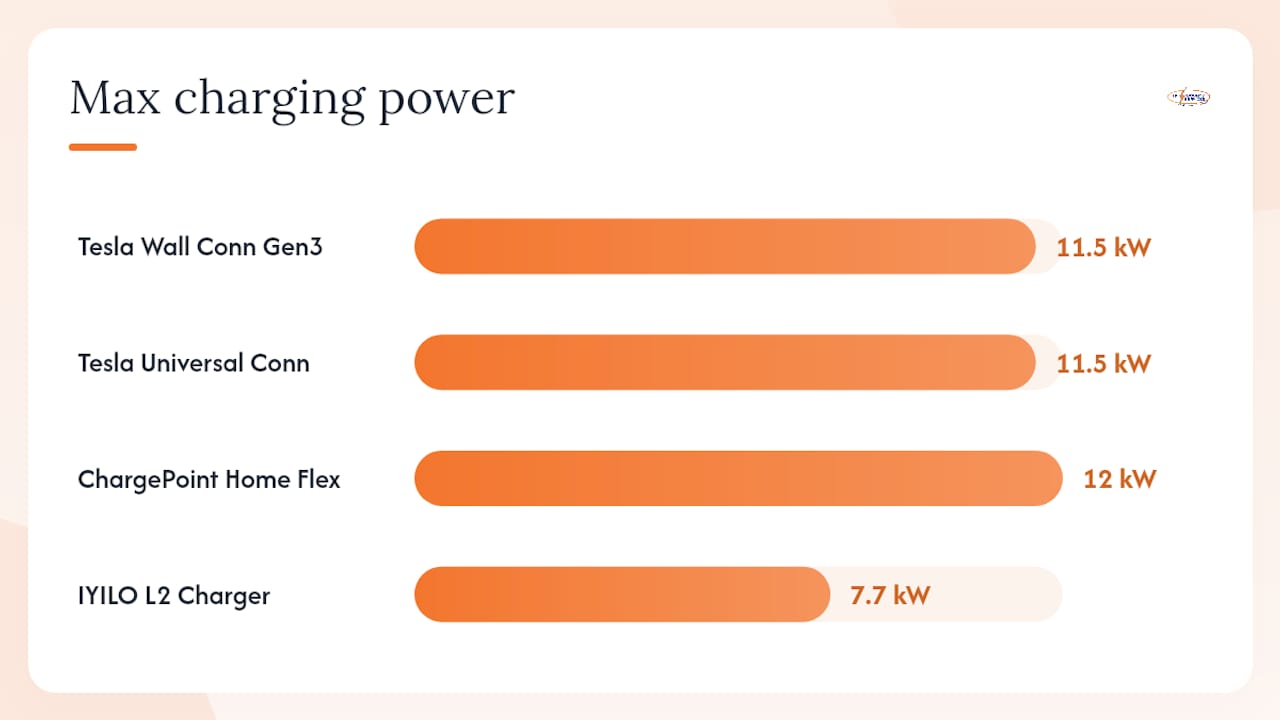
The IYILO Level 2 EV Charger tops out at 32A / 7.7 kW and plugs into a NEMA 14-50 outlet, which makes installation simpler but leaves meaningful charging speed on the table compared to a 48–50A hardwired unit.
Key takeaways for U.S. homeowners
The Tesla Wall Connector is the stronger pick for Tesla-only households; the ChargePoint Home Flex is the better fit for mixed-brand garages or homes with limited panel capacity.
| Point | Details |
|---|---|
| Tesla-only households | The Tesla Wall Connector’s native NACS integration and Tesla app workflow make it the cleaner choice at a lower hardware price. |
| Mixed-brand or future-proof | ChargePoint Home Flex adjustable amperage (16–50A) and J1772 compatibility serve households with multiple EV brands or uncertain future vehicles. |
| Budget option | The IYILO Level 2 EV Charger costs roughly $200–$300 retail but maxes out at 32A, so charging is noticeably slower than a 48–50A unit. |
| Installed cost range | Simple installs run $900–$1,600; moderate installs $1,600–$2,800; panel upgrades push totals to $3,500 or more. |
| Tri-County next step | Contact Tri-County Services Electric & Plumbing for a site assessment before purchasing hardware. |
Before you buy, run through this short checklist:
-
Confirm your car’s connector type (NACS or J1772) and onboard charger limit
-
Measure the distance from your panel to the planned charger location
-
Check your panel for a free 60A double-pole breaker slot (or budget for an upgrade)
-
Get an electrician quote that includes permit fees before committing to a unit
What installers actually think about long-term ownership
Most homeowners focus on the charger spec sheet. Electricians focus on the panel.
The Tesla Wall Connector requires a dedicated 60A circuit and hardwired installation. That is straightforward when your panel has room. When it does not, you are looking at a panel upgrade before the charger goes in, which adds cost and timeline. The ChargePoint Home Flex’s adjustable amperage is a real advantage here: an electrician can set it to draw 32A or 40A on an existing circuit, avoiding an upgrade entirely until you are ready for one.
For homes with two EVs, load-sharing matters. The Tesla Wall Connector supports multi-unit power sharing when two units are wired together, automatically splitting available amperage between vehicles. ChargePoint handles this through its app-based scheduling rather than hardware-level load sharing, which works but requires more manual setup.
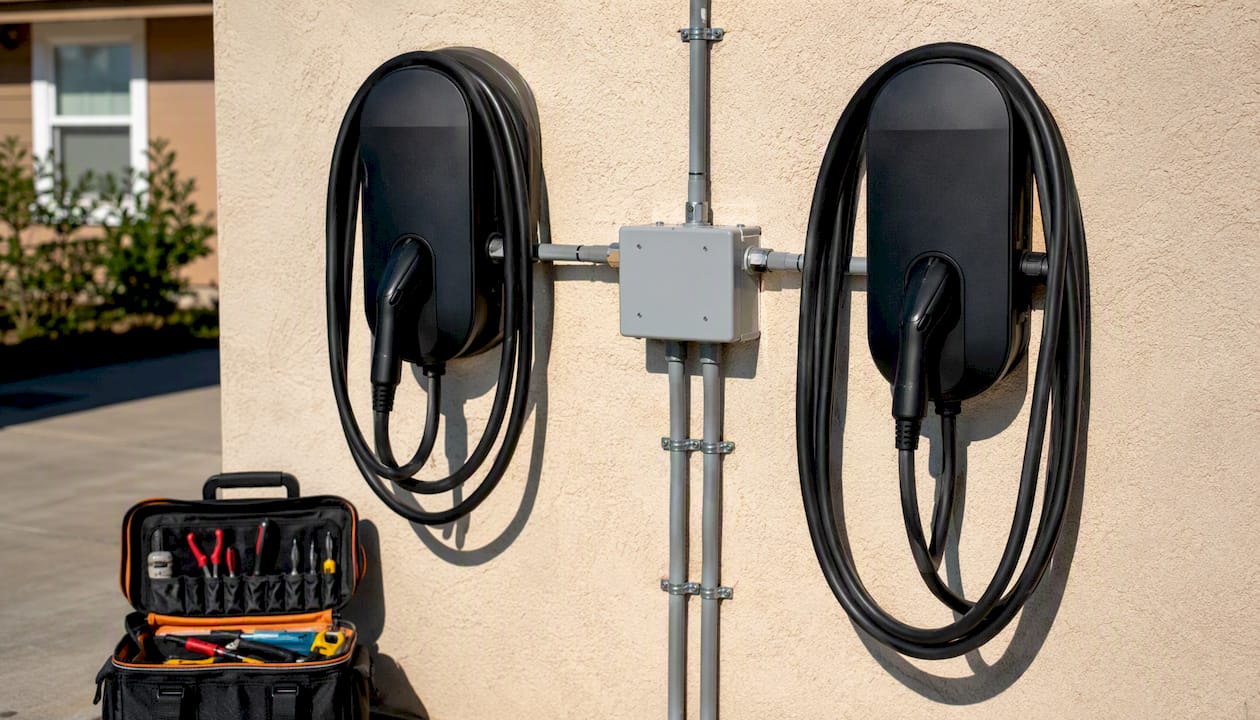
On warranties: Tesla’s four-year coverage edges ChargePoint’s three-year term. More practically, professional installation with a pulled permit and inspection record protects both warranties and makes future service calls cleaner. An unpermitted install can void coverage and create headaches at resale.
The Tesla Universal Wall Connector narrows the flexibility gap considerably. Its built-in adapter lets non-Tesla vehicles charge without a separate dongle, which matters if you ever add a Ford, Rivian, or GM vehicle. As NACS adoption spreads across major automakers, the J1772 advantage that historically made ChargePoint the default resale-friendly choice is shrinking.
Pro Tip: Ask your electrician to check the wire gauge from the panel to the garage before you finalize your charger choice. Undersized wire limits usable amperage regardless of what the charger is rated for, and upgrading wire after the fact costs more than doing it right the first time.
Get your EV charger installed right in Northeast Ohio

Choosing the right charger is only half the job. The other half is a clean, permitted installation that protects your warranty and your home. Tri-County Services Electric & Plumbing has handled EV charger installations across Northeast Ohio since 1975, pulling permits, sizing circuits, and flagging panel issues before they become expensive surprises.
A standard install typically takes one day. If your panel needs an upgrade first, plan for an additional visit. Either way, having a professional assess the site before you order hardware saves money. Call (440) 325-0136 or visit tricountyelectricservice.com to schedule. Have your vehicle model and a photo of your electrical panel ready for an accurate quote.
Useful sources and further reading
| Source | What it covers |
|---|---|
| Tesla Wall Connector vs. ChargePoint Home Flex | Side-by-side specs: amps, kW, cable length, connector standards, installation options |
| Tesla Wall Connector vs ChargePoint Home Flex: Which Should You Install? | Practical recommendations by household type; installed cost ranges |
| Tesla Wall Connector vs ChargePoint Home Flex — Which Home Charger Wins | Real-world range-per-hour estimates; retail price ranges |
| What Bay Area Electricians Actually Recommend | Installer perspective: weatherproofing, load sharing, permitting |
| ChargePoint Home Flex review — VoltPicks | App features, energy reporting, scheduling capabilities |
| NACS adoption context — EVRangeTools | Connector landscape and future-proofing considerations |
FAQ
Is the Tesla Wall Connector better than ChargePoint?
For Tesla owners, yes. The Tesla Wall Connector integrates natively with the Tesla app and NACS connector, and it costs less than the ChargePoint Home Flex. For households with non-Tesla EVs, ChargePoint’s adjustable amperage and J1772 compatibility make it the stronger fit.
Can a Tesla use a ChargePoint charger?
Yes. Tesla vehicles can charge on a ChargePoint Home Flex using a J1772-to-NACS adapter, which Tesla includes with new vehicles. The ChargePoint Home Flex also ships in a NACS cable variant in some markets.
How fast does a Level 2 home charger actually charge?
At 48–50A, a Level 2 charger typically adds roughly 30–44 miles of range per hour, depending on the vehicle’s onboard charger limit. The charger’s rated amperage sets the ceiling; your car’s hardware determines what you actually get.
What does EV charger installation cost in Northeast Ohio?
Simple installs typically run $900–$1,600 for hardware, labor, and permits. Moderate installs with longer wire runs land around $1,600–$2,800. If your panel needs an upgrade, total costs can reach $3,500 or more. Tri-County Services Electric & Plumbing can provide an accurate quote after a site assessment.