

If your generator has had a professional inspection in the last year, holds fresh fuel, passed a load test, and sits at least 20 feet from your home’s doors and windows, it’s likely ready for storm season. If any of that is missing or you’re not sure, call a professional before the next system rolls through. Never run a generator indoors or in a garage, even with the door open.
TL;DR:
- A generator ready for storm season must be professionally inspected within the last year, with fresh fuel and located at least 20 feet from openings, to ensure safe operation.
- Conducting a brief visual inspection for leaks, wire damage, and fluid levels monthly helps detect early issues like fuel smell or low battery voltage before use.
- Annual professional maintenance includes load testing, oil and filter changes, and verification of safety devices, with early booking essential during storm season.
- Regularly testing the generator under load and timing the transfer switch ensures it can handle actual demand and transitions smoothly when needed.
- Proper placement, ventilation, and pre-storm fuel supply are critical for safety, especially maintaining at least 20 feet clearance from structures and checking for hazardous conditions.
Table of Contents
- Review and Update Your Emergency Plan Before Storm Season Hits
- Quick Visual Inspection: What to Check on Your Generator Now
- Schedule Professional Maintenance and What Expect During the Visit
- Test the Generator Under Load and Verify Transfer Switch Timing
- Fuel Supply and Safe Refueling Practices
- Placement, Ventilation, and Carbon Monoxide Safety
- Decide What Your Generator Should Power Before the Storm Hits
- Emergency Supplies and Spare Parts to Keep on Hand
- After the Storm: Safety Checks and When to Call a Professional
- Why Call a Professional: Tri-County Services Electric & Plumbing’s Pre-Storm Inspection
- A Technician’s Field Note on Generator Failures
- Book Your Pre-Storm Inspection and Generator Tune-Up
- Sources
- FAQ
Review and Update Your Emergency Plan Before Storm Season Hits
A generator is only as useful as the plan around it. Before storm season arrives, sit down with your household and decide who does what once the power goes out.
- Assign roles: one person starts and monitors the generator, another tracks fuel, someone else handles communications with family or neighbors.
- Build a contact list that includes your utility company, local emergency services, and Tri-County Services Electric & Plumbing at (440) 253-0332.
- Store the owner’s manual, model and serial numbers, and past service records both in a physical folder and in a cloud account you can reach from your phone.
- Run a short outage drill once a year so everyone knows the steps cold, not just in theory.
Households that skip this step often lose the first 20 minutes of an outage figuring out who’s supposed to do what.
Quick Visual Inspection: What to Check on Your Generator Now
Before storm season, walk out to your generator and give it five minutes of honest attention. This isn’t a repair job, just a look.
- Check the ground and housing for oil or fuel leaks, and inspect wiring for fraying, cracking, or chew marks from rodents.
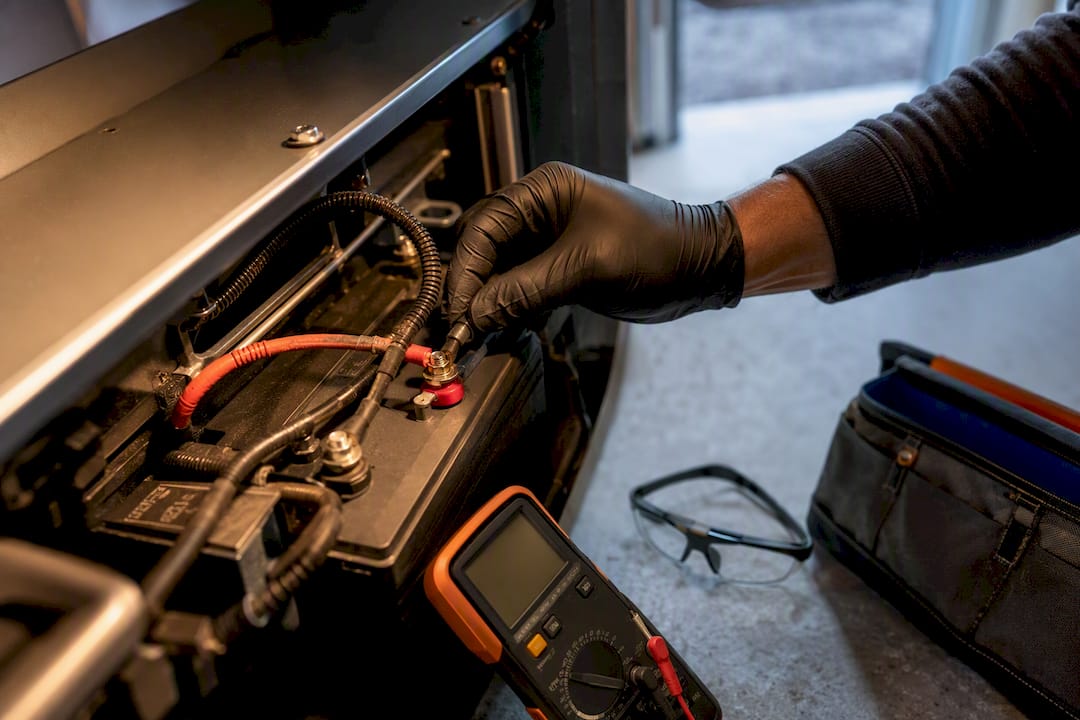
- Verify oil and coolant levels against the manufacturer’s marks, and test battery resting voltage. A healthy reading sits between 12.6 and 12.8 volts.
- Clear leaves, mulch, and debris away from the unit, and confirm it’s still sitting level with proper drainage underneath.
- Look at hoses and fuel lines for cracks or soft spots that weren’t there last season.
Pro Tip: Keep a small notebook or phone note with the date and voltage reading every time you check the battery. A slow decline over a few months tells you it’s failing before it leaves you stranded.
If you smell fuel, see scorched or melted wiring, or the battery reads well below 12.6 volts, stop there. Those are signs for a professional to look at, not a weekend fix.
Schedule Professional Maintenance and What Expect During the Visit
Annual professional service is what actually keeps a generator reliable when you need it, not the occasional glance in the driveway.
- Oil and filter changes, battery load testing, and a check of the automatic transfer switch (ATS)
- A load-bank test that confirms the unit can carry real demand, not just idle smoothly, following manufacturer and FEMA guidance
- Verification that transfer equipment and electrical connections meet current standards
Professional service also protects you if something goes wrong later. Insurance carriers and manufacturers often ask for maintenance documentation before honoring a warranty or claim tied to a generator failure. Book your appointment early. Installers and service techs fill their storm season calendars fast once the first forecast hits the news, and ask for a written service report with a run-hour log so you have a paper trail for next year.
Test the Generator Under Load and Verify Transfer Switch Timing
A generator that starts isn’t the same as a generator that works. The real test is whether it can carry your household’s load without stumbling.
- Run short weekly starts to keep the engine lubricated and the battery charged.
- Once a month or quarter, run a longer load test at 50 to 75 percent of the unit’s rated capacity to confirm it holds steady under real demand.
- Simulate an outage by switching over manually or watching the ATS engage, and time how long the transition takes.
- Identify your priority circuits ahead of time, refrigeration, sump pump, medical equipment, and note which ones draw a heavy surge on startup.
Weekly short runs paired with monthly load tests are standard practice among generator manufacturers and service providers because they catch weak batteries and fuel system problems before an actual storm does. If you notice voltage instability, a dropping oil pressure gauge, or a new knocking sound during a test, shut it down and call a professional instead of running it through the storm.
Fuel Supply and Safe Refueling Practices
Fuel is where storm season prep quietly falls apart for a lot of homeowners. Whatever your generator runs on, plan around it before the forecast turns ugly.
- Propane owners should top off tanks before a storm watch is issued. Delivery trucks get backed up fast once a warning goes out.
- Natural gas systems need a working connection check. Confirm your line and meter are in good condition ahead of the season.
- Gasoline for portable units should be fresh or treated with stabilizer, and it should never be stored or transported inside your home.
- Never refuel a generator while it’s running. Shut it down, let it cool completely, and use an approved container.
Topping off propane and checking fuel stabilizers before a named storm is standard advice from meteorologists for good reason: waiting until the storm is on the radar usually means empty tanks and long delivery lines.
Placement, Ventilation, and Carbon Monoxide Safety
This is the section that actually saves lives, and it’s the one homeowners skip most often because it feels like common sense until it isn’t.
- Portable generators belong outdoors, positioned at least 20 feet away from any windows, doors, or vents, because carbon monoxide is odorless and builds up fast in enclosed spaces.
- Standby units need clearance per the manufacturer’s specs, plus room around them for a technician to service the unit later.
- Never run a generator under eaves, in a garage with the door open, or anywhere near an occupied structure.
- Test your carbon monoxide alarms monthly, not just when you change the batteries twice a year.
Carbon monoxide poisoning tied to generators spikes every storm season, almost always because a unit was placed too close to a window or air intake. NFPA guidance treats the 20 foot rule as a baseline, not a suggestion.
Decide What Your Generator Should Power Before the Storm Hits
Not every circuit in your house needs to run during an outage, and trying to power all of them at once is how generators fail mid storm.
- Build a labeled breaker load chart that lists your essential circuits: refrigeration, sump pump, furnace blower, medical equipment.
- Add loads one at a time when you restore power, since appliances like refrigerators and well pumps draw a heavy surge on startup.
- If your household has added an EV charger, a larger HVAC system, or other new demand since your generator was sized, your current setup might be underpowered.
- Talk to Tri-County Services Electric & Plumbing about whether a panel upgrade or an automatic transfer switch adjustment makes sense before the season starts, rather than after a breaker trips at midnight.
Emergency Supplies and Spare Parts to Keep on Hand
A generator running on empty shelves doesn’t help much. Stock the basics now, while stores are calm and shelves are full.
- Fuel safe containers, spare oil, filters, fuses, and a backup battery, plus basic hand tools.
- A NOAA weather radio, flashlights, extra batteries, cash, medications, and pet supplies.
- Store your generator’s paperwork and Tri-County Services Electric & Plumbing’s contact info in a waterproof folder, backed up to the cloud.
Ready a gallon of water per person per day and enough supplies to get through several days without outside help, which is a reasonable baseline for planning how much fuel and how many spare parts to keep on hand too.
After the Storm: Safety Checks and When to Call a Professional
Getting through the storm is only half the job. What you do in the hours after matters just as much.
- Wait until it’s safe to move around outside before approaching the generator at all.
- If the unit was exposed to standing water or heavy flooding, don’t attempt to run it. Water and electrical components don’t mix safely.
- Check fuel lines, electrical connections, the enclosure seals, and exhaust routing for anything that shifted or loosened during the storm.
- If the generator ran for more than 24 hours straight, logged any fault codes, or shows signs of fuel or oil leakage, schedule a post-storm service visit.
- Take photos and keep records of everything. They matter later for warranty coverage or an insurance claim.
Why Call a Professional: Tri-County Services Electric & Plumbing’s Pre-Storm Inspection
A DIY glance at your generator catches the obvious problems. It won’t catch a failing transfer switch or a battery that tests fine cold but drops under load, which is exactly what a professional inspection is built to find. Tri-County Services Electric & Plumbing has served Northeast Ohio homeowners since 1975, and our technicians check batteries, ATS function, fuel systems, and run a full load test, then document everything in writing for your records. That documentation is often what protects a warranty or insurance claim later. Call (440) 253-0332 to book your pre-storm generator inspection before the calendar fills up.
A Technician’s Field Note on Generator Failures
The most common call we get isn’t a broken generator. It’s a battery that sat idle all year and quietly died, so the unit won’t crank when the power finally goes out. The fix is simple: a fresh battery and a habit of running the unit monthly. Keep a log, book service before storm season, and you’ll rarely need us on the emergency line.
— Lindsay Paramore
Book Your Pre-Storm Inspection and Generator Tune-Up
A generator that’s been professionally inspected, load tested, and properly fueled is the difference between riding out a storm comfortably and scrambling in the dark. Tri-County Services Electric & Plumbing has handled electrical work across Northeast Ohio since 1975, and we now offer plumbing services too, so one call covers more of what your home needs before severe weather hits.

Storm season books up fast, and appointment slots for pre-storm generator service tend to disappear once the first watch is issued. If your generator hasn’t been inspected this year, or you’re considering a whole-home standby system instead of a portable unit, now is the time to act. Call Tri-County Services Electric & Plumbing at (440) 253-0332 or visit our generator installations page to schedule your inspection before the next storm forecast rolls in.
Sources
- Safer emergencies: give your power generator some space — NIST
- Ready
- Generator safety — FEMA
- Carbon monoxide — NFPA
FAQ
Can You Run a Generator Outside in a Snowstorm?
Yes, but the unit still needs at least 20 feet of clearance from doors, windows, and vents, and it should sit somewhere snow and ice won’t block the exhaust or tip the unit over.
How Do I Get My Generator Ready for Storm Season?
Schedule a professional inspection that covers the battery, transfer switch, and a load test, then confirm fresh fuel, clear the area around the unit, and stock spare parts and emergency supplies well before the first storm watch.
Do I Need to Cover My Generator in the Rain?
A standby generator’s enclosure is built to handle rain, but portable units should run under an open sided canopy rated for generator use, never a tarp or airtight cover that traps exhaust.
Can You Run a Generator During a Thunderstorm?
Yes, as long as it stays outdoors with proper clearance and isn’t sitting in standing water; lightning itself isn’t a reason to shut a properly placed generator down.
When Should I Call a Professional Instead of Troubleshooting Myself?
Call Tri-County Services Electric & Plumbing at (440) 253-0332 if you notice a fuel smell, damaged wiring, a weak battery reading, or any fault after the generator ran through a storm. Those issues involve electrical or fuel systems that are risky to diagnose without training.